CuAAC, SPAAC & Tetrazine LigationSelective Reactive-Handle CouplingCustom Bioconjugates for Research & Assay Development
BOC Sciences provides custom click chemistry bioconjugation services for the controlled assembly of antibodies, proteins, peptides, oligonucleotides, small molecules, fluorescent probes, polymers, lipids, nanoparticles, and other functional components. By pairing complementary reactive handles such as azide–alkyne, azide–cyclooctyne, or tetrazine–trans-cyclooctene (TCO), click chemistry enables selective bond formation while minimizing interference from many native functional groups present in complex biomolecules.
Our service supports reaction selection, clickable-handle installation, linker and spacer design, conjugation optimization, purification, and analytical verification. Depending on molecule sensitivity, desired conjugation site, reaction speed, and downstream use, projects can be developed using copper-catalyzed azide–alkyne cycloaddition (CuAAC), copper-free strain-promoted azide–alkyne cycloaddition (SPAAC), tetrazine ligation, or a related custom bioconjugation strategy. For additional technical background, explore our resource on bioorthogonal click chemistry.
A successful click conjugation project involves more than selecting two reactive handles. Research teams frequently need to determine which partner should carry the bulkier click group, whether copper exposure is acceptable, how the handle can be introduced without disrupting molecular function, and how linker length, reagent hydrophobicity, conjugation ratio, and purification strategy will affect the final construct. A reaction can be chemically selective yet still generate a heterogeneous product if the clickable handle was introduced randomly at multiple positions.
Our development approach therefore connects handle installation with the final conjugate requirement. We evaluate molecule type, available functional groups, desired attachment site, buffer conditions, concentration, payload properties, aggregation risk, and analytical requirements before selecting the reaction route. This helps address common problems including poor conversion at low concentration, loss of protein activity, uncontrolled labeling ratios, steric shielding of clickable groups, copper-related oxidation, hydrophobicity introduced by strained cyclooctynes, incomplete removal of free payload, and inconsistent conjugate populations.
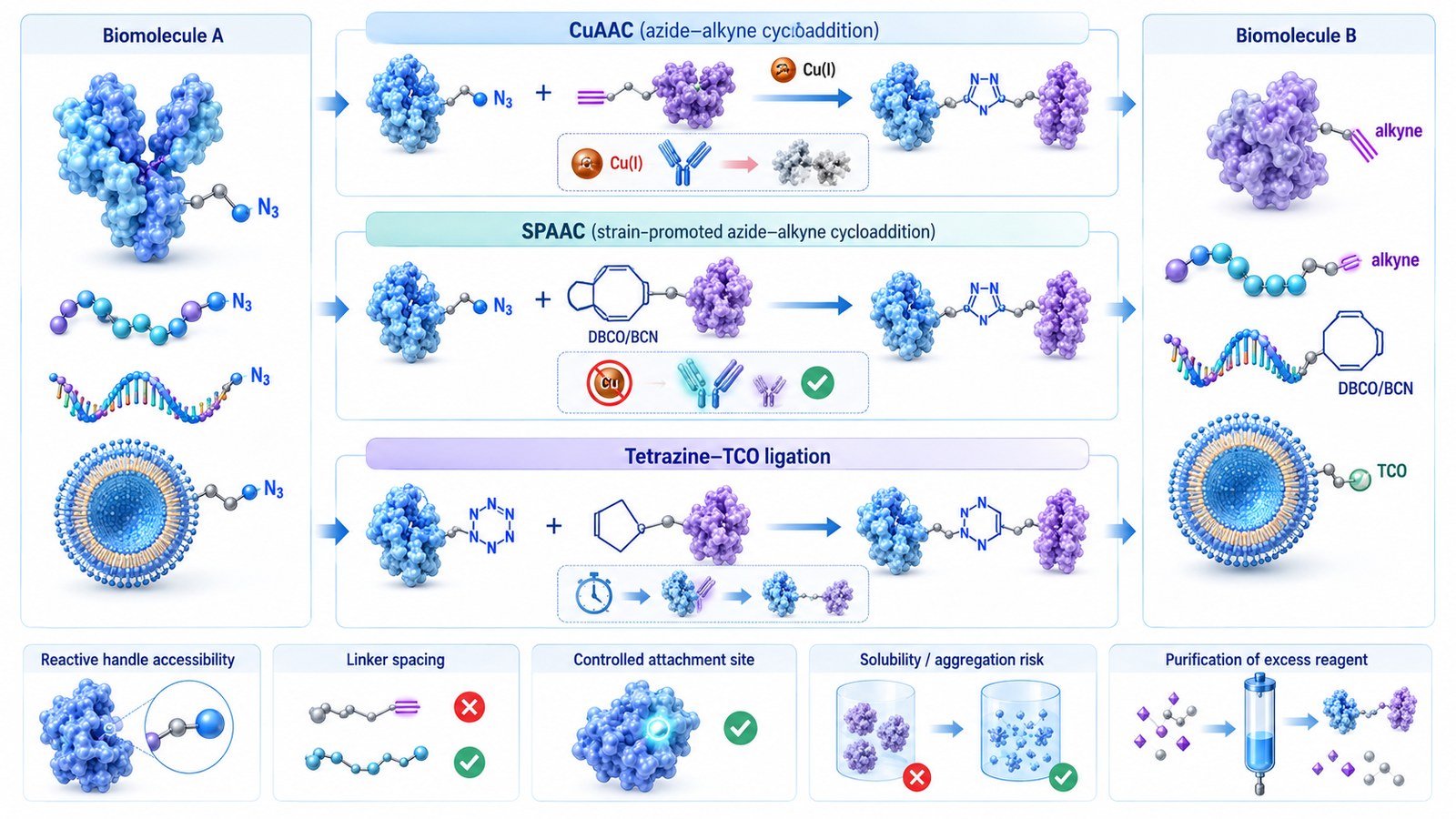 Selection of click chemistry routes according to reactive handles, molecule sensitivity, steric accessibility, and conjugate design requirements.
 CuAAC Conjugation
Learn more about Cu-catalyzed azide–alkyne cycloaddition.
 Copper-Free SPAAC
See our technical overview of SPAAC chemistry and guidance on DBCO vs BCN selection.
 Tetrazine–TCO Ligation
Review additional design considerations for tetrazine ligation.
 Antibody & Protein Conjugation
Related capabilities include antibody conjugation services and protein conjugation services.
 Peptide & Oligo Conjugation
Explore our peptide conjugation and oligonucleotide bioconjugation capabilities.
 Small-Molecule & Surface Conjugation
Click chemistry bioconjugation generally separates the project into two design problems: installing complementary reactive handles and then performing the selective ligation. One molecular partner is functionalized with a handle such as an azide, while the second carries a compatible alkyne, strained cyclooctyne, TCO, or tetrazine group. When the partners are combined under chemistry-specific conditions, the complementary handles react to create a covalent connection.
Handle Installation: Click functionality can be introduced during peptide or oligonucleotide synthesis, through a linker attached to accessible protein residues, through site-selective protein modification, or as part of a prefunctionalized small molecule, polymer, lipid, or surface.
Partner Orientation: Either molecular partner may carry a given click handle, but the orientation is not always interchangeable. Molecular size, hydrophobicity, linker accessibility, synthesis practicality, reagent stability, and purification behavior all influence which orientation is preferable.
Selective Ligation: CuAAC uses Cu(I) to couple azides and terminal alkynes. SPAAC replaces the linear alkyne with a strained cyclooctyne such as DBCO or BCN and therefore avoids a copper catalyst. Tetrazine ligation pairs a tetrazine with a strained dienophile such as TCO and is selected when rapid copper-free ligation is advantageous.
Conjugate Control: Click chemistry does not automatically create a site-specific product. If several clickable handles are randomly installed on a protein, several attachment positions may still result. More defined conjugates require controlled handle placement, controlled handle number, or an appropriately engineered molecular substrate.
The most appropriate route depends on the complete molecular system rather than reaction speed alone. For projects comparing the major modalities, see CuAAC vs SPAAC vs IEDDA.
Click chemistry is particularly useful when molecular partners can be equipped with complementary orthogonal handles. The matrix below summarizes common design routes. Actual handle placement should be reviewed against molecular structure, accessible functional groups, solubility, stability, and the required degree of conjugation.
| Molecule Type | Common Handle Options | Compatible Click Partner | Key Design Questions | Typical Project Goal |
| Antibodies | Azide, DBCO/BCN, TCO, tetrazine introduced through lysine-, cysteine-, glycan-, enzymatic-, or engineered-site strategies | Complementary dye, oligonucleotide, peptide, small molecule, polymer, or surface handle | Where is the handle installed? How many handles are present? Is the modification remote from functionally important regions? | Controlled labeling, antibody–oligonucleotide assembly, probe preparation, multifunctional conjugates |
| Proteins & Enzymes | Azide, alkyne, strained cyclooctyne, TCO, or tetrazine | Small-molecule probes, dyes, peptides, oligonucleotides, polymers, surfaces | Will handle installation alter structure, activity, charge, or aggregation behavior? | Protein labeling, interaction studies, immobilization, functional probe development |
| Peptides | N- or C-terminal azide/alkyne, side-chain azide, DBCO/BCN, TCO, tetrazine | Peptides, proteins, oligonucleotides, lipids, dyes, polymers, small molecules | Which terminus or residue provides the cleanest attachment without disrupting the active sequence? | Peptide–payload, peptide–oligo, peptide–protein, and labeled peptide constructs |
| Oligonucleotides | 5′, 3′, or internal azide, alkyne, DBCO, BCN, or compatible linker handle | Proteins, antibodies, peptides, dyes, affinity ligands, surfaces | Will the modification affect hybridization, folding, nuclease-sensitive regions, or target accessibility? | Protein–oligo conjugates, labeled probes, affinity reagents, surface-functionalized oligos |
| Small Molecules & Dyes | Azide, terminal alkyne, DBCO/BCN, TCO, tetrazine | Click-ready biomolecules, polymers, beads, nanoparticles, surfaces | Can a handle and spacer be added without masking the functional pharmacophore or reporter group? | Probe labeling, affinity-tag installation, fluorescent conjugates, modular payload attachment |
| Polymers, Lipids & Nanomaterials | Azide, alkyne, cyclooctyne, TCO, tetrazine displayed at defined or statistical densities | Proteins, peptides, antibodies, oligonucleotides, small molecules | Are handles sufficiently surface-accessible, and will conjugation change dispersion or assembly behavior? | Surface functionalization, multivalent presentation, capture materials, research nanoconjugates |
Click chemistry is most valuable when conventional amine- or thiol-reactive coupling does not provide sufficient orthogonality, modularity, or control. It is not automatically the best route for every conjugation project; a simpler NHS ester or maleimide strategy may be more practical when an accessible native functional group already provides the required product profile.
Azide, alkyne, strained cyclooctyne, tetrazine, and TCO handles can provide a dedicated reaction pair that is distinct from many native biomolecular functional groups, simplifying assembly of chemically complex constructs.
When the click handle can be introduced at a defined position, subsequent ligation can preserve that positional control and reduce the structural ambiguity associated with indiscriminate modification of multiple native residues.
SPAAC or tetrazine ligation can be considered for copper-sensitive proteins, sensitive biological systems, or workflows where introducing and subsequently removing a metal catalyst is undesirable.
A click-ready intermediate can often be paired with different probes or payloads carrying the complementary handle, which is useful for screening several construct architectures without rebuilding every precursor from the beginning.
Complex molecules may contain many amines, thiols, carboxylates, or other reactive groups. An introduced click pair can provide a more isolated reaction channel when native-group chemistry would produce difficult-to-control mixtures.
Orthogonal handle combinations can simplify sequential assembly of multifunctional probes, protein–oligonucleotide constructs, surface-bound systems, and other architectures containing more than two functional modules.
Chemistry selection should consider handle availability, desired positional control, reaction environment, substrate sensitivity, linkage requirements, purification burden, and the scale of the project. The table below provides a practical comparison rather than a universal ranking.
| Conjugation Method | Reactive Pair | Primary Strength | Key Limitation | When It Fits Best |
| CuAAC | Azide + terminal alkyne | Compact handles, strong chemoselectivity, well-established triazole-forming chemistry | Requires controlled Cu(I) catalysis and appropriate post-reaction copper management | Purified biomolecules and synthetic components that tolerate the selected CuAAC conditions |
| SPAAC | Azide + DBCO, BCN, or other strained cyclooctyne | Copper-free and compatible with mild aqueous conjugation | Strained alkynes are bulkier and can affect hydrophobicity, accessibility, or side-reaction profile | Sensitive proteins, antibodies, oligonucleotides, and modular copper-free assemblies |
| Tetrazine Ligation | Tetrazine + TCO or compatible strained dienophile | Very rapid copper-free ligation with highly distinctive reactive handles | Handle stability, TCO isomerization, reagent hydrophobicity, and storage conditions require attention | Low-concentration ligations and projects requiring rapid orthogonal coupling |
| NHS Ester Coupling | Activated ester + primary amine | Simple workflow with broadly available reagents | Multiple accessible lysines can generate positional heterogeneity | Routine labeling where statistical amine modification is acceptable |
| Maleimide–Thiol | Maleimide + thiol | Rapid reaction with cysteine or introduced thiols under mild conditions | Requires thiol control; linkage stability and competing thiols may need consideration | Defined cysteine labeling or projects with a convenient thiol handle |
| EDC/NHS Coupling | Carboxyl + amine | Uses common native functional groups and can avoid adding a permanent spacer from the coupling reagent | Orientation and reaction-site control can be limited when multiple carboxylates and amines are present | Surface coupling, carrier conjugation, and systems where positional heterogeneity is acceptable |
For projects where several routes appear feasible, our chemistry selection process considers the final conjugate rather than choosing a method solely by reaction speed or reagent familiarity.
A structured workflow helps separate problems caused by handle installation from problems caused by the ligation step itself. Development stages are adapted to the molecule class and final conjugate requirements.


We review both conjugation partners, molecular weights, available functional groups, existing modifications, buffer composition, desired attachment site, target conjugation ratio, downstream use, and material availability. This establishes whether click chemistry offers a meaningful advantage over a simpler coupling route.

Potential azide, alkyne, DBCO/BCN, TCO, or tetrazine installation positions are evaluated. We consider whether handles can be introduced during synthesis or require post-synthetic modification and whether the selected site remains accessible after conjugation.

CuAAC, SPAAC, tetrazine ligation, or an alternative route is selected according to copper sensitivity, concentration, reaction kinetics, linker footprint, solubility, handle stability, and the desired degree of positional control.

Reaction parameters such as stoichiometry, concentration, buffer, cosolvent, temperature, time, catalyst system, and linker orientation are adjusted as appropriate. Pilot-scale evaluation helps identify conditions that favor conversion without unnecessary exposure of sensitive biomolecules.

Free payload, excess click reagent, catalysts, low-molecular-weight components, aggregates, or undesired conjugate populations are removed using methods appropriate to the molecular system. The conjugate can then be transferred into a suitable downstream buffer where required.

Selected analytical methods are used to evaluate conjugation, integrity, purity, conjugation ratio, and aggregation or free-payload content where relevant. Final material is supplied with project-specific analytical information and handling recommendations.
Purification and analytical design should reflect the molecular architecture of the conjugate. A protein–small molecule conjugate, for example, presents different separation and verification requirements from a peptide–oligonucleotide conjugate or a surface-functionalized nanoparticle. Where possible, orthogonal analytical methods are selected to answer complementary questions about identity, purity, conjugation extent, and structural integrity.
| Development Objective | Potential Methods | Question Addressed | Commonly Relevant Constructs |
| Remove Free Payload | SEC, desalting, dialysis, ultrafiltration/diafiltration, preparative HPLC as appropriate | Has unconjugated dye, linker, oligo, peptide, or small molecule been separated from the product? | Protein, antibody, polymer, nanoparticle, and oligonucleotide conjugates |
| Resolve Product Populations | SEC, ion-exchange chromatography, RP-HPLC, or other molecule-appropriate chromatography | Are unmodified material, conjugate populations, aggregates, or reaction byproducts separable? | Proteins, peptides, oligonucleotides, and heterogeneous conjugate mixtures |
| Confirm Molecular Identity | Mass spectrometry, LC-MS, HPLC-based analysis, electrophoretic approaches | Is the molecular species consistent with the intended modification or conjugation event? | Peptides, small molecules, oligonucleotides, proteins, and selected antibody constructs |
| Assess Conjugation Ratio | UV-Vis, intact-mass analysis, chromatographic integration, or other chemistry-specific quantification | How much label or payload is associated with each biomolecule or particle population? | Dye conjugates, antibody conjugates, protein conjugates, multivalent materials |
| Monitor Aggregation | SEC-based analysis, DLS where appropriate, visual or solution-state observations | Did handle installation or click conjugation alter the physical state of the biomolecule or particle? | Antibodies, proteins, polymers, and nanoparticles |
| Verify Functional Integrity | Project-specific binding, activity, hybridization, fluorescence, or other functional measurements where applicable | Does the conjugated material retain the function required for the intended research workflow? | Binding proteins, enzymes, oligonucleotide probes, fluorescent constructs |
Characterization requirements are selected project by project. For strained-alkyne systems, additional technical context is available in our resource on characterization of DBCO- and BCN-based bioconjugates.
The position and number of clickable groups often determine the final conjugate distribution. A single synthetically installed peptide or oligonucleotide handle can provide strong positional definition, whereas random modification of several protein lysines with an azide-bearing NHS reagent may still create multiple structural isomers. Site-control goals should therefore be defined before handle installation.
CuAAC can be highly useful when its catalytic system is compatible with the substrates, but proteins and other sensitive biomolecules may require careful ligand selection, reaction-time control, protection from oxidative damage, and copper removal. SPAAC or tetrazine ligation may be preferable when introducing copper creates unnecessary risk.
Two complementary handles cannot react efficiently if one becomes buried against a protein surface, embedded in a polymer layer, or shielded by a bulky payload. Spacer length and handle orientation should provide sufficient accessibility without unnecessarily increasing molecular size.
Reactive-handle stability must be considered throughout synthesis, storage, purification, and conjugation. Tetrazines can vary substantially in stability and reactivity, while TCO-containing reagents require handling that limits loss of the reactive trans configuration. Handle stability should be matched to the complete workflow rather than the ligation step alone.
DBCO, TCO, tetrazine, hydrophobic dyes, and certain payloads can alter conjugate solubility when combined with already hydrophobic biomolecules. Short hydrophilic spacers, appropriate cosolvent levels, lower modification densities, or alternative handle orientation may help manage aggregation risk.
Increasing reagent excess can improve conversion but may complicate purification or expose sensitive substrates to unnecessary reagent concentrations. The appropriate molar ratio depends on reaction rate, accessible handle concentration, material value, purification method, and the required final conjugation ratio.
Related service: antibody oligonucleotide conjugation.
Related capability: nanoparticles and beads conjugation.
CuAAC, SPAAC, and tetrazine ligation are evaluated against substrate sensitivity, reactive-handle accessibility, concentration, linker footprint, and purification requirements so the chemistry is selected around the actual construct.

We consider how clickable groups are introduced before optimizing the ligation itself. This is important when customers need controlled labeling ratios, defined orientation, or reduced positional heterogeneity.
Reagent excess and linker design are planned with downstream purification in mind, helping reduce problems caused by free payload, residual catalyst, difficult size separation, aggregation, or closely related conjugate populations.
Projects can integrate antibodies, proteins, peptides, oligonucleotides, small molecules, labels, polymers, beads, and nanoparticles, allowing click chemistry to be coordinated with broader bioconjugation workflows rather than treated as an isolated reaction.
Whether you already have azide-, alkyne-, DBCO-, BCN-, TCO-, or tetrazine-functionalized starting materials or need support designing the clickable intermediates, BOC Sciences can help develop a conjugation strategy around your molecule pair and downstream research requirements.
Provide information about the molecular components, available functional groups, preferred attachment site, required conjugation ratio, sample amount, buffer conditions, and intended application. Our team can assess chemistry options, handle orientation, linker design, purification, and characterization requirements and propose a project-specific workflow. Contact our scientific team to discuss your click chemistry bioconjugation project.
Project design can use CuAAC, copper-free SPAAC, tetrazine-TCO ligation, or another suitable orthogonal strategy depending on the molecular partners, available handles, substrate sensitivity, and desired conjugate architecture.
CuAAC couples an azide with a terminal alkyne using a Cu(I) catalyst. SPAAC couples an azide with a strained cyclooctyne such as DBCO or BCN without copper. CuAAC uses smaller handles, while SPAAC is often considered when copper exposure is undesirable.
Tetrazine ligation is useful when a rapid, copper-free reaction is desirable, particularly at relatively low reactant concentrations. TCO configuration, tetrazine stability, reagent solubility, and linker orientation should be considered during design.
No. The click reaction is selective for its complementary handles, but the final positional homogeneity depends on where and how many handles were installed. Random installation of several azides on a protein can still produce heterogeneous conjugates.
Either orientation may be possible. Selection depends on how easily each handle can be installed, the size and sensitivity of each partner, DBCO or BCN hydrophobicity, steric accessibility, purification requirements, and the desired modification site.