Fluorescently Labeled siRNA Services
High-PrecisionRNA Delivery VisualizationCustom Fluorescent siRNA
Accelerate your research and therapeutic development with our cutting-edge fluorescently labeled siRNA services, specifically designed for biotechnology, pharmaceutical, and diagnostic companies. Our high-performance solutions provide optimal fluorescence for siRNA tracking, delivery efficiency assessments, and gene silencing studies. Powered by advanced conjugation chemistries, stringent quality control, and optimized reaction systems, we deliver fluorescently labeled siRNA that exhibits superior brightness, stability, and reproducibility. These features are crucial for enterprise-level applications, including therapeutic development, RNA-based diagnostics, and large-scale research programs.
Whether you are developing RNA interference therapies, advancing delivery methods, or performing gene silencing experiments, our fully customized fluorescent labeling services ensure that your research provides the most accurate and reliable data. Our tailored approach guarantees high sensitivity, photostability, and exceptional performance across diverse experimental setups.
What Is Fluorescent siRNA Labeling?
Fluorescent siRNA labeling allows real-time tracking, localization, and quantification of RNA molecules within cells, tissues, and animal models. By conjugating fluorophores to siRNA, our service supports key applications such as gene silencing, RNA delivery efficiency studies, and optimizing RNA-based therapeutic approaches. This non-disruptive labeling method preserves siRNA bioactivity, ensuring that its interference function is maintained throughout the process, making it ideal for both in vitro and in vivo studies.
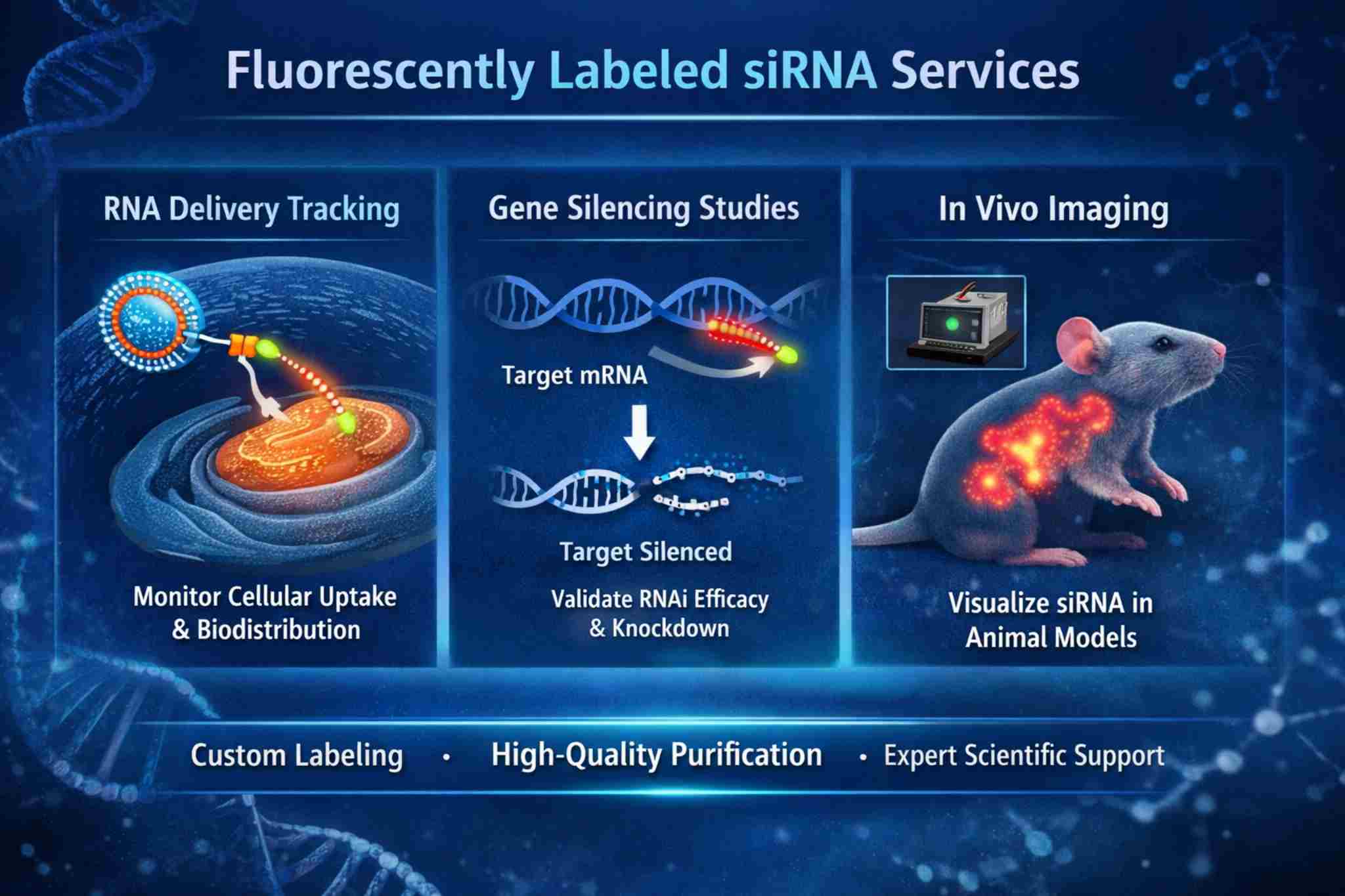 Applications of fluorescently labeled siRNA in RNA delivery optimization, gene silencing studies, and preclinical in vivo imaging.
Challenges in Fluorescent siRNA Labeling for Enterprises
Low Fluorescent Signal
Our advanced labeling protocols optimize the dye-to-siRNA ratio to ensure strong, stable fluorescent signals. This is crucial for enterprise-level applications that demand high sensitivity in detection, such as gene silencing assays, real-time imaging, and RNA delivery tracking.
Integrity and Functionality of siRNA
We employ non-invasive conjugation methods that preserve the integrity and functionality of siRNA. This ensures that the RNA interference activity remains intact after labeling, a critical factor for high-impact research and clinical applications requiring maximum gene silencing efficiency.
RNA Delivery and Uptake Efficiency
Fluorescently labeled siRNA enables comprehensive studies of RNA delivery and uptake efficiency, essential for optimizing delivery systems. Our custom fluorescent labeling provides insights into the cellular uptake and trafficking pathways of siRNA, critical for the development of effective RNA-based therapeutics.
Background Interference and Signal Clarity
We utilize state-of-the-art purification methods to minimize background fluorescence, ensuring that your imaging results are clear and precise. This is especially important in multiplex assays and high-throughput screening, where clean signal clarity is required for accurate data analysis.
Our Fluorescent siRNA Labeling Services
We offer a comprehensive suite of custom fluorescent siRNA labeling services designed to support large-scale research, RNA-based therapeutic development, and enterprise-level applications. With our precision chemistry, optimized conjugation methods, and stringent quality control, we ensure that your fluorescently labeled siRNA performs consistently, maintaining bioactivity while enabling effective tracking and functional analysis across diverse experimental setups.
 Fluorescent siRNA Labeling for Gene Silencing
Capabilities include:
- Site-specific or random fluorescent labeling via optimized conjugation chemistries
- Custom dye-to-siRNA ratio optimization for robust fluorescent signals without disrupting functionality
- High-throughput compatibility for gene silencing screening and RNA interference studies
- Fluorescent siRNA suitable for a wide range of delivery platforms (lipid nanoparticles, viral vectors, electroporation)
- Full QC support, including fluorescence spectra, DOL (Degree of Labeling), and functional gene silencing assays
Popular fluorophores:
FITC, Cy3, Alexa Fluor 488, Cy5, TRITC
 Fluorescent siRNA Labeling for Delivery Studies
Capabilities include:
- Fluorescently labeled siRNA for in vivo and in vitro RNA delivery studies and tracking
- Dye integration for monitoring cellular uptake, endosomal escape, and RNA release
- Optimized conjugation strategies that ensure siRNA integrity and effective cellular internalization
- Customizable fluorescent panels for multi-target RNA delivery and multiplex studies
- Rigorous quality control with stability testing, photostability analysis, and functional validation
Popular fluorophores:
Alexa Fluor, Cy7, DiO, FAM, BODIPY
 Fluorescent siRNA for Live-Cell Imaging
Capabilities include:
- Fluorescently labeled siRNA for dynamic tracking in live cells and tissues
- Site-specific conjugation ensures minimal disruption of siRNA bioactivity for real-time gene silencing monitoring
- Advanced fluorophore selection for clear and precise imaging with minimal background interference
- Compatibility with high-resolution microscopy techniques, including confocal and live-cell imaging systems
- Validation support with imaging data, fluorescence intensity analysis, and RNA trafficking studies
Popular fluorophores:
Cy3, Cy5, FITC, GFP, TRITC
 Fluorescent siRNA for High-Throughput Screening (HTS)
Capabilities include:
- Fluorescent siRNA tailored for high-throughput screening assays and RNA interference library screening
- Optimized conjugation for reliable fluorescence detection across multiple siRNA sequences
- High sensitivity and minimal background noise for accurate screening results in complex biological assays
- Ability to multiplex fluorescently labeled siRNA with other reagents for concurrent assays
- Rigorous quality control, including fluorescence spectra, siRNA integrity testing, and screening data verification
Popular fluorophores:
Alexa Fluor 488, Cy5, FITC, TRITC, Cy7
Fluorophore Options for Fluorescent siRNA Labeling
| Fluorophore | Excitation (nm) | Emission (nm) | Applications | Features |
|---|---|---|---|---|
| FITC (Fluorescein Isothiocyanate) | 495 | 519 | Gene silencing, flow cytometry | High brightness, commonly used for antibody labeling |
| ALEXA FLUOR 488 | 495 | 519 | Microscopy, RNA delivery tracking | Bright, photostable, ideal for multicolor panels |
| CY3 | 550 | 570 | Imaging, live-cell tracking | Bright emission, suitable for protein and RNA labeling |
| CY5 | 649 | 670 | in vivo imaging, high-resolution imaging | Low background, ideal for multiplexing |
| ALEXA FLUOR 647 | 650 | 668 | in vivo tracking, deep tissue imaging | Excellent photostability, ideal for long-term tracking |
| TRITC | 543 | 580 | Microscopy, fixed-cell studies | Strong fluorescence, commonly used in fixed-cell assays |
Key Benefits of Fluorescent siRNA Labeling for Enterprises
| Benefit | Description | Impact on Enterprises |
|---|---|---|
| Improved Signal Sensitivity | Enhanced fluorescent signal for better detection and tracking. | Enables more accurate and reliable gene silencing studies, ensuring high-quality data for therapeutic research. |
| Optimized for RNA Delivery | Fluorescently labeled siRNA for tracking siRNA delivery systems in vivo and in vitro. | Improves RNA-based therapeutic development by optimizing RNA delivery methods and ensuring efficient cellular uptake. |
| Photostability | Long-lasting fluorescence ideal for extended tracking periods. | Supports long-term experiments and high-resolution imaging, essential for RNA therapeutics development and gene therapy studies. |
| Scalability | High-throughput compatible for large RNA interference screening projects. | Supports enterprise-scale RNA interference studies and therapeutic screening, enabling faster discoveries and clinical research advancements. |
| Custom Fluorophore Selection | Wide range of fluorophores to suit specific research needs and applications. | Tailors the service to meet custom research requirements, offering flexibility in experimental design. |
General Workflow for Fluorescent siRNA Labeling Services


Project Assessment & Strategy Design
We begin by understanding your target molecules, research goals, and preferred fluorophore. Based on this, we design a custom fluorescent siRNA labeling strategy that maximizes efficiency and preserves the biological activity of your siRNA.

Sample Preparation & Pre-Processing
Incoming siRNA samples are carefully inspected and quantified. If necessary, we perform buffer exchange and purification to ensure that the siRNA is free from contaminants, optimizing it for the fluorescent labeling process.

Fluorescent Labeling Reaction
The siRNA is conjugated with the selected fluorophore using our optimized conjugation methods. We ensure that the fluorescent dye is properly attached without compromising the silencing activity of the siRNA molecule.

Purification & Removal of Free Dye
To ensure the highest purity and minimal background fluorescence, excess dye and other impurities are removed via size-exclusion chromatography or HPLC purification, leaving you with clean and high-quality labeled siRNA.

Quality Control & Data Verification
Our QC process involves multiple checks, including fluorescence characterization, DOL (degree of labeling), and functional validation through gene silencing assays to ensure that the labeled siRNA performs as expected in your experiments.

Final Delivery & Technical Support
Once the fluorescently labeled siRNA has passed all quality control tests, we deliver it along with a detailed report and handling guidelines. Our team is available for technical support to ensure successful downstream applications.
Advantages of Our Fluorescent siRNA Labeling Services
High Sensitivity & Specificity
Our fluorescent siRNA labeling provides exceptional sensitivity and specificity, ensuring that even low-abundance siRNA can be detected with high precision. This is essential for tracking RNA molecules in complex biological systems, providing clear, reliable data for your research.

Versatility Across Biomolecules
Our services cover a wide range of biomolecules, including proteins, nucleic acids, lipids, and small molecules, making our fluorescent siRNA labeling an ideal solution for enterprises involved in broad research areas like gene therapy, drug discovery, and diagnostics.
High-Throughput Capability
With multicolor fluorescence and multiplexing capabilities, our fluorescent siRNA labeling is perfect for high-throughput screening (HTS) and large-scale gene silencing studies, ensuring that you can efficiently analyze multiple targets in parallel.
Real-Time, High-Resolution Data
Our fluorescent siRNA solutions provide real-time tracking and high-resolution imaging, allowing enterprises to visualize and analyze gene silencing and RNA delivery in living cells and animal models, providing timely insights for therapeutic development.
Applications of Fluorescent siRNA Labeling Technology
Gene Silencing & Functional Genomics
- Track gene expression knockdowns and siRNA-mediated silencing in various cell types and tissues.
- Visualize RNA interference (RNAi) efficacy, gene silencing kinetics, and target validation in complex biological systems.
- Fluorescent siRNA enables efficient screening of gene-target interactions, identification of new drug targets, and biomarker discovery.
RNA Delivery & Drug Development
- Fluorescently labeled siRNA helps monitor RNA delivery systems, assessing uptake efficiency, endosomal escape, and intracellular distribution in live cells.
- Optimize RNA delivery methods for therapeutic RNA molecules, ensuring effective siRNA-based drug delivery to target cells and tissues.
- Critical for clinical development of RNA-based therapies, such as RNA interference (RNAi) and gene silencing therapeutics.
in vivo Imaging & Pre-clinical Studies
- Track siRNA in animal models, assessing the biodistribution, pharmacokinetics, and pharmacodynamics of RNA-based therapeutics in real-time.
- Non-invasive monitoring of RNA delivery and gene silencing in tissues and organs, supporting pre-clinical research and therapeutic development.
- Enables long-term in vivo tracking of RNA molecules for drug efficacy studies and toxicology assessments.
High-Throughput Screening (HTS) & Compound Screening
- Fluorescent siRNA enables automated high-throughput screening (HTS) of siRNA libraries, identifying new gene silencing candidates for drug discovery.
- Ideal for large-scale screening of RNA interference libraries, target identification, and efficacy testing of small molecules or biologics.
- Compatible with multi-well plates and automated screening systems, enabling enterprises to screen thousands of compounds simultaneously.
Therapeutic Development & RNAi-Based Therapies
- Enable development of RNA-based therapeutics by monitoring gene silencing and efficacy in drug discovery pipelines.
- Assess the therapeutic potential of siRNA molecules in targeting disease genes involved in cancer, genetic disorders, and viral infections.
- Supports pre-clinical testing for RNAi therapeutics, ensuring safe and efficient delivery and long-term therapeutic activity.
Personalized Medicine & Biomarker Discovery
- Fluorescent siRNA enables the tracking of gene expression profiles in different patient-derived models, facilitating personalized therapeutic strategies.
- Supports the discovery and validation of biomarkers by observing the gene expression changes in response to siRNA treatments across diverse patient populations.
- Targeting specific genes with fluorescently labeled siRNA aids in biomarker profiling for more precise treatment approaches in oncology and infectious diseases.
What Our Enterprise RNA Clients Say

"We needed fluorescently labeled siRNA to validate delivery performance and intracellular uptake. The team provided clear labeling design guidance (strand and terminus selection) and delivered material with clean signal and documentation suitable for internal review."
— Feedback from an enterprise RNA delivery development team (anonymized)
"For high-content imaging and flow cytometry workflows, minimizing background and ensuring batch consistency were critical. The purification quality and QC readouts supported confident interpretation across repeated assays."
— Feedback from a pharmaceutical screening and analytics group (anonymized)
"Our program required fluorescent siRNA that preserved silencing performance after labeling. The optional functional verification and stability-focused handling guidance helped standardize results across teams and sites."
— Feedback from an RNA therapeutics R&D program (anonymized)
Custom Fluorescently Labeled siRNA for Delivery, Imaging, and RNAi Validation
Whether your priority is tracking cellular uptake, optimizing delivery systems (e.g., LNP formulations), validating RNAi activity, or supporting high-throughput assay workflows, we provide fluorescently labeled siRNA designed around enterprise requirements for reproducibility, documentation, and downstream compatibility. Share your sequence, strand preference, labeling position (5'/3'), fluorophore requirements, and application context—and our scientific team will recommend a practical labeling strategy and QC package aligned to your study goals. Reach out to us for a quote or technical consultation.
Frequently Asked Questions (FAQ)
What is fluorescently labeled siRNA used for?
Fluorescently labeled siRNA is primarily used to track RNA delivery, monitor cellular uptake, and evaluate gene silencing efficiency in vitro and in vivo. It enables researchers to visualize siRNA localization, study intracellular trafficking, optimize delivery systems (such as lipid nanoparticles), and validate RNA interference (RNAi) performance in preclinical research.
Does fluorescent labeling affect siRNA gene silencing activity?
Properly designed fluorescent labeling should not significantly compromise siRNA silencing activity.
Labeling position (5' or 3' end), dye size, and conjugation chemistry are critical factors. Terminal labeling is commonly used because it minimizes interference with RISC loading and target binding. However, functional validation is strongly recommended for therapeutic programs to confirm knockdown efficiency after labeling.
Where should siRNA be labeled – 5' end or 3' end?
The choice depends on the experimental goal:
5' labeling may affect RISC loading if applied to the antisense strand.
3' labeling is generally considered less disruptive.
Passenger strand labeling is often preferred for delivery tracking studies.
Antisense strand labeling may be used for mechanistic studies but requires validation.
An experienced design strategy is critical to balance fluorescence intensity and biological functionality.
Can fluorescent siRNA be used for in vivo imaging?
Yes, fluorescently labeled siRNA can be used for in vivo imaging in animal models.
Can fluorescently labeled siRNA be used for high-throughput screening?
Yes. Fluorescent siRNA is compatible with automated high-throughput screening (HTS) platforms, including multi-well plate systems and high-content imaging systems.