Cysteine-Directed Bioconjugation Services
Defined Thiol Attachment SitesControlled Cysteine LoadingResearch-Ready Conjugates with Analytical Support
BOC Sciences provides cysteine-directed bioconjugation services for research projects that use cysteine thiols as defined attachment points for labels, linkers, peptides, polymers, oligonucleotides, and other functional payloads. Projects can address native cysteine residues, selectively reduced disulfides, or engineered cysteine sites in antibodies, proteins, peptides, and related biomolecules.
The development strategy considers cysteine accessibility, oxidation state, disulfide architecture, thiol-reactive chemistry, linker stability, desired loading, purification, and analytical verification. Related work can connect with antibody conjugation services, protein conjugation services, and bioconjugation method development and optimization.
What Problems Can Cysteine-Directed Bioconjugation Solve?
Cysteine provides a useful thiol handle for selective biomolecule modification, but native cysteines may be buried or engaged in disulfides, while partial reduction of protein disulfides can generate multiple reactive species. Cysteine-directed development therefore combines residue selection, thiol preparation, coupling chemistry, reaction control, and analytical assessment.
The objective is to establish a practical conjugation window that balances site selectivity, conversion, loading, linkage stability, and biomolecule integrity. Where native cysteines do not provide adequate control, engineered cysteine sites or alternative site-specific strategies can be considered.
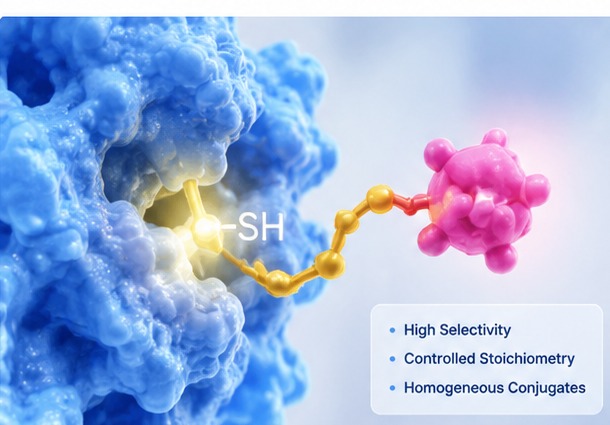
Technical illustration of cysteine-directed bioconjugation services, highlighting the relationship between site selection, conjugation chemistry, and functional payload attachment.
Key Challenges in Cysteine-Directed Bioconjugation Projects
Establishing the Reactive Thiol State
Free thiol availability depends on native residue accessibility, disulfide structure, oxidation state, and sample handling. Reduction and activation conditions must be selected around the biomolecule.
Selecting Thiol-Reactive Chemistry
Maleimides, haloacetyl reagents, activated disulfides, and other thiol-reactive groups have different reactivity and stability profiles. Chemistry is matched to the payload and desired conjugate behavior.
Controlling Cysteine Loading
Native or partially reduced proteins may present more than one reactive thiol. Site selection, controlled reduction, stoichiometry, and engineered cysteine placement can influence product distribution.
Managing Conjugate Stability
The linkage chemistry and local protein environment can affect stability. Conjugates are evaluated using appropriate analytical and stress conditions rather than assuming all thiol-derived linkages behave identically.
Our Cysteine-Directed Bioconjugation Services
We provide custom development from route selection and reaction planning through conjugation, purification, and analytical characterization. Project scope can be configured around customer-supplied biomolecules, functionalized payloads, engineered constructs, or an existing method requiring optimization.
 Engineered Cysteine Conjugation
Capabilities include:
- Use customer-defined cysteine substitutions as predetermined thiol attachment sites.
- Select thiol-reactive chemistry and linker architecture around the engineered residue.
- Evaluate site accessibility, loading, and functional impact.
Typical applications:
Defined antibody and protein conjugates, fluorescent labeling, and linker-payload studies.
 Native Cysteine Modification
Capabilities include:
- Use accessible native cysteine residues without introducing a new protein sequence when the substrate permits.
- Assess cysteine environment and potential competition from other thiols.
- Optimize stoichiometry and reaction conditions for the desired product distribution.
Typical applications:
Protein labeling, peptide conjugation, and selected antibody conjugates.
 Controlled Disulfide Reduction and Conjugation
Capabilities include:
- Use controlled reduction to expose selected thiols when disulfide architecture permits.
- Balance reduction extent with structural integrity and desired conjugation level.
- Characterize the resulting product distribution and aggregation behavior.
Typical applications:
Antibody conjugates and disulfide-associated protein modification.
 Thiol-Reactive Linker Selection
Capabilities include:
- Compare maleimide, haloacetyl, activated disulfide, or other compatible thiol-reactive linkers.
- Consider linkage stability, payload chemistry, spacer length, and purification behavior.
- Select the linker around the final application rather than reaction conversion alone.
Typical applications:
ADC research, fluorescent probes, PEGylation, and functional payload attachment.
Key Design Parameters for Cysteine-Directed Bioconjugation
Site-specific conjugation performance depends on the relationship between the biomolecule, accessible attachment site, reaction chemistry, linker and payload, loading target, and downstream analytical requirements. The table below summarizes the variables that most often influence development decisions.
| Design Parameter | Common Options | Development Considerations | Impact on Conjugate Performance | Why It Matters to Customers |
| Cysteine Context | Native cysteine, engineered cysteine, disulfide-associated cysteine | Accessibility, neighboring residues, and disulfide architecture influence reactivity. | Determines whether a thiol can serve as a practical attachment point. | Reduces the risk of treating all cysteines as equivalent. |
| Thiols and Redox State | Free thiol, disulfide, selectively reduced thiol | Reduction and oxidation conditions affect the available reactive population. | Controls site availability and product distribution. | Critical for reproducible cysteine-directed conjugation. |
| Reactive Group | Maleimide, haloacetyl, activated disulfide, other thiol-selective handle | Reactivity, stability, and compatibility vary among chemistries. | Affects conversion and linkage behavior. | Connects chemistry selection to conjugate stability. |
| Stoichiometry and Loading | Defined equivalents, low/moderate loading, engineered single-site loading | Excess reagent can increase nonspecific modification or complicate purification. | Influences DAR or payload-to-biomolecule ratio and heterogeneity. | Provides a practical target for development. |
| Linker Architecture | Short spacer, PEG-like spacer, cleavable or non-cleavable linker where relevant | Length, flexibility, hydrophobicity, and stability influence the final construct. | Can affect accessibility, solubility, and downstream function. | Important when the payload is bulky or hydrophobic. |
| Purification and Analytics | SEC, HPLC, LC-MS, peptide mapping, intact-mass, functional assays | Methods should resolve unmodified, modified, aggregated, and free species as needed. | Establishes product distribution and conjugate quality. | Supports reproducibility and rational route selection. |
Cysteine-Directed Bioconjugation Strategies & Process Development Considerations
Method selection should be driven by biomolecule architecture, site accessibility, reactive-group compatibility, payload properties, desired loading, and the analytical evidence needed to verify the final construct. Different routes can be compared when a single chemistry does not adequately balance selectivity, stability, and product quality.
| Conjugation Strategy | Technical Approach | Common Applications | Development Advantages |
| Direct Thiol–Electrophile Coupling | A cysteine thiol reacts with a compatible thiol-selective electrophile such as a maleimide or haloacetyl group. | Protein and antibody labeling, ADC research | Direct and widely adaptable when a suitable thiol is available. |
| Controlled Disulfide Reduction | Selected disulfide bonds are reduced to generate reactive thiols before payload attachment. | Antibody and protein conjugation | Can increase the number of accessible thiols, but requires control of reduction extent and product distribution. |
| Engineered Cysteine Conjugation | An introduced cysteine provides a predetermined thiol site. | Site-specific antibody and protein conjugates | Improves positional control when the engineered construct is well characterized. |
| Thiol-Compatible Modular Coupling | A thiol handle is connected to a linker or intermediate that is subsequently functionalized. | Multistep and multifunctional conjugates | Separates biomolecule coupling from payload installation when this simplifies route design. |
| Disulfide-Based Reversible Strategies | Compatible thiol/disulfide exchange chemistry is used when reversible or cleavable linkage behavior is part of the construct design. | Selected research conjugates | Provides an alternative linkage architecture where chemically appropriate. |
Analytical Characterization & Quality Control Framework
Analytical characterization is used to establish whether the intended modification occurred and whether the resulting conjugate has the purity, loading, structural integrity, and functional properties needed for the research objective. Orthogonal methods are selected according to construct and development stage.
| Analytical Category | Methodology | Purpose in Development | Data Delivered |
| Thiol Availability | Ellman-type thiol assays, LC-MS, or other suitable measurements | Estimate free thiol availability before and after preparation. | Thiol-state observations and comparative data. |
| Conjugation Site / Modification | Peptide mapping, LC-MS/MS, intact mass | Assess modification location and product distribution. | Site or modification assignment data. |
| Loading | LC-MS, HPLC, UV-Vis, or appropriate quantitative method | Estimate payload loading and compare reaction conditions. | Loading or DAR summary. |
| Purity and Aggregation | SEC-HPLC, HPLC, electrophoresis | Monitor free species, product purity, and aggregation. | Chromatographic profiles and purity observations. |
| Functional Assessment | Binding, activity, labeling, or application-specific assay | Determine whether cysteine modification preserves relevant function. | Comparative functional data. |
Workflow for Custom Cysteine-Directed Bioconjugation Services
 Project workflow: strategy selection, site-specific conjugation, purification, analytical characterization, and delivery of the resulting research conjugate and data package.
Substrate and Thiol-State Review
Define biomolecule format, cysteine context, disulfide architecture, and desired modification level.
Reduction and Chemistry Selection
Establish the reactive thiol state and select a compatible thiol-reactive linker or payload.
Conjugation and Purification
Run the controlled coupling reaction and remove unreacted materials and unsuitable product species.
Analytical and Functional Characterization
Assess thiol state, modification, loading, purity, aggregation, and application-relevant function.
Conjugate Delivery and Documentation
Provide the conjugate with analytical results and relevant process information.
Why Choose Our Cysteine-Directed Bioconjugation Platform
Residue-Level Chemistry Expertise
Cysteine accessibility, disulfide structure, redox state, and reactive-group selection are considered together.

Controlled Loading Strategy
Reaction stoichiometry and thiol preparation are linked to the desired product distribution rather than maximizing conversion alone.
Linker-Aware Development
Linker stability and payload behavior are incorporated into chemistry and purification decisions.
Orthogonal Characterization
Site, loading, purity, aggregation, and function are assessed with methods appropriate to the conjugate.
Common Research Applications of Cysteine-Directed Bioconjugation
Antibody Conjugation
- Cysteine-directed modification of native or engineered antibody sites.
- Control of thiol exposure and payload loading.
- Characterization of DAR, product distribution, and functional performance.
Protein Labeling
- Defined attachment of fluorophores, biotin, PEG, peptides, or other labels.
- Site and loading optimization around protein structure.
- Analytical comparison of modified and unmodified protein.
Peptide and Oligonucleotide Conjugation
- Use cysteine-containing peptides or engineered thiol handles for selective coupling.
- Linker selection around oligonucleotide or peptide size and chemistry.
- Preparation of functional conjugates for research studies.
Linker–Payload Conjugation
- Attach drug-like, fluorescent, affinity, or other payloads through thiol-reactive linkers.
- Compare linker chemistry and loading targets.
- Support purification and analytical characterization of final conjugates.
Discuss Your Cysteine-Directed Bioconjugation Project
Whether your project uses an engineered cysteine, an accessible native thiol, or controlled disulfide reduction, we can support chemistry selection, conjugation, purification, and characterization.
Share your biomolecule, cysteine or disulfide information, payload or linker, desired loading, and application with our scientific team. Contact our scientific team to discuss your cysteine-directed bioconjugation requirements.
Frequently Asked Questions (FAQ)
Why is cysteine useful for bioconjugation?
Cysteine provides a reactive thiol that can be addressed with several selective chemistries and is less abundant than lysine in many proteins, which can enable more controlled modification.
Does cysteine conjugation always give a single product?
No. Multiple native cysteines or partial disulfide reduction can generate heterogeneous products. Engineered sites and controlled reduction can improve definition.
What is commonly used for cysteine conjugation?
Maleimide–thiol coupling is common, while haloacetyl, disulfide exchange, rebridging, and selected orthogonal chemistries can also be considered.
Can cysteine-directed conjugation be used for antibodies?
Yes. Engineered cysteine, accessible native cysteine, controlled interchain disulfide reduction, and disulfide-rebridging strategies can be evaluated depending on antibody format.
How is cysteine conjugation characterized?
Appropriate methods can include LC-MS, HPLC or SEC, peptide mapping, electrophoresis, aggregate assessment, and functional or binding tests.