Method-Matched Bioconjugate PurificationControlled Free Component RemovalPurity, Recovery & Conjugate Integrity Evaluation
Bioconjugation reactions frequently produce mixtures containing the desired conjugate together with unreacted biomolecule, free label or payload, residual linker, aggregates, and conjugate populations with different loading levels. BOC Sciences provides custom bioconjugate purification services to develop practical separation strategies around the molecular properties of each project rather than applying a single cleanup method. We support antibody, protein, peptide, oligonucleotide, small molecule, polymer, and nanoparticle-related conjugates at different development stages, including newly generated reaction mixtures, difficult separations, existing methods with poor recovery, heterogeneous conjugate populations, and projects requiring purification method optimization before scale-up or downstream characterization.
Our purification development is organized around the actual impurities present, the physicochemical difference between the target conjugate and competing species, and the required final material profile. Depending on the project, purification may involve a single cleanup step or a staged process combining fractionation, polishing, buffer exchange, concentration, and analytical verification.
 Free Component Removal
We develop purification approaches for removing low-molecular-weight or unconjugated components that remain after the coupling reaction.
Deliverables may include purified conjugate fractions, recovery data, residual free-component assessment, and recommended operating conditions for repeat preparations.
 Conjugate Fractionation
When conjugation produces multiple populations rather than a single clean product, purification can be developed around differences in size, charge, hydrophobicity, or other measurable properties.
This service is useful when a simple free-reagent cleanup does not provide the product profile required for downstream research.
 Aggregate Control
Bioconjugation can change surface charge, hydrophobicity, molecular size, and solubility, creating aggregates or other high-molecular-weight species that complicate downstream work.
The objective is a purification window that improves product quality while minimizing unnecessary stress on sensitive biomolecular conjugates.
 Buffer Exchange
Purification often needs to place the conjugate into a buffer suitable for characterization, storage, assay development, or a subsequent reaction step.
Final buffer selection can be coordinated with planned analytical testing or downstream experimental conditions.
 Method Development
For conjugates without an established purification method, we develop and compare candidate separation routes based on the properties of the feed mixture.
The resulting process is documented around practical parameters that can guide repeat purification or subsequent scale adjustment.
 Scale-Up Support
A purification method that works for an analytical sample may not behave identically when sample volume, mass loading, or concentration changes.
Scale-up support is designed to preserve the separation logic established during development while identifying parameters that need re-optimization.
Bioconjugate purification becomes difficult when the desired product differs only slightly from unreacted material, when conjugation creates multiple product populations, or when the conjugate is less soluble and stable than its parent molecule. We evaluate the entire post-reaction mixture before selecting the purification route so that resolution, recovery, and conjugate integrity are considered together.
The target conjugate and parent biomolecule may have similar size or related chromatographic behavior. We evaluate whether conjugation produces a usable difference in charge, hydrophobicity, apparent size, affinity, or another property before selecting a separation mode.
Excess dye, linker, payload, peptide, oligonucleotide, small molecule, catalyst, or activated reagent can interfere with downstream analysis and assays. Cleanup is designed around both component size and chemical behavior rather than molecular weight alone.
Random or partially controlled conjugation can produce populations with different degrees of labeling or payload loading. Where these populations have distinguishable hydrophobicity, charge, or size, fractionation strategies can be investigated to enrich the desired material.
Hydrophobic labels, payloads, linkers, high salt, concentration steps, and chromatographic surfaces can increase aggregation risk. Purification conditions are evaluated with product integrity in mind rather than optimizing peak resolution in isolation.
Losses may arise from membrane retention, nonspecific adsorption, precipitation, broad peak collection, unstable fractions, or repeated processing steps. We evaluate where material is being lost and whether a simpler or more selective workflow can improve usable recovery.
A purification procedure developed for the unconjugated biomolecule may no longer work after charge, hydrophobicity, or molecular size changes. Existing methods can be reassessed and adapted for the actual conjugate rather than transferred unchanged.
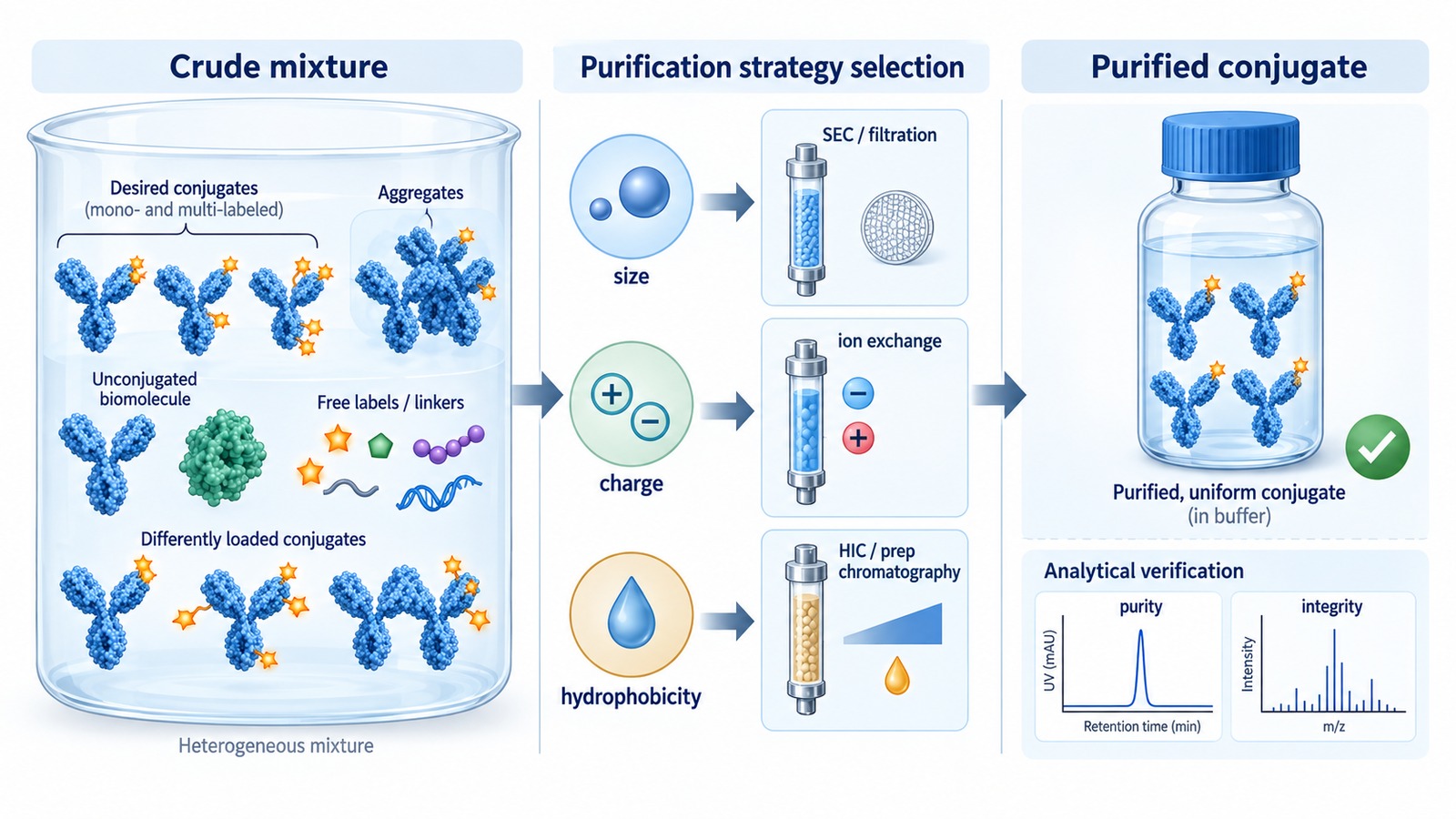 Bioconjugate purification development matches separation methods to free-component removal, conjugate heterogeneity, aggregation control, recovery, and final buffer requirements.
Purification method selection begins with the measurable differences between the desired conjugate and the species that must be removed. The most useful separation principle can change substantially after a biomolecule is labeled, crosslinked, PEGylated, coupled to an oligonucleotide, or modified with a hydrophobic small molecule.
| Parameter / Attribute | Why It Matters | What We Evaluate | Potential Development Approach |
| Hydrodynamic Size | Size differences can allow removal of small free components, aggregates, fragments, or substantially different conjugation partners. | Approximate molecular sizes, oligomerization, aggregate content, and expected size shift after conjugation. | SEC, desalting, ultrafiltration/diafiltration, TFF, or size-based polishing where resolution is sufficient. |
| Net Charge | Conjugation may shift surface charge or introduce strongly charged components such as oligonucleotides. | Molecular pI or charge behavior, buffer pH, conjugation partner, charge variants, and stability window. | Anion exchange, cation exchange, or alternative charge-based separation. |
| Hydrophobicity | Hydrophobic payloads, dyes, lipids, or linkers can produce useful retention differences but may also increase aggregation. | Payload properties, loading distribution, protein stability, solubility, and chromatographic retention behavior. | HIC for suitable protein conjugates or RP-HPLC/preparative HPLC for compatible peptides, oligonucleotides, and smaller conjugates. |
| Loading Heterogeneity | Differently loaded populations can have different hydrophobicity, charge, mass, and functional performance. | Desired loading range, analytical profile, population distribution, and whether individual fractions can be resolved. | HIC, IEX, RP-HPLC, or another orthogonal fractionation strategy based on the conjugate format. |
| Solubility & Aggregation | A theoretically selective method may be unsuitable if its salt, solvent, pH, or concentration conditions destabilize the conjugate. | Precipitation tendency, aggregate formation, concentration limits, buffer tolerance, and surface adsorption. | Adjusted buffer systems, shorter processing time, alternative purification mode, reduced concentration, or stabilizing conditions. |
| Linker Stability | Certain conjugate linkages can be sensitive to pH, nucleophiles, reducing conditions, metal exposure, or prolonged processing. | Conjugation chemistry, linker architecture, purification pH, additives, temperature, and expected processing duration. | Conditions selected to minimize unnecessary stress while still achieving required separation. |
| Feed Concentration & Volume | Sample concentration and total load affect membrane behavior, column capacity, peak width, recovery, and process practicality. | Available mass, reaction volume, desired final volume, column loading, membrane cutoff, and concentration target. | Scaled chromatography, UF/DF, TFF, staged concentration, or combined purification workflows. |
| Purity vs. Recovery | Narrow fraction collection may improve purity while sacrificing material; broad pooling can increase recovery but retain impurities. | Required purity profile, acceptable recovery, critical impurity classes, and downstream sensitivity. | Fraction-window optimization, selective polishing, or prioritization of purity or recovery according to project goals. |
| Final Buffer Requirement | Purification is often followed immediately by analysis, storage, another conjugation step, or assay development. | Required pH, salts, excipients, concentration, solvent limits, and downstream analytical compatibility. | Integrated desalting, dialysis, UF/DF, TFF, or final SEC/buffer-exchange step. |
The purification route depends strongly on both components of the conjugate. We therefore review the parent biomolecule, conjugation partner, linker, reaction chemistry, and expected product distribution together before recommending a process.
| Molecule / Conjugate Type | Common Purification Challenges | Potential Purification Options | Development Focus |
| Antibody Conjugates | Free payload or label, unconjugated antibody, variable loading, aggregates, hydrophobic species, and charge variants. | SEC, HIC, IEX, UF/DF, TFF, affinity-based approaches, and method-specific polishing. | Maintaining antibody integrity while balancing free-component removal, loading profile, aggregate control, and recovery. |
| Protein & Enzyme Conjugates | Free label, free linker, unreacted partner, aggregation, structural sensitivity, and activity loss during purification. | Desalting, SEC, IEX, affinity chromatography, UF/DF, and selected HIC approaches. | Separation under conditions compatible with protein solubility, structure, and downstream functional studies. |
| Peptide Conjugates | Closely related synthetic impurities, unconjugated peptide, free small molecule, regioisomers, and hydrophobic products. | Preparative RP-HPLC, IEX, SEC where appropriate, and complementary desalting or concentration steps. | Resolution of chemically similar species while considering peptide solubility and recovery. |
| Oligonucleotide Conjugates | Unreacted oligonucleotide, excess ligand, truncated material, differently modified strands, and highly charged product mixtures. | IEX, RP-HPLC or ion-pair RP-HPLC where appropriate, SEC, desalting, and membrane-based processing. | Exploiting charge and hydrophobicity changes introduced by the conjugated partner without compromising strand integrity. |
| Small Molecule–Biomolecule Conjugates | Excess small molecule, residual linker, different loading populations, increased hydrophobicity, and nonspecific association. | SEC, UF/DF, HIC, IEX, preparative HPLC, or combined cleanup and polishing. | Efficient free-component removal followed by fractionation only where product heterogeneity requires it. |
| Polymer Conjugates | Free polymer, broad molecular-weight distributions, viscosity, heterogeneous substitution, and difficult size separation. | SEC, membrane filtration, IEX, selective chromatography, or multi-step purification depending on polymer properties. | Managing broad distributions and recovery while distinguishing covalent conjugate from free polymer. |
| Nanoparticle Conjugates | Unbound biomolecule, free ligand, particle aggregates, broad size distribution, and colloidal instability. | Centrifugal separation, membrane filtration, SEC, dialysis, or other particle-compatible cleanup approaches. | Removing unbound material without destabilizing the particle dispersion or stripping functional surface components. |
Different impurity classes require different separation principles. A method is selected because it creates useful selectivity between the target conjugate and the actual contaminants—not simply because it is commonly used for the parent molecule.
Size exclusion chromatography and desalting approaches are useful when the target conjugate is substantially larger than free labels, salts, small linkers, or other low-molecular-weight components. SEC can also support aggregate or fragment separation when the size difference is large enough. Development considerations include pore range, sample volume, peak broadening, dilution, resolution, and the limited ability of SEC to separate species with nearly identical hydrodynamic size.
Ultrafiltration/diafiltration and tangential flow filtration can combine concentration with removal of small permeable components and buffer exchange. These approaches are particularly useful for macromolecular conjugates when there is a large molecular-weight difference between product and free reagent. Membrane cutoff, nonspecific adsorption, concentration polarization, product solubility, and the inability to resolve similar macromolecular populations are considered during development.
Ion exchange chromatography can exploit charge differences introduced by conjugation and is useful for separating charge variants, unmodified parent molecules, differently modified species, or highly charged conjugates such as some protein–oligonucleotide systems. Method development considers pH relative to molecular charge, salt tolerance, binding strength, gradient design, recovery, and whether the required buffer conditions are compatible with conjugate stability.
HIC can be valuable when conjugation with a hydrophobic payload, linker, or label creates measurable hydrophobicity differences between product populations. It is particularly relevant to antibody and protein conjugates with loading-dependent hydrophobicity. Development focuses on salt conditions, resin interaction, aggregate behavior, loading resolution, fraction pooling, and whether the conjugate tolerates the required binding and elution environment.
Reversed-phase or other preparative HPLC modes can provide high resolution for peptides, oligonucleotides, small biomolecules, and compatible conjugates. They can separate closely related products where size-based cleanup is insufficient. Mobile-phase composition, organic solvent exposure, pH, temperature, product solubility, peak identity, and recovery are evaluated before using this approach for sensitive macromolecules.
Affinity-based purification may provide strong selectivity when the conjugate or one component contains a suitable affinity interaction, engineered tag, binding partner, or accessible recognition element. We evaluate whether affinity capture distinguishes the desired species from unreacted components and whether elution conditions preserve conjugate structure. Affinity purification may also be combined with SEC, IEX, or buffer exchange as a polishing workflow.
Purification development begins by identifying which product attribute offers the most useful separation from the unwanted species. The decision matrix below illustrates how project variables influence method selection.
| Project Variable | Key Question | Purification Implication | Typical Development Direction |
| Parent Molecule | Is the primary molecule an antibody, protein, peptide, oligonucleotide, polymer, or particle? | Determines structural sensitivity, size range, charge behavior, solvent tolerance, and practical processing options. | Start with molecule-compatible modes, then refine around conjugation-induced property changes. |
| Conjugation Partner | Is the attached component a dye, small molecule, peptide, oligonucleotide, protein, polymer, lipid, or particle? | The partner may create a new size, charge, or hydrophobicity difference that can be exploited. | Select the separation principle that best distinguishes conjugated from free and unconjugated components. |
| Conjugation Chemistry | Which reactive groups and reaction additives were used? | Chemistry determines likely residual reagents, by-products, buffer constraints, and linkage sensitivity. | Design the first cleanup step around reaction contaminants while protecting the formed linkage. |
| Conjugation Site | Is modification random, selectively introduced, or site-specific? | Random modification may produce broader product heterogeneity than a defined site-specific process. | Assess whether population fractionation is needed in addition to free-component removal. |
| Linker Properties | Does the linker add hydrophobicity, charge, PEG character, cleavability, or environmental sensitivity? | Linker design can strongly influence retention, aggregation, solubility, and allowable purification conditions. | Avoid purification environments likely to destabilize the linker or drive unwanted association. |
| Loading Distribution | Is the goal simply to remove free material or also to isolate a narrower loading population? | Population control requires greater resolving power than routine desalting or filtration. | Evaluate HIC, IEX, preparative HPLC, or another orthogonal fractionation method when differences are measurable. |
| Solubility & Stability | Which pH, salt, solvent, temperature, and concentration ranges can the conjugate tolerate? | These limits can exclude otherwise attractive chromatographic conditions. | Select the least disruptive method that still provides useful separation. |
| Purity Requirement | Which impurity classes must be reduced for the intended downstream study? | Different applications may tolerate residual parent molecule but not free label, aggregates, or specific loading populations. | Define fraction-pooling criteria around the impurities that materially affect the project. |
| Analytical Requirement | How will conjugate identity, purity, loading, aggregation, or free component removal be measured? | Purification cannot be optimized reliably without methods that distinguish useful fractions from misleading peaks. | Coordinate purification development with orthogonal analytical characterization. |
| Project Scale | Is the method intended for a small development batch, repeat preparation, or larger research-scale production? | Sample load and volume can alter resolution, processing time, membrane behavior, and recovery. | Select methods and parameters that can be adapted to the expected project scale. |
Purification development should be planned together with the conjugation reaction because each chemistry creates a different impurity profile, product distribution, and stability constraint. We use the reaction route to anticipate what needs to be removed and which purification environments should be avoided.
Amine-directed reactions may require removal of hydrolyzed reagent, activated small molecules, excess label, linker, or reaction by-products. Purification is selected according to the molecular-weight and charge differences between these species and the conjugate. For related chemistry considerations, see our NHS ester conjugation resource.
Thiol-directed conjugation may leave reducing agents, unreacted maleimide components, linker-payload, or differently loaded conjugate populations. Purification conditions are selected with both free-component removal and linkage stability in mind. See our maleimide conjugation resource for related reaction design considerations.
Click reactions can require removal of excess azide- or alkyne-functionalized components, hydrophobic cyclooctyne reagents, catalysts, ligands, or side components depending on the reaction. Purification can be coordinated with SPAAC or CuAAC workflows according to the selected handles.
Tetrazine-based ligation often introduces hydrophobic or structurally distinct reactive handles whose residual free components may require careful cleanup. Where conjugation creates sufficient hydrophobicity or charge differences, fractionation can also be evaluated. Related chemistry information is available in our tetrazine ligation resource.
Aldehyde-, ketone-, hydrazide-, or aminooxy-based conjugation workflows may require removal of excess carbonyl-reactive reagents, quenching components, or unreacted partners. Purification pH and buffer composition are selected with the stability of the final linkage and the parent biomolecule in mind.
Enzymatic workflows can introduce enzymes, cofactors, substrates, or other macromolecular components that require separation from the final conjugate. Depending on the molecular design, size-, charge-, or affinity-based methods may be useful. Projects can also be coordinated with our enzymatic crosslinking services.
Purification development is performed as a decision-driven process. Each stage narrows the separation strategy using information from the molecule, crude reaction profile, candidate fractions, and analytical results.


We review the parent molecule, conjugation partner, chemistry, current reaction conditions, crude mixture, known impurities, sample amount, stability constraints, and desired final material. This establishes what actually needs to be separated before selecting equipment or chromatography modes.

Candidate purification routes are prioritized according to differences in size, charge, hydrophobicity, affinity, loading, and solubility. The goal is to identify the simplest separation principle capable of addressing the critical impurity classes.

Initial scouting evaluates suitable columns, membranes, buffer conditions, loading ranges, gradients, fraction windows, or concentration parameters. Multiple routes may be compared when the best separation mechanism is not obvious from molecular properties alone.

Fractions are assessed using methods matched to the project, such as chromatographic purity, free-component analysis, aggregation assessment, concentration, loading measurements, mass-based confirmation, or other suitable characterization. This links the purification profile to actual conjugate quality.

Loading, gradients, wash conditions, pooling criteria, membrane parameters, buffer exchange, concentration, or a secondary polishing step are adjusted to improve the required balance among purity, recovery, free-component removal, and conjugate integrity.

The selected workflow is reviewed against the agreed project objectives. Deliverables may include purified conjugate, analytical results, recovery information, relevant fraction data, final buffer details, and recommended purification parameters for repeat work or subsequent scale adjustment.
A purification process is evaluated by more than the appearance of a single chromatographic peak. We consider whether the process removes the impurities that matter while retaining usable, structurally appropriate conjugate.
We evaluate the proportion and profile of desired conjugate relative to relevant impurities using analytical methods appropriate for the molecular format.
Material balance and recovered conjugate are considered so that increased purity is interpreted together with losses from adsorption, precipitation, broad fractionation, or repeated processing.
Residual label, linker, payload, conjugation partner, salts, catalysts, or other reaction components are assessed where they are relevant to downstream use.
Purified material is reviewed for aggregation, fragmentation, precipitation, unexpected product changes, or other signs that the separation conditions are damaging the conjugate.
For heterogeneous conjugates, we evaluate whether target and non-target populations are sufficiently resolved to support meaningful fraction selection and pooling.
When repeat processing is required, key purification parameters and analytical profiles can be compared to identify conditions that provide more consistent separation behavior.
Dedicated purification development is most useful when post-conjugation cleanup has become a project-limiting step or when the crude product contains more complexity than a routine desalting procedure can address.
Use purification development when residual dye, biotin reagent, linker-payload, small molecule, peptide, oligonucleotide, or another free component interferes with downstream analysis or experimental readouts.
A dedicated strategy is appropriate when differently modified populations need to be compared, enriched, or narrowed rather than simply separated from small free reagent.
Method redevelopment can help when concentration, high salt, organic solvent, resin interaction, repeated filtration, or long processing times reduce recovery or alter conjugate integrity.
Conjugation may change size, charge, pI, hydrophobicity, solubility, or surface properties enough that the parent-molecule purification method is no longer selective or stable.
This service is useful when fraction identity cannot be judged from UV traces alone and purification decisions need to be supported by loading, mass, aggregation, purity, or free-component analysis.
Purification development can establish which column, membrane, loading, pooling, buffer-exchange, and concentration parameters need adjustment before increasing batch size.
Purification is selected around the actual difference between product and impurity—size, charge, hydrophobicity, affinity, loading, or particle behavior—rather than forcing all projects through the same cleanup method.

Method decisions consider usable material recovery together with impurity removal, helping avoid purification schemes that generate attractive chromatograms but unacceptable product loss.
Fraction selection can be supported by orthogonal characterization so that pooling decisions reflect conjugate purity, loading, aggregation, free-component removal, and other project-specific attributes.
Purification can be coordinated with conjugation chemistry, buffer exchange, characterization, repeat preparation, and research-scale process adjustment, reducing the need to troubleshoot each stage independently.
To evaluate a bioconjugate purification project, provide your molecule or conjugate type, conjugation partner, current chemistry or process status, available sample amount, known impurities, current purification method if one exists, and the problem you are trying to solve. Information on desired purity, acceptable recovery, final buffer, loading profile, aggregation concerns, analytical requirements, and expected project scale is also useful.
You do not need to have the purification method or analytical strategy selected before contacting us. BOC Sciences can review the molecular properties and current development data to recommend a practical starting strategy for free-component removal, conjugate fractionation, polishing, buffer exchange, and purification performance evaluation. Contact our scientific team to discuss your bioconjugate purification requirements and project objectives.
Provide the parent molecule, conjugation partner, conjugation chemistry, approximate sample amount and concentration, current buffer, known or suspected impurities, existing purification method if available, desired final material profile, and planned downstream use. Chromatograms or other characterization data are useful when available.
Yes. Customer-supplied crude or partially purified material can be evaluated when sufficient information about the conjugate, reaction mixture, buffer, handling requirements, and analytical objectives is available. The first step is determining which properties can distinguish the target conjugate from the unwanted species.
Yes. Existing SEC, HPLC, IEX, HIC, filtration, desalting, or other workflows can be reviewed when recovery, resolution, aggregate removal, free-component removal, processing time, or reproducibility is inadequate. Optimization may involve changing loading, buffer conditions, gradients, pooling windows, membrane parameters, or the overall sequence of purification steps.
Method selection is based on the parent molecule, conjugation partner, size difference, charge, hydrophobicity, linker properties, loading distribution, solubility, stability, impurity profile, analytical requirements, and project scale. The preferred method is the one that creates useful selectivity without unnecessarily stressing the conjugate.
Evaluation can include product purity, recovery, removal of free components, aggregate or fragment levels, conjugate integrity, loading or population distribution, and reproducibility. The exact analytical package depends on the molecular format and the purpose of the purification step.