Selective Aldehyde & Ketone TargetingOxime & Hydrazone ConjugationCustom Carbonyl Handle Engineering
Carbonyl-selective conjugation provides a practical route for attaching labels, linkers, biomolecules, polymers, and other functional components to defined aldehyde or ketone handles. By pairing carbonyl groups with aminooxy, hydrazide, hydrazine, or other appropriately designed nucleophiles, researchers can achieve selective modification under relatively mild conditions while avoiding direct dependence on abundant native amines or thiols.
BOC Sciences provides custom carbonyl-selective conjugation services covering carbonyl handle assessment and installation, oxime and hydrazone ligation, linker design, reaction optimization, purification, and analytical verification. Projects can be integrated with broader custom bioconjugation services for proteins, peptides, oligonucleotides, glycoconjugates, small molecules, and multifunctional research constructs.
Our development strategy considers not only whether a carbonyl reaction is chemically possible, but whether the selected carbonyl is accessible, sufficiently reactive, compatible with the biomolecule, and capable of producing a conjugate with the stability and homogeneity required for the intended downstream research workflow.
Carbonyl-selective conjugation projects often involve more than mixing an aldehyde with an aminooxy reagent. Poor carbonyl accessibility, slow ketone reactivity, uncontrolled oxidation, unstable linkage selection, unsuitable pH, excess unreacted probe, and difficult purification can all determine whether a theoretically selective reaction produces a useful conjugate. We therefore build each project around the substrate, handle location, desired linkage, application environment, and analytical requirements.
 Oxime Ligation
We develop oxime-forming conjugation between aldehyde- or ketone-containing substrates and aminooxy-functionalized reaction partners. Oxime chemistry is particularly useful when a defined carbonyl handle is available and a comparatively hydrolytically stable carbonyl-derived linkage is preferred.
Deliverables can include purified oxime conjugates, analytical data, reaction summaries, and recommended handling conditions for downstream research.
 Hydrazone Ligation
Hydrazide- or hydrazine-functionalized reagents can be coupled to accessible aldehydes or ketones through hydrazone formation. This route is useful for carbohydrate-directed labeling, probe attachment, capture strategies, and constructs where the stability profile of the hydrazone linkage is compatible with the experimental design.
Method selection is based on the intended use rather than treating oxime and hydrazone formation as interchangeable reactions.
 Carbonyl Handle Installation
When a suitable aldehyde or ketone is not already present, we evaluate whether a defined carbonyl handle can be introduced without compromising the functional region of the substrate.
Projects involving protein substrates can also be coordinated with our protein conjugation services.
 Glycan-Directed Conjugation
Carbohydrate structures provide useful opportunities for carbonyl-selective modification because suitable diols can be converted into aldehydes and subsequently reacted with aminooxy or hydrazide partners. This can shift modification away from densely distributed protein amines.
Related carbohydrate-focused projects may be integrated with our glycan conjugation capabilities.
 Peptide Carbonyl Conjugation
Peptides can be designed with terminal or side-chain carbonyl handles, or with aminooxy/hydrazide groups that react with a carbonyl-bearing partner. This enables controlled construction of peptide–probe, peptide–polymer, peptide–oligonucleotide, and other modular conjugates.
Broader peptide modification requirements can be supported through our peptide conjugation services.
 Custom Linker Integration
We support heterobifunctional linker designs in which an aminooxy, hydrazide, aldehyde, or ketone terminus provides the carbonyl-selective reaction while the second terminus supports attachment to another molecule or functional module.
Linker architecture is selected according to molecular size, reactive-handle placement, steric requirements, purification constraints, and the desired final conjugate format.
Carbonyl-selective conjugation takes advantage of the electrophilic character of aldehydes and ketones. An α-effect nucleophile such as an aminooxy or hydrazine derivative attacks the carbonyl carbon, followed by condensation and loss of water to produce an oxime or hydrazone linkage. When the carbonyl handle is uniquely positioned on the target molecule, this reaction can provide substantially greater positional control than modification of broadly distributed lysine residues.
Aldehydes generally react more readily than analogous ketones, while steric environment, electronic structure, reagent concentration, pH, and the selected nucleophile can strongly influence reaction rate. Oxime formation often provides a useful balance of chemoselectivity and linkage stability, whereas hydrazone chemistry may be preferred for certain carbohydrate-labeling, capture, or intentionally more dynamic systems. Catalysts can accelerate some oxime and hydrazone reactions, particularly when near-neutral conditions are required, but catalyst compatibility must be considered for sensitive biomolecules.
Carbonyl chemistry should not automatically be treated as completely bioorthogonal in every sample. Naturally occurring or chemically generated carbonyls may be present in carbohydrates, metabolites, or oxidized biomolecules. Selectivity therefore depends on the composition of the substrate, how the target carbonyl is introduced, and whether competing reactive carbonyl species are present.
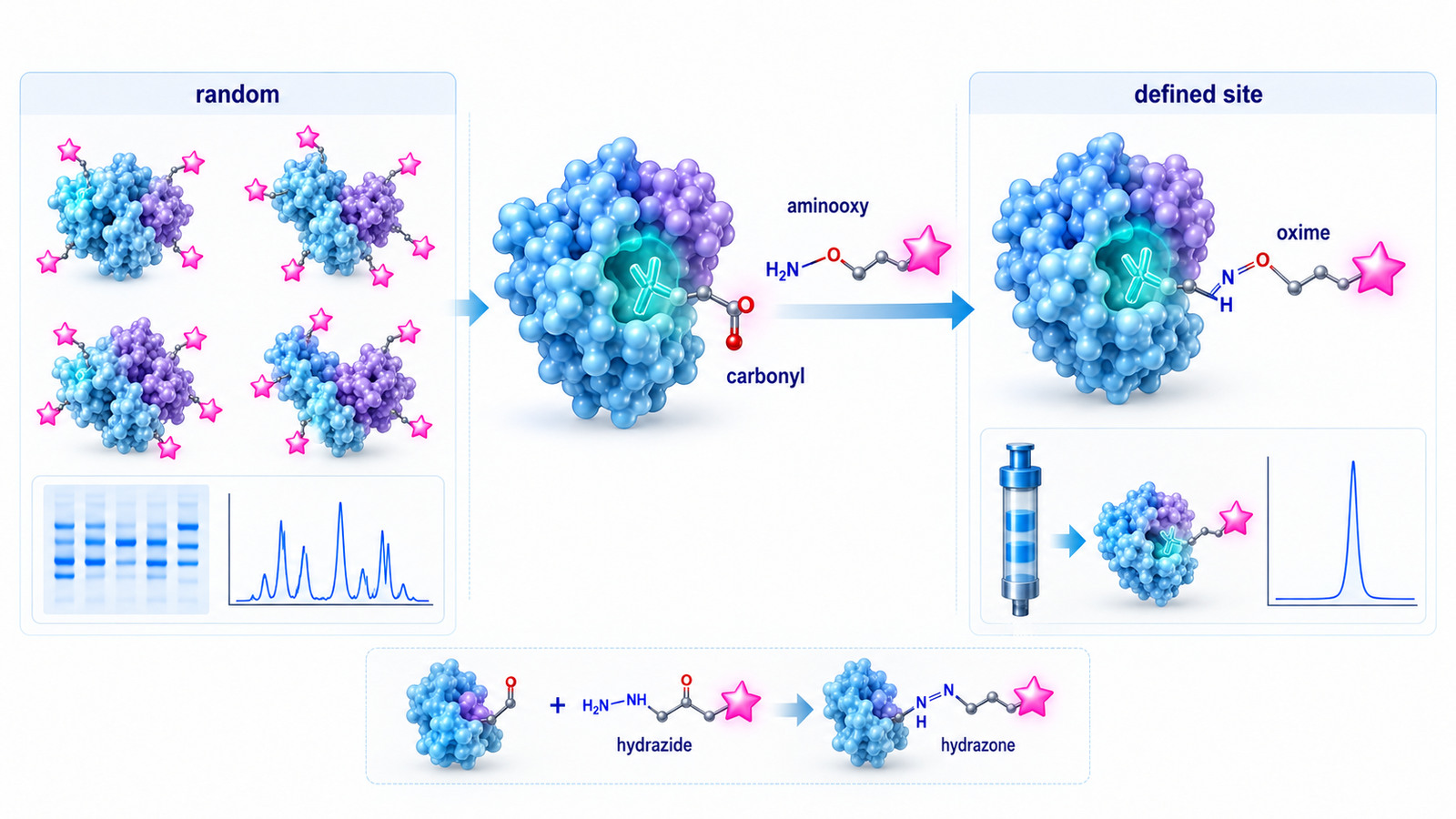 Carbonyl-selective conjugation directs an aminooxy or hydrazide reagent toward a defined aldehyde or ketone handle, helping reduce the heterogeneous modification that can occur when broadly distributed native functional groups are targeted.
The value of carbonyl-selective conjugation depends on matching the molecule, carbonyl source, reaction partner, and desired linkage. The matrix below summarizes common design routes used when evaluating a custom project.
| Molecule / Platform | Carbonyl or Reactive Handle | Typical Reaction Partner | Key Technical Considerations | Potential Research Uses |
| Proteins & Antibodies | Introduced aldehyde/ketone, engineered carbonyl handle, N-terminal carbonyl, oxidized glycan | Aminooxy probe, hydrazide reagent, hydrazine derivative | Handle accessibility, activity retention, oxidation-sensitive residues, aggregation, reaction pH | Site-controlled labeling, immobilization, polymer attachment, protein–molecule conjugates |
| Glycoproteins & Glycans | Aldehydes generated from compatible vicinal diols or reducing-end carbonyls | Hydrazide or aminooxy reagent | Oxidation level, glycan heterogeneity, carbonyl density, preservation of protein structure | Glycan-directed probe attachment, affinity capture, carbohydrate labeling |
| Peptides | Synthetic aldehyde/ketone, terminal carbonyl, aminooxy group | Aminooxy-, carbonyl-, or hydrazide-functionalized partner | Sequence stability, disulfides, steric access, purification behavior | Peptide–probe, peptide–polymer, peptide–oligonucleotide, and peptide–protein constructs |
| Oligonucleotides | 5′, 3′, or internally introduced aldehyde/ketone or aminooxy functionality | Complementary carbonyl or α-nucleophile partner | Modification position, linker length, oligonucleotide integrity, purification resolution | DNA/RNA conjugates, probes, programmable assemblies, assay reagents |
| Small Molecules & Dyes | Aldehyde, ketone, aminooxy, hydrazide | Complementary biomolecule handle | Solubility, linker orientation, reagent excess, removal of free small molecule | Fluorescent labeling, biotinylation, affinity-tag installation, chemical probes |
| Polymers & Surfaces | Terminal carbonyl or aminooxy/hydrazide group | Protein, peptide, oligonucleotide, or small molecule | Multivalency, steric accessibility, surface density, solubility, purification route | Biomolecule immobilization, polymer conjugates, functional research materials |
For oligonucleotide-containing constructs, modification-site planning and downstream purification can also be coordinated with our oligonucleotide bioconjugation platform.
Carbonyl-selective conjugation is particularly useful when project requirements favor a deliberately installed reactive handle rather than modification of abundant native residues. It can also provide a convenient route to carbohydrate-associated structures that are difficult to address selectively through conventional amine or thiol chemistry.
When better site control is required: A unique aldehyde or ketone can provide a defined attachment point and reduce the positional heterogeneity associated with random lysine modification.
When native thiols are unavailable or functionally important: Carbonyl chemistry provides an alternative to maleimide–thiol coupling without requiring reduction or engineering of cysteine residues.
When glycan-directed modification is advantageous: Compatible carbohydrate structures can be converted into reactive aldehydes, providing access to glycoprotein- or glycan-focused conjugation strategies.
When metal-free ligation is preferred: Oxime and hydrazone formation do not inherently require a transition-metal catalyst, which can simplify some biomolecule workflows.
When a modular synthetic handle can be installed: Carbonyl and aminooxy groups can be incorporated into peptides, oligonucleotides, small molecules, and linkers during synthesis, enabling controlled assembly of otherwise difficult conjugates.
When linkage behavior can be matched to the study: Oxime, hydrazone, and carbonyl-directed reductive approaches provide different stability profiles, allowing chemistry selection to reflect the required experimental conditions.
Carbonyl-selective chemistry is one option among several established bioconjugation strategies. The best route depends on which reactive groups are already present, whether site control is required, the stability of the biomolecule, and how the final conjugate will be purified and used. Related approaches are discussed in our overview of bioorthogonal reactions and broader chemical crosslinking services.
| Conjugation Method | Primary Handles | Site-Control Potential | Key Advantages | Important Limitations |
| Carbonyl-Selective Oxime | Aldehyde/ketone + aminooxy | High when a unique carbonyl handle is installed | Chemoselective, metal-free, compatible with many aqueous workflows, comparatively stable oxime linkage | Carbonyl introduction may be required; reaction rate depends strongly on carbonyl structure, pH, and accessibility |
| Hydrazone Ligation | Aldehyde/ketone + hydrazide/hydrazine | High when the target carbonyl is uniquely positioned | Useful for glycans and carbonyl-containing substrates; straightforward reagent design | Hydrazone stability can be lower than corresponding oxime systems and must be matched to application conditions |
| NHS Ester Coupling | Activated ester + primary amine | Usually limited on proteins containing multiple accessible lysines | Simple, widely applicable, broad reagent availability | Can generate heterogeneous products and alter function when important lysines are modified |
| Maleimide–Thiol | Maleimide + cysteine/thiol | Good when a unique accessible thiol is available | Efficient under mild conditions and widely used for protein conjugation | May require thiol generation or reduction; linkage stability and competing thiols should be considered |
| CuAAC / SPAAC | Azide + alkyne/cyclooctyne | High after orthogonal handles are introduced | Strong chemoselectivity and broad modularity | Requires installation of click handles; CuAAC uses copper while SPAAC introduces bulkier strained partners |
| IEDDA | Tetrazine + strained alkene | High after installation of compatible handles | Very useful when rapid orthogonal ligation is required | Reactive-handle size, stability, accessibility, and reagent availability must be considered |
Each project follows a substrate-driven workflow so that handle generation, conjugation conditions, purification, and characterization are planned as one process rather than optimized independently.


We review the target molecule, conjugation partner, available material, molecular size, sensitive functional groups, intended application, and desired attachment position. This establishes whether a native or introduced carbonyl strategy is appropriate.

Existing aldehyde, ketone, aminooxy, or hydrazide functionality is assessed. If a new carbonyl must be generated, potential installation routes are compared against substrate stability, site control, and downstream purification requirements.

We select oxime, hydrazone, or another carbonyl-directed strategy together with an appropriate spacer and reagent configuration. Solubility, steric access, conjugate architecture, and final linkage stability are considered at this stage.

Small-scale experiments can be used to optimize pH, reagent equivalents, substrate concentration, reaction time, temperature, and catalyst conditions. Particular attention is paid to incomplete conversion, competing carbonyls, precipitation, and degradation.

Free reagent, catalyst, unconjugated substrate, and relevant side products are separated using a purification strategy matched to the molecular properties of the conjugate. Buffer exchange can be incorporated where required for subsequent analysis or use.

Appropriate analytical methods are used to assess identity, conjugation, purity, aggregation, labeling level, or other project-specific attributes. Final materials are supplied together with available analytical results and project-relevant handling information.
Carbonyl-selective reactions can still produce mixtures containing residual starting material, hydrolyzed reagent, excess aminooxy or hydrazide component, catalyst, oxidation byproducts, or differently modified conjugate populations. Purification and analytical design are therefore selected together with the reaction chemistry.
| Stage | Available Approaches | What It Helps Evaluate | Selection Considerations |
| Small-Molecule Removal | Desalting, dialysis, ultrafiltration, buffer exchange, chromatographic separation | Removal of excess aminooxy/hydrazide probe, catalyst, salts, and low-molecular-weight components | Molecular-size difference, recovery, sample volume, conjugate stability |
| Preparative Purification | RP-HPLC, SEC, ion-exchange or other substrate-appropriate chromatography | Separation of unconjugated starting material, conjugate species, aggregates, or side products | Molecule class, hydrophobicity, charge, size, and required resolution |
| Identity Verification | LC-MS, intact mass analysis, peptide or small-molecule MS where appropriate | Expected mass change and confirmation of conjugate formation | Molecular size, ionization behavior, conjugate heterogeneity |
| Purity Assessment | Analytical HPLC/UPLC, SEC, electrophoretic analysis where appropriate | Main conjugate population, residual substrate, degradation, aggregation | Required information depends on the molecular format and downstream study |
| Labeling Assessment | UV-Vis, fluorescence, mass-based analysis, or other reagent-specific measurements | Label incorporation or approximate conjugation ratio when the molecular design permits | Requires an analytically distinguishable label or suitable quantitative approach |
| Functional Evaluation | Substrate-appropriate binding, activity, hybridization, or assay comparison where requested | Whether the selected conjugation strategy preserves the function relevant to the project | Functional testing is designed according to the molecule and intended research use |
A chemically reactive aldehyde or ketone can still perform poorly if it is buried inside a folded protein, positioned next to a surface, or sterically shielded by a bulky linker. Handle placement and spacer design should therefore be evaluated before increasing reagent excess or reaction time.
Oxime and hydrazone formation is sensitive to proton-transfer chemistry, so reaction rate can change substantially with pH. Mildly acidic conditions can favor condensation, while nucleophilic catalysts may support faster reactions closer to neutral pH. The final conditions must remain compatible with the biomolecule.
These linkages should not be selected solely on reaction convenience. Oximes are generally favored where greater hydrolytic stability is important, while hydrazone behavior depends strongly on molecular structure and environmental conditions and may be useful when a more dynamic linkage is acceptable.
Oxidative carbonyl generation can create useful handles but may also modify oxidation-sensitive residues or create more than one aldehyde. Carbonyl-installation conditions therefore need to balance sufficient handle formation against preservation of the original biomolecule.
Naturally occurring sugars, oxidized biomolecules, metabolites, or carbonyl-containing excipients can react with aminooxy and hydrazide reagents. Complex samples should therefore be reviewed for background carbonyl chemistry before assuming complete orthogonality.
Highly selective chemistry does not automatically mean simple purification. Small labels may require efficient free-reagent removal, while conjugates with small mass differences or multiple carbonyl sites may require chromatographic method development to resolve product populations.
We evaluate the actual carbonyl, reaction partner, substrate architecture, and required linkage properties before selecting oxime, hydrazone, carbonyl installation, or an alternative approach.

Project planning can accommodate proteins, peptides, glycans, oligonucleotides, small molecules, polymers, labels, and heterobifunctional linkers, including constructs that require more than one conjugation chemistry.
Reaction conditions are developed with downstream separation in mind. This helps avoid conjugation designs that appear successful analytically but produce product populations that are difficult to isolate or reproduce.
Characterization strategies are selected according to the conjugate type, providing relevant evidence for identity, conjugation, purity, aggregation, labeling behavior, or other project-specific attributes rather than relying on a single generic measurement.
Whether your project starts with an aldehyde-containing protein, an oxidizable glycan, a ketone-functionalized peptide, an aminooxy-modified oligonucleotide, or a custom carbonyl-reactive linker, we can help evaluate the conjugation route from handle design through purification and analytical verification.
Share your substrate structure or sequence, available reactive handles, desired conjugation partner, expected scale, and downstream research requirements. Contact our scientific team to discuss a project-specific carbonyl-selective conjugation strategy.
Carbonyl-selective conjugation targets aldehyde or ketone groups with complementary nucleophiles such as aminooxy, hydrazide, or hydrazine reagents. When a unique carbonyl handle is present, the approach can provide greater positional control than modification of broadly distributed native amines.
Oximes are formed from carbonyl compounds and aminooxy reagents, while hydrazones are formed using hydrazine or hydrazide derivatives. Oxime linkages are generally preferred when greater hydrolytic stability is important, whereas hydrazone chemistry can be useful for carbohydrate labeling and applications where its particular stability profile is acceptable.
Yes, depending on the protein. Possible approaches include carbohydrate oxidation, N-terminal carbonyl-generation strategies, engineered aldehyde-containing motifs, or incorporation of carbonyl-bearing building blocks. The appropriate route depends on sequence, structure, modification site, and sensitivity to the reaction conditions.
Yes. Compatible carbohydrate motifs can be oxidized to generate aldehydes that subsequently react with aminooxy or hydrazide reagents. Oxidation conditions must be controlled because excessive treatment can increase heterogeneity or affect oxidation-sensitive parts of the biomolecule.
Not in every case. Reaction rate depends on the carbonyl structure, nucleophile, pH, concentration, and accessibility. Some systems react adequately without a catalyst, while nucleophilic catalysts can accelerate slower reactions, particularly when operation near neutral pH is desirable. Catalyst compatibility must be evaluated for sensitive substrates.