Carbonyl-Selective BioconjugationAminooxy–Aldehyde/Ketone CouplingCustom Conjugates with Controlled Reactive Handles
BOC Sciences provides custom oxime ligation services for the chemoselective coupling of aldehyde- or ketone-bearing molecules with aminooxy-functionalized partners. This carbonyl-selective conjugation chemistry is useful when researchers need a defined reactive handle, mild aqueous reaction conditions, and an oxime linkage that is generally more hydrolytically stable than a corresponding simple hydrazone. Projects can be designed for proteins, antibodies, peptides, oligonucleotides, glycans, small molecules, polymers, and other functionalized research materials.
Our support extends beyond the ligation step itself. We evaluate how the carbonyl or aminooxy group should be introduced, whether the handle remains accessible after modification, how linker design affects molecular function, whether catalysis is appropriate, and how excess reagent and side products can be removed. Oxime ligation projects can also be coordinated with our custom bioconjugation services, protein conjugation services, and peptide conjugation services.
A successful oxime conjugation project depends on more than combining an aldehyde with an aminooxy reagent. Common development challenges include inefficient carbonyl installation, poorly accessible reactive groups, slow reaction at the required pH, instability of sensitive biomolecules, excessive linker or payload equivalents, difficult removal of unreacted reagent, and heterogeneous products caused by uncontrolled handle placement. We therefore design each project around the starting molecules, available functional groups, desired conjugation site, final application, and analytical requirements.
 Protein Oxime Ligation
We support oxime conjugation of proteins carrying an aldehyde, ketone, or aminooxy handle introduced through a chemically or biochemically appropriate strategy.
Typical deliverables may include purified conjugate, reaction and purification summary, analytical data, and recommended handling conditions.
 Peptide Oxime Ligation
Peptides are particularly adaptable to oxime chemistry because aminooxy or carbonyl groups can be incorporated at defined positions during synthesis or introduced through suitable post-synthetic modification.
The objective is to establish a ligation route compatible with peptide synthesis history, folding requirements, solubility, and downstream study design.
 Antibody Oxime Ligation
For antibodies and antibody-derived proteins, oxime ligation can provide carbonyl-directed conjugation when an appropriate and sufficiently controlled aldehyde or ketone installation strategy is available.
Projects requiring broader antibody chemistry can also be coordinated with our antibody conjugation services.
 Oligonucleotide Oxime Ligation
Aminooxy- or carbonyl-functionalized oligonucleotides can be coupled to peptides, small molecules, glycans, polymers, or other compatible partners through a defined linker architecture.
Related constructs can be integrated with our oligonucleotide bioconjugation capabilities.
 Glycan Oxime Ligation
Carbohydrates and glycoconjugates can provide naturally occurring or chemically generated carbonyl groups that are useful for aminooxy coupling, although carbonyl location and sugar integrity must be considered carefully.
This approach can be useful for glycoconjugate research when a carbonyl-directed attachment route is preferable to broad amine- or thiol-targeting chemistry.
 Handle & Linker Design
When the starting molecules are not already oxime-ready, we can develop a handle-introduction and linker strategy before the final ligation.
Handle planning at the start of a project can reduce downstream troubleshooting caused by inaccessible carbonyl groups, premature aminooxy reactions, or difficult purification.
Oxime ligation is based on the reaction of a carbonyl group—typically an aldehyde or ketone—with an aminooxy group, also described as an alkoxyamine functionality. Nucleophilic attack on the carbonyl is followed by condensation and loss of water to produce an oxime linkage containing a C=N–O bond. Because aminooxy groups are substantially more reactive toward carbonyls than ordinary primary amines, the reaction can provide useful chemoselectivity in molecules that contain many native amines, alcohols, and other biological functional groups.
Reaction rate is controlled by several variables rather than by the reactive handles alone. Carbonyl structure, steric accessibility, pH, reagent concentration, temperature, solvent composition, and the presence or absence of a nucleophilic catalyst can all influence conversion. Aldehydes are often more reactive than comparable ketones, while sterically hindered or poorly exposed carbonyls may require additional optimization. Oxime formation is generally favored by mildly acidic conditions, but nucleophilic catalysts such as aniline or suitable derivatives can accelerate selected ligations and broaden the usable reaction window when biomolecule stability limits the choice of pH.
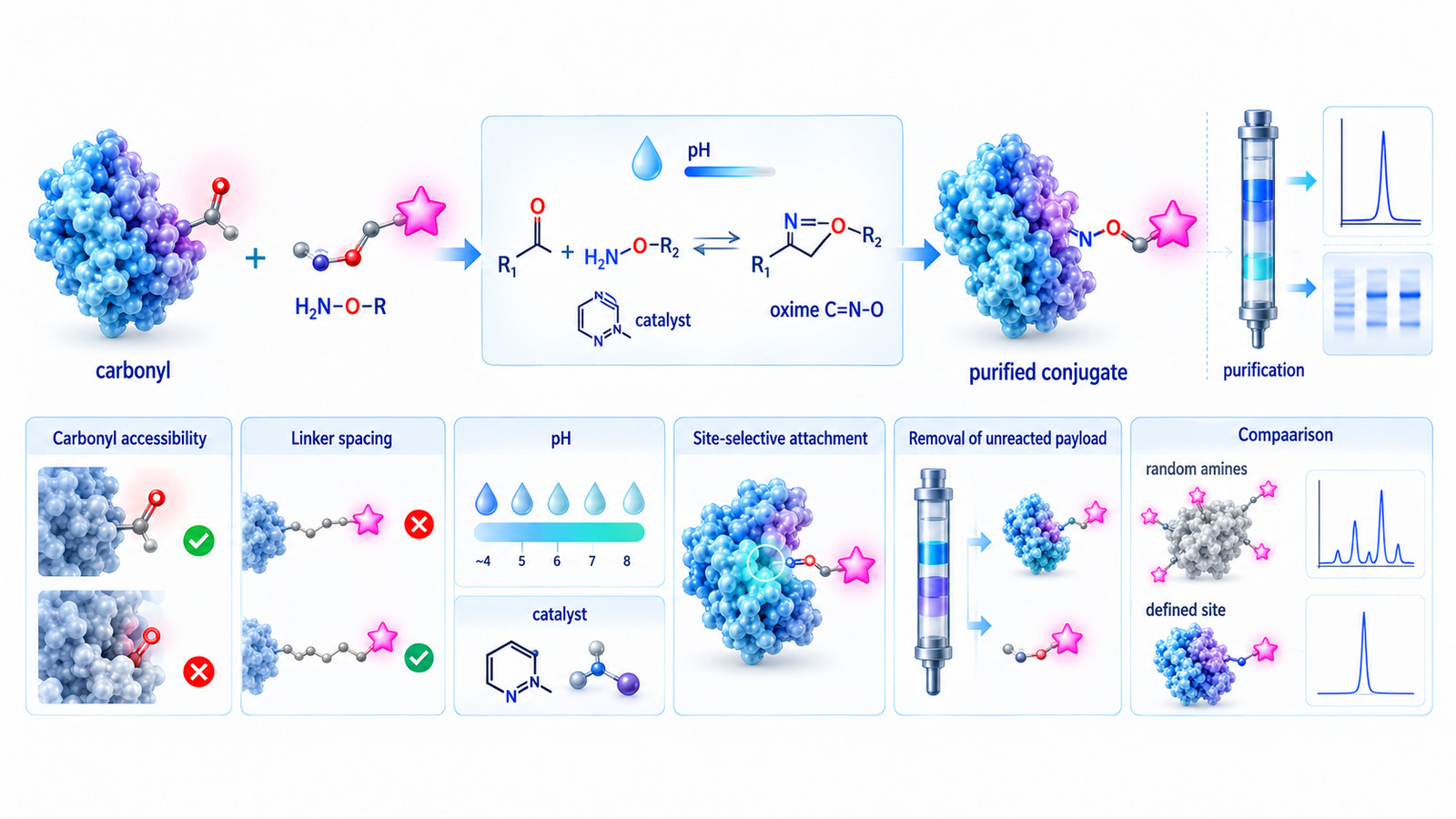 Oxime ligation couples an aminooxy-functionalized molecule with an aldehyde- or ketone-bearing partner while leaving many common biological functional groups unchanged.
Oxime chemistry is most useful when at least one conjugation partner can carry a defined carbonyl group and the other can be functionalized with an accessible aminooxy handle. The best installation route depends on molecular class, desired site control, sensitivity to oxidation or acidic conditions, and whether the modification itself can alter biological function.
| Molecule Class | Oxime-Reactive Handle | Possible Introduction Strategy | Key Technical Considerations | Typical Conjugation Goal |
| Proteins | Aldehyde, ketone, or aminooxy | N-terminal modification, glycan-related chemistry, engineered carbonyl handles, or linker installation | Handle accessibility, native structure, aggregation, buffer compatibility, and site heterogeneity | Protein labeling, protein–small molecule, protein–peptide, or protein–polymer conjugates |
| Antibodies & Fragments | Typically defined carbonyl plus aminooxy-functionalized payload | Appropriate glycan-associated, chemical, enzymatic, or engineered handle strategy | Conjugation location, glycoform heterogeneity, aggregation, binding-region accessibility, and payload properties | Research labels, affinity constructs, reporter conjugates, or defined payload attachment |
| Peptides | Aminooxy, aldehyde, or ketone | Protected aminooxy building blocks, terminal carbonyl generation, or synthetic carbonyl-containing residues | Sequence solubility, disulfide formation, protecting-group sequence, and reactive-handle position | Peptide–drug, peptide–probe, peptide–glycan, or peptide–polymer research constructs |
| Oligonucleotides | Terminal aminooxy or carbonyl-functionalized linker | 5'/3' modification or suitable linker incorporation | Hybridization effects, linker length, purification, and compatibility with nucleic-acid handling conditions | Peptide–oligonucleotide, ligand–oligonucleotide, or reporter-modified constructs |
| Carbohydrates & Glycans | Reducing-end or introduced aldehyde | Native reducing end or controlled oxidation where structurally appropriate | Multiple oxidizable sites, ring-chain equilibrium, structural preservation, and product heterogeneity | Glycan labeling, immobilization, glycoconjugate preparation, or multivalent display |
| Small Molecules & Polymers | Aminooxy, aldehyde, or ketone | Functional linker installation during chemical synthesis | Solubility, steric hindrance, linker length, organic cosolvent tolerance, and reagent removal | Biomolecule–small molecule, PEG/polymer, probe, or surface-functionalized constructs |
Oxime ligation is particularly useful when a project benefits from carbonyl-selective coupling and a defined reactive handle can be introduced without disrupting the starting molecules. It is often considered for projects that need greater positional control than random lysine labeling or that wish to avoid metal-dependent coupling chemistry.
Selecting a conjugation chemistry requires balancing reactive-handle accessibility, site control, reaction rate, biomolecule compatibility, linkage stability, and downstream purification. Oxime ligation is not automatically preferable to every alternative; its value is greatest when carbonyl selectivity directly addresses the constraints of the project.
| Conjugation Method | Reactive Handles | Site-Control Potential | Typical Strengths | Key Tradeoffs |
| Oxime Ligation | Aminooxy + aldehyde/ketone | High when the carbonyl is introduced at a defined site | Carbonyl-selective, metal-free, mild aqueous compatibility, stable oxime linkage | Requires handle installation; uncatalyzed reactions can be slow under some near-neutral conditions |
| Hydrazone Formation | Hydrazide/hydrazine + aldehyde/ketone | Similar carbonyl-dependent control | Simple carbonyl coupling and useful dynamic behavior in selected systems | Simple hydrazones are generally more hydrolysis-prone than comparable oximes |
| NHS Ester Coupling | Activated ester + primary amine | Often low on proteins containing multiple accessible lysines | Operationally straightforward and widely used for labeling | NHS ester hydrolysis competes with coupling; heterogeneous labeling can occur on lysine-rich proteins |
| Maleimide–Thiol | Maleimide + thiol | Moderate to high when a defined cysteine is available | Efficient thiol-directed conjugation under mild conditions | Requires accessible thiol control; product stability depends on linker and environment |
| CuAAC | Azide + terminal alkyne | High after defined handle installation | Highly selective and typically efficient | Uses copper catalyst, requiring compatibility assessment and subsequent removal |
| SPAAC | Azide + strained cyclooctyne | High after defined handle installation | Metal-free and strongly orthogonal to many biological functional groups | Strained cyclooctyne reagents are relatively bulky and may alter hydrophobicity or conjugate behavior |
For projects comparing carbonyl chemistry with azide-based approaches, our resources on click chemistry, bioorthogonal reactions, NHS ester conjugation, and maleimide conjugation provide additional method-selection context.
Oxime projects are planned from the final construct backward. This helps determine which molecule should carry the carbonyl, which should carry the aminooxy functionality, how the handle should be introduced, and which purification and analytical methods will be practical after coupling.


We review molecular structures, available sample amounts, existing functional groups, desired conjugation position, downstream application, formulation constraints, and analytical expectations. This determines whether oxime ligation is appropriate before additional chemistry is introduced.

We determine which component should receive the aldehyde or ketone and which should carry the aminooxy group. Handle location, linker length, protection strategy, and accessibility are considered together to reduce unnecessary heterogeneity.

Buffer, pH, substrate concentration, reagent equivalents, temperature, cosolvent level, and catalyst requirements are selected according to substrate stability and reaction kinetics. Small-scale screening can be used when the acceptable operating window is narrow.

The functionalized partners are reacted under the selected conditions while conversion and physical behavior are monitored using methods appropriate for the substrate. Reaction time is adjusted according to carbonyl reactivity and available concentration rather than applying a single universal protocol.

Free linker, unreacted payload, unconjugated biomolecule, catalyst, salts, and reaction byproducts are removed using a method matched to molecular size and physicochemical properties. Analytical testing then verifies the intended product and evaluates relevant quality attributes.

Final conjugates are supplied with the agreed analytical information and project-specific handling recommendations. For repeat or larger-scale requests, the established reaction and purification logic can be used as the basis for subsequent batches.
Purification must be designed around the difference between the desired oxime conjugate and the remaining starting materials. A small aminooxy dye attached to a large protein requires a different separation strategy from a peptide–peptide ligation or an oligonucleotide–small molecule conjugate. Depending on the construct, purification may involve size-exclusion chromatography, RP-HPLC, ion-exchange chromatography, desalting, dialysis, ultrafiltration, or combinations of these approaches.
LC-MS, intact-mass analysis, MALDI-TOF MS, or related mass-based approaches may be selected to verify the expected mass shift and distinguish conjugated material from starting components. The appropriate method depends strongly on molecular size and heterogeneity.
RP-HPLC, UPLC, SEC, ion-exchange, or other chromatographic methods can be used to assess conjugate purity, residual starting material, aggregation, or closely related product species where the analytical separation is technically suitable.
For proteins and antibodies, SEC, SDS-PAGE, capillary electrophoresis, UV absorbance, or related techniques may be incorporated to assess molecular integrity and identify aggregation or fragmentation associated with the conjugation process.
Where useful, carbonyl content, label-to-biomolecule ratio, chromophore absorbance, or other handle-specific measurements can help determine whether the intended modification level was achieved and whether excess reactive material has been adequately removed.
Analytical packages are selected according to the scientific question rather than applying every method to every conjugate. For complex biomolecules, orthogonal measurements are particularly useful because a single chromatogram or mass shift may not fully describe aggregation, modification distribution, or functional integrity.
The quality of an oxime conjugate is often determined before ligation begins. A carbonyl introduced at multiple uncontrolled sites can produce a heterogeneous product even though the oxime-forming step itself is selective. We therefore evaluate whether terminal modification, glycan-associated chemistry, synthetic incorporation, or another defined route offers the most appropriate site control.
Free aminooxy groups are highly reactive toward carbonyl compounds and may require protection during earlier synthesis or folding steps. Linker length and placement also influence whether the aminooxy group remains sufficiently accessible when attached to a peptide, oligonucleotide, polymer, or other macromolecule.
Oxime formation is acid-catalyzed, and uncatalyzed reactions can become slow as conditions approach neutral pH. Aromatic amine catalysts can accelerate selected systems, but catalyst identity and concentration should be evaluated against biomolecule stability, solubility, purification requirements, and the chemistry of the particular carbonyl substrate.
Macromolecular conjugations are often performed at concentrations far below those used for small-molecule synthesis. When one partner is scarce, using excess of the less valuable component may drive conversion, but it also increases purification burden. Reaction design must therefore balance kinetics, material consumption, and downstream separation.
A chemically present aldehyde or ketone is not necessarily a practically reactive one. Steric shielding, protein folding, surface adsorption, linker collapse, and polymer architecture can all reduce accessibility. Spacer design and handle position are therefore considered together with intrinsic carbonyl reactivity.
Oximes are generally more resistant to hydrolysis than simple hydrazones, but product behavior still depends on oxime structure and surrounding conditions. Aldehyde- and ketone-derived oximes may also exist as geometric isomers depending on substrate structure, which should be considered when chromatographic profiles show closely related species.
We evaluate oxime ligation in the context of the actual substrates instead of treating carbonyl coupling as a universal protocol. Handle accessibility, pH tolerance, concentration, catalyst use, and purification are planned together.

Projects can involve proteins, antibodies, peptides, oligonucleotides, glycans, small molecules, polymers, or mixed molecular formats, allowing the conjugation strategy to follow the research objective rather than a fixed substrate class.
We can address the precursor stage as well as the final ligation, including carbonyl introduction, protected aminooxy design, linker length, spacer properties, and orientation considerations.
Modification site, reagent loading, reaction conditions, and purification are selected with attention to maintaining the structural or recognition features required for the customer's downstream research.
Characterization is matched to the conjugate rather than limited to a single generic measurement, helping distinguish successful coupling from incomplete conversion, excess reagent, aggregation, or heterogeneous modification.
Workflows can support early feasibility studies, method optimization, repeat preparation, and larger research batches, with reaction and purification conditions documented for more consistent follow-up work.
Whether you already have an aldehyde-, ketone-, or aminooxy-functionalized molecule or need help designing an oxime-ready precursor, BOC Sciences can support the project from reactive-handle assessment through conjugation, purification, and analytical verification.
Share the structures or molecular formats of both conjugation partners, available sample quantity, intended attachment site, desired final construct, and downstream research requirements. Our team can use this information to evaluate the most practical oxime ligation strategy and identify important chemistry, purification, and characterization considerations before experimental work begins. Contact our scientific team to discuss your oxime ligation project and request a project-specific proposal.
Oxime ligation is a chemoselective condensation between an aminooxy group and an aldehyde or ketone. The reaction forms an oxime linkage containing a C=N-O bond and is widely used to connect suitably functionalized biomolecules and synthetic components under relatively mild conditions.
Aldehydes are often more reactive because they are generally less sterically hindered and more electrophilic than comparable ketones. However, actual performance depends on the carbonyl structure, accessibility, concentration, pH, and surrounding molecular environment, so ketones can also be practical handles when their greater structural stability or placement is advantageous.
Not always. Many oxime reactions proceed without an added catalyst, particularly under suitably acidic conditions or at favorable substrate concentrations. When reaction rates are insufficient, aniline or other nucleophilic aromatic amine catalysts can be evaluated to accelerate carbonyl condensation. Catalyst compatibility should be assessed for each biomolecule and purification workflow.
Oxime formation is acid-catalyzed and is often faster under mildly acidic conditions. Biomolecules that require near-neutral conditions may react more slowly unless an appropriate catalyst or particularly reactive carbonyl is used. A project-specific pH window is therefore preferable to applying one fixed condition to every substrate.
Oxime chemistry is highly chemoselective when a defined aldehyde or ketone and an aminooxy partner are introduced into a system, and it is frequently used in bioorthogonal-style conjugation strategies. It is not absolutely orthogonal in every biological environment because naturally occurring or chemically generated carbonyl compounds may also be present.