Primary Amine-Reactive ConjugationControlled Labeling & Linker InstallationCustom Purification & Analytical Verification
BOC Sciences provides custom NHS ester conjugation services for research projects requiring reliable covalent attachment of dyes, biotin, linkers, affinity tags, polymers, small molecules, or other functional groups to amine-containing biomolecules. NHS ester chemistry reacts primarily with accessible primary amines, including lysine side chains, N-terminal amines, and purpose-installed amino handles, forming stable amide bonds under mild aqueous conditions.
Our service is designed around the complete conjugation problem rather than the coupling reaction alone. We evaluate amine availability, reagent solubility, buffer compatibility, NHS ester hydrolysis, labeling stoichiometry, conjugate heterogeneity, activity retention, purification requirements, and the analytical data needed to determine whether the final construct is suitable for its intended research workflow.
Projects can involve proteins, antibodies, peptides, amino-modified oligonucleotides, polymers, particles, surfaces, or custom small-molecule systems. NHS ester conjugation can also be integrated with related protein conjugation, antibody conjugation, fluorescence labeling, and biotinylation workflows.
NHS ester chemistry is versatile, but reaction design must be adapted to the molecular target and the functional group being installed. We provide modular conjugation services covering routine amine labeling as well as projects that require optimization of reagent ratio, linker architecture, labeling density, solubility, purification, or downstream function.
 Protein & Antibody Labeling
We conjugate NHS ester-functionalized labels and linkers to accessible lysine residues and N-terminal amines on proteins and antibodies.
This service is particularly useful when a straightforward lysine-directed modification provides sufficient conjugate control without requiring an engineered site-specific handle.
 Peptide Amine Conjugation
NHS ester coupling can be applied to peptides containing an accessible N-terminal amine, lysine side chain, or purpose-designed amino linker.
Projects requiring broader peptide engineering can be coordinated with our peptide conjugation services.
 Amino-Oligo Conjugation
Amino-modified DNA, RNA, and other synthetic oligonucleotides provide defined reactive handles for coupling with NHS ester-functionalized dyes, linkers, affinity tags, and small molecules.
The defined amino handle often provides better positional control than lysine-rich protein substrates because the oligonucleotide can be synthesized with the reactive amine at a predetermined location.
 Dye & Biotin Labeling
NHS ester-functionalized fluorophores and biotin derivatives are widely used to convert amine-containing biomolecules into detectable or affinity-addressable research reagents.
Projects can be coordinated with dedicated fluorescence labeling or biotinylation workflows when the label itself is a major design variable.
 Linker Handle Installation
Heterobifunctional NHS ester reagents can convert a naturally occurring or installed primary amine into a new reactive handle for subsequent conjugation.
This two-step approach is useful when direct NHS ester attachment cannot provide the architecture or selectivity needed in the final construct.
 Custom Method Development
Difficult substrates often require more than a standard labeling protocol. We develop project-specific conditions for conjugates affected by limited solubility, sensitive biomolecules, competing nucleophiles, multiple reactive amines, or challenging purification.
NHS ester conjugation is based on nucleophilic attack by a non-protonated primary amine on an activated carboxylic ester. Accessible lysine ε-amines, N-terminal α-amines, or synthetic amino handles can react with the NHS ester to form a covalent amide linkage while N-hydroxysuccinimide is released. The chemistry is typically performed under neutral-to-mildly alkaline conditions selected to provide sufficient amine reactivity without allowing excessive hydrolysis of the activated ester.
The reaction itself is straightforward, but customer projects often fail because four competing practical factors are not controlled together: NHS ester hydrolysis, buffer competition, uncontrolled labeling density, and loss of molecular function. Our conjugation strategy is therefore built around these project-level problems rather than a fixed reagent protocol.
NHS esters gradually hydrolyze after exposure to water, converting the activated reagent into a non-reactive carboxylate. Higher pH can accelerate both desired aminolysis and undesired hydrolysis. We therefore coordinate reagent preparation, addition order, pH, concentration, and reaction time so useful coupling occurs before excessive reagent loss.
Primary-amine-containing components such as Tris, glycine, or ethanolamine can react with NHS esters and compete with the intended target. Sample formulation is reviewed before conjugation, and buffer exchange is introduced when interfering nucleophiles could compromise labeling efficiency or reproducibility.
Proteins and antibodies may contain many accessible lysines. Excessive modification can alter charge, solubility, binding behavior, enzyme activity, or aggregation tendency. We use controlled reagent ratios and analytical feedback to identify a practical labeling range rather than maximizing substitution.
Conventional NHS ester labeling generally modifies whichever accessible primary amines react under the selected conditions. For applications requiring a single defined attachment site, alternative strategies such as cysteine-directed chemistry, engineered handles, or click chemistry may provide better positional control.
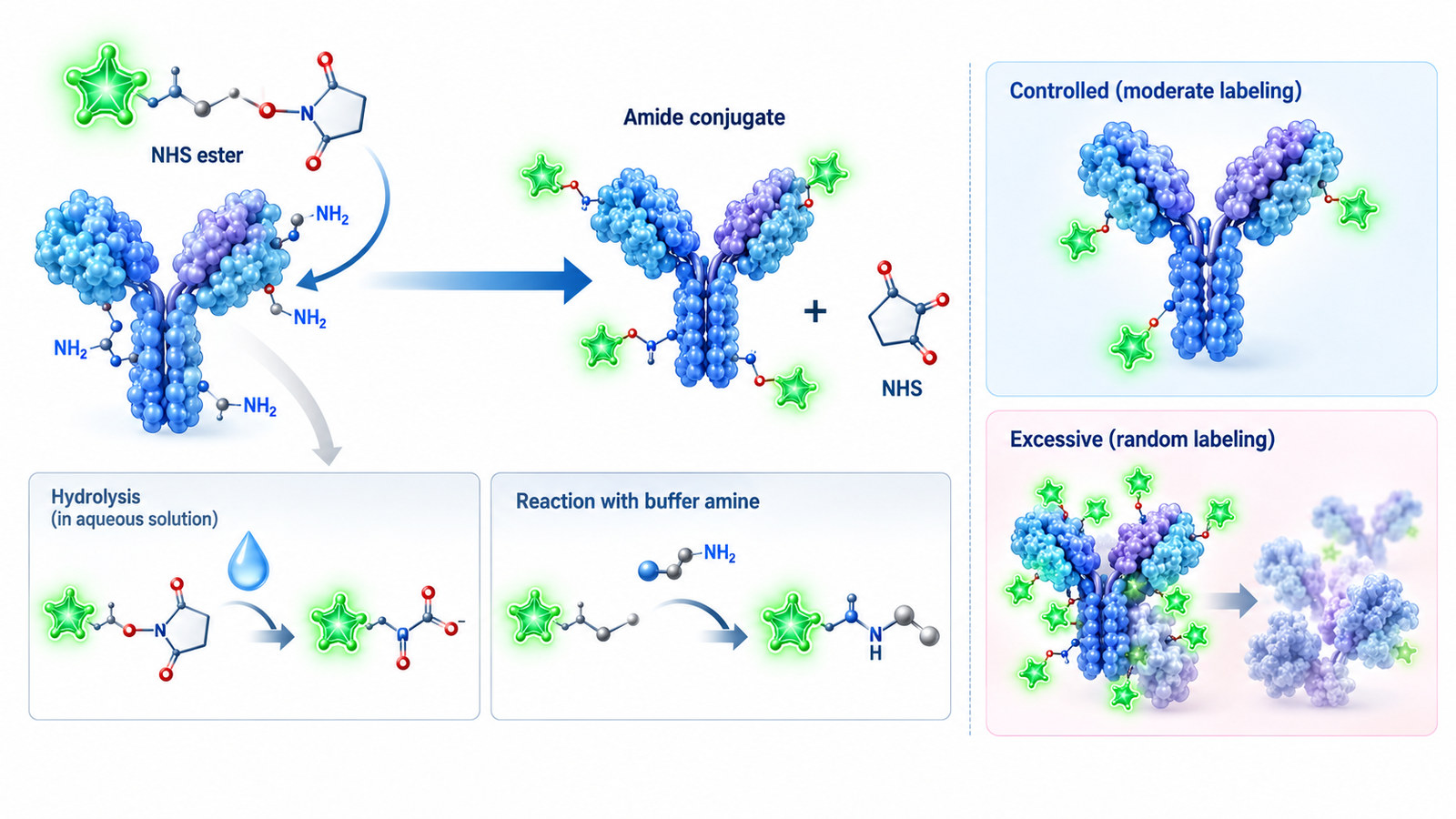 NHS ester conjugation couples an activated ester to an accessible primary amine while reaction design balances aminolysis, competing hydrolysis, and labeling-density control.
The key requirement for direct NHS ester conjugation is an accessible primary amine. The amine may occur naturally, as with lysine residues and protein N-termini, or it may be installed synthetically to create a defined attachment point. Secondary amines, alcohols, and unmodified carboxyl groups are not equivalent substitutes for the primary-amine handle under standard NHS ester labeling conditions.
| Molecule Class | Relevant Reactive Handle | Typical NHS Ester Partner | Key Design Considerations | Typical Research Use |
| Proteins | Lysine ε-amines and N-terminal α-amine | Dye-NHS, biotin-NHS, PEG-NHS, linker-NHS, reporter-NHS | Number and accessibility of lysines, protein stability, labeling density, aggregation, activity retention | Protein labeling, affinity reagents, assay probes, linker installation |
| Antibodies | Surface-accessible lysines and polypeptide N-termini | Fluorophore-NHS, biotin-NHS, heterobifunctional NHS linkers | Binding-site proximity, label-to-antibody ratio, charge shift, solubility, free-label removal | Immunoassay research, imaging reagents, detection probes, secondary conjugation |
| Peptides | N-terminal amine, lysine side chain, introduced amino linker | Dye-NHS, biotin-NHS, PEG-NHS, small-molecule NHS ester | Number of amines, regioselectivity, protecting-group history, peptide solubility, HPLC separation | Probe preparation, affinity studies, fluorescent peptide reagents |
| Oligonucleotides | 5′-, 3′-, or internal amino modifier | Dye-NHS, biotin-NHS, linker-NHS, small-molecule NHS ester | Spacer accessibility, reagent hydrophobicity, nucleic-acid integrity, chromatographic purification | Hybridization probes, affinity capture reagents, multifunctional oligonucleotides |
| Small Molecules | Primary aliphatic amine | Activated dye, linker, PEG, tag, or other NHS ester intermediate | Competing nucleophiles, solvent compatibility, reaction stoichiometry, chromatographic resolution | Tagged ligands, probe intermediates, bifunctional research molecules |
| Polymers | Terminal or pendant primary amines | NHS-activated labels, biomolecules, or heterobifunctional linkers | Amine density, polymer dispersity, accessibility, solubility, excess reagent removal | Functional polymer conjugates and biomolecule presentation |
| Particles & Beads | Amine-functionalized particle or bead surface | NHS-functional dye, linker, PEG, or other activated ligand | Surface density, colloidal stability, nonspecific adsorption, separation method | Affinity capture, assay particles, functionalized research materials |
| Surfaces | Surface-accessible primary amino groups | NHS-activated biomolecule or linker | Surface coverage, orientation, steric accessibility, residual reactive groups | Immobilization and surface-functionalization studies |
NHS ester chemistry is most useful when the target already contains accessible primary amines or can be equipped with an amino handle without disrupting its intended function. It is especially attractive for research programs that prioritize a direct, well-established coupling route and can tolerate some distribution of labeling sites.
Choose NHS ester chemistry when a protein or antibody contains accessible lysines and a controlled but not strictly site-specific labeling pattern is acceptable.
Amino-modified peptides and oligonucleotides can provide a predetermined reaction handle, making NHS ester chemistry useful for installing dyes, tags, linkers, or small molecules at designed positions.
Many commercially available fluorophores, affinity tags, and spacer reagents are supplied as NHS esters, making the chemistry convenient for preparation of labeled research reagents.
NHS-containing heterobifunctional linkers can first modify an amine-bearing molecule and introduce a maleimide, azide, alkyne, DBCO, or other handle for a second conjugation step.
NHS ester coupling can often be performed without harsh activation conditions, provided the target is stable in the selected pH range and any required organic co-solvent is compatible with the molecule.
Once molar ratio, buffer, reaction time, purification, and acceptance criteria are defined, the workflow can be transferred to repeat batches with controlled process parameters.
NHS ester chemistry may be less appropriate when a project requires a single predetermined conjugation site, when critical lysines must remain unmodified, when the target cannot tolerate the required reaction environment, or when the NHS ester reagent is too hydrophobic to use without destabilizing the biomolecule.
Chemistry selection should be based on the functional groups already present on the target, the degree of site control required, acceptable preprocessing, linker requirements, and the analytical definition needed for the final conjugate. NHS ester chemistry is not automatically preferable to thiol-, carboxyl-, or click-based approaches; each route solves a different conjugation problem.
| Method | Primary Reactive Handles | Site Control | Main Advantages | Important Limitations | When It Fits Best |
| NHS Ester | Primary amines | Usually distributed across accessible amines unless a unique amino handle is introduced | Direct reaction, broad reagent availability, stable amide product, suitable for many biomolecule classes | Hydrolysis competes with coupling; multiple lysines can create heterogeneous products; amine-containing buffers interfere | Routine protein labeling, amino-modified oligos or peptides, tag and linker installation |
| Maleimide–Thiol | Free thiols, commonly cysteine | Potentially higher when a unique or engineered cysteine is available | Useful for cysteine-directed labeling and lower site multiplicity than lysine chemistry in many proteins | Requires accessible reduced thiol; thiol oxidation and maleimide linkage behavior must be considered | Projects needing cysteine-directed modification or improved positional control |
| EDC/NHS Coupling | Carboxyl group on one molecule and primary amine on another | Depends on number and accessibility of carboxyl and amine groups | Allows direct connection of naturally occurring carboxyl and amine functionalities without retaining a large linker | Carboxyl activation must be controlled; side reactions and crosslinking can occur in multifunctional molecules | Carboxyl-to-amine coupling when a pre-activated NHS ester reagent is not available |
| SPAAC Click | Azide and strained alkyne such as DBCO/BCN | High once orthogonal handles are installed at defined positions | Bioorthogonal reaction pair, useful for modular and site-controlled assembly | Requires prior installation of complementary handles and can add linker size and synthetic steps | Projects where selectivity and modular assembly outweigh the additional handle-installation step |
| CuAAC Click | Azide and terminal alkyne | High once handles are positioned | Strong chemoselectivity and versatile linker design | Requires copper catalyst and careful compatibility assessment for sensitive biomolecules | Defined synthetic constructs and systems compatible with copper-catalyzed conditions |
For projects where site distribution is the main concern, our team can evaluate whether maleimide conjugation, click chemistry, or another site-specific protein labeling strategy is more appropriate than conventional lysine-directed NHS ester coupling.
Our workflow connects chemistry selection with purification and characterization so reaction success is evaluated in the context of the final research objective rather than by reagent consumption alone.


We review the target molecule, concentration, current buffer, available primary amines, reagent or payload structure, desired modification level, downstream use, and required analytical outputs. This identifies potential incompatibilities before material is committed.

NHS ester type, linker architecture, reagent solubility, reaction buffer, target concentration, molar ratio, pH window, addition sequence, and quenching strategy are selected according to the molecule and intended conjugate.

Interfering components are removed where necessary, fresh NHS ester reagent is prepared under conditions appropriate to its solubility, and conjugation is performed using controlled stoichiometry. For sensitive projects, multiple ratios or reaction conditions can be compared.

Unreacted reagent, hydrolysis products, quencher, and low-molecular-weight impurities are removed using a method matched to the conjugate, such as desalting, size exclusion, dialysis, ultrafiltration, or preparative chromatography.

Appropriate analytical methods are selected to verify conjugation, labeling ratio or mass shift, purity, aggregation state, molecular integrity, and other project-specific characteristics. Functional testing can be incorporated when conjugation may affect biological recognition or activity.

Final conjugates are supplied with the agreed data package and handling information. Optimized reaction parameters can also support repeat preparation, comparative batches, or further integration into multistep conjugation workflows.
A successful NHS ester reaction does not automatically mean the resulting material is ready for downstream work. Free dye or linker can raise assay background, hydrolyzed reagent can complicate analysis, excessive labeling can promote aggregation, and heterogeneous substitution can make a bulk concentration value misleading. Purification and characterization are therefore selected together with the conjugation strategy.
| Stage / Question | Example Method | What It Evaluates | When It Is Useful |
| Free Reagent Removal | Desalting or size-exclusion chromatography | Separates larger biomolecule conjugates from unreacted label, NHS, salts, and other low-molecular-weight species | Common for proteins and antibodies labeled with dyes, biotin, or small linkers |
| Buffer Exchange | Dialysis or ultrafiltration | Removes small components and places the conjugate into a downstream-compatible buffer | Useful when molecular size, volume, or subsequent assay conditions make column desalting less suitable |
| High-Resolution Purification | RP-HPLC, ion-exchange, SEC, or other project-specific chromatography | Separates conjugate from unmodified material, excess reagent, side products, or different modification states | Especially useful for peptides, oligonucleotides, smaller conjugates, and systems needing higher compositional resolution |
| Labeling Ratio | UV-Vis or label-specific spectroscopic analysis | Estimates average label-to-biomolecule ratio when the label has suitable optical properties | Fluorescent protein, antibody, and other chromophore-containing conjugates |
| Identity / Mass Shift | LC-MS, intact mass, MALDI-TOF, or suitable mass analysis | Confirms molecular mass or conjugation-associated mass change | Peptides, oligonucleotides, proteins, and other constructs compatible with mass analysis |
| Purity / Integrity | HPLC, UPLC, SDS-PAGE, CE, or related methods | Assesses major impurities, fragmentation, unmodified material, or overall sample integrity | Selected according to molecule class and required resolution |
| Aggregation State | SEC-HPLC or related size-based analysis | Evaluates monomeric material and higher-molecular-weight species after conjugation | Important for antibodies and proteins where hydrophobic labels or high substitution can affect colloidal behavior |
| Functional Retention | Binding, enzyme, hybridization, or other project-specific functional assay | Determines whether the labeled molecule still performs its intended recognition or biochemical role | Recommended when lysine modification, labeling density, or linker position may influence function |
The analytical panel is selected according to the molecule and decision required. Not every project needs every method; for example, a small amino-modified peptide and a fluorescent antibody generally require different purification and characterization strategies.
NHS ester coupling requires enough non-protonated primary amine to support nucleophilic reaction, which is why mildly alkaline conditions are commonly used. At the same time, increasing pH accelerates NHS ester hydrolysis. The practical reaction window must therefore balance amine reactivity, hydrolysis rate, and biomolecule stability. Phosphate, bicarbonate, HEPES, borate, or another compatible non-amine buffer may be considered according to the molecule and reagent.
Moisture and prolonged exposure to aqueous solution reduce active NHS ester content. Reagent stocks are therefore prepared close to use, and hydrophobic NHS esters may require an anhydrous organic solvent such as DMSO or DMF before controlled addition to the aqueous biomolecule solution. Organic-solvent tolerance must be considered separately for sensitive proteins and other macromolecules.
Reagent-to-target ratio is a major control point. Too little reagent can produce insufficient modification, whereas excessive reagent may generate broad substitution distributions, increase hydrophobicity, alter charge, or compromise molecular function. Screening several ratios can be more informative than relying on a single theoretical input ratio.
The number of amines in a sequence does not equal the number that will react. Surface exposure, local structure, neighboring residues, pKa environment, steric effects, and reagent size influence accessibility. For antibodies and proteins, this is one reason conventional NHS ester labeling typically produces a population of related conjugate species rather than a single defined isomer.
Fluorophores, hydrophobic payloads, long linkers, and some polymers can change the solubility profile of a biomolecule after conjugation. Reaction concentration, co-solvent level, linker design, modification density, ionic strength, and purification conditions may all need adjustment to reduce precipitation or aggregation.
Random lysine labeling is appropriate for many research reagents but is not equivalent to site-specific conjugation. If modification of a functionally important lysine is unacceptable, or if a narrow positional distribution is necessary for mechanistic studies, a cysteine-directed, engineered-handle, enzymatic, or click-based method may be preferable. Our broader chemical crosslinking services can support alternative strategy evaluation.
NHS ester chemistry is accessible, but reliable conjugate preparation depends on matching the reaction and analytical strategy to the actual molecule. Our service model focuses on project-specific chemistry decisions, practical purification, and data that help research teams evaluate whether a conjugate should advance.
We evaluate whether NHS ester chemistry fits the available reactive handles, desired site control, molecular stability, and downstream application instead of applying the same protocol to every substrate.

Molar ratio, reaction concentration, pH, linker properties, and labeling time are considered together to achieve useful modification while reducing unnecessary over-labeling and function loss.
Purification is matched to molecular size, label properties, conjugate hydrophobicity, and the separation challenge rather than relying on a single generic cleanup method.
Characterization is selected around the question the project must answer—such as labeling ratio, conjugate identity, free-label removal, aggregation, purity, or retained function—so the resulting data are directly useful for downstream decisions.
Whether you need to label a protein with a fluorophore, biotinylate an antibody, functionalize an amino-modified oligonucleotide, install a secondary click or thiol-reactive handle, or troubleshoot an existing NHS ester workflow, BOC Sciences can develop a conjugation plan around your molecule and downstream research requirements.
To begin a feasibility review, provide the target molecule or sequence, molecular weight where available, current buffer and concentration, NHS ester reagent or desired label, preferred modification level, required quantity, downstream application, and any analytical requirements. Contact our scientific team to discuss your NHS ester conjugation project and request a project-specific proposal.
NHS esters primarily react with accessible primary amines. Common examples include lysine ε-amines and N-terminal α-amines in proteins, as well as purpose-installed amino groups on peptides, oligonucleotides, polymers, particles, or small molecules.
Neutral-to-mildly alkaline conditions are generally used because the reactive form of the primary amine must be sufficiently available for coupling. A range around pH 7.2-8.5 is commonly considered, but the optimal value depends on substrate stability, reagent reactivity, concentration, and hydrolysis rate. NHS ester hydrolysis becomes faster as pH increases.
Tris, glycine, ethanolamine, and other compounds containing accessible primary amines can compete with the intended biomolecule for the NHS ester. Samples formulated in these components may therefore require buffer exchange before conjugation.
Conventional NHS ester labeling of proteins is generally not site-specific because multiple accessible lysines and N-terminal amines may react. A defined amino modifier on an oligonucleotide or synthetic peptide can provide better positional control. For proteins requiring a predetermined attachment site, cysteine-directed, engineered-handle, enzymatic, or click-based strategies may be more suitable.
Both use essentially the same amine-reactive chemistry. Sulfo-NHS-containing reagents include a sulfonate group that generally improves aqueous solubility, which can be helpful when minimizing organic co-solvent is important.