Fit-for-Purpose Analytical StrategyIdentity, Loading & Heterogeneity AssessmentOrthogonal Characterization for Complex Conjugates
Bioconjugate development often reaches a point where reaction completion is no longer the main question: teams need to know whether the intended conjugate was formed, how pure and homogeneous it is, how much partner is attached, where attachment occurred, and whether aggregation or instability has been introduced. BOC Sciences provides project-specific bioconjugate characterization services that combine orthogonal analytical approaches around the attributes that matter for each construct. Support can be tailored to antibody, protein, peptide, oligonucleotide, small-molecule, polymer, and selected particle-based conjugates, including new conjugation programs, troubleshooting studies, method transfer situations, scale-change comparisons, and projects in which an existing analytical method does not adequately resolve product identity, loading, heterogeneity, or site occupancy.
A useful characterization package should be built around the structural and functional questions of the project rather than a fixed list of instruments. We evaluate the conjugate architecture, conjugation partner, chemistry, expected loading, purification status, and downstream decision before selecting an analytical combination.
 Identity Confirmation
We assess whether the expected conjugate has formed and whether the observed molecular profile is consistent with the proposed construct.
Deliverables can include interpreted mass profiles, comparison with expected structures, and recommendations for additional confirmation when the product remains analytically ambiguous.
 Purity Profiling
We evaluate whether the desired conjugate can be distinguished from unreacted starting material, free conjugation partner, fragments, aggregates, and other product-related populations.
Purity assessment can be coordinated with purification troubleshooting when poor separation prevents reliable characterization.
 Loading Analysis
We characterize how much conjugation partner is attached and, where the analytical system allows, how loading is distributed across the product population.
For antibody-focused projects, our analytical planning can also be aligned with the considerations described in our antibody conjugate characterization guide.
 Site Occupancy Mapping
For site-selective or site-specific constructs, average loading alone may not establish whether the intended reactive position was modified.
Site analysis is particularly useful when a nominally site-specific reaction gives unexpected loading, activity loss, or batch-to-batch variation.
 Heterogeneity Assessment
Bioconjugation can create multiple product populations even when the average conjugation ratio appears acceptable. We evaluate the forms of heterogeneity most relevant to the construct.
The goal is to distinguish a chemically successful reaction from a product population that remains too heterogeneous for the intended research workflow.
 Aggregation Assessment
Conjugation can change hydrophobicity, charge, molecular size, and intermolecular interactions, leading to aggregation or loss of soluble material.
Results can help determine whether aggregation is linked to loading level, linker or payload properties, reaction conditions, purification, or formulation environment.
A common characterization problem is not the absence of data, but the inability of existing data to distinguish the desired conjugate from competing molecular populations. A single UV spectrum, gel band, mass shift, or chromatography peak may confirm that something changed after conjugation without explaining loading distribution, residual free component, site occupancy, aggregation, or the source of an unexpected activity change. Our characterization strategy is therefore built around the decision the data must support.
An observed signal shift may be consistent with conjugation but not sufficient to distinguish covalent product from residual reagent, non-covalent association, adducts, or partially modified material. We select structural confirmation methods that match the molecular size and complexity of the conjugate.
Average loading values can hide broad distributions of unmodified, under-loaded, target-loaded, and over-loaded species. We determine whether population-level resolution is needed in addition to an average DAR, DOL, or substitution value.
Site-selective chemistry does not automatically demonstrate complete or exclusive modification of the intended position. We use site-focused analysis when occupancy, off-target modification, or accessible-handle fraction is important to the project.
Hydrophobic payloads, high loading, altered charge, crosslinking, or unfavorable purification conditions can create high-molecular-weight species. Aggregate profiling helps separate a reaction-efficiency problem from a product-stability problem.
Free dye, linker, drug-like small molecule, oligonucleotide, peptide, or other conjugation partner can distort loading measurements and downstream readouts. We assess whether cleanup is adequate before interpreting the final conjugate.
Complex conjugates may produce different conclusions by UV, chromatography, MS, gels, or light scattering. We investigate whether buffer effects, sample preparation, solubility, ionization, spectral overlap, or unresolved populations explain the discrepancy.
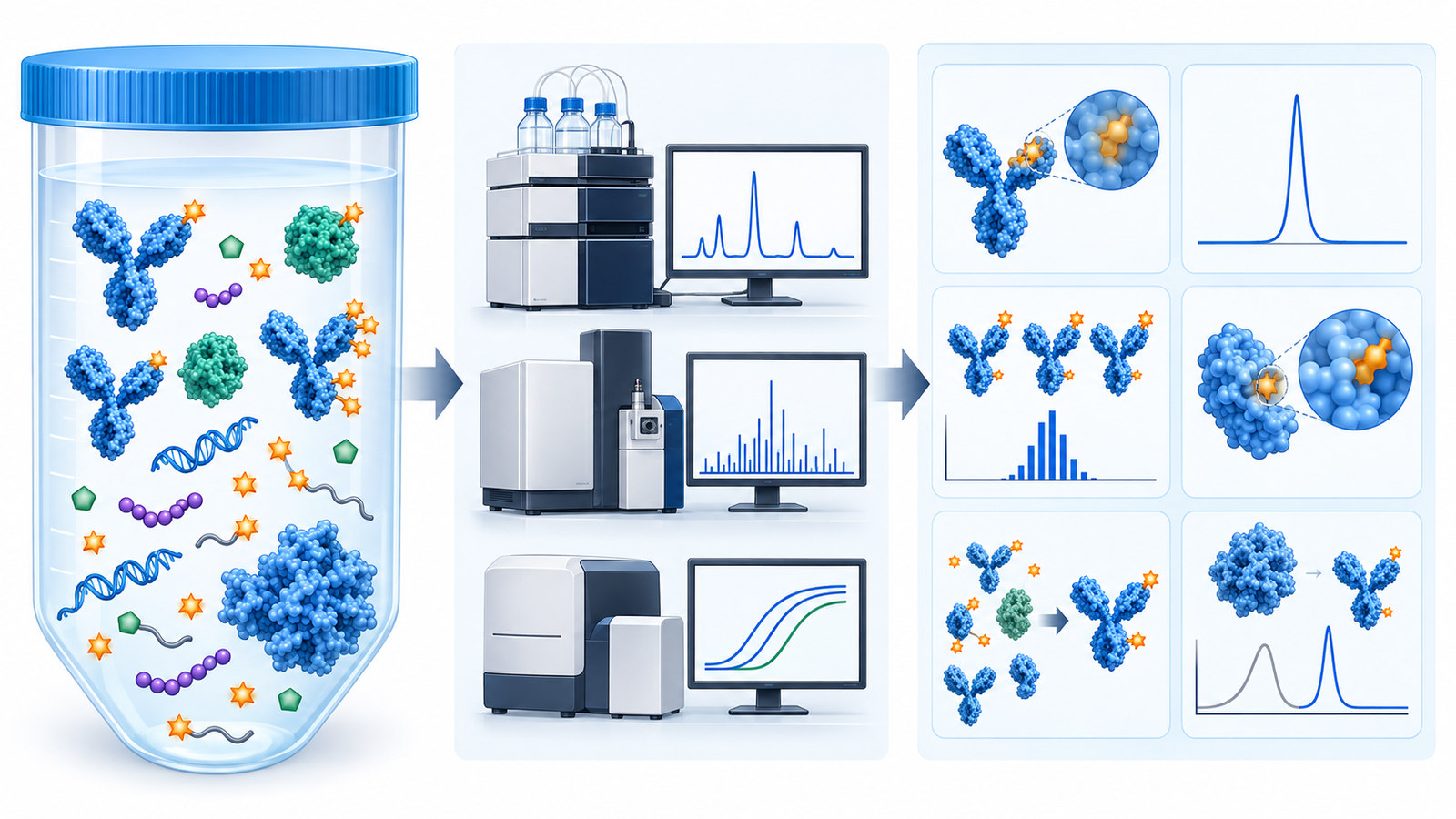 Integrated characterization helps separate intended bioconjugate from free components, heterogeneous loading populations, off-target species, and aggregates.
The most useful analytical package depends on what must be learned about the conjugate. The matrix below links common characterization attributes with the project decisions they support and illustrates how the analytical approach can change according to molecular architecture.
| Parameter / Attribute | Why It Matters | What We Evaluate | Potential Characterization Approach |
| Identity | Confirms that the expected covalent construct was formed rather than only showing disappearance of starting material. | Expected mass, component connectivity, characteristic modification, comparison with unconjugated material. | Intact or component LC-MS, reduced/subunit analysis, peptide mapping, oligonucleotide MS, chromatography, or complementary structural methods where appropriate. |
| Purity | Free starting material and side populations can interfere with functional studies and quantitative loading measurements. | Main conjugate population, unreacted biomolecule, fragments, residual conjugation partner, and process-related side species. | SEC, RP-HPLC/UPLC, HIC, IEX, CE, gel-based approaches, or other separation methods selected by molecule properties. |
| Conjugate Loading | Payload or label number can alter solubility, binding, signal, hydrophobicity, and product distribution. | Average DAR, DOL, ligand ratio, oligonucleotide ratio, degree of substitution, or equivalent construct-specific metric. | UV-Vis or fluorescence ratio analysis, HIC/RP methods, intact mass, compositional analysis, or orthogonal combinations. |
| Loading Distribution | An acceptable average value can conceal substantial under- or over-conjugated populations. | Relative populations with different substitution levels and whether a broad distribution is intrinsic to the chemistry. | HIC, RP-HPLC, LC-MS, CE, or other population-resolving methods depending on conjugate class. |
| Site Occupancy | Important when the conjugation strategy is designed to modify a defined residue, tag, terminus, or engineered handle. | Intended modification sites, unoccupied sites, and relevant off-target modifications. | LC-MS/MS peptide mapping, subunit analysis, site-focused chromatographic workflows, or targeted component analysis. |
| Aggregation & Size Variants | Conjugation or purification can shift molecular association behavior even when chemical conversion is high. | Monomer, oligomer, higher-molecular-weight species, fragments, hydrodynamic-size change, and polydispersity where relevant. | SEC, SEC-MALS, DLS, electrophoretic methods, and comparative stress or storage studies. |
| Charge / Hydrophobicity Shift | Modification can create new populations that are poorly resolved by size-based methods alone. | Charge variants, hydrophobicity-related species, and conjugation-dependent profile changes. | IEX, cIEF or other charge-sensitive methods, HIC, and RP chromatography where compatible. |
| Linkage Integrity | An initially correct conjugate may change during handling, storage, or exposure to the intended experimental environment. | Loss of conjugation partner, hydrolysis, exchange reactions, degradation, and changes in loading distribution. | Time-course LC-MS or chromatography, loading analysis, free-component assessment, and selected stress comparisons. |
| Functional Retention | Structural confirmation alone does not establish that the conjugated biomolecule still performs its intended research function. | Binding, enzymatic activity, fluorescence behavior, hybridization, capture performance, or another project-specific readout. | Application-matched functional testing interpreted together with structural and physicochemical characterization. |
Analytical requirements change substantially with molecular size, conjugation partner, charge, hydrophobicity, and expected heterogeneity. We therefore define the characterization panel around the actual construct rather than applying the same methods to every bioconjugate.
| Molecule / Conjugate Type | Typical Characterization Questions | Common Analytical Focus | Important Development Considerations |
| Antibody Conjugates | What is the DAR/DOL/OAR? Are multiple loading species present? Has aggregation or site distribution changed? | Loading and distribution, intact/subunit identity, SEC profile, free partner, site occupancy, binding retention. | Glycoform complexity, random versus site-specific chemistry, hydrophobic payloads, chain-level modification, and preservation of binding. |
| Protein Conjugates | Is the expected modification present and how much partner is attached without compromising protein integrity? | Mass shift, degree of substitution, purity, aggregation, charge change, and functional activity. | Protein molecular weight, oligomeric state, reactive-site accessibility, buffer compatibility, and sensitivity to denaturation. |
| Peptide Conjugates | Was the correct peptide species formed and are positional or reaction-related impurities present? | LC-MS identity, chromatographic purity, linker or payload integrity, stoichiometry, and degradation products. | Closely related impurities, hydrophobicity shifts, positional isomers, oxidation, and conjugation-site definition. |
| Oligonucleotide Conjugates | Is the oligonucleotide intact, correctly modified, and separated from unconjugated sequence or free partner? | LC-MS, chromatographic or electrophoretic purity, conjugate ratio, hybridization-relevant integrity, and residual free component. | Multiple charge states, salt adducts, sequence length, secondary structure, hydrophobic conjugation partners, and mobile-phase compatibility. |
| Hybrid Biomolecule Conjugates | Can both molecular components and their intended connectivity be demonstrated? | Protein–oligonucleotide, peptide–oligonucleotide, protein–peptide, and other mixed biomolecule constructs may require orthogonal component-specific methods. | The two components can have very different solubility, charge, detection response, ionization, and chromatographic behavior. |
| Polymer & PEG Conjugates | How much polymer is attached, how broad is the molecular distribution, and has conjugation changed aggregation behavior? | Degree of substitution, mass or molecular-size distribution, free polymer, SEC profile, and physicochemical change. | Polymer dispersity can make discrete mass interpretation difficult and may require complementary chromatographic or light-scattering data. |
| Nanoparticle / Liposome Conjugates | Was surface functionalization achieved and does the final particle remain physically stable? | Ligand loading, residual free ligand, hydrodynamic size, polydispersity, surface-property change, and application-specific binding. | Analytical strategy must distinguish covalent or stable surface association from adsorption and particle aggregation. |
Characterization is most informative when several complementary analytical dimensions are planned together. The relative importance of each dimension depends on the conjugate architecture and the decision the project must make.
We first determine what level of structural confirmation is required. Smaller or relatively homogeneous conjugates may be addressed by direct mass analysis, while complex proteins and antibodies may benefit from intact, subunit, reduced, or peptide-level approaches. Hybrid constructs may require separate confirmation of both components.
Separation is selected according to the physical difference between desired product and impurities. Size-based separation can reveal aggregates and fragments, while hydrophobicity-, charge-, polarity-, or sequence-sensitive methods may be needed to resolve loading variants and unconjugated material.
We distinguish between average loading and population distribution. A rapid spectroscopic ratio can be useful for some labeled constructs, whereas heterogeneous antibody or multivalent conjugates may require chromatography or mass-based analysis to show individual loading populations.
Site occupancy becomes a priority when the project uses an engineered residue, terminal modification, enzymatic tag, glycan-directed handle, or another defined conjugation position. Site-focused LC-MS workflows can help identify incomplete occupancy or modification outside the intended region.
Aggregation assessment is incorporated when the carrier is a protein, antibody, polymeric conjugate, particle, or another architecture sensitive to intermolecular association. Measurements are interpreted alongside loading and formulation variables because high loading can itself shift aggregation behavior.
We evaluate whether broad product profiles arise from different loading numbers, positional isomers, charge variants, size variants, incomplete reaction, or degradation. Orthogonal methods are introduced when one separation mode cannot distinguish these possibilities.
Characterization strategy is selected from the project variables that determine analytical behavior. These variables are reviewed before experimental work so that sample preparation, purification status, detection method, and data interpretation are compatible with one another.
| Project Variable | Why It Changes the Strategy | Characterization Decision |
| Molecule | Antibodies, proteins, peptides, oligonucleotides, polymers, and particles differ in size, ionization, separation behavior, and structural complexity. | Select molecule-compatible sample preparation and combine mass, chromatography, electrophoresis, spectroscopy, or biophysical methods as needed. |
| Conjugation Partner | Dyes, small molecules, peptides, oligonucleotides, enzymes, polymers, and particles contribute different mass, absorbance, charge, and hydrophobicity changes. | Choose readouts that distinguish the partner from the carrier and allow residual free component to be assessed. |
| Conjugation Chemistry | Random amine chemistry, thiol chemistry, click reactions, carbonyl coupling, and enzymatic methods generate different expected sites and side populations. | Match identity and site-analysis depth to the expected reaction selectivity and potential side reactions. |
| Conjugation Site | A random lysine conjugate requires different interpretation from a defined cysteine, terminal handle, glycan, or engineered tag. | Determine whether average loading is sufficient or whether peptide-level site confirmation and occupancy analysis are needed. |
| Target Loading | Higher substitution can increase hydrophobicity, alter charge, broaden population distribution, or create aggregation. | Combine average loading with distribution and aggregation analysis when the loading range can affect product behavior. |
| Solubility & Stability | Some conjugates are sensitive to organic solvent, salt, pH, temperature, concentration, or surface adsorption during analysis. | Adapt dilution, desalting, mobile-phase exposure, concentration, and sample-handling conditions to reduce analytical artifacts. |
| Purification Status | Free partner or residual reagent can distort UV ratios, fluorescence, MS spectra, and apparent loading. | Assess whether additional cleanup or fraction comparison is required before quantitative interpretation. |
| Analytical Requirement | Confirmation of conjugation, troubleshooting, lot comparison, site analysis, and stability assessment require different analytical depth. | Build a focused panel that answers the current development question rather than collecting redundant data. |
| Available Material | Some analytical approaches consume more sample or require concentration ranges that may not be practical for early screening constructs. | Prioritize high-information measurements and stage deeper analysis after feasibility is established. |
| Scale / Batch Comparison | Changes in scale, purification, reagent lot, or reaction setup can alter loading and product distributions. | Use the same core attribute panel across samples to compare identity, loading, purity, heterogeneity, and aggregation consistently. |
Characterization should be planned with the conjugation chemistry because reaction selectivity determines which attributes are most informative. We use the expected chemistry, reactive group, and product architecture to decide whether the emphasis should be on average loading, distribution, site occupancy, residual reagent, or linkage integrity.
Random amine modification can generate broad loading and positional distributions. Characterization commonly emphasizes average DOL or payload ratio, population heterogeneity, aggregation, and functional retention. See our NHS ester conjugation resource for related chemistry considerations.
Carbodiimide-mediated coupling can require careful interpretation of reaction conversion, crosslinking, and residual starting material. Characterization is selected according to whether a defined small-molecule conjugate or a more heterogeneous biomolecule-to-biomolecule product is expected. Related considerations are discussed in our amine-reactive conjugation resource.
Analysis can focus on thiol accessibility, expected loading, distribution, aggregate formation, and linkage behavior over time. For antibody and protein constructs, reduced or subunit analysis may help localize modification. Learn more about maleimide conjugation resource.
Copper-free click conjugates may require confirmation of handle conversion, triazole-linked product identity, residual DBCO/BCN-containing component, and loading distribution. Analytical planning can be coordinated with SPAAC conjugation workflows.
Characterization typically focuses on expected click-product formation, starting-material removal, loading, and product integrity after reaction and cleanup. The specific analytical approach depends on whether the partners are peptides, proteins, oligonucleotides, or small molecules.
Fast bioorthogonal coupling can still generate analytical complexity when multiple reactive handles or large conjugation partners are present. We evaluate product identity, conversion, loading, and remaining unconjugated components in the context of the selected tetrazine ligation design.
Aldehyde- or ketone-directed conjugation may require confirmation of the intended carbonyl-derived linkage together with assessment of unreacted carrier, unreacted partner, side products, and changes introduced during oxidation or carbonyl-generation steps.
Enzyme-directed modification is often selected for improved site control, making occupancy and intended-site confirmation particularly important. Analytical strategy can be integrated with our enzymatic crosslinking services.
The workflow begins with the analytical question rather than the instrument. This helps avoid generating data that cannot distinguish the product attributes responsible for the development problem.


We review the carrier molecule, conjugation partner, expected structure, chemistry, current purification status, available material, and the decision the analytical data must support. Existing chromatograms, spectra, or failed methods can be included in this assessment.

Identity, purity, loading, distribution, site occupancy, aggregation, stability, and functional retention are prioritized according to the construct. Attributes that will not change the project decision are not added simply to expand the data package.

We select complementary analytical modes based on molecular size, charge, hydrophobicity, spectral properties, expected heterogeneity, and sample constraints. Orthogonal methods are introduced where one measurement cannot resolve the required attribute.

Dilution, desalting, buffer compatibility, concentration, reduction, digestion, fractionation, or other preparation steps are adapted to the conjugate. Existing analytical methods can also be adjusted when peak shape, recovery, ionization, or resolution is inadequate.

Selected samples are evaluated across the agreed attributes. Results are interpreted together so that, for example, a high loading value can be assessed alongside population distribution, aggregation, and residual free component rather than in isolation.

We summarize what the analytical data establishes, identify unresolved questions or conflicting readouts, and provide practical recommendations for additional purification, conjugation optimization, method refinement, stability follow-up, or comparative testing where useful.
The value of characterization is determined by whether the selected methods answer the project questions with sufficient resolution and interpretability. Evaluation therefore focuses on attributes of the conjugate rather than on generating the largest possible number of analytical outputs.
Does the analytical evidence support the expected conjugate structure, and can the intended product be distinguished from starting materials, adducts, or alternative species?
Can the desired conjugate be resolved from free conjugation partner, unconjugated biomolecule, fragments, aggregates, and other major side populations?
Can the amount of attached partner be estimated or quantified in a way appropriate to the molecule, and is an average value sufficient for the intended decision?
Can important under-loaded, over-loaded, charge, size, positional, or other conjugate populations be distinguished rather than hidden within one broad analytical response?
For controlled conjugation designs, can modification at the intended site be demonstrated and incomplete or competing modification assessed at an appropriate analytical level?
Can conjugation-related changes in monomer content, high-molecular-weight species, or particle-size behavior be separated from chemical conversion and loading effects?
Characterization support is most useful when the next project decision depends on understanding the composition of the conjugate rather than simply confirming that a reaction was performed.
Use characterization when a gel shift, UV change, fluorescence signal, or reaction-conversion result suggests modification but does not establish the expected covalent product.
Use deeper analysis when the project needs to distinguish under-conjugated, target-loaded, and over-conjugated populations rather than relying on one average DAR or DOL value.
Site-selective and site-specific projects benefit from occupancy or conjugation-site analysis when successful chemistry alone does not prove modification occurred where intended.
Characterization can help determine whether aggregation correlates with loading, payload hydrophobicity, reaction conditions, purification, buffer exchange, concentration, or storage.
Use analytical support when free partner, unconjugated carrier, or closely related conjugate populations overlap and make it difficult to determine whether cleanup is sufficient.
A defined attribute panel can compare changes in identity, loading, purity, heterogeneity, and aggregation after reaction optimization, scale adjustment, purification changes, or repeat preparation.
Characterization begins with the question the project must answer. We prioritize identity, loading, purity, heterogeneity, site occupancy, aggregation, or stability according to the actual conjugate rather than applying the same panel to every sample.

Complex conjugates rarely yield their full story through one measurement. We combine complementary structural, chromatographic, physicochemical, and functional readouts when additional evidence is needed to distinguish competing interpretations.
Analytical strategy is adapted to antibodies, proteins, peptides, oligonucleotides, hybrid biomolecules, polymers, and selected particle systems, accounting for differences in mass, charge, solubility, heterogeneity, and detection behavior.
When characterization reveals low occupancy, excessive loading, aggregation, incomplete cleanup, or broad product distribution, findings can be connected back to conjugation chemistry, purification, linker design, or reaction-condition development.
To define a practical characterization strategy, share your molecule or conjugate type, conjugation partner, current chemistry or method if known, purification status, the analytical problem you are seeing, the attributes you need to understand, and the approximate project scale or available sample amount. Existing chromatograms, spectra, loading data, or functional results can also help identify where the current analytical approach is insufficient.
You do not need to have the final conjugation chemistry, purification method, or analytical strategy established before contacting us. BOC Sciences can review the current development status and help determine which identity, purity, loading, heterogeneity, site-occupancy, aggregation, stability, or function-related measurements are most useful for the next project decision. Contact our scientific team to discuss your bioconjugate characterization requirements.
Provide the carrier molecule, conjugation partner, expected construct, conjugation chemistry if known, current purification status, available sample amount, buffer or formulation, and the analytical question you need to answer. Existing spectra, chromatograms, loading measurements, or functional data are also useful when troubleshooting an established method.
Yes. The analytical strategy is adapted to the molecular class rather than using one universal panel. Antibody and protein conjugates may emphasize loading, aggregation, mass, and site distribution, while peptide and oligonucleotide conjugates often require different chromatographic, electrophoretic, and mass-spectrometric conditions. Hybrid constructs may require methods that evaluate both components independently and together.
Method selection considers molecule size, conjugation partner, chemistry, intended site, expected loading, heterogeneity, solubility, stability, purification status, available sample, and the decision the data must support. Orthogonal methods are used when a single measurement cannot distinguish identity, loading, purity, aggregation, or site occupancy reliably.
Yes. Existing methods can be reviewed when they show poor peak shape, insufficient separation, inconsistent recovery, difficult mass spectra, unresolved loading populations, or conflicting results between analytical techniques. Development may involve sample preparation, buffer compatibility, chromatographic conditions, detection mode, or an additional orthogonal method.
The appropriate measurement depends on the conjugate. Options may include corrected UV-Vis or fluorescence ratios, chromatography-based population profiling, intact or subunit mass analysis, or other composition-based approaches. For heterogeneous conjugates, both average loading and loading distribution may be important because the same average value can arise from very different product populations.