Successful antibody conjugation is not confirmed by reaction completion alone. A usable antibody conjugate must be characterized for conjugation ratio, purity, aggregation, free payload, identity, site occupancy, and retained biological function. This guide explains how to design a fit-for-purpose analytical package for antibody-drug conjugates, fluorescent antibodies, biotinylated antibodies, antibody-oligonucleotide conjugates, enzyme-labeled antibodies, PEG-antibody conjugates, and other custom antibody conjugates.
DAR measurementDOL analysisSEC and aggregationLC-MS confirmationpeptide mappingfunctional testing
Antibody conjugation changes a complex biomolecule. After conjugation, the product may contain unconjugated antibody, correctly conjugated antibody, over-labeled species, under-labeled species, aggregates, fragments, hydrolyzed linker, residual free payload, and side products. Characterization is the process of determining whether the conjugate is suitable for its intended use.
The analytical strategy depends on the conjugate type. An antibody-drug conjugate usually requires drug-to-antibody ratio, drug load distribution, purity, aggregation, linker stability, free payload analysis, and functional testing. A fluorescent antibody may require degree of labeling, spectral confirmation, background assessment, and binding retention. An antibody-oligonucleotide conjugate may require oligonucleotide-to-antibody ratio, free oligonucleotide removal, intact mass or subunit analysis, gel or chromatographic profiling, and assay performance testing.
No single analytical method answers every question. A strong characterization plan uses orthogonal methods that evaluate the conjugate from different angles: ratio, identity, purity, structure, and function.
Conjugation success is not only conversion
A reaction may consume starting material but still produce an unsuitable conjugate if the product aggregates, loses binding, contains free payload, or has an uncontrolled labeling distribution.
QC should match the final application
Early research conjugates may need a practical confirmation package, while ADCs and advanced assay reagents often need deeper structural and functional characterization.
Key Quality Attributes for Antibody Conjugates
Characterization begins by defining which quality attributes matter for the specific antibody conjugate. These attributes are not identical for every project, but most antibody conjugates require assessment of ratio, purity, aggregation, identity, and function.
Quality Attribute
What It Answers
Why It Matters
Common Readouts
Conjugation ratio
How many payloads are attached per antibody?
Ratio affects potency, signal intensity, hydrophobicity, aggregation, and assay reproducibility.
DAR, DOL, OAR, average payload number, distribution profile.
Purity
How much desired conjugate is present?
Unconjugated antibody, free payload, and side products can distort biological or assay results.
HPLC, SEC, electrophoresis, LC-MS, UV or fluorescence profile.
Aggregation
Does conjugation promote high-molecular-weight species?
Aggregates can affect stability, binding, formulation, and downstream interpretation.
SEC, SEC-MALS, DLS, stress studies.
Identity
Is the expected payload attached to the antibody?
Mass shift and structural confirmation help distinguish the intended product from side products.
Ratio measurement is one of the most important parts of antibody conjugate characterization. The correct term depends on the payload type. ADCs are usually described by drug-to-antibody ratio, or DAR. Fluorescent and biotinylated antibodies are often described by degree of labeling, or DOL. Antibody-oligonucleotide conjugates may be described by oligonucleotide-to-antibody ratio, or OAR.
Average ratio alone may not be sufficient. Two ADC samples can have the same average DAR but different distributions of DAR species. One may contain a narrow population centered around the target loading, while another may contain a mixture of underloaded and overloaded species. These differences can affect potency, hydrophobicity, aggregation, and pharmacokinetic behavior.
Ratio Type
Typical Conjugate
Useful Methods
Important Limitation
DAR
Antibody-drug conjugates
HIC, LC-MS, UV-visible analysis, reduced mass analysis.
Average DAR may hide distribution differences.
DOL
Fluorescent, biotinylated, or hapten-labeled antibodies
UV-visible spectroscopy, fluorescence analysis, LC-MS where feasible.
Dye absorbance correction and free dye removal are critical.
OAR
Antibody-oligonucleotide conjugates
Native or denaturing LC-MS, SEC-MS, gel analysis, UV-based methods.
Oligonucleotide mass, charge, and heterogeneity can complicate analysis.
Average payload number
PEG-antibody, enzyme-antibody, polymer-antibody, or nanoparticle-related conjugates
SEC, LC-MS when possible, UV or colorimetric methods, orthogonal biochemical assays.
Large or heterogeneous payloads may require indirect or application-specific readouts.
For ADCs
DAR measurement supports process optimization, product comparison, and biological interpretation. HIC and LC-MS are commonly used because they can provide ratio and distribution information when the method is compatible with the ADC.
For labeled antibodies
DOL should be interpreted with binding and background data. A higher label ratio may increase signal, but it can also increase nonspecific binding, quenching, or activity loss.
Purity, Free Payload, and Aggregation Analysis
Purity analysis determines whether the final antibody conjugate is separated from unreacted antibody, free payload, degraded linker, fragments, aggregates, and reaction byproducts. This step is especially important when the payload is cytotoxic, fluorescent, enzymatic, nucleic acid-based, highly hydrophobic, or strongly charged.
Size-exclusion chromatography is commonly used to evaluate monomer content and high-molecular-weight species. HPLC methods can help separate conjugate species, residual small molecules, and hydrophobic variants. Electrophoretic methods provide a useful orthogonal view, especially for antibody fragments, antibody-oligonucleotide conjugates, and conjugates where size or charge changes are informative.
Analytical Question
Useful Methods
What to Look For
Is the product aggregated?
SEC, SEC-MALS, DLS, stress stability studies.
High-molecular-weight species, monomer loss, aggregation after storage or freeze-thaw.
HPLC, LC-MS, UV-visible analysis, fluorescence scan, gel or membrane-based checks.
Residual dye, drug-linker, oligonucleotide, biotin reagent, or other payload.
Are fragments present?
SDS-PAGE, CE-SDS, reduced mass analysis, SEC.
Heavy chain, light chain, clipped antibody, degraded fragments.
Did purification change the product?
SEC before and after purification, ratio analysis, binding assay.
Loss of desired species, enrichment of aggregates, altered DAR or DOL distribution.
Mass-Based Confirmation of Antibody Conjugates
Mass spectrometry is one of the most informative tools for antibody conjugate characterization when the conjugate is compatible with the method. LC-MS workflows may be performed at the intact antibody level, reduced heavy-chain and light-chain level, subunit level, or peptide level. Each level answers a different question.
Intact mass analysis can confirm global mass shift and distribution. Reduced mass analysis can show whether the payload is on the heavy chain, light chain, or both. Subunit analysis can localize modification to larger antibody regions. Peptide mapping can support site-level confirmation, especially for site-specific conjugates and ADCs where positional information matters.
MS Level
What It Shows
Best Used For
Limitation
Intact mass
Overall mass distribution of the conjugate.
Confirming expected mass shift and broad conjugate profile.
May not identify exact attachment site in complex mixtures.
Reduced mass
Payload distribution between heavy and light chains.
Antibody conjugates where chain-level localization is useful.
May not resolve site isomers within the same chain.
Subunit analysis
Modification on Fab, Fc, or smaller antibody regions.
Glycan conjugates, engineered formats, and site-selective workflows.
Requires suitable digestion or fragmentation strategy.
Peptide mapping
Residue-level or near-residue-level localization.
Site-specific conjugation confirmation and off-target modification analysis.
Payload stability, digestion efficiency, and data interpretation can be challenging.
Bioanalytical LC-MS
Payload, catabolites, free drug, or conjugated species in biological matrices.
ADC stability, PK, and translational studies.
Requires method development matched to analyte and matrix.
LC-MS characterization can be designed at intact, reduced, subunit, or peptide levels depending on the structural question.
Site Occupancy and Conjugation Site Analysis
Site analysis is most important when the conjugation method is intended to be site-specific or site-selective. If a payload is designed to attach to an engineered cysteine, Fc glycan, enzymatic tag, terminal handle, or bioorthogonal site, the analytical package should confirm that modification occurred where expected.
Site occupancy analysis also helps troubleshoot unexpected activity loss. If a random lysine conjugation modifies a region near the antigen-binding site, binding may decrease. If a site-specific construct shows low occupancy, the handle may be poorly accessible, oxidized, sterically hindered, or incompatible with the selected linker-payload.
For random conjugates
Complete site mapping may not always be required, but understanding modification distribution can help explain activity loss, broad product profiles, or unexpected aggregation.
For site-specific conjugates
Site confirmation is often central to proving that the designed conjugation strategy produced the expected product rather than an off-target mixture.
Conjugation Type
Site Analysis Need
Useful Methods
Engineered cysteine conjugate
Confirm payload on engineered cysteine and check off-target thiol modification.
Reduced mass analysis, peptide mapping, intact/subunit LC-MS.
Glycan-based conjugate
Confirm Fc glycan modification and remodeling efficiency.
Structural confirmation does not prove functional suitability. An antibody conjugate may have the correct mass and ratio but still lose antigen binding, show high background, display poor assay signal, or fail in a cell-based workflow. Functional testing should therefore be selected according to the intended application.
Conjugate Type
Functional Question
Possible Assays
ADC
Does the ADC bind target and show intended biological activity?
The best analytical package depends on the conjugation chemistry, payload, antibody format, and application stage. The table below provides a practical method-selection overview.
Method
Primary Use
Best For
Limitations
UV-visible spectroscopy
Average label or drug ratio when payload has a suitable absorbance.
Dye-labeled antibodies, some ADCs, biotin or hapten workflows with compatible readouts.
Requires correction factors and clean removal of free payload.
Fluorescence analysis
Signal confirmation and dye behavior assessment.
Fluorescent antibody conjugates.
Can be affected by quenching, environment, and free dye contamination.
SEC
Size profile, monomer content, aggregation, and some purity questions.
Most antibody conjugates, especially aggregation-sensitive products.
May not resolve all conjugation ratio species.
HIC
DAR distribution and hydrophobic variant separation.
Many ADCs and hydrophobic payload conjugates.
Method compatibility depends on payload, antibody, and salt conditions.
RP-HPLC
Hydrophobic impurities, payload-related species, and some reduced/subunit workflows.
Requires method development and may be challenging for heterogeneous or very large payloads.
Peptide mapping
Site localization and off-target modification analysis.
Site-specific conjugates and troubleshooting activity loss.
Digestion and payload stability can complicate interpretation.
SDS-PAGE or CE-SDS
Chain integrity, fragments, conjugation shift, and orthogonal purity view.
Protein and antibody conjugates, antibody-oligo conjugates, enzyme conjugates.
Limited structural resolution compared with LC-MS.
Binding assay
Retention of antigen recognition.
All functional antibody conjugates.
Does not identify structural cause of failure.
Antibody conjugate characterization usually requires orthogonal methods that combine ratio, purity, mass, site, and function data.
Practical QC Planning Framework
A characterization plan should be built before the conjugation reaction begins. The payload, conjugation chemistry, purification method, and analytical methods should be compatible with one another.
Basic confirmation package
Conjugation ratio or degree of labeling.
Purity and aggregate assessment.
Removal of free payload or free label.
Binding or application-specific function check.
Advanced characterization package
Intact and reduced mass analysis.
Subunit or peptide-level site confirmation.
DAR or DOL distribution profiling.
Stability, stress, or serum incubation studies.
Functional potency or assay performance testing.
Step-by-Step QC Planning
Define the intended application. ADC, fluorescent antibody, biotinylated antibody, antibody-oligo conjugate, enzyme conjugate, and PEG-antibody products need different QC priorities.
Define the target ratio. Determine whether the project needs a narrow DAR, average DOL, defined OAR, or only qualitative confirmation.
Select purification before analysis. Free payload and reaction byproducts can distort ratio, signal, and functional results.
Use at least one purity method. SEC, HPLC, electrophoresis, or another suitable method should confirm that the product profile is acceptable.
Use mass analysis when structural confirmation is needed. LC-MS is especially useful for ADCs, engineered-site conjugates, and site-specific workflows.
Confirm function last, but plan it first. Functional testing should reflect the real downstream use of the conjugate.
Unexpected QC results often reveal problems in conjugation design, purification, reagent compatibility, or analytical method selection. The table below links common observations to likely causes and corrective directions.
Observation
Possible Cause
Method to Confirm
Corrective Direction
Low DAR or DOL
Poor reagent solubility, low handle accessibility, insufficient molar excess, or short reaction time.
Simplify sample, use orthogonal methods, improve purification, or redesign conjugation chemistry.
BOC Sciences Support for Antibody Conjugate Characterization
BOC Sciences supports custom antibody conjugation projects with fit-for-purpose analytical planning. Characterization can be integrated with conjugation development so that method selection, purification, ratio measurement, structural confirmation, and functional testing are aligned with the final application.
Conjugation ratio assessment
DAR, DOL, OAR, or average payload-number assessment for ADCs, fluorescent antibodies, antibody-oligonucleotide conjugates, biotinylated antibodies, and other antibody conjugates.
Purity and aggregation analysis
Evaluation of monomer content, high-molecular-weight species, unconjugated antibody, free payload, and product distribution using appropriate chromatographic or electrophoretic methods.
Mass and site confirmation
LC-MS-based assessment may include intact mass, reduced mass, subunit analysis, peptide mapping, or site-occupancy analysis depending on the conjugate type.
Function-oriented testing
Binding, signal, enzymatic, hybridization, or cell-based readouts can be selected according to the intended use of the antibody conjugate.
Need Characterization Support for an Antibody Conjugate?
Share your antibody format, payload type, conjugation chemistry, target DAR or DOL, purification status, available material amount, and intended application. BOC Sciences can help design a practical characterization package for custom antibody conjugates, from basic ratio and purity checks to advanced mass and site analysis.
DAR, DOL, OAR, and payload-ratio assessment
Purity, aggregation, and free-payload analysis
LC-MS, subunit, and peptide-level characterization support
Binding, signal, enzymatic, hybridization, or cell-based functional testing
DAR can be measured using methods such as hydrophobic interaction chromatography, LC-MS, UV-visible analysis, intact or reduced mass analysis, and other orthogonal approaches. The best method depends on the ADC structure, linker-payload chemistry, and whether average DAR or DAR distribution is required.
What is the difference between DAR and DOL?
DAR means drug-to-antibody ratio and is commonly used for ADCs. DOL means degree of labeling and is often used for fluorescent, biotinylated, or other labeled antibodies. Both describe how many payloads are attached per antibody, but the terminology depends on the payload and application.
How do I confirm site-specific antibody conjugation?
Site-specific conjugation can be confirmed using intact or reduced mass analysis, subunit LC-MS, peptide mapping, glycan analysis, or site-specific LC-MS workflows. The correct approach depends on whether the target site is an engineered cysteine, Fc glycan, enzymatic tag, terminal handle, or click chemistry handle.
Which method detects antibody conjugate aggregation?
Size-exclusion chromatography is commonly used to assess antibody conjugate aggregation. SEC-MALS, dynamic light scattering, and stress stability studies may provide additional information when aggregation risk is important.
How can I check whether free payload remains after purification?
Free payload can be checked by HPLC, LC-MS, UV-visible analysis, fluorescence scanning, gel analysis, or payload-specific assays depending on whether the payload is a dye, drug-linker, oligonucleotide, biotin reagent, enzyme, or polymer.
What QC data should I request for a custom antibody conjugation project?
A practical QC package usually includes conjugation ratio, purity, aggregation, free payload assessment, and functional testing. Advanced projects may also require mass confirmation, site occupancy analysis, peptide mapping, stability studies, and application-specific performance assays.
References
The following references support the analytical background for antibody conjugate characterization, including DAR analysis, LC-MS strategies, ADC bioanalysis, and antibody-oligonucleotide conjugate analysis.
Tang Y, Tang F, Yang Y, Zhao L, Zhou H, Dong J, Huang W. Real-Time Analysis on Drug-Antibody Ratio of Antibody-Drug Conjugates for Synthesis, Process Optimization, and Quality Control. Scientific Reports. 2017;7:7763.
Recent LC-MS review. Advances in LC-MS strategies for comprehensive characterization and bioanalysis of antibody-drug conjugates.
Bioanalytical review. Recent Advances in Bioanalytical Methods for Quantification and Characterization of Antibody-Drug Conjugates.
Antibody-oligonucleotide conjugate protocol. Protocol to generate, purify, and analyze antibody-oligonucleotide conjugates.
Multidimensional LC-MS review. Multi-dimensional LC-MS: the next generation characterization of antibody therapeutics.
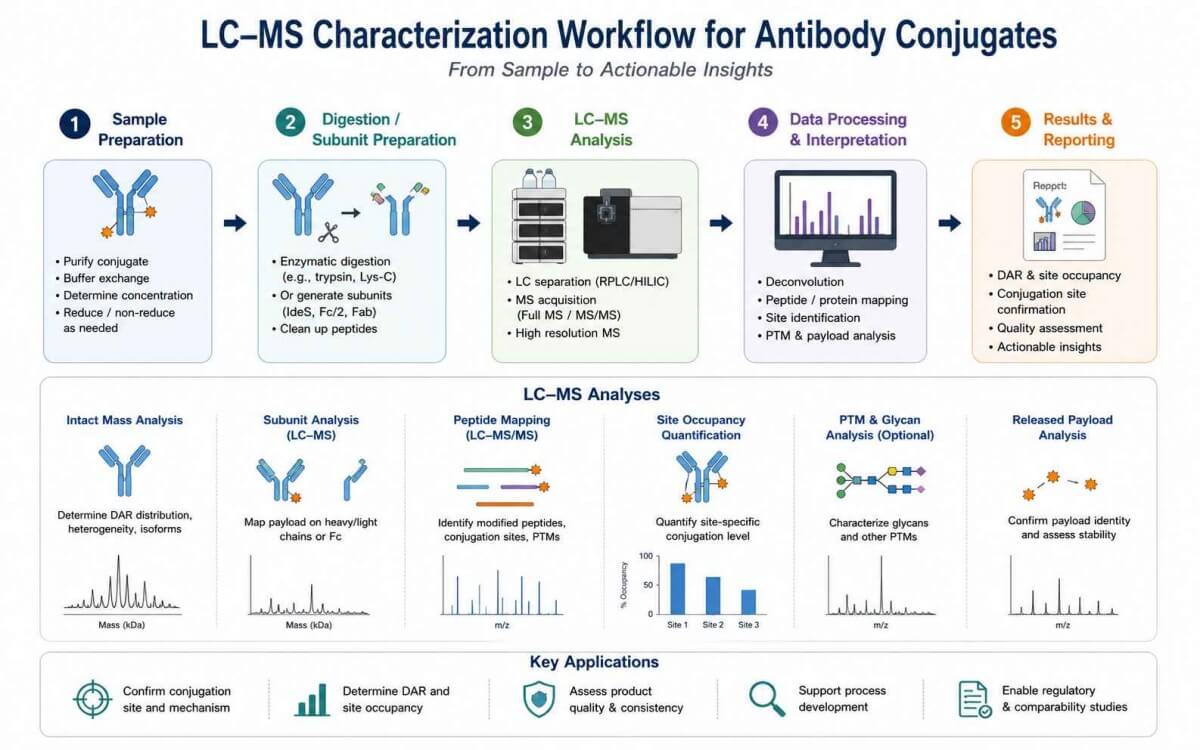 LC-MS characterization can be designed at intact, reduced, subunit, or peptide levels depending on the structural question.