Fluorescently Labeled Lipids
High-PrecisionLipid Bioconjugation ChemistryCustom Lipid Probes
Drive high-confidence lipid research with precision-engineered fluorescently labeled lipids designed for enterprise-level biotechnology, pharmaceutical, diagnostics, and nanomedicine programs. Our lipid labeling services combine advanced lipid chemistry, controlled fluorophore integration, and rigorous quality systems to deliver lipid probes with defined structure, high fluorescence stability, and reproducible performance. We support labeling of phospholipids, fatty acids, glycolipids, sphingolipids, cholesterol derivatives, and synthetic lipid analogs used in membrane biology, drug delivery, and metabolic studies.
Each fluorescent lipid is developed to preserve native biophysical behavior, membrane compatibility, and biological relevance. From single-labeled lipid standards to complex multi-component lipid systems, our solutions enable accurate visualization, tracking, and quantification across cell imaging, lipid trafficking, nanoparticle formulation, and in vivo biodistribution studies.
What Is Fluorescent Lipid Labeling?
Fluorescent lipid labeling is a specialized bioconjugation approach that enables direct visualization and quantitative analysis of lipid molecules within biological membranes, lipid assemblies, and complex biological systems. By integrating fluorescent dyes into defined positions of phospholipids, fatty acids, sterols, or lipid analogs, researchers can monitor lipid distribution, membrane dynamics, intracellular trafficking, and metabolic behavior with high spatial and temporal resolution.
Our fluorescent lipid labeling services are designed for high-level research and development workflows, ensuring that labeled lipids retain native amphiphilicity, membrane insertion properties, and functional relevance. Through controlled chemical modification and validated purification strategies, we deliver lipid probes suitable for applications including live-cell imaging, liposome and LNP tracking, lipid metabolism studies, drug–membrane interaction analysis, and in vivo biodistribution assessment.
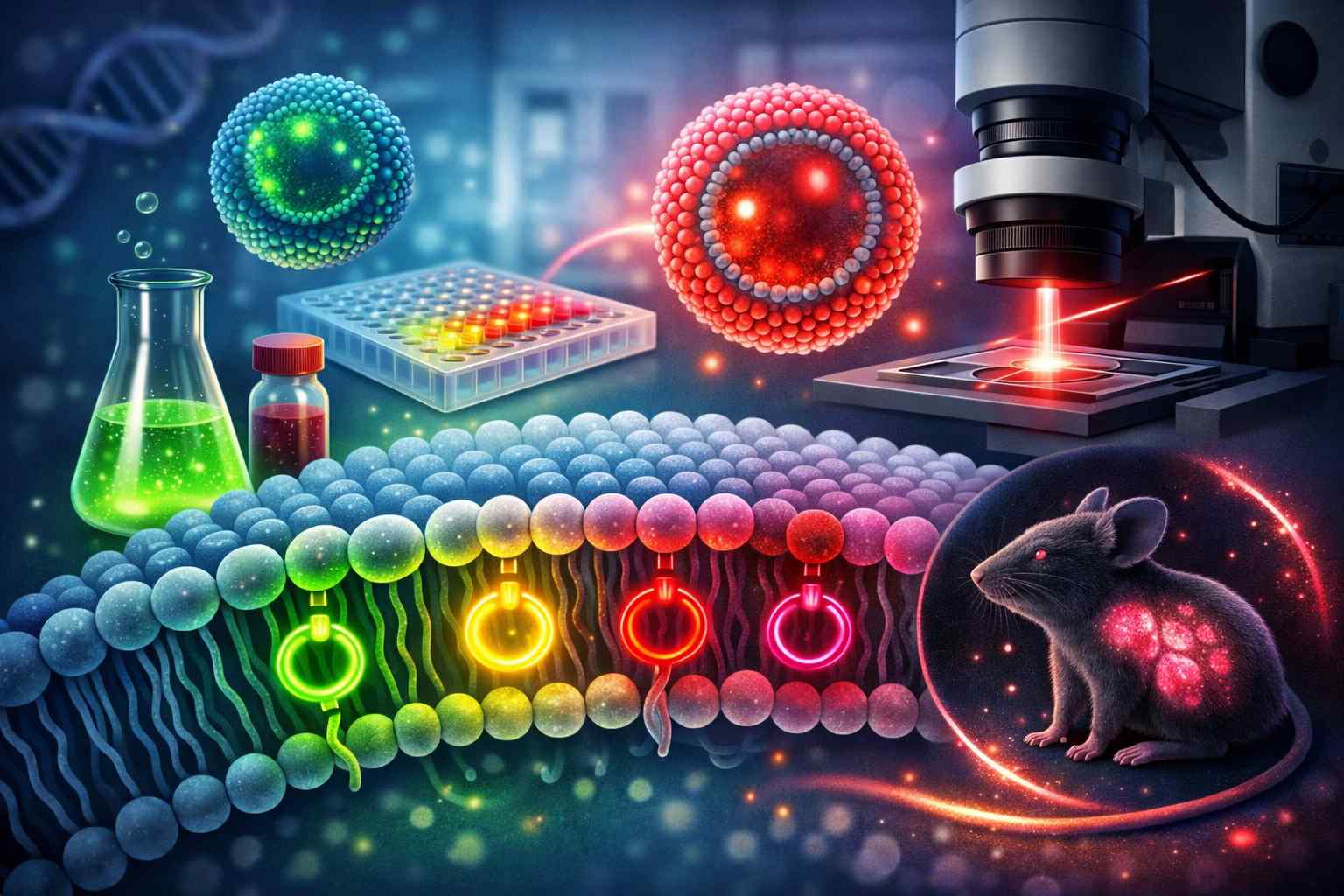 Illustration of fluorescently labeled lipids incorporated into biological membranes and lipid nanoparticles, enabling visualization of membrane dynamics, lipid trafficking, and in vivo biodistribution in advanced research applications.
What Problems We Solve
Altered Membrane Behavior
Improper dye placement or bulky fluorophores can disrupt lipid packing, membrane fluidity, and phase behavior. We design fluorescent lipid probes with defined labeling positions and linker chemistries to preserve native bilayer insertion, lateral diffusion, and domain organization.
Poor Fluorescence Stability in Membranes
Many conventional dyes suffer from quenching or rapid photobleaching when embedded in lipid environments. We select membrane-compatible fluorophores and optimize local chemical environments to ensure stable fluorescence during extended imaging and high-intensity illumination.
Inconsistent Lipid Labeling Efficiency
Variability in dye incorporation can lead to irreproducible signal intensity and misleading quantitative results. Our controlled lipid synthesis and conjugation workflows deliver consistent labeling stoichiometry and batch-to-batch reproducibility for enterprise-scale research.
High Background and Free Dye Contamination
Residual free dye or loosely associated fluorophores can generate high background signals and false-positive localization. We apply rigorous purification and analytical verification to ensure that fluorescence originates exclusively from lipid-bound probes.
Limited Compatibility with Liposomes and LNPs
Fluorescent lipids that destabilize lipid assemblies can compromise nanoparticle integrity and delivery performance. Our labeled lipids are validated for compatibility with liposomes, lipid nanoparticles (LNPs), and complex formulations used in drug delivery and vaccine platforms.
Difficulty Tracking Lipid Metabolism and Trafficking
Non-physiological labeling strategies can alter lipid uptake and metabolic fate. We develop probes that closely mimic endogenous lipids, enabling accurate studies of lipid transport, turnover, intracellular trafficking, and metabolic remodeling in cells and in vivo systems.
Our Fluorescent Labeling Services
We provide specialized fluorescent lipid labeling services supporting membrane biology, lipid metabolism, drug delivery, and nanomedicine research. Our capabilities span individual lipid probes through complex lipid assemblies, developed using controlled lipid chemistry, membrane-compatible fluorophores, and enterprise-grade quality control to ensure reproducible and biologically relevant performance.
 Fluorescent Labeling of Lipids & Phospholipids
Capabilities include:
- Fluorescent labeling of phospholipids, glycolipids, sphingolipids, sterols, and synthetic lipid analogs
- Defined labeling at headgroup, linker, or acyl-chain positions to preserve membrane behavior
- Integration of membrane-compatible fluorophores such as BODIPY, NBD, DiI/DiO, and selected Alexa Fluor dyes
- Custom linker design to minimize steric interference and fluorescence quenching
- High-purity lipid probes prepared by chromatographic purification
- Validation of membrane insertion, fluorescence stability, and lipid integrity
- Suitable for live-cell and fixed-cell membrane imaging
- Batch-consistent production for enterprise research programs
Popular dyes:
BODIPY FL, BODIPY 500/510, NBD, DiI, DiO, Alexa Fluor
 Fluorescent Labeling of Fatty Acids
Capabilities include:
- Labeling of saturated and unsaturated fatty acids (C6–C20) for metabolic and transport studies
- Fluorophore attachment strategies designed to retain native uptake and β-oxidation behavior
- Integration of BODIPY, NBD, and rhodamine-based dyes commonly used in lipid metabolism research
- Optimization for cellular uptake, lipid droplet localization, and membrane incorporation
- High-purity products (>95%) via HPLC purification
- Compatibility with live-cell imaging and quantitative fluorescence assays
- Format optimization for serum-containing and physiological conditions
Popular dyes:
BODIPY FL C12, BODIPY C16, NBD, Rhodamine derivatives
 Fluorescent Liposomes & Lipid Nanoparticles
Capabilities include:
- Preparation of fluorescently labeled liposomes and lipid nanoparticles (LNPs)
- Labeling via lipid incorporation, covalent lipid modification, or fluorescent lipid blending
- Support for neutral, cationic, anionic, and PEGylated lipid formulations
- Multi-color labeling for biodistribution, uptake, and trafficking studies
- Size-controlled assemblies suitable for drug delivery and vaccine research
- Purification by size-exclusion chromatography to remove free dye
- QC including particle size, fluorescence intensity, and formulation stability
Popular dyes:
DiI, DiO, DiD, BODIPY, Cy5, Cy7
 Fluorescent Lipid-Coated Beads & Model Membranes
Capabilities include:
- Lipid bilayer coating of microspheres for membrane interaction studies
- Incorporation of fluorescent lipids into supported lipid bilayers
- Custom lipid composition for receptor binding and membrane protein assays
- Multi-color membrane systems for interaction and fusion studies
- Uniform fluorescence distribution and batch reproducibility
- Suitable for biophysical assays, biosensor development, and screening platforms
Popular dyes:
BODIPY, NBD, DiI, DiO, Alexa Fluor
Fluorophores We Offer
To support enterprise lipid R&D programs across membrane biology, lipid trafficking, liposome/LNP development, and in vivo biodistribution studies, we offer a curated portfolio of membrane-compatible fluorophores commonly used in fluorescently labeled lipid probes. Selection is guided by spectral needs, membrane partitioning behavior, photostability, and fitness for microscopy, flow cytometry, and whole-animal imaging workflows.
| Fluorophore | Excitation (nm) | Emission (nm) | Lipid Applications | Membrane / Lipid Properties |
| BODIPY FL | 503 | 512 | Lipid metabolism probes, membrane trafficking, fatty acid analog tracking | Compact fluorophore with strong signal; frequently used in lipid analogs due to favorable membrane compatibility |
| NBD | 470 | 540 | Membrane insertion studies, lipid transport assays, supported bilayers | Small, polarity-sensitive dye widely used on phospholipids; can be sensitive to environmental quenching in membranes |
| DiO | 484 | 501 | Membrane labeling, liposome tracking, cell–lipid interaction studies | Strongly lipophilic membrane dye; typically used by membrane incorporation in lipid assemblies |
| DiI | 549 | 565 | Lipid bilayer labeling, vesicle uptake assays, membrane dynamics | Highly lipophilic carbocyanine dye; robust membrane staining with low aqueous solubility |
| DiD | 644 | 665 | LNP/liposome tracking, multiplex membrane imaging, deep-tissue fluorescence applications | Far-red membrane dye offering reduced autofluorescence interference relative to green channels |
| DiR | 748 | 780 | In vivo biodistribution, near-IR liposome/LNP tracking, whole-animal imaging | Near-IR lipophilic dye suited for deeper tissue imaging and lower background in animal studies |
| Texas Red | 596 | 615 | Fluorescent phospholipids (e.g., PE-labeled), membrane imaging, lipid mixing/fusion assays | Bright red-emitting dye commonly available as lipid conjugates; useful for multicolor membrane panels |
| Cy5 | 649 | 670 | Far-red lipid conjugates (e.g., PEG-lipids), nanoparticle tracking, multiplex imaging | Far-red channel supports reduced background; frequently used in labeled lipid conjugates for tracking lipid assemblies |
| Cy7 | 749 | 776 | Near-IR lipid conjugates, in vivo imaging of lipid assemblies, biodistribution studies | Near-IR emission enables deeper tissue imaging; often used for lipid nanoparticle and liposome tracking |
Our Labeling Chemistry & Methods
Reliable fluorescently labeled lipid probes require chemistry that preserves amphiphilicity, bilayer insertion, and lipid-specific biological behavior. Our platform supports lipid-appropriate conjugation and incorporation strategies used across phospholipids, fatty acids, glycolipids, sterols, and lipid-based nanostructures, enabling controlled fluorophore placement and reproducible performance for enterprise research workflows.
| Labeling Method | Chemistry | Lipid Use Cases | Impact on Lipid Structure & Function |
| NHS Ester Coupling (Amine-Containing Lipids) | NHS esters react with primary amines (e.g., phosphatidylethanolamine headgroups) to form stable amide bonds under controlled conditions. | Headgroup-labeled phospholipids, membrane probes, fluorescent PE derivatives | Enables defined headgroup labeling; linker and dye selection are used to minimize disruption of membrane packing. |
| Carbodiimide Chemistry (EDC/NHS) | Activation of carboxyl groups (on carboxylated lipids or lipid-linked acids) followed by coupling to amines to form amide linkages. | Carboxyl-functional lipid conjugates, lipid–ligand coupling, probe construction | Useful for functionalized lipid building blocks; requires control to avoid side reactions and preserve lipid integrity. |
| Maleimide–Thiol Coupling | Maleimide groups react selectively with thiols on thiolated lipids (or thiol-functional linkers) to form stable thioether bonds. | Thiol-functional lipid conjugates, PEG-lipid constructs, targeted lipid assemblies | Provides site-selective attachment on thiol handles; supports modular assembly with controlled labeling positions. |
| Click Chemistry (SPAAC / Azide–Alkyne) | Strain-promoted azide–alkyne cycloaddition enables catalyst-free conjugation between azide- and alkyne-functional lipid building blocks. | Site-defined lipid probes, modular dye integration, PEG-lipid and ligand-lipid conjugates | High specificity and yield supports precise probe design; minimizes harsh conditions that can compromise lipid assemblies. |
| Hydrazide/Carbonyl Chemistry | Hydrazides react with aldehydes/carbonyls generated on oxidized carbohydrates (e.g., oxidized glycolipid headgroups) to form hydrazones. | Glycolipid-related probes, carbohydrate-containing lipid headgroup labeling | Enables targeting of oxidized sugar moieties; appropriate for certain glycobiology-oriented lipid probe designs. |
| Noncovalent Membrane Incorporation (Lipophilic Dyes) | Strongly lipophilic dyes (e.g., carbocyanines) are incorporated into lipid bilayers by hydrophobic partitioning rather than covalent bonding. | Liposome/LNP membrane staining, vesicle tracking, rapid labeling of lipid assemblies | Fast and practical for membranes; does not define molecular attachment site, so it is best for tracking assemblies rather than lipid metabolism. |
Quality Control & Data Delivered
We provide a QC package tailored to fluorescent lipid probes and lipid-based assemblies, supporting enterprise requirements for identity, purity, fluorescence performance, and reproducibility. Analytical selection is matched to the lipid class and intended application (membranes, liposomes/LNPs, or metabolic probes).
| QC Parameter | Description / Method | Reported Output |
| Purity Analysis | HPLC/UPLC and/or TLC (method selected based on lipid class and probe properties) | Chromatograms and/or TLC documentation, % purity |
| Identity / Structural Confirmation | LC-MS (and HRMS where appropriate for exact mass confirmation) | Mass spectra, expected mass confirmation |
| Dye Incorporation / Labeling Confirmation | UV-Vis absorbance profiling and fluorescence measurement (as applicable to the dye) | Absorbance/fluorescence readouts supporting labeling confirmation |
| Fluorescence Characterization | Excitation/emission spectra and signal assessment under relevant conditions | Spectral profiles |
| Free Dye / Impurity Removal Verification | Chromatographic assessment and/or comparative fluorescence evaluation pre/post purification | Evidence of free dye reduction (chromatographic and/or fluorescence-based) |
| Particle Characterization (for Liposomes/LNPs) | DLS sizing and PDI; zeta potential where relevant to formulation needs | Size distribution report, PDI (and zeta potential if performed) |
| Stability Assessment (Optional, Project-Dependent) | Storage stability and/or photostability evaluation appropriate to the intended imaging workflow | Stability observations and supporting data (scope defined per project) |
General Workflow for Fluorescent Lipid Labeling Services


Project Assessment & Strategy Design
We assess lipid class, molecular structure, intended biological context, and downstream application. Fluorophore selection and labeling strategy are defined to preserve membrane behavior, lipid dynamics, and experimental relevance.

Sample Preparation & Pre-Processing
Lipid materials are inspected for purity, functional group availability, and formulation compatibility. Pre-processing may include solvent optimization, functional group activation, or lipid building block preparation.

Fluorescent Labeling Reaction
Labeling is performed under controlled conditions using lipid-appropriate chemistry or membrane incorporation strategies. Reaction parameters are optimized to achieve reproducible dye integration without compromising lipid integrity.

Purification & Removal of Free Dye
Excess dye and reaction byproducts are removed using chromatographic or formulation-specific purification methods to ensure low background fluorescence and clean lipid probes.

Quality Control & Data Verification
Each fluorescent lipid undergoes identity confirmation, purity assessment, and fluorescence characterization aligned with its intended application, including membrane systems or lipid nanoparticles.

Final Delivery & Technical Support
Labeled lipid probes are delivered with full QC documentation and handling guidance. Technical support is provided to assist integration into membrane studies, formulation workflows, or imaging platforms.
Advantages of Our Fluorescent Labeling Services
Preserved Lipid Functionality
Labeling strategies are designed to retain native lipid amphiphilicity, membrane insertion, and biological behavior, supporting meaningful interpretation of imaging and trafficking data.

Compatibility with Lipid Assemblies
Our fluorescent lipids are validated for use in liposomes, lipid nanoparticles, supported bilayers, and mixed-lipid systems without destabilizing formulation performance.
Enterprise-Grade Reproducibility
Controlled synthesis and QC processes deliver consistent labeling performance across batches, supporting long-term programs and cross-study comparability.
High-Quality Fluorescence Performance
Carefully selected fluorophores provide stable signal output, appropriate spectral separation, and compatibility with advanced imaging and detection platforms.
Applications of Fluorescent Labeling Technology
Membrane Biology
- Visualize lipid distribution, membrane domains, and bilayer organization in cells.
- Study lipid diffusion, phase separation, and membrane remodeling processes.
- Analyze lipid–protein interactions within native or model membranes.
- Support mechanistic studies of membrane-associated signaling pathways.
Liposome & Lipid Nanoparticle Research
- Track liposome and LNP uptake, trafficking, and intracellular fate.
- Evaluate formulation stability and biodistribution in delivery systems.
- Support optimization of lipid-based drug and nucleic acid delivery platforms.
- Enable multi-component formulation tracking using spectrally distinct lipids.
Lipid Metabolism Studies
- Monitor fatty acid uptake, transport, and intracellular processing.
- Study lipid storage and lipid droplet dynamics in metabolic models.
- Investigate lipid turnover and remodeling under physiological or disease conditions.
- Support quantitative fluorescence-based metabolic assays.
Live-Cell & Advanced Imaging
- Perform real-time visualization of lipid movement in living cells.
- Enable multicolor imaging of lipid assemblies and membrane dynamics.
- Support confocal, super-resolution, and time-lapse microscopy workflows.
- Reduce background interference through optimized fluorophore selection.
Drug–Membrane Interaction Studies
- Investigate interactions between small molecules and lipid membranes.
- Assess membrane permeability and compound-induced lipid reorganization.
- Support mechanistic evaluation of membrane-active therapeutics.
- Enable fluorescence-based screening assays.
In Vivo Lipid Tracking
- Track lipid assemblies and delivery vehicles in animal models.
- Support biodistribution and clearance studies using near-IR lipid probes.
- Enable whole-animal and organ-level fluorescence imaging.
- Support translational and preclinical lipid-based research.
What Our Research Clients Say

"Their guidance on membrane-compatible dye selection and labeling position helped us avoid probe-induced artifacts. The fluorescently labeled lipids delivered clean signal with low background in our membrane dynamics assays."
— Director of Imaging Sciences, Global Biopharma R&D
"We needed fluorescent lipids that integrate into liposomes and LNPs without destabilizing formulation performance. The batch consistency and QC documentation supported reliable comparison across our uptake and biodistribution studies."
— Formulation Lead, Lipid Nanoparticle Delivery Program
"For lipid trafficking and metabolism work, identity and purity are non-negotiable. The LC-MS confirmation and spectra data made it straightforward to validate probe integrity and quantify results across experiments."
— Principal Scientist, Metabolic & Lipidomics Research Group
Custom Fluorescently Labeled Lipids for Enterprise Research & Delivery Platforms
Whether your program requires membrane probes, fluorescent fatty acid analogs, or labeled lipids for liposomes and lipid nanoparticles, we provide customized fluorescent lipid solutions aligned with enterprise R&D standards. Our specialists support fluorophore selection, labeling strategy, purification, and QC documentation so your teams can deploy probes confidently across imaging, formulation, and biodistribution workflows. Reach out to us for a quote or technical consultation, and let us help define the right fluorescently labeled lipid for your application.
Frequently Asked Questions (FAQ)
What are fluorescently labeled lipids used for?
Fluorescently labeled lipids are used to visualize and track lipid behavior in biological systems. Common applications include membrane biology studies, lipid trafficking, lipid metabolism analysis, liposome and lipid nanoparticle (LNP) tracking, and in vivo biodistribution research. By incorporating a fluorophore into a defined position of a lipid molecule, researchers can monitor lipid localization, movement, and interaction without relying on indirect staining methods.
How are fluorescent lipids different from membrane dyes?
Fluorescent lipids are structurally defined lipid molecules with covalently attached fluorophores, whereas membrane dyes (such as DiI or DiO) often label membranes through noncovalent insertion. Fluorescent lipids enable more precise studies of lipid metabolism, trafficking, and molecular behavior, while membrane dyes are typically used for general membrane visualization and tracking of lipid assemblies.
Do fluorescent labels affect lipid membrane behavior?
Yes, fluorescent labeling can affect lipid behavior if not carefully designed. Factors such as fluorophore size, hydrophobicity, and attachment position influence membrane insertion, diffusion, and phase behavior. Properly designed fluorescent lipids use established labeling positions and membrane-compatible dyes to minimize disruption and preserve native lipid properties.
Which fluorophores are commonly used for fluorescent lipid labeling?
Common fluorophores for lipid labeling include BODIPY, NBD, DiI, DiO, DiD, Texas Red, Cy5, and near-infrared dyes such as DiR or Cy7. Selection depends on the application, required excitation/emission wavelengths, membrane compatibility, photostability, and whether the study involves live cells or in vivo imaging.
Are fluorescently labeled lipids suitable for live-cell imaging?
Yes, many fluorescently labeled lipids are suitable for live-cell imaging when used at appropriate concentrations. Lipid-compatible fluorophores and controlled labeling strategies help reduce cytotoxicity and phototoxicity. Experimental conditions should always be optimized for the specific cell type and imaging duration.
Can fluorescent lipids be used in liposomes or lipid nanoparticles (LNPs)?
Fluorescent lipids are widely used in liposomes and LNPs to study formulation stability, cellular uptake, intracellular trafficking, and biodistribution. Properly selected fluorescent lipids integrate into lipid assemblies without destabilizing the formulation and allow tracking across in vitro and in vivo models.