PEG Conjugated Oligonucleotide
Defined Site-Controlled PEGylationCustom PEG Architectures for DNA & RNAPurified Conjugates with Analytical Verification
Build research-ready PEG conjugated oligonucleotides with a workflow designed for teams working in antisense, siRNA, aptamer, probe, and nucleic-acid delivery research. PEG conjugation can be used not only to increase hydrophilicity and adjust molecular size, but also to create a controllable spacer between the oligonucleotide and its payload, surface, or functional environment. For many projects, the real challenge is not attaching PEG once—it is selecting the right PEG format, attachment site, and purification strategy so the final construct remains functional, consistent, and easier to evaluate.
We support custom development from oligonucleotide review and PEG strategy selection through site-controlled conjugation, purification, and analytical characterization. Projects can be aligned with broader oligonucleotide bioconjugation programs or more general PEGylation development needs, including workflows that require terminal modification, internal handle installation, or post-synthetic coupling through orthogonal chemistry.
Whether you are PEGylating a DNA probe, RNA oligo, aptamer, ASO, or duplex oligonucleotide system, we design the process around the role PEG is expected to play in your project—shielding, spacing, solubility adjustment, circulation-oriented research support, formulation compatibility, or multicomponent assembly.
 Fig.1 PEG-conjugated oligonucleotide synthesis. (Chowdhury et al., 2023)
What Problems Can PEG Conjugated Oligonucleotide Solve?
Many oligonucleotide programs run into practical limits once the sequence leaves a simple buffer system and has to function in a more demanding research setting. The construct may clear too quickly in circulation-oriented studies, behave poorly during formulation or surface immobilization, lose accessibility after attachment to a payload, or show inconsistent performance because PEG size and placement were chosen empirically rather than as part of a full conjugation strategy. PEG conjugated oligonucleotide development helps solve these issues by turning PEG into a deliberate structural element rather than a generic add-on.
A well-designed PEGylated oligonucleotide can improve handling, tune steric presentation, reduce unfavorable interactions, and create better separation between the oligonucleotide and nearby chemical or biological components. At the same time, PEG can also interfere with hybridization, duplex behavior, or target binding if the chain length, architecture, or installation site is poorly matched to the sequence. That is why successful projects require coordinated review of oligonucleotide format, attachment chemistry, PEG type, purification plan, and analytical readout before scale-up or repeat production.
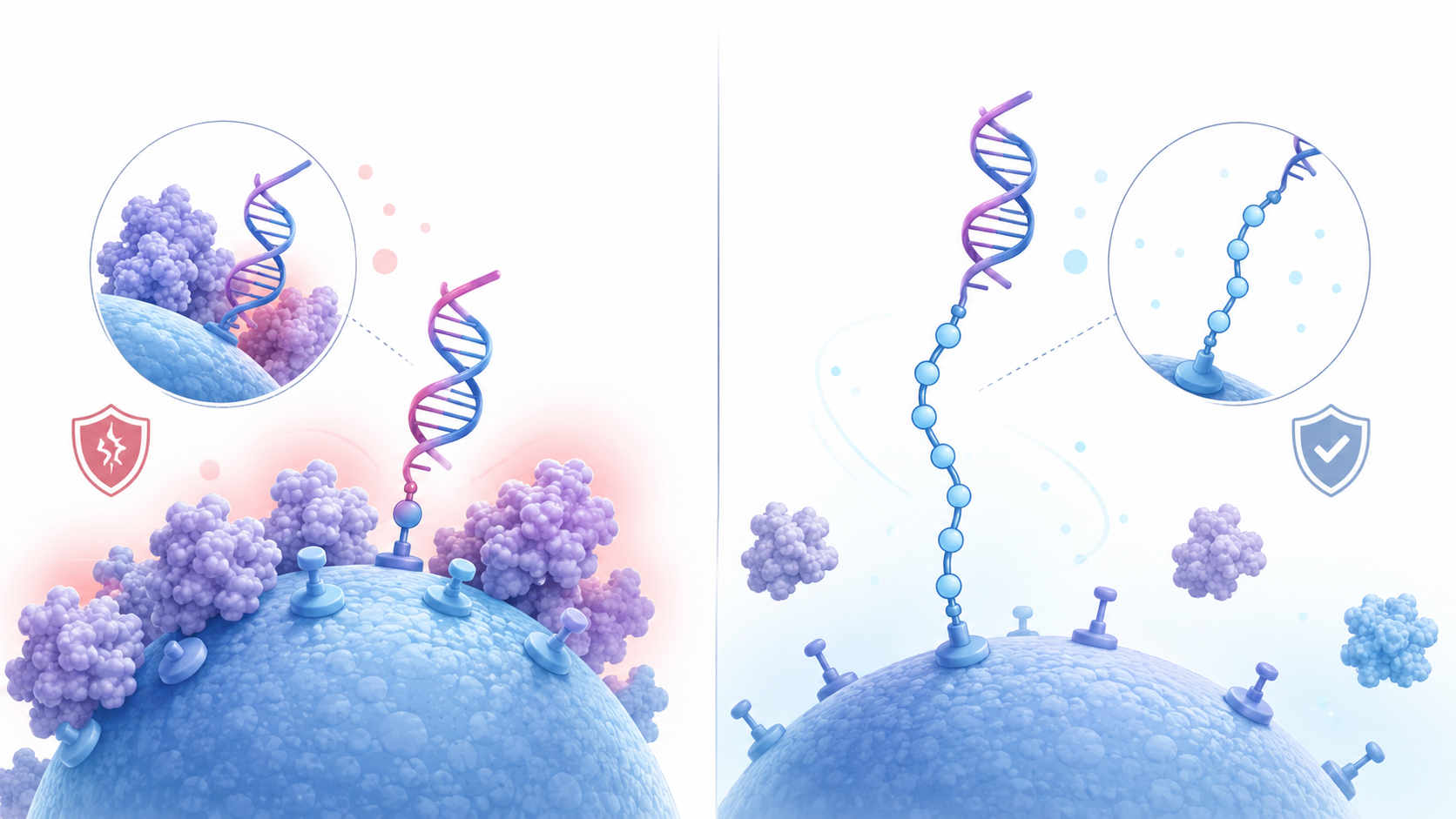 PEG conjugated oligonucleotide design can improve spacing, handling, and construct stability while reducing the risk of steric masking or inconsistent conjugation outcomes.
Key Challenges Research Teams Face in PEG–Oligonucleotide Projects
Activity Drops After PEG Attachment
PEG can help a construct, but it can also hinder it. If PEG is installed at the wrong terminus, on the wrong strand, or at an internal position that affects folding or hybridization, the conjugate may show weaker target binding, poorer duplex behavior, or reduced assay performance.
PEG Size Is Chosen Without Clear Design Logic
Linear, defined-length, branched, and multifunctional PEG formats do not behave the same way. Projects often stall because PEG molecular weight, architecture, and cleavability were selected for availability rather than for the actual need—such as shielding, spacer length, or formulation compatibility.
Free PEG and Unconjugated Oligo Complicate Evaluation
Even when the coupling reaction works, residual free PEG, unconjugated oligonucleotide, hydrolyzed linker, or shortmer-related impurities can distort downstream interpretation. Separation strategy matters because a clean analytical profile is often necessary before the construct can be meaningfully compared in function-focused studies.
Early Builds Cannot Be Reproduced Reliably
Small changes in oligo handle quality, PEG reactivity, strand annealing order, or purification conditions can shift the final product profile. Research teams need a controlled workflow that supports repeat batches, troubleshooting, and clearer transfer from feasibility work to larger or follow-up builds.
Our PEG Conjugated Oligonucleotide Services
We provide custom service packages for PEG conjugated oligonucleotides ranging from design-stage planning to purified, analytically characterized conjugates. Projects may start from a customer-supplied sequence, an existing modified oligo that needs PEG installation, or a broader conjugation concept requiring support with linker chemistry, spacer engineering, or downstream compatibility with other components.
 PEG Strategy Design
Capabilities include:
- Review of DNA, RNA, ASO, siRNA, aptamer, and other modified oligonucleotide formats intended for PEG conjugation
- Selection of PEG role in the construct, such as shielding, hydrophilicity tuning, spacer function, surface separation, or circulation-oriented support
- Recommendation of linear, defined-length PEG, branched PEG, or multifunctional PEG architectures where appropriate
- Planning of 5′, 3′, or internal attachment positions based on sequence accessibility, duplex design, and downstream use
- Evaluation of stable versus cleavable linker logic when the PEG should remain permanent or serve as a temporary structural element
Customer value:
This stage reduces trial-and-error by matching PEG format and attachment site to the actual project objective rather than treating PEGylation as a one-condition screening exercise.
 Site-Controlled Coupling
Capabilities include:
- Solid-phase or post-synthetic strategies for defined PEG installation at terminal or internal sites
- Coupling routes using amine-, thiol-, azide-, alkyne-, or other orthogonally modified oligonucleotides and reactive PEG derivatives
- Use of NHS ester, maleimide, and click-enabled routes where compatible with the sequence and conjugate objective
- Spacer and linker design to reduce steric masking and preserve sequence presentation after PEG attachment
- Strand-specific planning for duplex systems so PEG is installed on the most appropriate strand and position
Deliverables:
Defined coupling strategy, reaction execution, and process notes that support repeat builds or further optimization using related bioorthogonal click chemistry workflows when needed.
 Format-Specific PEGylation
Capabilities include:
- PEGylation support for antisense oligonucleotides, duplex siRNA-related systems, aptamers, probe sequences, and other custom oligo constructs
- Planning around modality-specific constraints such as aptamer folding, probe accessibility, annealed duplex behavior, or payload spacing
- Support for customer-supplied modified oligos or new-build sequences prepared as part of a broader oligonucleotide bioconjugation program
- Comparative builds to assess multiple PEG sizes, termini, or linker formats when design risk is high
- Integration logic for projects that may later connect with peptide, surface, nanoparticle, or affinity-tag constructs
Typical applications:
Aptamer stabilization studies, siRNA/ASO construct optimization, probe engineering, and PEG-enabled spacer design for more complex oligonucleotide assemblies.
 Purification & QC
Capabilities include:
- Removal of free PEG, unconjugated oligonucleotide, hydrolyzed PEG derivatives, and other reaction-related species using fit-for-purpose purification routes
- Analytical confirmation of conjugate identity, purity, and product profile using appropriate orthogonal methods
- Support for RP-HPLC, ion-exchange, SEC, LC-MS, MALDI, UV-based assessment, or other relevant analytical workflows depending on construct type
- Optional review of duplex integrity, hybridization-related behavior, or application-relevant comparability testing
- Handling, storage, and documentation recommendations to improve repeatability across batches
Customer value:
The goal is not only to show that PEG was attached, but to deliver a conjugate package that is easier to interpret, compare, and use in downstream research.
Key Design Parameters for PEG Conjugated Oligonucleotides
Successful PEGylation depends on the relationship between oligonucleotide format, PEG structure, conjugation route, and the intended role of PEG in the final construct. The table below highlights the variables that most often determine whether a PEG–oligo build is practical and reproducible.
| Design Parameter | Common Options | Development Considerations | Impact on Conjugate Performance | Why It Matters to Customers |
| Oligonucleotide Format | DNA, RNA, ASO, siRNA-related strands, aptamer, modified probe, other custom oligo | Sequence architecture, folding behavior, duplex state, and terminal modifications affect PEG placement options | Influences whether PEG improves usability without weakening function | Helps determine whether the project should use a simple terminal PEG or a more controlled build plan |
| Attachment Site | 5′, 3′, internal, strand-selective placement for duplex systems | Placement must be matched to hybridization, binding region accessibility, and downstream assembly logic | Controls steric presentation, activity retention, and conjugate uniformity | Reduces the risk of making a PEGylated construct that is analytically correct but functionally weak |
| PEG Architecture & Size | Linear PEG, defined-length PEG, branched PEG, multifunctional PEG | Different PEG formats change hydrodynamic effect, spacing, flexibility, and analytical interpretability | Affects solubility, shielding behavior, steric reach, and purification difficulty | Supports rational selection instead of over- or under-engineering the conjugate |
| Linker Chemistry | NHS–amine, maleimide–thiol, click-enabled routes, preinstalled PEG building blocks | Chemistry must align with available reactive handles, oligo stability, and desired process control | Determines coupling efficiency, side-product profile, and repeatability | Improves the chance of obtaining a clean, scalable route for repeat batches |
| Cleavability | Stable PEG linkage or cleavable PEG connection depending on project design | The PEG may be intended as a permanent modifier or as a temporary spacer in a larger construct | Changes how the conjugate behaves during storage, assays, or downstream studies | Ensures the linkage supports the final use case rather than only simplifying synthesis |
| Purification & Analytics Plan | RP-HPLC, IEX, SEC, LC-MS, MALDI, UV-based or function-relevant checks | Method choice depends on oligo chemistry, PEG size, and the need to resolve free PEG or unconjugated material | Defines how clearly the final product can be assigned and compared | Provides the data needed for screening, troubleshooting, and informed reordering |
PEG–Oligonucleotide Conjugation Strategies & Process Development Considerations
There is no single PEGylation route that fits every oligonucleotide. Method selection should be driven by handle availability, desired site control, PEG definition, sequence sensitivity, and how easily the final product must be purified and characterized.
| Conjugation Strategy | Technical Route | Common Use Scenarios | Development Advantages |
| Direct PEG Building Block Incorporation | PEG or PEG-like modifier introduced during oligonucleotide synthesis through suitable phosphoramidite or support-based design | Constructs requiring defined position control and a cleaner synthetic plan | Strong control over placement and good fit for well-planned terminal or internal modification strategies |
| NHS–Amine Coupling | Amine-modified oligonucleotide reacted with NHS-activated PEG under controlled conditions | Terminal amine oligos, straightforward post-synthetic PEGylation, screening of PEG size variants | Accessible and versatile route when amine handles are already available |
| Maleimide–Thiol Coupling | Thiol-modified oligonucleotide or PEG derivative coupled through maleimide chemistry | Projects requiring site-selective terminal coupling with sulfur-based handles | Useful for defined end-group installation and compatible with many heterobifunctional PEG designs |
| Click-Enabled Coupling | Azide/alkyne or related orthogonal handles used for efficient post-synthetic connection | Complex conjugates, modular builds, and projects needing cleaner orthogonality across multiple functional groups | Expands design flexibility when conventional amine- or thiol-based routes are limiting |
| Heterobifunctional PEG Bridging | PEG linker with different reactive ends used to connect the oligonucleotide to a second component or to preserve a specific spacer function | Multicomponent constructs, payload spacing, surface separation, and more advanced conjugate engineering | Provides greater control over distance, orientation, and downstream compatibility |
Analytical Characterization & Quality Control Framework for PEG–Oligo Conjugates
For PEG conjugated oligonucleotides, analytical quality is not limited to confirming that the PEG is present. It should also clarify product identity, free PEG removal, remaining unconjugated oligo, and whether the final construct is still fit for its intended research purpose.
| Analytical Category | Typical Methodology | Purpose in Development | Data Delivered |
| Identity Confirmation | LC-MS, MALDI, or other suitable mass-based confirmation | Verify the expected PEG–oligo product and distinguish it from unconjugated starting material | Assigned mass or identity summary with product interpretation notes |
| Purity Profile Assessment | RP-HPLC, IEX, SEC, or orthogonal chromatographic methods | Evaluate residual free PEG, unconjugated oligo, and process-related byproducts | Chromatograms, purity profile summary, and comparative batch information where relevant |
| Conjugation Success & Stoichiometry | Mass shift review, UV-based assessment, or other fit-for-purpose quantification | Confirm PEG installation and help judge whether the expected product distribution was achieved | Conjugation summary and product distribution observations |
| Structure-Relevant Function Check | Hybridization comparison, duplex review, binding comparison, or assay-relevant testing | Assess whether PEG placement preserved the needed oligonucleotide behavior | Comparative performance observations or application-fit notes |
| Handling & Stability Review | Buffer compatibility, storage observation, and reconstitution-related checks | Support repeat use and reduce variability caused by sample handling | Recommended handling conditions and stability-oriented notes |
| Documentation Package | Structured reporting of build route, purification, and analytical outcome | Support decision-making, repeat orders, and project transfer between teams | Conjugation record, analytical summary, and recommended next-step guidance |
Workflow for Custom PEG Conjugated Oligonucleotide Development


Requirement Review
We begin by clarifying the oligonucleotide format, intended PEG function, target scale, and any existing sequence or handle constraints. This step aligns the project around what PEG is expected to achieve rather than assuming one standard route fits all constructs.

Oligo & PEG Design
The sequence, modification pattern, PEG architecture, and attachment site are reviewed together. We define whether the best route is terminal or internal PEGylation, stable or cleavable linkage, and direct incorporation or post-synthetic coupling.

Route Selection
Conjugation chemistry is selected based on available handles and the need for site control, orthogonality, and downstream purification. This may involve amine-, thiol-, or click-compatible strategies depending on the build design.

Conjugation & Purification
The PEGylation reaction is executed under conditions chosen to protect oligonucleotide integrity and manage side products. Purification is then tailored to remove free PEG and unconjugated species rather than relying on a generic cleanup step.

Analytical Verification
Identity, purity, and product profile are confirmed using appropriate analytical methods. Where relevant, function-oriented comparison can be added to determine whether PEG placement preserved the intended oligonucleotide behavior.

Delivery & Follow-Up
Final output can include research-grade PEG–oligo conjugates, analytical summaries, and recommended handling conditions to support screening, repeat batches, or the next round of optimization. For related programs, workflows can also connect naturally with PEGylation or other conjugation services.
Why Choose Our PEG Conjugated Oligonucleotide Services
Oligo-First Design Logic
We design PEGylation around the oligonucleotide's real behavior—hybridization, duplex structure, folding, and presentation—so the final construct is planned for function instead of only for chemical attachment.

Flexible PEG Options
Projects can be built with different PEG sizes, architectures, and linker concepts, helping research teams compare simple terminal PEGylation with more structured spacing or multifunctional designs when the application requires it.
Purification for Real Byproducts
We focus on the impurities that actually complicate PEG–oligo work—free PEG, unconjugated oligo, and mixed product profiles—so the delivered material is easier to interpret in downstream testing.
Decision-Ready Analytics
Our analytical framework is built to support project decisions, not only product confirmation. That means clearer data for troubleshooting, repeat ordering, comparative studies, and internal handoff between chemistry and biology teams.
Common Research Applications of PEG Conjugated Oligonucleotides
ASO & siRNA Research
- PEGylated oligonucleotides can be used to compare how spacing, shielding, or hydrodynamic size affect construct behavior in antisense and duplex oligo research.
- Strand-selective PEG installation supports more deliberate design in duplex systems.
- Useful for feasibility studies, sequence-format comparison, and follow-up optimization.
Aptamer Stabilization Studies
- Terminal PEGylation can be explored to improve handling, spacing, or circulation-oriented performance in aptamer projects.
- PEG selection can be adjusted to preserve target accessibility and folding behavior.
- Applicable to binding constructs, switch formats, and other custom aptamer designs.
Probe & Capture Reagents
- PEG can serve as a practical spacer in oligonucleotide probes and capture sequences used in biosensing, hybridization, and surface-based assay development.
- Controlled spacing may reduce crowding near solid supports or neighboring functional groups.
- Useful when oligonucleotide accessibility matters more than simple end-label installation.
Surface & Material Interfaces
- PEG–oligo constructs can help tune presentation on beads, nanoparticles, or other research interfaces where direct oligo attachment gives poor accessibility.
- The PEG segment can act as a defined separation element between the oligonucleotide and the surrounding material environment.
- Supports method development for more complex nucleic-acid-enabled assemblies.
Discuss Your PEG Conjugated Oligonucleotide Project
Whether you are designing a first PEGylated oligonucleotide, comparing multiple PEG sizes, or troubleshooting a construct that lost activity after modification, we provide technically focused support across design, conjugation, purification, and characterization.
Our team works with customer-defined sequences, PEG formats, and application goals to deliver conjugates and data packages that are easier to evaluate, reproduce, and advance within downstream research. Contact our scientific team to discuss your PEG conjugated oligonucleotide requirements and request a project-specific proposal.
Frequently Asked Questions (FAQ)
What are the steps involved in PEG conjugation to oligonucleotides?
PEG conjugation to oligonucleotides typically involves the covalent attachment of a PEG molecule to the oligonucleotide's functional groups. This process can be achieved through chemical cross-linking or other conjugation methods like NHS or maleimide chemistry, depending on the PEG derivative used. The result is a stable PEGylated oligonucleotide ready for various applications.
What are the common PEG derivatives used in oligonucleotide conjugation?
BOC Sciences offers a variety of PEG derivatives for oligonucleotide conjugation, including NHS-PEG, maleimide PEG, thiol PEG, and amino PEG. Each derivative serves different conjugation needs, allowing for flexibility in modifying oligonucleotides for specific applications, such as improving solubility or enabling targeted delivery.
How do PEGylated oligonucleotides perform in hybridization assays?
PEGylated oligonucleotides exhibit enhanced resistance to nuclease degradation, which improves their performance in hybridization assays. The PEG modification protects the oligonucleotide from enzymatic breakdown, allowing for more reliable and consistent results in techniques like PCR, FISH, or microarray assays.