Biotin Labeled Nucleotides
Custom Biotinylated dNTP & NTP FormatsApplication-Matched Incorporation SupportClean Reagents for Capture, Detection & Probe Workflows
We support custom biotin labeled nucleotide projects for research teams that need more than a catalog analog. Our service scope covers design, preparation, and application alignment for biotinylated nucleotide building blocks used in DNA labeling, RNA labeling, affinity capture, nonradioactive probe generation, and streptavidin-based assay development. Projects can be configured around biotin-dNTPs for PCR, nick translation, or random priming; biotin-NTPs for in vitro transcription; chain-terminating formats such as biotin-ddNTPs; and specialized end-labeling reagents such as pCp-biotin for RNA workflows.
We can start from a customer-defined nucleotide format, an enzyme-driven incorporation route, or a downstream assay requirement. For broader projects, this service can be coordinated with biotinylation, biotin labeled nucleic acids, biotin labeled oligonucleotides, or oligonucleotide bioconjugation support when the labeled nucleotide must fit a larger probe, capture, or conjugation workflow.

What Problems Can Biotin Labeled Nucleotides Solve?
Biotin labeled nucleotides are widely used when researchers need a strong affinity handle without relying on radioactive labeling. By incorporating a biotinylated nucleotide into DNA or RNA, the resulting product can be captured, immobilized, enriched, or detected through streptavidin-based systems. In practice, however, successful use depends on more than simply choosing any biotin analog. Nucleotide class, linker length, labeling density, polymerase compatibility, and cleanup strategy all influence whether a project delivers strong capture with acceptable synthesis performance and low background.
This service is especially useful when teams need to decide between DNA labeling and RNA labeling routes, compare internal incorporation with terminal labeling, or troubleshoot why a labeled product binds poorly after synthesis. We help match the biotin nucleotide format to the actual workflow—such as PCR amplicon preparation, nick translation, random priming, in vitro transcription, 3′ end labeling, bead capture, or blot/ISH probe generation—so the final reagent is easier to incorporate, purify, verify, and use downstream.
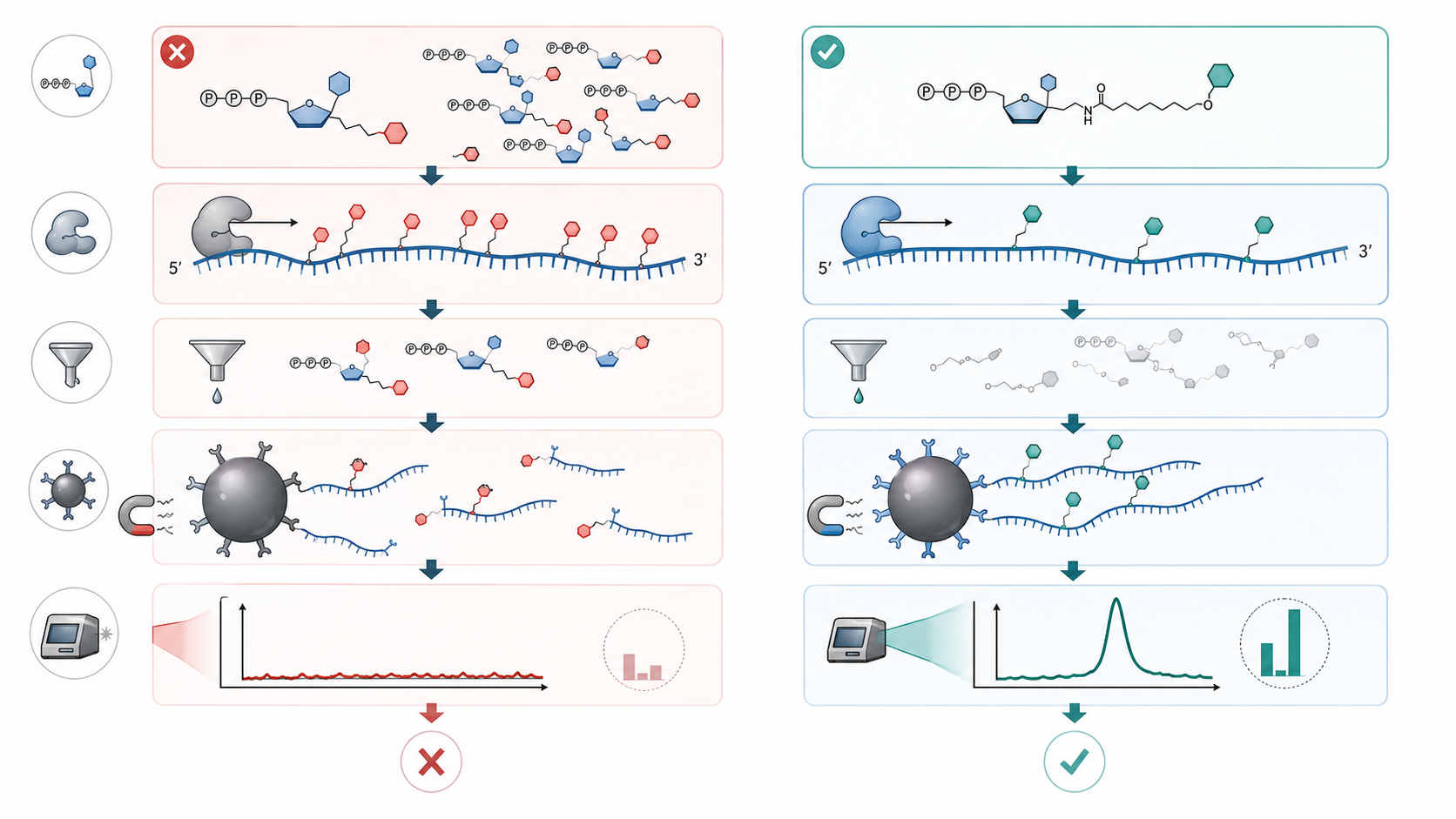 Schematic comparison of a poorly matched biotin nucleotide workflow versus an optimized design that improves incorporation, reduces free-label background, and increases streptavidin-based capture efficiency.
Key Challenges Research Teams Face in Biotin Labeled Nucleotide Projects
Labeling Reduces Enzymatic Efficiency
Biotin adds steric bulk, and not every nucleotide analog behaves the same way in polymerase- or ligase-driven workflows. We help assess whether the project is better served by a biotin-dNTP, biotin-NTP, ddNTP, or end-labeling route instead of forcing one chemistry into every application.
Streptavidin Access Is Weaker Than Expected
A labeled product can still underperform if the biotin is buried, too densely incorporated, or attached through a spacer that does not suit the final surface or bead format. We review linker presentation, nucleotide substitution strategy, and downstream capture geometry so the affinity handle remains usable after incorporation.
Background Persists After Labeling
Free biotin, unincorporated biotin nucleotide, and leftover labeled primer can compete with the intended product during streptavidin capture or detection. We build purification and cleanup logic into the workflow so the delivered material is more suitable for pull-down, immobilization, and signal-development steps.
QC Does Not Predict Assay Performance
A successful synthesis result is not always an application-ready reagent. Beyond identity and purity, many projects need evidence that the labeled nucleotide is incorporated as expected and still supports capture, hybridization, transcription, or extension behavior relevant to the assay.
Our Biotin Labeled Nucleotide Services
We provide custom support from nucleotide-format selection through synthesis planning, incorporation strategy design, purification, and analytical review. Projects may focus on a single biotin analog or on a broader labeling workflow in which the nucleotide choice must match enzyme behavior, probe architecture, capture format, and downstream readout.
 Biotin dNTPs
Capabilities include:
- Planning and preparation support for DNA-focused biotinylated nucleotide formats such as biotin-dUTP and related biotin-dNTP analogs.
- Selection of linker presentation and substitution strategy for PCR, primer extension, nick translation, random priming, or DNA probe labeling workflows.
- Review of whether partial replacement or controlled incorporation is preferable to maximize usable labeling while preserving workable enzymatic performance.
- Alignment of nucleotide format with downstream applications such as streptavidin capture, blot probes, or hybridization-based detection.
Typical applications:
Nonradioactive DNA probe generation, PCR-derived capture products, DNA pull-down constructs, and labeled amplicons for downstream affinity workflows.
 Biotin NTPs
Capabilities include:
- Support for RNA-labeling nucleotide formats such as biotin-UTP and related biotin-NTP analogs used in in vitro transcription.
- Method planning around transcript length, intended labeling density, and polymerase-driven incorporation strategy.
- Selection of analog-to-natural NTP balance when projects require control over biotin frequency rather than maximum substitution.
- Coordination with downstream RNA probe, capture, or transcript-tracking studies that rely on streptavidin-based detection or enrichment.
Typical applications:
Biotinylated RNA probe preparation, in vitro transcription products for pull-down or hybridization studies, and assay development using labeled transcripts.
 Biotin ddNTPs
Capabilities include:
- Project support for chain-terminating biotin-labeled nucleotides when controlled extension stop points or end-marking strategies are required.
- Assessment of whether a terminating nucleotide is the right choice for sequencing-oriented, primer-extension, or mapping-style workflows.
- Discussion of stoichiometry, extension control, and downstream detection requirements before committing to a terminating analog.
- Integration with custom assay builds that require a single defined affinity handle rather than distributed internal incorporation.
Typical applications:
Extension-stop experiments, defined-end labeling strategies, and method-development studies using chain-terminating affinity nucleotides.
 3′ End Labeling
Capabilities include:
- Support for ligation-ready biotin nucleotide formats such as pCp-biotin and related reagents used for 3′ RNA end labeling.
- Evaluation of substrate type, terminal accessibility, and ligase-based workflow fit for RNA, miRNA, or short transcript labeling.
- Planning for single-site labeling when random internal incorporation is not desirable.
- Guidance on cleanup and verification so the final RNA product is suitable for capture, hybridization, or interaction studies.
Typical applications:
RNA end labeling, small-RNA probe preparation, mobility-shift style studies, and workflows that require a defined 3′ biotin handle.
 Method Development
Capabilities include:
- Workflow design around PCR, nick translation, random priming, in vitro transcription, terminal transferase, or ligase-based labeling routes.
- Selection of incorporation strategy based on desired label density, product length, assay sensitivity, and downstream capture format.
- Troubleshooting support for low incorporation, reduced yield, poor streptavidin binding, or excessive background after labeling.
- Natural alignment with related fluorescence labeling of nucleic acids or biotin labeled oligonucleotides programs when a nucleotide route is not the best final format.
Focus areas:
Enzyme compatibility, linker accessibility, workable labeling density, product cleanup, and fit to the actual detection or capture method.
 QC & Release
Capabilities include:
- Identity and purity review using appropriate analytical tools for nucleotide reagents and labeled products.
- Assessment of incorporation outcome by method-appropriate readouts such as chromatography, electrophoresis, or functional capture checks.
- Evaluation of residual free biotin or unincorporated labeled species when these impurities could affect streptavidin-based workflows.
- Reporting structured for repeat ordering, process transfer, or follow-up optimization.
Deliverables:
Project summary, analytical data package, handling recommendations, and application-relevant observations for downstream use.
Biotin-Labeled Nucleotide Formats and Selection Considerations
The best biotin nucleotide is determined by the intended incorporation route, the target nucleic acid type, and how the biotin handle will be used after labeling. The table below summarizes common format choices and the practical questions they help answer during project planning.
| Nucleotide Format | Typical Use Route | Common Output | Key Development Considerations | Why It Matters to Customers |
| Biotin-dUTP / Biotin-dNTPs | PCR, nick translation, random priming, DNA polymerase-based labeling | Biotinylated DNA fragments or amplicons | Balance incorporation with polymerase tolerance, probe length, and required capture strength | Useful when teams need DNA probes or labeled DNA products that can be captured or detected without radioactivity |
| Biotin-UTP / Biotin-NTPs | In vitro transcription with RNA polymerases | Biotinylated RNA transcripts or RNA probes | Choose analog ratio, transcript architecture, and purification strategy with the final RNA application in mind | Supports RNA-focused workflows where internal biotin incorporation is preferred over terminal oligo modification |
| Biotin-ddNTPs | Controlled chain termination or defined-end labeling workflows | Stopped extension products with a defined affinity handle | Must match the required stop behavior, extension design, and downstream detection logic | Helpful when a single controlled biotin position is more useful than distributed labeling |
| pCp-Biotin / 3′ End-Labeling Reagents | T4 RNA ligase or related end-labeling strategies | 3′ biotin-labeled RNA or small RNA products | Terminal accessibility, ligation efficiency, and cleanup are central to method success | Provides defined 3′ labeling for projects where internal incorporation would disrupt the biology or readout |
| Long-Linker Biotin Analogs | DNA or RNA labeling workflows where steric access is limiting | Labeled nucleic acids with more accessible biotin presentation | Spacer length can improve streptavidin access but should still fit the incorporation chemistry | Important for bead capture, surface immobilization, and crowded assay formats where a short linker underperforms |
Incorporation Routes and Process Development Considerations
Biotin labeled nucleotides can be introduced into nucleic acids by several different enzymatic routes. Choosing the right route early helps avoid poor incorporation, excessive background, and mislabeled products that do not behave well in downstream capture or detection workflows.
| Incorporation Strategy | Typical Labeled Nucleotide | Common Output | Critical Control Points |
| PCR / Primer Extension | Biotin-dUTP or related biotin-dNTPs | Biotinylated DNA amplicons or extension products | Polymerase compatibility, labeled-to-natural nucleotide ratio, amplicon yield, and removal of excess labeled primer or nucleotide |
| Nick Translation / Random Priming | Biotin-dUTP | Labeled DNA probes for hybridization workflows | Fragment size distribution, substitution level, probe integrity, and downstream hybridization behavior |
| In Vitro Transcription | Biotin-UTP or related biotin-NTPs | Biotinylated RNA transcripts and RNA probes | RNA polymerase acceptance, transcript length, labeling density, and post-transcription cleanup |
| Terminal Transferase Labeling | Compatible biotinylated nucleotide substrates | 3′-end modified DNA products | End accessibility, tail length control, and whether the added biotin distribution suits the planned assay |
| 3′ RNA Ligation | pCp-biotin or other ligation-ready biotin formats | Defined 3′ biotin-labeled RNA | Ligase performance, terminal structure, cleanup efficiency, and confirmation of single-site end labeling |
Analytical Characterization and Quality Control Framework
For biotin labeled nucleotide programs, quality evaluation should confirm both chemical identity and workflow relevance. Depending on the project, that means checking not only the nucleotide reagent itself, but also whether the final labeled DNA or RNA is clean, correctly sized, and functionally accessible to streptavidin-based capture or detection.
| Analytical Category | Representative Method | Purpose in Development | Data Delivered |
| Identity Confirmation | LC-MS or other mass-based confirmation | Verifies that the intended biotinylated nucleotide or labeled product was generated | Identity summary and molecular confirmation notes |
| Purity Assessment | HPLC, ion-exchange HPLC, or related chromatography | Measures major product content and identifies residual unlabeled or side-product species | Chromatograms, purity observations, and lot comparison data |
| Size / Integrity Review | Gel electrophoresis or capillary analysis | Confirms the expected size profile of labeled DNA or RNA products | Band pattern, size distribution, and integrity comments |
| Incorporation Check | Method-appropriate incorporation or conversion assessment | Shows whether the labeled nucleotide entered the product as intended | Incorporation summary and comparative build observations |
| Affinity Accessibility Test | Streptavidin capture, binding, or detection-oriented functional check | Determines whether the biotin remains accessible after labeling and cleanup | Capture or signal observations relevant to the intended assay |
| Documentation Package | Structured reporting of synthesis, purification, and QC | Supports repeat ordering, project transfer, and downstream process refinement | Batch record summary, analytical package, and handling guidance |
Workflow for Custom Biotin Labeled Nucleotide Projects


Application Review and Feasibility Scoping
We begin by clarifying the nucleic acid type, intended labeling route, downstream capture or detection method, and whether the project needs a distributed label or a defined terminal biotin. This prevents early chemistry choices from being made without assay context.

Nucleotide and Enzyme Compatibility Planning
The labeled nucleotide format is aligned with the relevant polymerase, ligase, or extension strategy. Linker style, expected incorporation behavior, and target labeling density are reviewed before synthesis or method execution.

Synthesis or Reagent Preparation
We prepare or organize the selected biotin nucleotide format and configure the labeling workflow around the intended DNA or RNA substrate, keeping the final use case in view rather than treating the nucleotide as a standalone commodity.

Labeling Execution and Cleanup
The incorporation or end-labeling step is carried out using the chosen enzymatic route, followed by cleanup designed to reduce interference from free biotin, unincorporated nucleotide, or residual labeled primer.

QC and Functional Verification
Appropriate analytical methods are used to confirm identity, purity, size, and incorporation outcome, with added emphasis on whether the final labeled product still behaves as needed in streptavidin-based detection or capture.

Delivery and Follow-Up Guidance
Final output can include the labeled nucleotide reagent, the prepared labeled nucleic acid, analytical documentation, and practical recommendations for storage, handling, and next-step assay integration.
Why Choose Our Biotin Labeled Nucleotide Service
Application-Matched Format Selection
We help distinguish when a project needs a biotin-dNTP, biotin-NTP, ddNTP, or end-labeling reagent rather than treating all biotin nucleotide formats as interchangeable.

Strong Focus on Usable Biotin Access
We consider linker presentation, labeling density, and cleanup because a nucleotide that incorporates successfully is not automatically optimal for streptavidin capture or immobilization.
Integrated Development from Reagent to Product
Support can cover the labeled nucleotide itself as well as the downstream DNA or RNA labeling workflow, reducing the disconnect between reagent choice and assay performance.
QC Framed Around Workflow Fit
Analytical review is structured to answer practical questions about purity, incorporation, and streptavidin accessibility so the data package is easier to use for decision-making and repeat builds.
Common Research Applications of Biotin Labeled Nucleotides
Nonradioactive DNA Probe Labeling
- Preparation of biotinylated DNA probes for Southern, Northern, and related hybridization assays.
- Useful when a stable affinity label is preferred over radioactive detection formats.
- Compatible with downstream streptavidin-enzyme or streptavidin-fluorophore detection workflows.
RNA Probe Transcription
- In vitro transcription of biotinylated RNA probes for hybridization and transcript-focused studies.
- Supports internal RNA labeling when a terminally modified oligo is not the preferred format.
- Useful for applications that combine RNA synthesis with downstream affinity detection or enrichment.
Affinity Capture and Pull-Down
- Generation of biotin-labeled DNA or RNA products for streptavidin bead capture and enrichment.
- Applicable to nucleic acid–protein interaction studies, target recovery, and workflow prototyping.
- Helps create capture-ready materials for washing, partitioning, and downstream analysis.
Surface Immobilization Workflows
- Supports attachment of labeled nucleic acids to streptavidin-coated plates, beads, chips, and other assay surfaces.
- Useful for biosensor development, microarray-style formats, and custom assay construction.
- Linker accessibility can be tuned for crowded or surface-sensitive formats.
In Situ and Hybridization Studies
- Biotin-labeled nucleotides can support DNA or RNA probe preparation for in situ hybridization-style studies.
- Particularly useful where capture-based or amplified detection is preferred after hybridization.
- Workflow design can be adapted for probe size, labeling density, and detection format.
Method Development and Controls
- Useful for evaluating polymerase acceptance, labeling density effects, and capture behavior in new assay builds.
- Supports screening of nucleotide formats before committing to a larger probe or kit-development program.
- Provides labeled standards or intermediate reagents for internal workflow comparison.
Discuss Your Biotin Labeled Nucleotide Project
Whether you need a biotin-dUTP strategy for DNA probe preparation, a biotin-UTP workflow for in vitro transcription, or a defined 3′ RNA labeling approach, we provide technically focused support across format selection, incorporation planning, purification, and QC.
If your project is better served by a prebuilt modified probe rather than nucleotide incorporation, we can also coordinate with biotin labeled oligonucleotides and broader biotin labeled nucleic acids programs. Contact our scientific team to discuss your target workflow and request a project-specific proposal.
Frequently Asked Questions (FAQ)
Are biotinylated nucleotides suitable for use in next-generation sequencing (NGS)?
Yes, biotinylated nucleotides are commonly used in NGS for DNA fragmentation, enrichment, and targeted sequencing. The biotin-streptavidin binding system ensures efficient capture and purification of specific DNA fragments.
How can I improve the efficiency of biotinylated nucleotide incorporation in DNA synthesis?
To enhance nucleotide incorporation, consider optimizing the reaction temperature, nucleotide ratio, and enzyme activity. Additionally, using high-quality biotinylated nucleotides ensures more consistent and efficient labeling during DNA synthesis.
Can I use biotinylated nucleotides for RNA applications like hybridization?
Biotinylated nucleotides are highly effective for RNA hybridization assays, as they allow for the specific capture and detection of RNA molecules. Their ability to bind to streptavidin-coated surfaces enables easy isolation and analysis of biotinylated RNA.
Can biotinylated nucleotides be used in multiplex assays?
Yes, biotinylated nucleotides are ideal for use in multiplex assays, especially in PCR or microarray-based applications. Their ability to be detected with high specificity enables the simultaneous analysis of multiple targets in a single experiment.