PEG Lipid Synthesis & Conjugation
Stealth Surface Engineering for NanocarriersCustom PEG Lipid Design & SynthesisFor Liposomes, Micelles & LNP Research
PEG lipids are amphiphilic conjugates that combine a lipid anchor with a polyethylene glycol spacer and, when needed, a terminal functional group for downstream coupling. They are widely used to control nanoparticle surface properties, reduce aggregation, improve colloidal behavior, and create chemically addressable interfaces for liposome, micelle, and lipid nanoparticle (LNP) systems.
We provide custom PEG lipid synthesis and conjugation services for research teams developing liposomal formulations, nucleic acid delivery systems, targeted nanocarriers, and surface-functionalized lipid assemblies. Projects can be tailored by lipid anchor, PEG molecular weight, terminal chemistry, conjugation route, and intended formulation workflow, with analytical characterization designed to help you move from concept screening to reproducible material supply.
How PEG Lipids Solve Real Delivery and Surface Engineering Problems
Many nanocarrier projects fail for practical rather than conceptual reasons: particles aggregate during storage, surface ligands are buried or inconsistently exposed, insertion into liposomes is unstable, or a formulation becomes too shielded to interact effectively with target cells. PEG lipids help address these issues by creating a hydrophilic steric layer at the particle surface, tuning anchor retention in membranes, and presenting reactive end groups for controlled attachment of peptides, antibodies, aptamers, dyes, biotin, or other ligands. When the anchor, PEG length, terminal group, and insertion strategy are matched to the intended system, PEG lipids become a design tool for balancing stability, functionality, and manufacturability rather than a simple excipient choice.
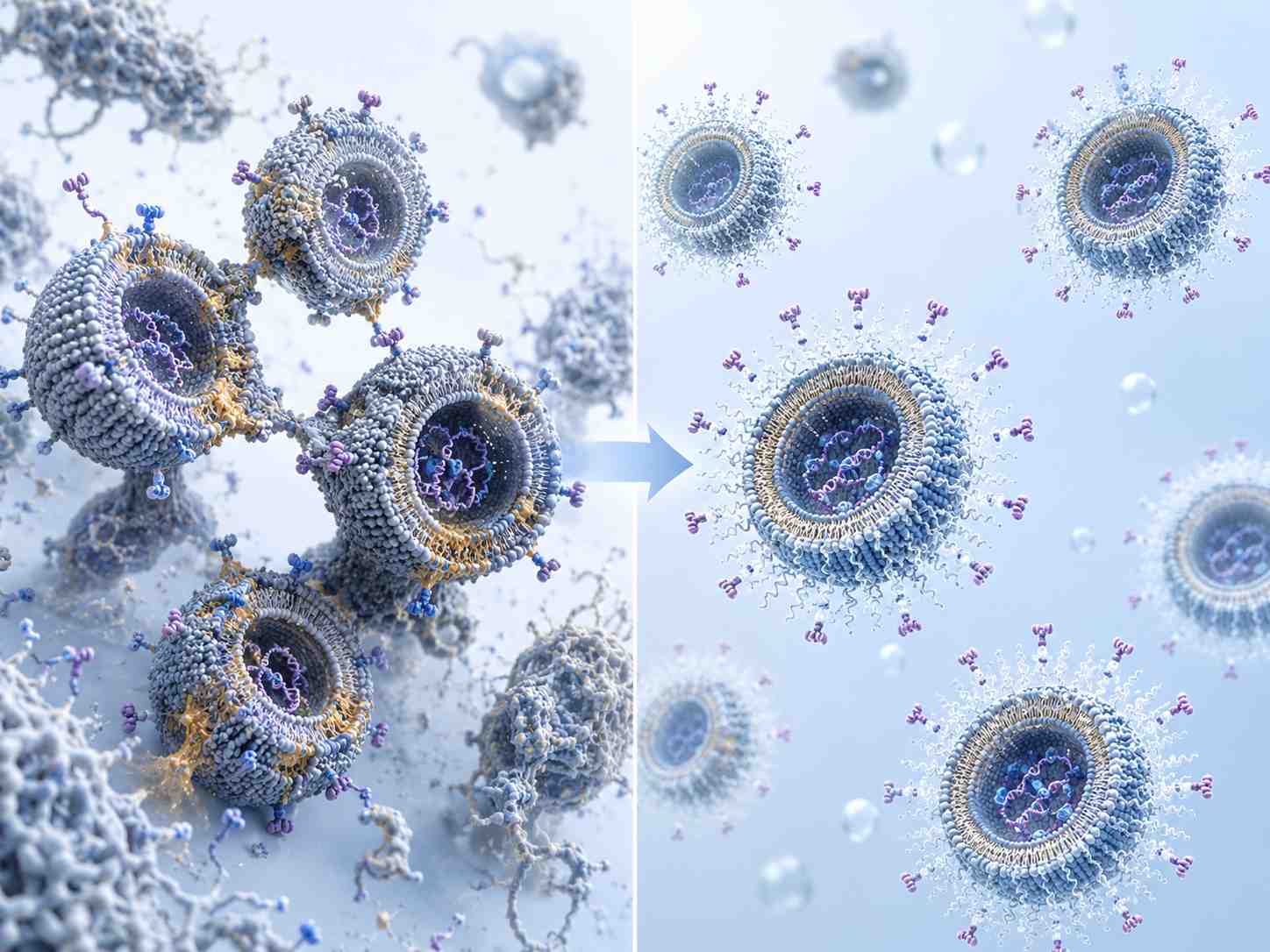 Illustration of PEG lipid-enabled surface engineering showing stabilized liposomes and LNPs with a hydrated PEG corona, controlled ligand presentation, and reduced aggregation risk.
Why PEG Lipid Projects Commonly Stall
Shielding That Improves Stability but Reduces Uptake
A PEG layer can improve colloidal stability and suppress nonspecific adsorption, but excessive shielding may also reduce membrane interaction or ligand accessibility. We help balance PEG density, spacer length, and ligand presentation so the formulation is not over-protected for its intended study.
Wrong Anchor Choice for the Intended Residence Time
Fast-exchanging and longer-retention PEG lipid anchors behave differently in liposomes and LNPs. Selecting the wrong anchor can lead to premature desorption, unstable post-insertion, or persistent surface shielding that does not fit the project goal.
Reactive End Groups Losing Activity During Conjugation
Maleimide hydrolysis, NHS ester degradation, or poorly controlled click reactions can reduce coupling efficiency and leave a high fraction of inactive material. We design reaction sequences, buffers, and handling conditions around the chemistry actually being used.
Uncontrolled Ligand Density on the Particle Surface
Even when a ligand–PEG–lipid conjugate is synthesized successfully, the final nanoparticle may display too little, too much, or poorly accessible ligand. We support projects that need rational control over spacer length, insertion ratio, and post-insertion conditions.
Purity and Batch Consistency Issues
Residual unconjugated lipid, free PEG species, partially reacted intermediates, or variable substitution levels can complicate interpretation of downstream formulation studies. Our workflows emphasize reaction control, purification fit-for-purpose, and batch comparability.
Analytical Gaps Between the Neat Conjugate and the Final Formulation
Confirming the structure of a PEG lipid alone is not the same as verifying how it behaves after insertion into a liposome or LNP. We can align conjugate characterization with formulation-facing readouts such as particle size, PDI, zeta potential, and ligand-associated signal tracking.
Our PEG Lipid Design, Synthesis & Surface Functionalization Services
We support PEG lipid programs from early design through purified conjugate delivery and formulation-facing evaluation. Depending on project scope, our work can be integrated with broader PEGylation, lipid conjugation, and liposome conjugation workflows.
 Custom PEG Lipid Synthesis
Capabilities include:
- Design of PEG lipids built around phospholipid, glyceride, sterol, or other lipid anchors
- Selection of PEG molecular weight based on steric shielding, linker reach, and formulation behavior
- Preparation of methoxy-terminated or reactive PEG lipids for non-targeted or derivatizable systems
- Route development for research-scale and repeated batch supply
- Purification strategies matched to the polarity and heterogeneity of the final conjugate
- Structure confirmation by orthogonal analytical methods
Typical uses:
PEGylated helper lipids for liposomes, micelles, emulsions, and LNP research where anchor choice and PEG architecture need to be tuned rather than purchased off-the-shelf.
 Reactive PEG Lipids with Defined End Groups
Capabilities include:
- Maleimide, NHS ester, carboxyl, amine, azide, alkyne, DBCO, biotin, and related terminal chemistries
- Chemistry selection based on ligand class, solvent constraints, and downstream reaction sequence
- Support for thiol-coupling, amine-coupling, and copper-free click workflows
- Stability-aware handling to reduce loss of terminal group reactivity
- Optional linkage planning for spacer exposure and steric accessibility
Related workflows:
For projects that require sterol anchors instead of phospholipid anchors, related cholesterol conjugation options can be incorporated into the design stage.
 Ligand–PEG–Lipid Conjugation
Capabilities include:
- Coupling of peptides, proteins, antibody fragments, aptamers, carbohydrates, fluorophores, and small molecules to PEG lipids
- End-group specific reaction design to preserve ligand activity where possible
- Control of linker orientation and conjugation site compatibility
- Purification plans to separate free ligand from the final conjugate
- Conjugates prepared for direct formulation or later post-insertion
Typical outcomes:
Ligand-ready PEG lipids for targeted or traceable lipid systems in screening and formulation development.
 Post-Insertion & Formulation Integration Support
Capabilities include:
- Preparation of PEG lipid conjugates intended for insertion into preformed liposomes or LNPs
- Support for evaluating insertion strategy versus pre-mixing during formulation
- Guidance on how anchor strength and PEG length may influence retention and exposure
- Compatibility planning for nucleic acid and other nanocarrier systems
- Optional alignment with oligonucleotide-loaded LNP research workflows
Typical uses:
Surface decoration studies, targeted liposome engineering, and modular ligand display on preformed particles.
 Analytical Characterization & Labeling Support
Capabilities include:
- Identity and purity assessment by LC-MS, HPLC, and NMR where appropriate
- Verification of substitution or conjugation state
- Residual free ligand and impurity review
- DLS and related particle characterization support after insertion or formulation
- Optional integration with fluorescent phospholipid labeling when tracing membrane incorporation or surface display is important
Deliverables:
Project-dependent data packages that help connect synthetic success with formulation usability.
Key Design Variables When Selecting a PEG Lipid
The most useful PEG lipid is not always the most familiar one. Selection should reflect how long the anchor needs to remain associated with the particle, how exposed the ligand must be, how much steric shielding the system requires, and what chemistry will be used after synthesis.
| Design Variable | Common Options | Why It Matters | Questions We Help Answer | Typical Service Implication |
| Lipid Anchor | DSPE-type, shorter-chain glyceride anchors, cholesterol-type anchors, other custom lipophilic motifs | Anchor identity affects membrane insertion, exchange rate, retention, and formulation compatibility | Should the PEG lipid remain persistently associated or exchange more readily after formulation? | Anchor-first design to match liposome, micelle, or LNP behavior rather than using a generic PEG-lipid default |
| PEG Molecular Weight | Short, intermediate, or longer PEG spacers depending on steric and display needs | PEG length influences hydration layer thickness, ligand reach, steric shielding, and insertion behavior | Is the goal stealth, ligand exposure, reduced aggregation, or a balance of all three? | Spacer optimization during design and screening |
| Terminal Group | mPEG, maleimide, NHS ester, amine, carboxyl, azide, alkyne, DBCO, biotin, fluorophore | End-group chemistry determines what ligands can be attached and how robust the coupling workflow will be | Is the ligand thiol-bearing, amine-bearing, click-compatible, or better introduced by a staged route? | Reactive PEG lipid synthesis or ligand-ready conjugate preparation |
| Linkage Strategy | Stable covalent coupling, cleavable linker options, direct versus spacer-mediated connection | Linkage choice can affect stability, steric accessibility, and how the surface-presented ligand behaves | Does the project need a permanent display handle or a more release-sensitive architecture? | Conjugation route planning and risk reduction |
| Insertion Mode | Pre-formulation incorporation or post-insertion into preformed particles | The insertion mode can change ligand exposure, process flexibility, and material handling requirements | Is it better to decorate the particle after formulation or build the PEG lipid in from the start? | Workflow selection based on material availability and screening speed |
| Surface Density Target | Low, moderate, or higher PEG-lipid loading depending on the system | PEG density affects steric protection, protein interactions, particle size control, and ligand accessibility | How much PEG is enough to stabilize the system without over-shielding the surface? | Screening-oriented formulation guidance and comparative study design |
PEG Lipid Synthesis and Conjugation Routes We Support
Different PEG lipid projects fail for different reasons, so route selection matters. Some programs need a stable non-reactive helper lipid, while others need a highly controlled reactive intermediate for ligand attachment or a post-insertion compatible construct for surface decoration after particle formation.
| Route | Typical Chemistry | Best Suited For | Main Advantages | Key Watch Points |
| Direct Lipid-PEG Coupling | Assembly of the lipid anchor and PEG block followed by terminal capping or further activation | Custom non-reactive PEG lipids and defined reactive intermediates | Straightforward control over anchor and PEG architecture | Requires purification plans that address amphiphilic behavior and closely related byproducts |
| Maleimide-Based Conjugation | Thiol-selective coupling to cysteine-bearing peptides, proteins, or thiolated probes | Ligand-presenting PEG lipids and targeted surface modification projects | Efficient covalent attachment under mild conditions | Maleimide hydrolysis and thiol oxidation can reduce effective coupling if handling is not controlled |
| NHS / Carboxyl / Amine Routes | Amide-bond forming workflows for amine-containing ligands or modular intermediate preparation | Small molecules, peptides, and certain biomolecule adaptation routes | Broad compatibility with common ligands and spacer designs | Buffer and pH control are important to avoid hydrolysis or low coupling efficiency |
| Bioorthogonal Click Conjugation | Azide-alkyne or strain-promoted copper-free click workflows such as azide/DBCO | Site-selective conjugation where orthogonality and modularity are priorities | Useful for staged builds and surface engineering with reduced interference from other functionalities | Reagent choice should fit solvent tolerance, ligand stability, and formulation timing |
| Post-Insertion of Ligand–PEG–Lipid Conjugates | Pre-synthesized ligand–PEG–lipid inserted into preformed liposomes or LNPs | Modular particle decoration and rapid comparative surface screening | Decouples conjugate synthesis from carrier formation and simplifies variant testing | Requires attention to anchor retention, insertion conditions, and final ligand accessibility |
| Labeling-Oriented PEG Lipids | Biotin, fluorophore, or affinity tag installation on lipid-PEG scaffolds | Tracking, localization, uptake, and membrane insertion studies | Supports mechanistic research without changing the full carrier design | Signal tag selection should avoid overwhelming the native behavior of the carrier |
Analytical Characterization Framework for PEG Lipid Projects
A PEG lipid that looks correct on paper can still underperform in a formulation if the reactive group is partly lost, the substitution level is inconsistent, or the inserted conjugate alters particle properties unexpectedly. Our analytical approach is designed to help research teams verify both the molecule itself and its formulation relevance.
| Analytical Category | Typical Methods | What It Verifies | Why Clients Ask for It |
| Identity Confirmation | LC-MS, HRMS, and NMR where appropriate | Confirms anchor, PEG block, terminal group, and expected molecular composition | Distinguishes successful synthesis from partially converted or misassigned material |
| Purity & Impurity Review | HPLC, UPLC, or orthogonal chromatographic methods | Evaluates free PEG species, unconjugated lipid, residual ligand, and closely related impurities | Helps prevent downstream formulation results from being confounded by mixed material |
| Reactive Group Integrity | LC-MS trend review, NMR, or reaction-performance checks depending on the chemistry | Assesses whether maleimide, NHS, azide, or other terminal groups remain functionally usable | Important when coupling efficiency matters more than nominal structure alone |
| Conjugation State | LC-MS with chromatographic separation and project-specific signal tracking | Distinguishes fully conjugated, partially conjugated, and unconjugated species | Supports more reliable interpretation of ligand density and activity studies |
| Particle-Level Characterization | DLS, PDI, zeta potential, and related formulation-facing measurements | Evaluates how the PEG lipid or conjugate affects particle size distribution and surface properties after insertion | Links synthetic material quality to liposome or LNP usability |
| Stability Review | Condition-dependent monitoring of neat material and, when relevant, formulated samples | Tracks storage sensitivity, end-group durability, and changes after insertion | Useful for projects that require repeated studies or staged screening |
| Comparability Support | Batch-to-batch analytical comparison | Reviews whether repeated preparations remain suitable for the same formulation workflow | Helps research teams reduce avoidable variability across screening rounds |
PEG Lipid Project Workflow from Design to Delivery


1. Technical Scoping
We review the intended carrier type, ligand class, anchor preference, PEG length target, and whether the project needs a helper lipid, reactive intermediate, or finished ligand–PEG–lipid conjugate.

2. Architecture Selection
A project-specific structure is proposed around anchor retention, spacer reach, terminal chemistry, and insertion strategy so the conjugate is aligned with the actual formulation question being asked.

3. Synthesis & Conjugation
We execute the selected synthetic route, including lipid-PEG assembly, activation, and ligand coupling where required, with process controls chosen for the chemistry involved.

4. Purification & Structural Verification
Purification is performed according to the polarity and heterogeneity of the product, followed by identity and purity analysis to confirm that the delivered material matches the intended design.

5. Formulation-Relevant Evaluation
When needed, we extend characterization toward insertion or formulation-facing behavior so the project does not stop at molecular confirmation alone.

6. Delivery of Material & Data Package
Final deliverables typically include the PEG lipid or conjugate, analytical data, and project notes that support continued screening, formulation refinement, or expansion to related nanocarrier work.
Why Teams Choose Our PEG Lipid Services
Design Starts from the Formulation Problem
We do not treat PEG lipids as interchangeable catalog items. Anchor retention, spacer length, terminal chemistry, and post-insertion needs are considered together so the material fits the intended carrier and experiment.

Practical Control of Reactive Chemistry
PEG lipid projects often fail at the coupling step, not at the concept stage. We plan around real issues such as hydrolysis, thiol sensitivity, orthogonality, and purification burden before the project reaches formulation work.
Synthetic and Analytical Thinking in One Workflow
Material identity, purity, and reactive group integrity are evaluated with downstream use in mind, helping reduce the gap between a structurally correct conjugate and a formulation-ready material.
Natural Extension to Adjacent Lipid Surface Engineering
PEG lipid work can be expanded into related projects involving targeted liposomes, labeled phospholipids, or broader surface-functionalized lipid systems without forcing a disconnected handoff between chemistry and formulation teams.
Research Applications of PEG Lipids
LNP Surface Stabilization
- PEG lipids used as low-percentage helper components to help control particle size and colloidal behavior.
- Comparative evaluation of anchor type, PEG length, and loading level during LNP formulation studies.
- Particularly relevant in nucleic acid delivery research where surface behavior influences screening outcomes.
Liposome Surface Functionalization
- Preparation of reactive PEG lipids for insertion or incorporation into liposomal bilayers.
- Presentation of ligands, dyes, or affinity tags at the liposome surface.
- Compatible with modular studies of targeting, tracking, and membrane display.
Targeted Nanocarrier Decoration
- Ligand–PEG–lipid conjugates for decorating liposomes or nanoparticles with peptides, antibody fragments, aptamers, or carbohydrates.
- Useful for projects that need a chemically defined spacer between the carrier and the targeting motif.
- Supports surface engineering studies where ligand accessibility matters.
Micelles and Amphiphilic Self-Assemblies
- PEG-lipid architectures for self-assembling carrier systems that require a tuned hydrophilic–hydrophobic balance.
- Useful when solubilization and surface stabilization need to be co-optimized.
- Can be adapted for labeled or ligand-bearing micellar studies.
Imaging and Tracking Studies
- Biotinylated or fluorescent PEG lipids for tracing insertion, localization, or surface persistence.
- Helpful in mechanistic studies of membrane incorporation and particle decoration.
- Can be combined with signal-based readouts without redesigning the full carrier system.
Comparative Surface Engineering Screens
- Head-to-head evaluation of different anchors, spacer lengths, or reactive end groups.
- Useful for narrowing from broad concepts to formulation-compatible candidates.
- Supports rational selection before larger batches or broader nanocarrier studies are initiated.
Build a PEG Lipid Strategy That Fits Your Carrier System
Whether you need a non-reactive PEG helper lipid, a reactive DSPE-PEG derivative, a ligand-ready PEG lipid for post-insertion, or a comparative panel for formulation screening, we can support the chemistry and characterization required for a more decision-ready workflow.
Our team works with research groups developing liposomes, micelles, LNPs, and other surface-engineered lipid systems to align anchor choice, PEG architecture, and conjugation chemistry with real project constraints.Contact our scientific team to discuss your PEG lipid design, synthesis, or surface functionalization project.
Frequently Asked Questions (FAQ)
What is a PEG lipid?
A PEG lipid is an amphiphilic conjugate that combines a lipid anchor with a PEG spacer and, in many cases, a terminal functional group for further coupling. In lipid-based systems, PEG lipids are widely used to influence colloidal stability, surface interactions, and overall delivery behavior.
How do I choose between DSPE-PEG and a faster-exchanging PEG lipid?
The choice depends on how long you want the PEG lipid to remain associated with the particle. Longer-retention anchors are often preferred when persistent surface coverage is needed, while faster-exchanging anchors can be useful when reduced long-term shielding is desired.
Which terminal groups are commonly used in PEG lipid projects?
Common options include methoxy, maleimide, NHS ester, amine, carboxyl, azide, DBCO, biotin, and related functional motifs. The right choice depends on the ligand class, reaction orthogonality, and the intended formulation workflow.
Can PEG lipids be used for post-insertion into preformed liposomes or LNPs?
Yes. Functionalized PEG lipids are commonly used for post-insertion and surface decoration when teams want to decouple conjugate synthesis from particle formation and compare multiple surface variants more efficiently.
What types of ligands can be attached to PEG lipids?
Depending on the chemistry, PEG lipids can be adapted for peptides, proteins or antibody fragments, aptamers, carbohydrates, fluorophores, biotin, and selected small molecules. Reactive end groups and spacer design are usually chosen around ligand stability and accessibility.