Copper-Free Click ConjugationDBCO, BCN & Azide Handle EngineeringCustom Biomolecule & Material Assembly
BOC Sciences provides custom SPAAC conjugation services for research projects requiring selective, copper-free coupling between azide-functionalized molecules and strained alkynes such as DBCO or BCN. Strain-promoted azide-alkyne cycloaddition (SPAAC) forms a stable triazole-containing linkage without a copper catalyst, making it particularly useful when proteins, antibodies, peptides, oligonucleotides, fluorophores, polymers, nanoparticles, or other sensitive components must be connected under mild conditions.
Our support extends beyond the final click reaction. We evaluate which partner should carry the azide or strained alkyne, how the reactive handle should be installed, whether DBCO or BCN better matches the substrate, how linker length and hydrophobicity may affect product behavior, and which purification and analytical methods can distinguish successful conjugation from residual starting material. Projects can also be coordinated with broader protein conjugation services, antibody conjugation services, peptide conjugation services, and oligonucleotide bioconjugation.
A successful SPAAC project depends on more than combining an azide with a commercially available cyclooctyne. Researchers commonly encounter low conversion at dilute concentration, inaccessible reactive handles, aggregation after DBCO installation, poorly controlled labeling ratios, difficult removal of excess click partner, or loss of biomolecule function after upstream handle modification. Our service strategy therefore considers handle installation, conjugation, purification, and final product requirements as one connected workflow.
We support projects starting from unmodified molecules as well as materials that are already azide-, DBCO-, BCN-, or otherwise click-functionalized. When the chemistry is not yet defined, we can compare alternative orientations and linker designs before committing valuable material to the final coupling step.
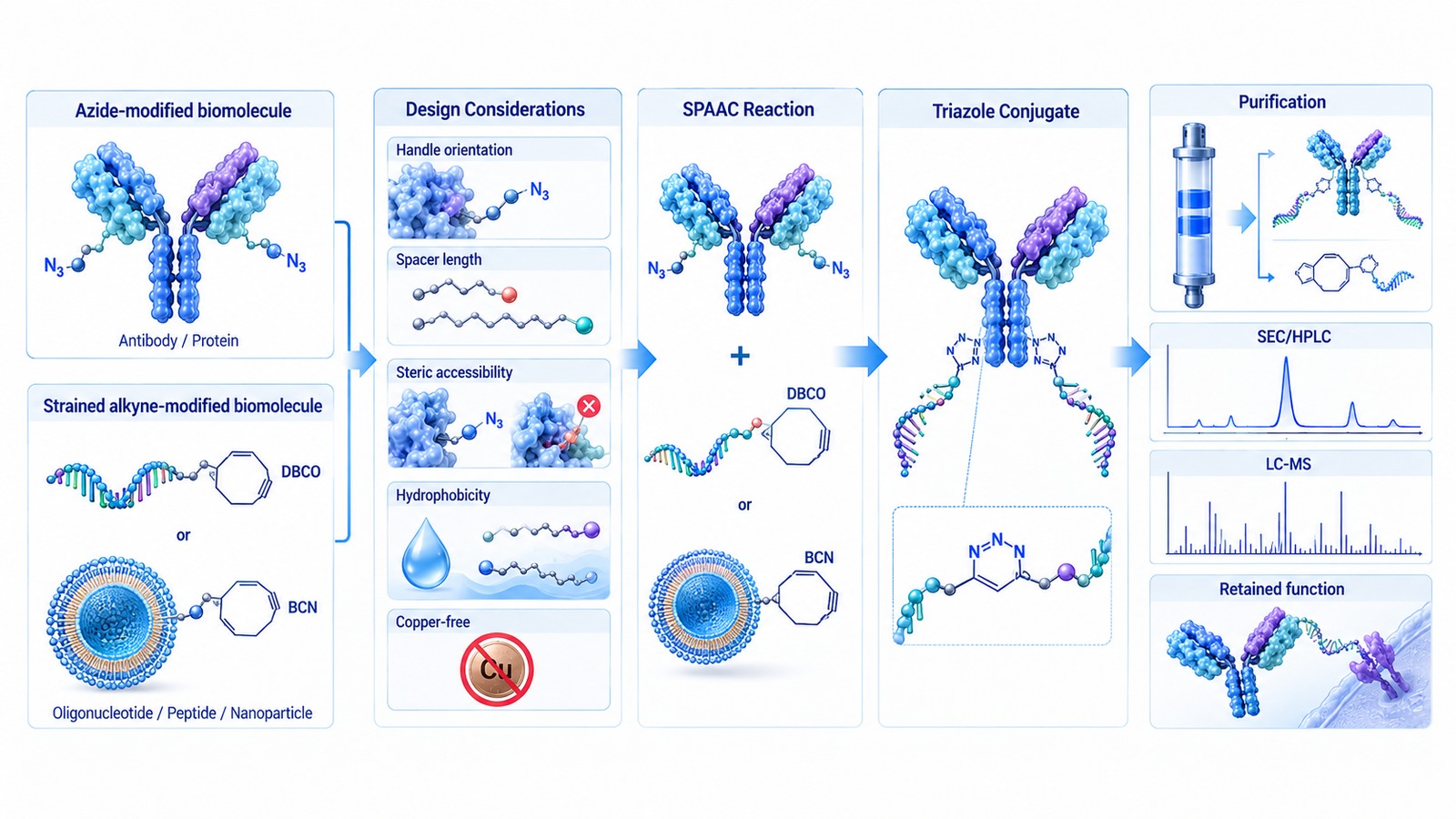 SPAAC project design should connect handle placement, strained alkyne selection, conjugation conditions, purification, and functional verification rather than treating the click step in isolation.
 Protein & Antibody SPAAC
We develop SPAAC workflows for proteins, antibodies, fragments, enzymes, binding proteins, and other folded biomolecules requiring modular attachment of labels, oligonucleotides, peptides, polymers, or small-molecule components.
Customer value: A coordinated route from biomolecule functionalization to qualified conjugate, rather than a click reaction performed without control of upstream handle placement.
 Peptide & Oligo SPAAC
SPAAC is well suited to modular coupling of peptides, DNA, RNA, modified oligonucleotides, aptamer components, and related synthetic biomolecules when complementary handles can be introduced at defined positions.
Customer value: Defined-handle assembly supports more controlled product architecture than relying on nonspecific modification during the final coupling step.
 Small-Molecule Click Assembly
We support SPAAC coupling of dyes, affinity tags, linker-payloads, lipids, ligands, chemical probes, and other small molecules to biomolecular or material partners.
Customer value: Greater flexibility in attaching chemically diverse payloads without introducing copper-catalyst handling into the final ligation step.
 Polymer & Particle Functionalization
SPAAC can also be used to assemble polymer-biomolecule, nanoparticle-biomolecule, hydrogel, bead, and functional-surface systems when complementary handles are accessible at the interface.
Customer value: The conjugation chemistry can be aligned with surface density, diffusion, particle stability, and downstream assay requirements.
 Label & Reporter Installation
Copper-free SPAAC provides a modular route for installing fluorescent reporters, affinity tags, biotin-containing components, analytical probes, and other functional labels onto azide- or cyclooctyne-bearing molecules.
Customer value: Reporter installation can be separated from the initial biomolecule modification step, making label screening and construct comparison easier to manage.
 Custom Handle Engineering
For projects that do not already contain SPAAC-compatible functionality, we design the precursor chemistry used to introduce azide, DBCO, BCN, or related strained-alkyne groups.
Customer value: Handle installation is designed around the final conjugate rather than selected as an isolated reaction.
SPAAC—strain-promoted azide-alkyne cycloaddition—is a copper-free cycloaddition between an organic azide and a ring-strained alkyne. Cyclooctyne derivatives such as DBCO and BCN contain a strained carbon-carbon triple bond that is sufficiently activated to react with azides without adding a copper catalyst. The two components undergo cycloaddition to create a stable triazole-containing connection.
In practical bioconjugation, the click step is commonly preceded by handle installation. For example, a protein may first be modified with a DBCO-bearing amine-reactive reagent, purified to remove excess reagent, and then reacted with an azide-modified oligonucleotide. The orientation can also be reversed. Which arrangement is preferable depends on handle accessibility, biomolecule stability, reagent availability, hydrophobicity, and the ease of characterizing each intermediate.
Step 1 — Introduce the Azide: Install an azide on one conjugation partner through a site-compatible modification route or incorporate it during synthesis.
Step 2 — Introduce the Strained Alkyne: Functionalize the complementary partner with DBCO, BCN, or another suitable cyclooctyne derivative.
Step 3 — Purify the Precursors: Remove residual handle-installation reagent before mixing the partners, reducing competition and simplifying interpretation of the final reaction.
Step 4 — Perform SPAAC: Combine the azide- and strained-alkyne-functionalized components under conditions compatible with the molecules being conjugated.
Step 5 — Purify & Verify: Separate the desired conjugate from excess partner, unreacted starting materials, aggregates, or other process-related species and confirm the relevant product attributes.
For additional background on the reaction family, see our SPAAC technical resource and overview of bioorthogonal reactions.
SPAAC is highly modular because the azide and strained-alkyne handles can be installed on many different molecular classes. Compatibility, however, should be evaluated at the level of the complete construct. The underlying biomolecule, linker, modification site, handle density, solvent requirements, and final payload can all influence whether the reaction is practical.
| Molecule Class | Typical SPAAC Handle Strategy | Common Conjugation Partner | Key Technical Considerations | Typical Analytical Focus |
| Proteins & Antibodies | Azide, DBCO, or BCN introduced through accessible amines, thiols, glycans, engineered sites, or other compatible precursor chemistry | Fluorophores, oligonucleotides, peptides, polymers, small molecules, affinity tags | Handle density, site distribution, protein concentration, hydrophobicity, aggregation, binding or activity retention | Degree of modification, SEC profile, intact mass or LC-MS where suitable, electrophoresis, functional comparison |
| Peptides | Terminal or side-chain azide/strained alkyne introduced during synthesis or post-synthetically | Oligonucleotides, dyes, lipids, ligands, proteins, polymers | Modification position, peptide solubility, sequence hydrophobicity, protecting-group history, steric access | HPLC, LC-MS, identity, purity, recovery |
| DNA, RNA & Oligonucleotides | 5′, 3′, or internal azide/DBCO/BCN modification according to synthesis design | Antibodies, proteins, peptides, small molecules, dyes, polymers, nanoparticles | Handle position, spacer length, hybridization accessibility, hydrophobic label effects, purification of unconjugated strands | HPLC, LC-MS where applicable, electrophoresis, UV analysis, hybridization-related checks |
| Small Molecules & Dyes | Azide-, DBCO-, or BCN-functionalized linker attached to an available synthetic handle | Proteins, antibodies, peptides, nucleic acids, polymers, particles | Solubility, linker placement, payload stability, excess-reagent removal, possible effect on final conjugate hydrophobicity | HPLC, LC-MS, UV-Vis or fluorescence where relevant |
| Polymers & PEG Constructs | Terminal or pendant azide/cyclooctyne groups | Biomolecules, labels, ligands, surfaces | Functional-group density, molecular-weight distribution, accessibility, multivalent coupling, product heterogeneity | Chromatography, spectroscopy, conjugation level, size-related analysis as appropriate |
| Nanoparticles & Beads | Surface-installed azide or strained alkyne, often separated from the particle surface by a spacer | Proteins, antibodies, peptides, oligonucleotides, dyes | Surface density, steric crowding, colloidal stability, nonspecific adsorption, removal of unbound partner | Particle size or surface-state analysis, loading assessment, optical measurements, functional response |
| Functional Surfaces & Hydrogels | Azide or cyclooctyne incorporated into the material or surface coating | Biomolecules, affinity ligands, probes, polymer components | Diffusion, surface accessibility, local handle density, nonspecific adsorption, incomplete surface conversion | Surface-specific or material-specific measurements and functional testing |
SPAAC chemoselectivity should not be confused with automatic site specificity. The final attachment site is controlled primarily by how the azide or strained alkyne is installed. Random lysine modification followed by SPAAC can still produce a distribution of attachment sites, whereas an azide introduced at a defined synthetic, enzymatic, glycan, or engineered site can provide substantially tighter positional control.
SPAAC is most useful when researchers need a modular click reaction but want to avoid copper in the final ligation step. It is especially valuable when the two conjugation partners can be prepared separately, purified, and then assembled through complementary azide and cyclooctyne handles.
SPAAC is a practical alternative to copper-catalyzed click chemistry when copper exposure, reducing conditions, catalyst removal, or potential effects on proteins and fluorescent components are undesirable.
When a biomolecule and payload need to be manufactured or characterized independently, azide and cyclooctyne handles allow each intermediate to be prepared first and joined later in a dedicated ligation step.
SPAAC is particularly useful when the azide or strained alkyne can be positioned at a defined terminus, synthetic residue, engineered site, or otherwise controlled modification point.
Protein-oligonucleotide, peptide-oligonucleotide, biomolecule-polymer, nanoparticle-biomolecule, and other structurally dissimilar partners can often be connected more conveniently after installation of a common SPAAC-compatible interface.
SPAAC can often be performed in aqueous or partly aqueous media under conditions compatible with folded biomolecules, provided solubility, concentration, and reagent stability are properly managed.
Labels or functional components can be attached after the main biomolecule has already been synthesized, expressed, purified, or otherwise prepared, simplifying construct diversification and comparative screening.
SPAAC is not the only useful bioconjugation reaction. Method selection should depend on available functional groups, desired site control, reaction concentration, sensitivity to copper or reducing conditions, required reaction speed, and the properties of the final product. The matrix below summarizes practical distinctions relevant to early project planning.
| Method | Reactive Pair | Catalyst / Key Reagent | Practical Strengths | Key Limitations | Typical Selection Scenario |
| SPAAC | Azide + strained alkyne such as DBCO or BCN | No copper catalyst required | Modular, selective handle pairing; mild conditions; convenient for many proteins, antibodies, peptides, oligos, polymers, and materials | Requires pre-installed handles; cyclooctyne size and hydrophobicity may affect product behavior; reaction efficiency can be concentration- and accessibility-dependent | Copper-free late-stage assembly of sensitive or structurally different partners |
| CuAAC | Azide + terminal alkyne | Cu(I), commonly with supporting ligand/reducing system | Highly established click reaction; small reactive handles; strong synthetic utility | Copper exposure and subsequent removal may be undesirable for some biological or fluorescence-sensitive systems | Projects where copper is acceptable and small azide/terminal-alkyne handles are advantageous |
| IEDDA | Tetrazine + strained alkene/alkyne such as TCO | No metal catalyst required | Very rapid bioorthogonal ligation can be advantageous at low concentration | Requires specialized reactive partners; reagent stability and handle architecture need project-specific consideration | Systems where very rapid ligation is a major design requirement |
| Maleimide-Thiol | Maleimide + sulfhydryl | No metal catalyst required | Direct, widely used approach for accessible cysteines or introduced thiols | Site distribution depends on thiol placement; competing thiols and final linkage behavior require consideration | Protein or peptide projects with a suitably positioned free thiol |
| NHS Ester | Activated ester + primary amine | No metal catalyst required | Simple and broadly applicable to proteins and other amine-bearing molecules | Multiple accessible amines can produce heterogeneous modification; hydrolysis competes with coupling | General labeling where site heterogeneity is acceptable |
| EDC/NHS Coupling | Carboxyl + amine | Carbodiimide activation | Uses common native functional groups and can avoid adding a large permanent linker | Competing functional groups and intermolecular crosslinking may complicate control | Molecules or materials where carboxyl-to-amine coupling is structurally appropriate |
When copper-catalyzed click chemistry is also under consideration, our CuAAC resource provides additional context for comparing the two azide-alkyne approaches.
The workflow is adapted to the substrate, handle-installation route, conjugate architecture, available quantity, and analytical requirements. For difficult projects, small-scale feasibility work may be used to compare handle orientation, strained alkyne type, or reagent ratio before the main preparation.


We review both conjugation partners, molecular structures or sequences, available quantities, buffers, desired attachment architecture, target labeling level, downstream use, and required analytical outputs. This establishes what the final conjugate needs to accomplish before the chemistry is selected.

We determine which partner should carry the azide and which should carry DBCO, BCN, or another suitable cyclooctyne. Linker length, PEG spacing, steric access, hydrophobicity, and intended attachment site are considered at this stage.

The SPAAC handles are introduced through substrate-compatible chemistry or incorporated during synthesis. Each intermediate is purified as needed to remove unreacted handle-installation reagent and to provide a cleaner starting point for the final click reaction.

The functionalized partners are combined using a reaction ratio, concentration, buffer, cosolvent level, temperature, and incubation period selected for the specific molecular system. Low-concentration or sterically hindered reactions can be screened under alternative conditions when needed.

The final reaction mixture is purified by a method appropriate to the size and physicochemical difference between product and starting materials. Analytical testing is then selected to examine identity, purity, conjugation level, aggregation, or functional retention as required by the project.

The final conjugate is supplied together with agreed analytical information and handling recommendations. Where follow-up batches are anticipated, observations from the development run can be used to define a more consistent repeat-production workflow.
SPAAC reactions often contain components that differ greatly in molecular weight, charge, hydrophobicity, or optical properties. Purification should therefore be selected around the actual product rather than around the reaction name. A protein-small molecule conjugate, peptide-oligonucleotide conjugate, and nanoparticle-protein construct may all require different separation strategies even when the same DBCO-azide chemistry is used.
| Development Need | Possible Method | What It Helps Evaluate | Typical Project Use |
| Remove Free Small Molecules | Desalting, size-exclusion chromatography, ultrafiltration, dialysis, or other size-based cleanup | Removal of excess DBCO/BCN reagent, azide label, solvent, salts, or low-molecular-weight byproducts | Proteins, antibodies, large polymers, nanoparticle-associated biomolecules |
| Resolve Closely Related Species | RP-HPLC, ion-exchange methods, SEC-HPLC, or other chromatographic approaches | Product purity, residual starting material, free label, truncated or side-product species | Peptides, oligonucleotides, small molecules, selected protein conjugates |
| Confirm Molecular Identity | LC-MS, intact mass, or other mass-spectrometric methods where compatible | Expected mass shift, conjugate identity, precursor conversion, product distribution | Small molecules, peptides, oligonucleotides, and suitable proteins |
| Assess Conjugation Level | UV-Vis, fluorescence, mass analysis, chromatography, or molecule-specific quantification | Approximate handle loading, degree of labeling, biomolecule-to-payload ratio, or comparative conversion | Antibody, protein, fluorescent, oligonucleotide, and multivalent conjugates |
| Monitor Aggregation | SEC, DLS, electrophoresis, particle analysis, or related methods as appropriate | High-molecular-weight species, particle growth, aggregation associated with handle installation or hydrophobic payloads | Proteins, antibodies, polymers, nanoparticles |
| Verify Functional Retention | Binding, hybridization, fluorescence, enzymatic, capture, or application-specific assays | Whether the conjugate retains the property required for the downstream experiment | Functional proteins, antibodies, nucleic-acid constructs, labeled probes, assay reagents |
The analytical package is selected according to the molecule and the project question. No single technique is sufficient for every SPAAC conjugate. For additional method-selection guidance, see characterization of DBCO- and BCN-based bioconjugates.
Deciding which partner carries the azide and which carries the strained alkyne can materially affect the project. Azides are relatively compact, while DBCO and other cyclooctynes add more structural bulk. Orientation should therefore account for synthesis access, biomolecule sensitivity, steric environment, purification, and the stability of each intermediate.
DBCO is widely available and frequently used for practical SPAAC workflows, while BCN provides a more compact strained-alkyne architecture that can be useful when steric burden or DBCO-associated hydrophobicity is a concern. The choice should be made using the full linker and substrate context rather than assuming one reagent is universally superior.
See our comparison of DBCO vs BCN for antibody and protein conjugation and DBCO vs BCN for oligonucleotide, peptide, and small-molecule conjugation.
SPAAC is a bimolecular reaction, so dilute systems can require longer reaction periods or adjusted reagent excess. Valuable substrates may justify using an excess of the less costly partner, but the downstream purification burden should be considered before simply increasing reagent input.
Linker architecture can influence both reaction access and final conjugate behavior. PEG-containing or otherwise hydrophilic spacers may help when aromatic cyclooctynes or hydrophobic payloads reduce aqueous handling. Excessive linker length, however, can also alter molecular size and presentation, so spacing should be application driven.
Buffers should be compatible with both conjugation partners and free of components that can consume or interfere with the intended click handles. Sodium azide should not be present in a reaction using a strained alkyne because it can compete with the intended azide-functionalized substrate. Systems containing accessible free thiols should also be evaluated because strained alkynes can show non-azide reactivity under some conditions.
SPAAC can provide highly selective coupling between the installed handles, but it does not correct poor handle placement. Modification near a binding site, catalytic region, hybridization domain, or structurally sensitive surface can still affect function. Where function matters, handle placement and post-conjugation testing should be planned together.
SPAAC is operationally straightforward only when the upstream handles and downstream product requirements have been designed correctly. Our service model focuses on the entire conjugation sequence so that decisions made during functionalization support purification, analytical interpretation, and downstream use.
We evaluate substrate chemistry, attachment site, available functional groups, molecular concentration, and final conjugate requirements before selecting the SPAAC orientation and precursor chemistry.
Strained alkyne selection is based on the complete molecular environment, including steric accessibility, linker design, solubility, hydrophobicity, and purification behavior rather than on reagent name alone.
Projects can involve proteins, antibodies, peptides, oligonucleotides, small molecules, dyes, polymers, particles, and selected functional materials, enabling cross-platform conjugate development.
Reaction design takes the final separation challenge into account, including molecular-weight differences, excess partner removal, hydrophobic species, aggregation, and the analytical resolution needed for the project.
Characterization can be selected around the actual decision to be made—identity, purity, degree of modification, aggregation, labeling level, or functional retention—rather than applying the same QC package to every molecule.
Difficult substrates, low-concentration systems, unusual linkers, multicomponent conjugates, and existing SPAAC workflows that need troubleshooting can be approached through project-specific method development.
Whether you need to connect an antibody to an oligonucleotide, attach a fluorescent or affinity label to a protein, prepare a peptide-oligonucleotide conjugate, functionalize a nanoparticle surface, or troubleshoot an existing DBCO-azide workflow, BOC Sciences can help develop a SPAAC strategy matched to your molecules and downstream research requirements.
To begin project evaluation, provide the identities or structures of both conjugation partners, available quantities and concentrations, current buffer conditions, any existing azide/DBCO/BCN modifications, desired attachment site or labeling level, preferred final format, and analytical requirements. Contact our scientific team to discuss your SPAAC conjugation project and request a project-specific proposal.
SPAAC, or strain-promoted azide-alkyne cycloaddition, is a copper-free click reaction between an organic azide and a strained alkyne such as DBCO or BCN. The reaction forms a stable triazole-containing linkage and is widely used to connect biomolecules, labels, polymers, nanoparticles, and other functional components.
Both reactions use an azide to form a triazole linkage. CuAAC reacts an azide with a terminal alkyne using Cu(I), while SPAAC uses a strained cyclooctyne and does not require a copper catalyst. SPAAC is often selected when avoiding copper exposure or catalyst-removal steps is important.
The choice depends on the complete conjugation system. DBCO is widely available and commonly used because of its practical reactivity, while BCN offers a more compact strained-alkyne structure and can be worth evaluating when steric load or DBCO-related hydrophobicity is a concern. Substrate concentration, linker structure, azide accessibility, and purification method should also be considered.
There is no universal orientation. Azide is relatively small and can often be placed on the more structurally sensitive partner, while DBCO or BCN may be installed on the component that better tolerates the larger strained alkyne. Synthetic access, handle stability, purification, solubility, and intended attachment site all influence the decision.
SPAAC is chemoselective for an installed azide/strained-alkyne pair, but site specificity depends on how that handle was introduced. A handle incorporated at a defined oligonucleotide terminus, peptide residue, engineered protein position, or other controlled site can support site-directed conjugation. Random upstream functionalization can still produce heterogeneous attachment sites.