Project-Specific Conjugation StrategyControlled Loading, Selectivity & StabilityOptimization Guided by Purification & Analytics
Bioconjugation projects often reach a point where a workable coupling route is not yet a reproducible method: conversion may be low, loading broad, aggregation may increase after modification, or a published protocol may fail with the actual biomolecule, linker, and scale. BOC Sciences provides bioconjugation method development and optimization services to define practical reaction conditions, stoichiometry, site strategy, purification, and analytical readouts around your specific construct. Support is suitable for new conjugates, rescue of underperforming methods, transfer of literature procedures, comparison of multiple chemistries, repeat-batch preparation, and scale-transition studies involving antibodies, proteins, peptides, oligonucleotides, small molecules, polymers, lipids, or nanoparticles. Development plans are adjusted to material constraints and the performance attributes that matter to the project.
Method development is planned around the specific molecular pair, available reactive groups, required conjugation ratio, stability limitations, purification challenge, analytical question, and intended downstream research use. Projects can begin with no established protocol, with a literature method that requires transfer, or with an existing process that needs focused troubleshooting and optimization.
 Reaction Condition Development
We develop reaction conditions around the chemical reactivity and stability limits of the biomolecule and conjugation partner rather than applying a single preset protocol.
Typical deliverables include a recommended reaction window, key parameter settings, observations from comparative conditions, and a development summary supporting repeat preparation.
 Stoichiometry & Loading Control
Reagent excess does not translate directly into useful loading. We evaluate molar ratio together with accessible sites, conjugation efficiency, partner size, hydrophobicity, and the desired final substitution range.
This service is useful when a project requires a defined operating range rather than simply maximizing incorporation.
 Site Selectivity Development
When conjugation position affects activity, heterogeneity, or interpretability, we assess whether random, limited-site, or site-selective modification is the more appropriate development route.
Development focuses on achieving sufficient reaction performance without introducing unnecessary structural complexity.
 Solubility & Aggregation Control
Hydrophobic partners, high local loading, incompatible buffers, reduction steps, or concentration changes can create precipitation or aggregate formation even when coupling itself is chemically successful.
The goal is to identify conditions that balance chemical conversion with usable conjugate recovery and physical integrity.
 Purification-Coupled Optimization
A reaction cannot be evaluated independently from its downstream separation. We therefore consider whether the selected chemistry produces a product mixture that can be purified efficiently and distinguished analytically.
Purification feedback can be used to revise reaction conditions when a chemically acceptable reaction generates an impractical product mixture.
 Analytical-Guided Optimization
Method decisions are tied to measurable attributes rather than appearance of a reaction endpoint alone.
The resulting data help determine which condition represents the best practical balance rather than the highest value for a single metric.
 Reproducibility & Scale Support
Conditions that work once at small scale may change when mixing, concentration, reagent addition, hold time, or purification load changes.
Customers receive a clearer operating framework for repeat preparation and future project expansion.
Bioconjugation method development becomes necessary when forming the desired covalent bond is only one part of the problem. Reaction conversion, product distribution, molecular integrity, solubility, purification behavior, and repeatability are interconnected. Changing reagent excess to improve conversion, for example, may increase loading heterogeneity or make free-component removal more difficult. Our development approach therefore evaluates the conjugation reaction as a complete experimental system.
Limited reactive-site accessibility, reagent hydrolysis, competing buffer components, insufficient activation, unfavorable pH, or poorly matched reaction time can leave a substantial fraction of starting material unconjugated. We investigate the variables most likely to control the specific reaction rather than increasing reagent excess without understanding the limiting step.
Multiple accessible sites can generate broad conjugate populations, while incomplete site conversion can complicate interpretation of otherwise site-directed workflows. We adjust stoichiometry, reaction environment, activation state, and site strategy to improve control over the population relevant to the project.
Modification near a functional region, excessive labeling, harsh reduction, unfavorable linker architecture, or structural stress can affect binding, hybridization, enzymatic activity, or another important molecular property. Development can include lower-loading conditions, alternative sites, spacer changes, or different chemistry where appropriate.
Hydrophobic conjugation partners, high protein concentration, large loading changes, organic co-solvent, ionic-strength shifts, or exposed hydrophobic surfaces may destabilize the construct. We evaluate reaction concentration, addition sequence, solvent exposure, loading target, and buffer conditions together with aggregate monitoring.
A reaction may show apparent conversion yet remain unsuitable because free label, unconjugated partner, hydrolyzed reagent, partially modified material, or aggregates cannot be separated or quantified effectively. Purification and analytics are incorporated early enough to influence chemistry selection and reaction design.
Differences in incoming material, concentration, reduction state, reagent age, mixing, reaction timing, or purification load can shift conjugation performance between batches. We identify parameters that require tighter control and assess whether the selected method maintains comparable behavior in repeat preparations.
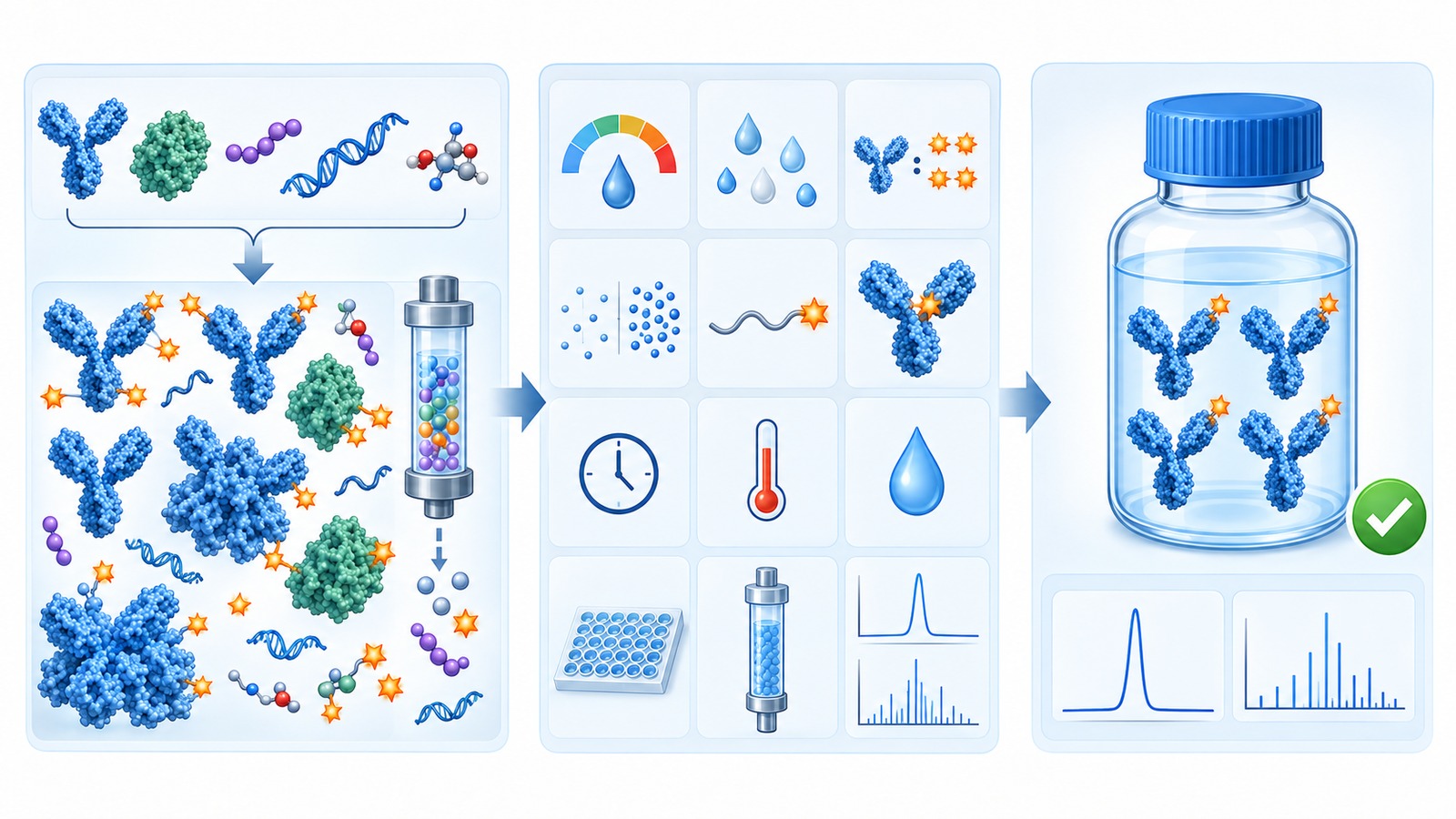 Bioconjugation method development connects reaction parameters, loading control, molecular stability, purification, and analytical evaluation to identify a practical operating window.
The most useful development variables depend on the specific chemistry and molecular pair. Screening every possible condition is rarely necessary or material-efficient. Instead, parameters are prioritized according to known reaction behavior, molecule sensitivity, current failure mode, and the attributes that must be controlled in the final conjugate.
| Parameter / Attribute | Why It Matters | What We Evaluate | Potential Development Approach |
| Reactive Group Availability | Accessible amines, thiols, carboxyls, carbonyls, azides, alkynes, or engineered handles determine which reactions are feasible and how selective they can be. | Functional-group accessibility, competing sites, modification history, reduction or activation requirements. | Select a compatible chemistry, introduce an orthogonal handle where appropriate, or adjust site strategy. |
| pH & Buffer Composition | Reactivity, reagent stability, biomolecule charge, and competing buffer components can all change with the reaction environment. | Compatible pH window, buffer interference, ionic strength, protein or oligonucleotide stability. | Screen a focused pH/buffer range and avoid components that consume or deactivate reactive groups. |
| Stoichiometry | Molar excess affects conversion and loading but can also broaden product distribution and increase purification burden. | Partner-to-biomolecule ratio, linker excess, available site number, target loading range. | Run staged ratio screening and compare loading, recovery, free component, and function-relevant behavior. |
| Reaction Concentration | Dilute systems may react slowly, while concentrated systems can increase aggregation or precipitation risk. | Biomolecule concentration, reagent solubility, intermolecular interactions, aggregate formation. | Identify a concentration window that supports sufficient reaction rate without compromising physical stability. |
| Time & Temperature | Longer or warmer reactions may increase conversion but also promote hydrolysis, oxidation, degradation, or structural stress. | Conversion profile, reagent lifetime, conjugate integrity, time-dependent aggregation. | Use time-course or temperature comparison studies to determine a practical reaction endpoint. |
| Linker & Spacer Design | Linker length, polarity, flexibility, and reactive termini affect accessibility, solubility, steric behavior, and separation. | Partner size, steric demand, hydrophobicity, site accessibility, downstream functional requirement. | Compare linker architecture or spacer length when the conjugation partner is poorly presented or destabilizing. |
| Loading & Distribution | A useful average loading value can hide a broad population of under- and over-modified species. | Average ratio, distribution where measurable, site occupancy, relationship between loading and function. | Adjust reagent ratio, reaction time, site strategy, or purification to narrow the usable population. |
| Purification Compatibility | A high-conversion reaction may still be impractical if free components or unwanted populations cannot be separated. | Molecular-size difference, charge, hydrophobicity, aggregate content, free partner level. | Develop reaction and purification together using size-, charge-, affinity-, or hydrophobicity-based separation as appropriate. |
| Reproducibility & Scale | Mixing, addition rate, hold time, material variability, and purification load can change as preparation size increases. | Repeat-run consistency, parameter sensitivity, concentration and mixing effects. | Define critical operating ranges and compare selected analytical attributes across repeated or scaled preparations. |
Development plans are adjusted to the chemistry and physical behavior of each molecular class. A strategy appropriate for an antibody–small molecule conjugate, for example, may be unsuitable for a peptide–oligonucleotide or protein–polymer construct because accessible sites, solubility, molecular size, purification options, and analytical methods differ substantially.
| Molecule / Conjugate Type | Common Development Questions | Relevant Handles / Approaches | Typical Development Focus |
| Antibodies & Antibody Fragments | How can loading be controlled without compromising recognition or increasing aggregation? | Accessible amines, native or introduced thiols, glycans, engineered handles, click-compatible groups. | Loading distribution, site strategy, reduction state, aggregation, binding retention, free partner removal. |
| Proteins & Enzymes | Which reactive sites are accessible and which conditions preserve structural or functional integrity? | Lysine/amine, cysteine/thiol, terminal groups, carboxyl groups, carbonyls, engineered or enzymatic handles. | Chemoselectivity, activity retention, solubility, linker placement, aggregate control. |
| Peptides | Can conjugation be directed to a defined terminus or side chain while avoiding competing residues? | N-terminus, lysine, cysteine, carboxyl groups, synthetic azide/alkyne or other orthogonal handles. | Site definition, side reactions, solubility, purification resolution, product identity. |
| Oligonucleotides & Nucleic Acids | Which terminal or internal modification best supports coupling while preserving hybridization or structural accessibility? | Amine, thiol, azide, alkyne, DBCO/BCN-compatible groups, phosphate-derived or other installed handles. | Handle orientation, linker length, reaction stoichiometry, free oligo removal, conjugate integrity. |
| Small Molecules & Haptens | Is the partner sufficiently soluble and is the selected reactive handle accessible without altering the desired functionality? | Activated esters, maleimides, carboxyl/amine pairs, click handles, carbonyl-reactive groups. | Solubility, linker installation, reagent excess, loading, free small-molecule clearance. |
| Polymers & PEG Derivatives | How do polymer size and dispersity affect reaction efficiency, conjugate heterogeneity, and separation? | Activated termini, maleimide, amine, carboxyl, click-functional polymer ends. | Site accessibility, polymer loading, viscosity, product distribution, unreacted polymer removal. |
| Lipids, Particles & Surfaces | How should biomolecules be presented on a multivalent or surface-bound platform without excessive crowding or loss of stability? | Amine, thiol, carboxyl, avidin–biotin assembly, click-enabled surface functionalization, linker-mediated coupling. | Surface density, orientation, colloidal or formulation stability, free component removal, reproducibility. |
The development strategy is selected according to the existing knowledge level of the project. A new molecular pair may require broader feasibility screening, whereas an established method with one persistent failure mode may need only a focused study around a few high-impact variables.
We identify a workable reaction environment by prioritizing the variables most likely to affect the selected chemistry: buffer, pH, reactant concentration, temperature, reaction time, activation state, addition order, and compatible co-solvent where needed. Screening is designed to conserve valuable biomolecule while still showing which parameters materially change performance.
Multiple reagent ratios can be compared to determine whether higher excess improves useful conjugate formation or simply increases over-labeling, hydrolyzed reagent, purification burden, or free component. The selected ratio is based on the required product attributes rather than conversion alone.
For constructs in which average loading does not sufficiently describe the product, development can focus on narrowing the population through limited-site chemistry, altered reagent feed, shorter reaction exposure, site-selective approaches, or downstream population separation.
Reaction concentration, hydrophobic partner content, reduction conditions, solvent exposure, ionic strength, and loading are assessed as interacting variables. Development aims to prevent aggregation during the reaction as well as during purification, concentration, and subsequent handling.
When product recovery or free-component removal is the limiting factor, purification behavior becomes part of the method-selection decision. A moderately converting chemistry that gives a cleanly separable conjugate may be preferable to a high-conversion route that produces unresolved or unstable populations.
Selected conditions can be repeated to distinguish a robust operating region from a single successful experiment. When the project requires larger research batches, concentration, mixing, reagent addition, purification load, and process timing can be reassessed before further scale expansion.
Development strategy selection begins with the variables that define the actual construct. The decision matrix below shows how project information is translated into an experimental plan and why two projects using the same nominal chemistry may still require different development approaches.
| Project Variable | Questions We Ask | Development Implication | Typical Decision |
| Molecule & Conjugation Partner | What are the size, structure, sensitivity, solubility, concentration limits, and available functional groups of both components? | Determines chemistry compatibility, reaction concentration, purification options, and likely analytical methods. | Choose a route that both components can tolerate rather than optimizing only the more reactive component. |
| Chemistry & Reactive Handles | Are reactive groups native, installed, protected, reduced, oxidized, or prone to competing reactions? | Controls whether direct coupling, pre-activation, two-step coupling, or an orthogonal route is preferable. | Prioritize the chemistry with the most suitable combination of reactivity, selectivity, and material compatibility. |
| Site & Loading Requirement | Is random modification acceptable, or must loading or position be more tightly controlled? | Determines whether a broad statistical reaction is sufficient or a limited-site/site-selective strategy is needed. | Match method complexity to the actual level of structural control required by the project. |
| Solubility & Stability | Does either component precipitate, aggregate, hydrolyze, oxidize, or lose function under candidate conditions? | May limit solvent, pH, temperature, reaction time, reagent excess, or maximum loading. | Develop within the stability window first, then optimize conversion inside that usable range. |
| Purity & Analytical Requirement | Which impurities must be distinguished and which attributes must be quantified? | Influences reaction route, purification strategy, sample preparation, and acceptable heterogeneity. | Select conditions that produce a conjugate that can be purified and measured with sufficient confidence. |
| Material Availability & Scale | How much starting material is available, and is the goal feasibility, repeated research batches, or larger-scale preparation? | Determines screening depth, replicate design, reaction volume, and the level of process-window definition. | Use material-efficient screening early and expand only the most informative conditions. |
Method development is not independent of conjugation chemistry. Each reaction has a different sensitivity to buffer composition, functional-group availability, reagent stability, stoichiometry, and molecular context. When the starting chemistry is not fixed, development can include comparison of alternative routes. When the chemistry is already defined, optimization focuses on its most influential operating parameters.
For amine-reactive workflows, optimization can focus on accessible amine content, buffer compatibility, pH, reagent excess, hydrolysis exposure, reaction time, and degree of modification. See our NHS ester conjugation resource for related chemistry-selection considerations.
Carbodiimide-mediated coupling requires particular attention to carboxyl activation, competing amines or carboxylates, activation timing, component orientation, and unwanted intermolecular coupling. Related considerations are discussed in our amine-reactive conjugation resource.
Method development may include thiol generation, reduction control, removal of competing reductants, maleimide exposure time, partner ratio, loading control, and stability of the resulting construct.
Copper-free click workflows can be optimized around azide/cyclooctyne orientation, handle accessibility, linker length, partner concentration, hydrophobicity, and removal of excess click-functional reagent. See SPAAC resource and our DBCO conjugation resource.
CuAAC development can consider handle orientation, catalyst system, ligand selection, component concentration, biomolecule compatibility, and cleanup requirements.
Tetrazine-enabled development may focus on handle accessibility, linker placement, reactant stability, reaction concentration, partner ratio, and removal of unreacted functionalized components. See our tetrazine ligation resource.
Aldehyde- or ketone-directed strategies may require control of carbonyl generation, reagent orientation, pH, reaction time, competing nucleophiles, linker design, and product stability. These routes can be evaluated when native amine or thiol modification provides insufficient site control.
Enzyme-mediated approaches introduce a different development space involving recognition motif accessibility, substrate ratio, enzyme loading, reaction time, and removal of enzyme or unreacted substrate. For related options, see our enzymatic crosslinking services.
The workflow is adjusted to whether the project starts from a new concept, an existing but underperforming protocol, or a method that already works at small scale but requires better control. Experimental depth is matched to the question being answered and the amount of material available.


We review both conjugation components, molecular format, available functional groups, current buffer, concentration, existing method, known failure mode, desired loading or site control, available material, scale, and analytical requirements. This establishes what is already known and which uncertainties need experimental testing.

Candidate chemistry, reactive-handle orientation, linker requirements, and high-impact process variables are prioritized. Rather than testing every possible condition, the screening plan is structured around the most plausible causes of low conversion, heterogeneity, aggregation, activity loss, or purification difficulty.

Small-scale reactions are used to compare selected conditions such as pH, stoichiometry, concentration, time, temperature, activation state, or addition order. Screening is designed to identify directional trends and eliminate conditions that create clear instability or impractical product mixtures.

Candidate reactions are compared using the attributes required to make a development decision. Depending on the construct, these may include conversion, identity, loading, purity, free component, aggregation, site occupancy, structural integrity, or a function-relevant readout.

Promising conditions are refined around the variables that showed the strongest effect. Purification, buffer exchange, concentration, and handling are incorporated at this stage so the selected method produces a conjugate that can be isolated and evaluated consistently.

The preferred condition can be repeated or translated to the required research scale to assess consistency. Final output may include selected reaction conditions, purification recommendations, analytical observations, identified parameter sensitivities, and suggestions for subsequent scale or construct development.
A development condition is not selected from a single number. Conversion, loading, recovery, purity, structural integrity, and repeatability can move in different directions as reaction conditions change. We therefore use a project-specific set of decision criteria and weigh each attribute according to the intended research use of the conjugate.
We assess whether the desired coupling proceeds sufficiently under the tested conditions and whether residual starting material indicates a reaction limitation, inaccessible sites, or insufficient reagent exposure.
Average labeling or component ratio is considered together with population breadth, site occupancy, or over-modification where these attributes can be measured and are relevant to the project.
We consider how much usable conjugate remains after reaction and purification, whether free components can be removed, and whether the selected process introduces unresolved impurities or substantial handling losses.
The reaction and purification sequence is reviewed for fragmentation, precipitation, aggregation, or other changes that may indicate that the chemistry or loading level is too stressful for the construct.
Where requested and experimentally appropriate, candidate conjugates can be compared using a customer-defined or project-relevant readout for binding, hybridization, enzymatic activity, recognition, or another important molecular property.
Repeat preparations help determine whether the proposed condition represents a controllable method rather than a single successful experiment. Parameters that remain sensitive are documented for future execution.
This service is most useful when the main project need is not simply obtaining a conjugated sample, but understanding and improving how that conjugate should be prepared.
The literature protocol uses a different protein, peptide, oligonucleotide, linker, concentration, buffer, or scale, and direct transfer gives poor conversion, instability, or an unexpected product distribution.
You know the two components that should be connected but have not yet selected the most appropriate reactive handles, linker architecture, stoichiometry, or reaction conditions.
The existing reaction produces too much unconjugated material, an undesirable average loading, excessive high-loading species, or inconsistent component-to-carrier ratios.
The biomolecule or conjugation partner becomes unstable during reduction, labeling, incubation, purification, concentration, or storage, and the cause needs to be separated from the coupling chemistry itself.
Coupling occurs, but the resulting mixture contains free label, linker, small molecule, oligonucleotide, peptide, aggregates, or multiple conjugate populations that are difficult to remove or quantify.
A small exploratory conjugation worked, but the project now requires better batch comparability, a more defined operating window, larger research preparations, or a method that another team can execute more consistently.
Chemistry selection and optimization are based on the customer's specific biomolecule, partner, available functional groups, loading target, solubility, and analytical needs rather than treating all conjugation projects as interchangeable labeling reactions.

Reaction conditions are evaluated together with purification behavior and analytical measurability. This helps avoid optimizing a reaction that generates a conjugate population that cannot be separated, characterized, or used reliably.
When starting biomolecule is limited, screening can focus on the parameters most likely to answer the development question. This is particularly useful for difficult proteins, custom oligonucleotides, specialized peptides, or expensive conjugation partners.
We consider conversion, loading, purity, recovery, aggregation, integrity, function, and repeatability as appropriate to the project, allowing the final method recommendation to reflect the complete conjugate rather than one isolated metric.
To begin a method development or optimization discussion, provide the molecule and conjugation-partner type, current method or development status, the main problem you are observing, the desired conjugate or loading outcome, available analytical information, and the approximate research scale where relevant. Existing reaction conditions, chromatograms, mass data, loading measurements, aggregation observations, or purification results can also help define the first development experiments.
You do not need to have the conjugation chemistry, purification method, or analytical strategy fully defined before submitting a project. BOC Sciences can review the available molecular information and development objective, identify the key uncertainties, and propose a project-specific route for chemistry selection, reaction optimization, purification integration, and performance evaluation. Contact our scientific team to discuss your bioconjugation method development requirements.
Useful starting information includes the biomolecule and conjugation partner, molecular format, available reactive groups or installed handles, current buffers, concentrations, existing reaction conditions, observed problems, desired loading or site control, analytical requirements, available material, and target research scale. Existing analytical or purification data can also help focus the first experiments.
Method development can be considered for antibodies, proteins, peptides, oligonucleotides, small molecules, polymers, lipids, nanoparticles, and compatible combinations of these materials. Feasibility depends on the available reactive groups, molecular stability, solubility, analytical accessibility, and amount of starting material.
Yes. Existing protocols can be reviewed for problems such as low conversion, excessive reagent consumption, broad loading, aggregation, poor recovery, difficult purification, activity loss, or batch variability. Development can then focus on the parameters most likely to cause the observed limitation.
Evaluation criteria are selected for the specific construct and may include conversion, conjugate loading, loading distribution, purity, recovered material, free component removal, aggregation, structural integrity, site occupancy, function-relevant performance, and repeatability. A condition is generally assessed across multiple relevant attributes rather than conversion alone.
Yes. Purification can be integrated into development because reaction conditions affect the composition and separability of the final mixture. Depending on the construct, development may consider desalting, size-based separation, chromatography, ultrafiltration, buffer exchange, or another suitable cleanup approach.