Azide–Alkyne Click ConjugationCu(I)/Ligand System OptimizationCustom Bioconjugates with Purification & Analytical Support
Copper(I)-catalyzed azide–alkyne cycloaddition (CuAAC) is a highly selective click chemistry reaction used to connect an azide-functionalized molecule with a terminal alkyne-functionalized partner through a stable 1,4-disubstituted 1,2,3-triazole linkage. Because azides and terminal alkynes are uncommon in native biomolecules, CuAAC provides a practical way to build defined conjugates while minimizing direct competition from amines, carboxylates, hydroxyl groups, and many other naturally occurring functionalities.
BOC Sciences provides custom CuAAC conjugation services for proteins, antibodies, peptides, oligonucleotides, small molecules, fluorescent labels, biotin derivatives, polymers, and other research materials. Support can begin with reactive-handle planning and linker design or with customer-supplied azide- and alkyne-functionalized components. Projects can include reaction-condition screening, Cu(I)/ligand selection, conjugation, purification, copper removal, and analytical verification. For additional background on the chemistry, see our Cu-catalyzed azide–alkyne cycloaddition resource and our overview of bioorthogonal click chemistry.
CuAAC projects differ substantially in molecular size, handle accessibility, copper sensitivity, solubility, and the level of site control required. Our service model therefore focuses on matching the click reaction to the actual substrate pair rather than applying one reaction recipe to every conjugation.
 Protein CuAAC Conjugation
We support CuAAC coupling of azide- or terminal alkyne-functionalized proteins with dyes, affinity tags, small molecules, peptides, polymers, or other click-ready partners.
Projects can be coordinated with broader protein conjugation services when clickable handles must first be introduced into the protein.
 Antibody CuAAC Conjugation
CuAAC can be used for antibody conjugation when a defined azide or terminal alkyne handle has been installed and the antibody is compatible with the selected copper exposure and cleanup process.
For projects in which copper exposure is a major concern, alternative approaches can be evaluated through our antibody conjugation services.
 Peptide CuAAC Conjugation
Peptides can be equipped with azide or terminal alkyne groups at the N-terminus, C-terminus, or selected side-chain positions and coupled to a wide range of functional partners.
CuAAC is particularly useful when a small orthogonal handle is preferred over direct modification of multiple native amino acid side chains.
 Oligonucleotide CuAAC Conjugation
We support click conjugation of DNA, RNA, and other oligonucleotide formats carrying terminal or internal azide/alkyne modifications.
Projects requiring broader nucleic-acid modification options can also be integrated with our oligonucleotide bioconjugation platform.
 Small-Molecule CuAAC Assembly
CuAAC provides a modular route for assembling click-ready probes, ligands, linkers, reporter molecules, and other functional small-molecule constructs.
This modular approach is useful when multiple analogs must be assembled from a common clickable intermediate without redesigning the full synthetic route.
 Label & Linker Installation
We can use CuAAC as the final ligation step for attaching labels and linker-equipped functional groups to pre-functionalized research molecules.
Projects involving fluorescent reporters can also be aligned with our fluorescence labeling capabilities.
CuAAC couples an organic azide with a terminal alkyne through copper(I)-catalyzed cycloaddition, producing a stable 1,4-disubstituted 1,2,3-triazole linkage. In many bioconjugation workflows, Cu(I) is generated in situ from a Cu(II) precursor using a reducing agent such as sodium ascorbate. A copper-binding ligand can then stabilize the catalytically active species, improve reaction efficiency in aqueous media, and reduce undesirable copper-mediated side reactions.
The apparent simplicity of the reaction can hide several practical failure points. A clickable group may be sterically inaccessible, hydrophobic labels may precipitate the conjugate, components such as strong copper chelators can interfere with catalysis, and excessive copper or poorly controlled redox conditions can promote oxidation of sensitive biomolecules. Proteins and antibodies may aggregate or lose function, while nucleic acids can also be vulnerable to copper-associated oxidative chemistry. Reaction design therefore needs to balance conversion, copper loading, ligand concentration, reducing conditions, substrate concentration, solubility, and the intended downstream purification route.
We evaluate these variables together so that the CuAAC step is designed around the final conjugate rather than simply around formation of the triazole bond. When copper exposure is incompatible with the substrate or experimental system, a copper-free approach such as SPAAC may provide a more suitable route.
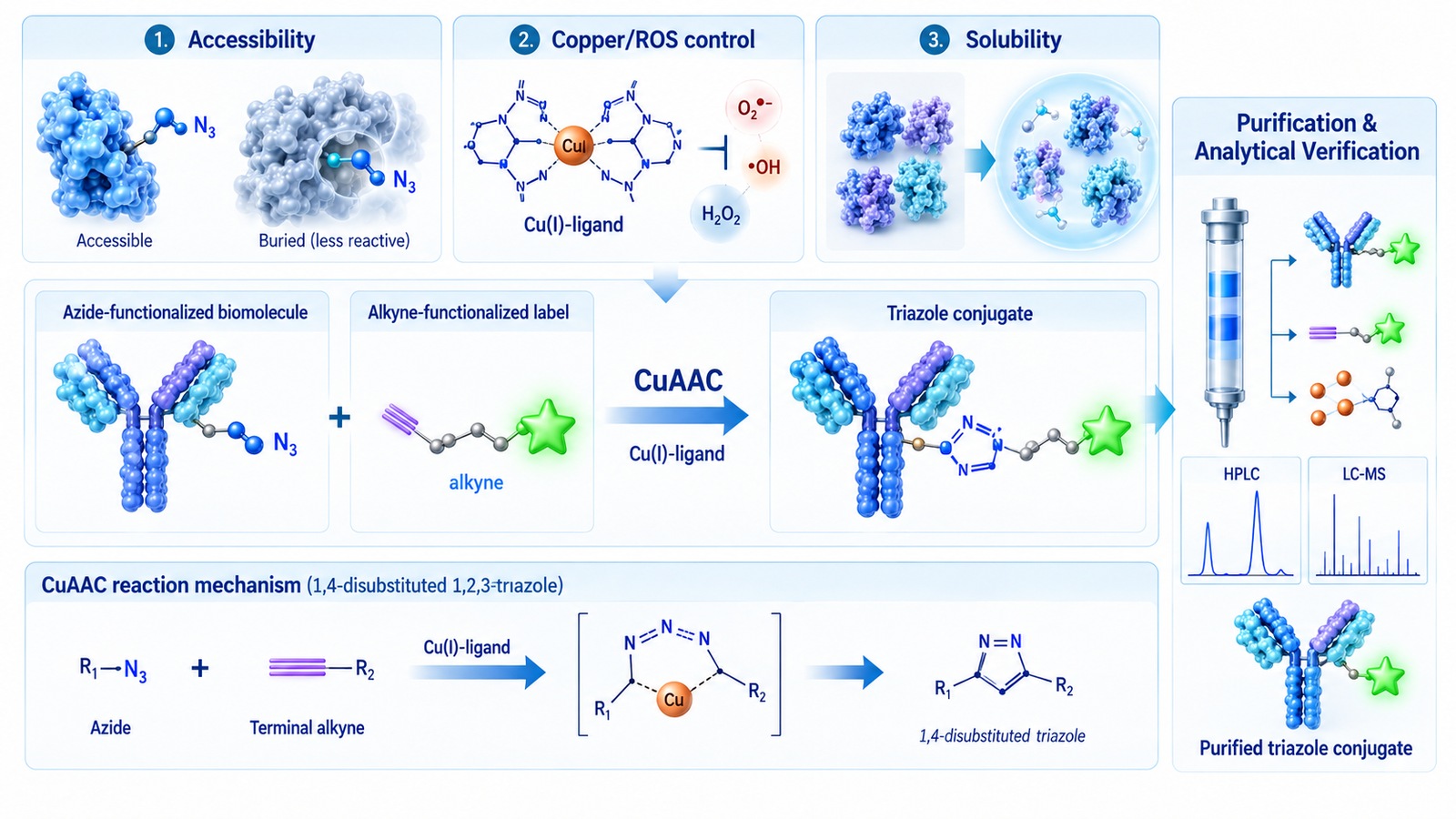 CuAAC workflow illustrating reactive-handle pairing, Cu(I)/ligand-mediated ligation, copper-related risk control, purification, and verification of the final conjugate.
The defining reactive pair for classical CuAAC is an organic azide and a terminal alkyne. Either partner can carry either handle, but handle orientation should be selected according to synthesis route, molecular stability, solubility, accessibility, and the purification strategy planned for the final conjugate.
| Molecule Class | Common CuAAC Handle Strategy | Typical Conjugation Partners | Key Technical Considerations | Useful Verification |
| Proteins | Azide or terminal alkyne introduced through a defined chemical or biosynthetic modification | Dyes, biotin, peptides, oligonucleotides, polymers, small molecules | Handle accessibility, copper sensitivity, aggregation, buffer composition, preservation of activity | SDS-PAGE, SEC-HPLC, intact MS, UV-Vis or functional testing as appropriate |
| Antibodies | Click handle installed at an accessible chemical or engineered site | Fluorophores, oligonucleotides, peptides, biotin derivatives, research payloads | Site distribution, labeling ratio, aggregation, copper removal, retention of binding behavior | SEC-HPLC, mass analysis, label ratio, binding-oriented assay when requested |
| Peptides | N-terminal, C-terminal, or side-chain azide/alkyne | Labels, lipids, oligos, small molecules, PEG/linkers, other peptides | Sequence solubility, handle location, side reactions, chromatographic resolution | RP-HPLC and LC-MS |
| Oligonucleotides | 5′, 3′, or internal azide/alkyne modification | Dyes, ligands, peptides, lipids, small molecules, other oligos | Oxidative sensitivity, secondary structure, reagent excess, full-length product recovery | HPLC, PAGE where useful, and mass analysis |
| Small Molecules | Synthetic azide or stable terminal alkyne building block | Linkers, labels, ligands, biomolecules, probe components | Solvent compatibility, copper coordination, functional-group stability, product polarity | HPLC, LC-MS and structural analysis as required |
| Polymers & Materials | Terminal or pendant azide/alkyne groups | Proteins, peptides, glycans, oligos, dyes, surface ligands | Handle density, accessibility, heterogeneous reaction environment, removal of unbound biomolecule | Composition-dependent chromatography, spectroscopy, size or surface analysis |
For biomolecular substrates, stable azide and terminal-alkyne handles are generally preferred. The complete linker surrounding the reactive group should also be reviewed because handle accessibility and neighboring chemical groups can affect both reaction behavior and final conjugate properties.
CuAAC is particularly useful when a project needs a compact, orthogonal reactive pair and the substrate can tolerate a controlled copper-containing reaction followed by appropriate purification. It is often selected for in vitro conjugate construction, probe synthesis, modular assembly, and reactions in which conventional amine- or thiol-directed chemistry would produce excessive heterogeneity.
Azides and terminal alkynes add relatively little steric bulk before ligation, which can be advantageous when a larger strained cyclooctyne or tetrazine-based handle would interfere with molecular properties or synthetic planning.
CuAAC can provide orthogonal ligation in molecules containing multiple amines, carboxylates, alcohols, and other native functionalities that would complicate less selective coupling strategies.
When a clickable handle has been introduced at a known site, CuAAC allows subsequent attachment to occur at that handle rather than across every accessible lysine or other native reactive residue.
A shared azide- or alkyne-functionalized intermediate can be coupled to different click-ready partners, making CuAAC useful for constructing related conjugate libraries or comparing multiple labels and linkers.
CuAAC may be less suitable when the target is highly sensitive to copper or oxidation, when residual metal would interfere with the downstream assay, or when conjugation must be performed directly in a living biological system. In those cases, copper-free SPAAC or an alternative bioorthogonal reaction should be evaluated before project initiation.
Chemistry selection should be based on the substrate, required site control, acceptable handle size, reaction environment, purification burden, and sensitivity to catalysts or redox conditions. The comparison below summarizes common decision points.
| Method | Reactive Pair | Catalyst / Trigger | Main Strength | Main Limitation | Typical Fit |
| CuAAC | Organic azide + terminal alkyne | Cu(I), commonly used with a stabilizing/accelerating ligand | Small orthogonal handles and reliable triazole-forming ligation | Copper exposure, oxidative side reactions, and catalyst-removal requirements | In vitro conjugation of click-ready molecules that tolerate copper-processing conditions |
| SPAAC | Azide + strained cyclooctyne such as DBCO or BCN | No metal catalyst | Copper-free azide ligation under mild conditions | Larger, more hydrophobic strained-alkyne handles can influence solubility or steric behavior | Copper-sensitive proteins, antibodies, cells, and workflows requiring metal-free coupling |
| IEDDA | Tetrazine + strained alkene/alkyne such as TCO | No added catalyst | Very rapid bioorthogonal ligation and useful low-concentration reactivity | Requires specialized handles whose stability must be considered during synthesis and storage | Fast labeling and advanced site-specific bioorthogonal workflows |
| NHS Ester | Activated ester + primary amine | pH-controlled nucleophilic acyl substitution | Straightforward labeling of amine-containing biomolecules | Multiple lysines can produce heterogeneous site distributions | Routine protein or antibody labeling when precise site control is not essential |
| Maleimide–Thiol | Maleimide + thiol | No metal catalyst | Useful cysteine-directed conjugation when thiol availability is controlled | Depends on thiol accessibility, reduction state, competing thiols, and linkage design | Protein and peptide conjugation involving native or engineered cysteine residues |
For a more focused comparison among click reactions, see CuAAC vs SPAAC vs IEDDA. Chemistry should be selected case by case rather than assuming that one click platform is preferable for every biomolecule.
The workflow is adapted to the molecular pair, desired conjugation level, analytical requirements, and sensitivity of the starting materials. Early review of handle chemistry and downstream purification is especially important because a reaction with good conversion can still be impractical if the final conjugate cannot be isolated cleanly.


We review the structures or sequences, molecular concentrations, desired conjugation site, final application, available clickable handles, buffer components, and known stability constraints. This establishes whether CuAAC is technically appropriate before reaction conditions are selected.

If one or both partners are not yet click-ready, we evaluate azide versus terminal-alkyne placement, spacer length, expected accessibility, and how handle installation could affect molecular function or purification.

Copper source, ligand, reducing system, buffer, substrate ratio, co-solvent, and reaction concentration are selected according to substrate sensitivity and solubility. Screening can be used when the working window is uncertain.

The click reaction is performed under controlled conditions with monitoring appropriate to the molecular system. Reaction time and reagent exposure are adjusted to obtain useful conversion without unnecessarily extending copper or reducing-agent contact.

Unreacted click partner, copper/ligand components, reducing agents, and side products are separated using purification methods matched to molecular size and physicochemical properties. Buffer exchange can be incorporated when required for downstream use.

Analytical methods are selected to answer project-specific questions such as identity, purity, conjugation level, aggregation, free-label removal, residual copper, or retention of relevant molecular function. Final material is delivered with the analytical information defined for the project.
Post-reaction processing is a central part of CuAAC bioconjugation because successful triazole formation does not by itself demonstrate that the conjugate is sufficiently clean for downstream research. Purification must address excess azide/alkyne reagent, ligand, reducing agent, copper species, unconjugated starting material, and any aggregates or reaction-derived impurities relevant to the substrate.
Depending on conjugate size and reagent properties, processing may include desalting, centrifugal ultrafiltration, size-exclusion chromatography, ion-exchange methods, or other protein-compatible separation strategies. SEC-based analysis can also help determine whether reaction conditions changed the monomer/aggregate profile.
Preparative or semi-preparative HPLC can be used to separate clicked products from unreacted precursors and closely related impurities. LC-MS and chromatographic purity analysis are commonly useful for confirming molecular identity and isolation quality.
Reverse-phase, ion-exchange, PAGE-based, or other sequence-appropriate methods can be considered according to oligonucleotide length, modification type, and conjugate hydrophobicity. The goal is to distinguish the full-length conjugate from free label and unconjugated oligonucleotide.
When downstream work is sensitive to residual copper, additional cleanup can be built into the process and residual metal analysis such as ICP-based measurement can be considered. The need for this testing should be defined from the final application rather than applied automatically to every project.
Depending on the construct, verification may include LC-MS, intact-mass analysis, HPLC, SDS-PAGE, UV-Vis spectroscopy, fluorescence analysis, or measurement of a label-to-biomolecule ratio. No single analytical method is sufficient for every conjugate class.
When conjugation could affect binding, enzymatic activity, hybridization, fluorescence, particle behavior, or another project-critical property, a relevant comparative assay can be incorporated to determine whether chemical conversion translates into a usable research conjugate.
CuAAC requires catalytically active Cu(I), but free or poorly controlled copper can also promote unwanted oxidation or bind to biomolecular functionalities. Ligands such as THPTA or BTTAA may be considered for aqueous bioconjugation because they can stabilize Cu(I), accelerate ligation, and reduce exposure to uncontrolled copper chemistry. Ligand choice and ligand-to-copper ratio should still be optimized for the specific substrate rather than treated as universal constants.
The azide does not always belong on the biomolecule and the alkyne does not always belong on the label. Orientation should reflect precursor availability, handle stability, site accessibility, linker architecture, purification behavior, and whether one partner is especially sensitive to modification. A strategically chosen orientation can simplify both synthesis and final conjugate isolation.
Buffer components should be reviewed before CuAAC because compounds that strongly coordinate copper can alter the catalyst system. Salt level, pH, reducing agents, metal chelators, protein stabilizers, surfactants, and co-solvents may all affect conversion or biomolecule stability. Existing customer buffers may therefore require exchange or modification before conjugation.
Using a large excess of a click partner may improve conversion but can make purification more difficult, especially with hydrophobic dyes, lipids, polymers, or other poorly soluble cargoes. Reaction concentration, co-solvent level, linker hydrophilicity, and reagent ratio should be planned together to avoid precipitation, aggregation, or unnecessary material consumption.
Copper/redox systems can generate reactive species that affect oxidation-sensitive proteins, peptides, or nucleic acids. Appropriate ligand selection, controlled reagent addition, limited reaction exposure, freshly prepared reducing components when applicable, and carefully selected additives can help reduce these risks. For highly sensitive materials, a copper-free conjugation route may be a better design choice.
Purification should be designed before the reaction begins. The molecular-weight difference between starting materials and product, charge, hydrophobicity, number of clickable sites, and required copper clearance all influence whether SEC, HPLC, dialysis, centrifugal filtration, ion exchange, or another method is most practical. A high-conversion reaction that produces an inseparable mixture is not an efficient development route.
We evaluate whether CuAAC is appropriate for the actual substrate pair and downstream application instead of selecting the reaction simply because clickable groups are available.
Azide/alkyne placement, spacer architecture, accessibility, and conjugation-site control are considered before coupling so that the reactive handle supports the intended final construct.
Copper source, ligand, reducing system, reaction exposure, and post-reaction removal can be adjusted around the sensitivity of proteins, antibodies, oligonucleotides, and other research molecules.
Projects can combine biomolecules, peptides, oligonucleotides, labels, linkers, polymers, and small molecules, including cases in which one or both clickable components require custom preparation.
Reaction planning includes removal of free cargo, unconjugated starting material, copper-containing components, and other relevant impurities rather than treating purification as an afterthought.
Analytical methods are selected to answer the questions that matter for each construct—identity, conversion, purity, conjugation level, aggregation, copper residuals, or retention of relevant function.
For projects that require chemistry selection beyond CuAAC, our custom bioconjugation services can support comparison with copper-free click chemistry, amine-directed, thiol-directed, and other conjugation strategies.
CuAAC can provide a highly useful route to defined conjugates, but successful project design requires more than combining an azide, an alkyne, and a copper source. Substrate sensitivity, reactive-handle accessibility, copper/ligand conditions, solubility, stoichiometry, purification, and analytical verification all influence whether the final material is suitable for downstream research.
Share your molecule type, available azide or terminal-alkyne handles, desired conjugation partner, target scale, buffer or solubility constraints, and required analytical readouts. BOC Sciences can evaluate the proposed CuAAC strategy and recommend a project-specific route from handle preparation through conjugation and characterization. Contact our scientific team to discuss your CuAAC conjugation requirements.
CuAAC, or copper(I)-catalyzed azide-alkyne cycloaddition, joins an organic azide with a terminal alkyne to form a stable 1,4-disubstituted 1,2,3-triazole. It is widely used for research bioconjugation because the two reactive handles can be introduced at defined positions and generally show little direct reactivity with common native biomolecular functional groups.
CuAAC uses a terminal alkyne and requires Cu(I) catalysis. SPAAC uses a strained cyclooctyne such as DBCO or BCN and does not require copper. CuAAC offers small reactive handles and robust ligation, whereas SPAAC is often selected for copper-sensitive proteins, antibodies, living systems, or workflows where residual metal would be problematic.
Either orientation can work. The better choice depends on how each handle can be introduced, the stability of the precursor, steric accessibility, linker design, solubility, and purification of the final conjugate. For custom projects, both orientations should be considered before synthesis begins rather than assuming a fixed arrangement.
Yes, provided a suitable azide or terminal-alkyne handle is available and the biomolecule tolerates the selected copper/ligand conditions. Protein and antibody projects require particular attention to oxidation, aggregation, buffer composition, copper removal, and retention of the relevant molecular function. Accelerating ligands such as THPTA have been used to stabilize Cu(I) and reduce copper-associated oxidative damage in protein-labeling workflows.
The appropriate cleanup method depends on the conjugate. Desalting, SEC, dialysis, centrifugal filtration, chromatography, buffer exchange, or combinations of these approaches may be used to remove low-molecular-weight copper/ligand components and excess reagent. If residual metal is important to downstream research, ICP-based copper measurement can also be considered.