Bench-to-Larger-Scale Process TranslationReaction, Purification & Analytical BridgingCustom Scale-Up Support for Diverse Bioconjugates
Scaling a bioconjugation reaction from feasibility quantities to larger research or pilot batches can change mixing, reagent exposure, temperature control, reaction kinetics, aggregation risk, purification load, and analytical comparability. BOC Sciences provides bioconjugation scale-up services to translate an existing small-scale method—or a recently optimized conjugation process—into a more reproducible larger-batch workflow. Support can include parameter mapping, intermediate-scale bridging, reagent addition and stoichiometry control, reaction execution, purification and buffer exchange, and analytical comparison. The service is suited to antibody, protein, peptide, oligonucleotide, small-molecule, polymer, and selected nanoparticle conjugation projects that need more material, better batch consistency, or a practical path beyond the original bench protocol.
Bioconjugation scale-up is not simply a proportional increase in reagent quantities. Each project is reviewed for scale-sensitive variables that can alter conjugation efficiency, loading distribution, molecular integrity, purification recovery, and repeatability. Our scale-up support can begin with a customer-developed protocol or with a process previously established through our custom conjugation work.
 Scale-Up Readiness Review
 Reaction Scale Translation
 Mixing and Addition Control
 Purification Process Scale-Up
 Analytical Comparability Planning
 Repeat Batch Support
A conjugation method that performs well in a microgram- or milligram-scale feasibility experiment can change substantially when reaction volume, vessel dimensions, mixing behavior, material concentration, purification load, or process timing changes. Scale-up development therefore focuses on preserving the attributes that made the original conjugate useful while identifying parameters that cannot simply be carried forward unchanged.
Larger reaction volumes can alter reagent dispersion, local molar excess, exposure time, and reaction kinetics. We evaluate the parameters that control conversion rather than relying only on proportional reagent scaling.
Antibody loading ratios, fluorophore incorporation, oligonucleotide loading, or other substitution levels may shift when addition and mixing change. Scale-up development examines stoichiometry, reagent addition, reaction time, and available reactive sites together.
Hydrophobic partners, concentrated biomolecules, organic co-solvents, rapid pH changes, or localized reagent exposure can increase aggregation or precipitation risk. We evaluate concentration, solvent exposure, addition profile, temperature, and downstream handling as connected variables.
A cleanup method that is practical for a small reaction may become slow, capacity-limited, or recovery-sensitive at larger volume. We reassess impurity removal, loading capacity, buffer exchange, concentration, and fraction handling for the new scale.
Charging reagents, mixing, sampling, quenching, transferring material, and initiating purification all take longer as batch size increases. We map process timing so scale-dependent delays do not unintentionally extend reactive exposure.
Similar total yield does not necessarily mean that the conjugate population is unchanged. Loading distribution, free component levels, aggregate content, molecular integrity, and function-relevant properties may also require comparison.
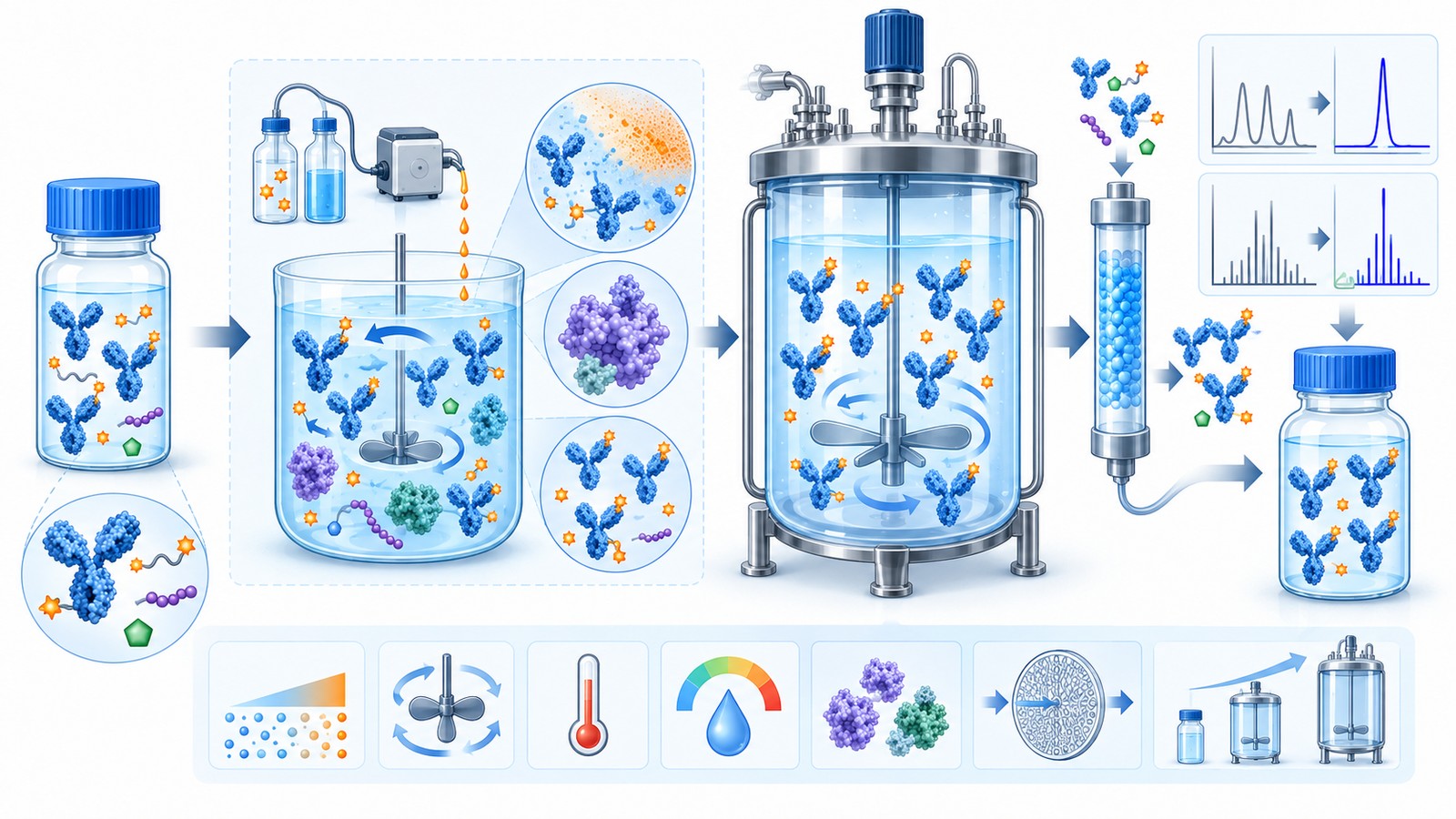 Bioconjugation scale-up requires coordinated control of reaction conditions, mixing, purification, and analytical comparability as batch size increases.
The parameters that matter most during scale-up depend on the molecule, conjugation partner, reaction mechanism, desired loading, and downstream purification route. The following matrix illustrates variables commonly reviewed when translating a bioconjugation process to larger batch sizes.
| Parameter / Attribute | Why It Matters | What We Evaluate | Potential Development Approach |
| Starting Concentration | Biomolecule concentration can affect reaction rate, aggregation, reagent use, and downstream processing. | Starting concentration, solubility, viscosity, aggregation tendency, and practical working volume. | Maintain an established concentration where practical or bridge alternative concentrations before full scale-up. |
| Reagent Stoichiometry | Excess reagent influences conversion, loading distribution, side reactions, and purification burden. | Molar equivalents, reactive-site availability, reagent stability, and residual free component. | Confirm the useful stoichiometric window at intermediate scale and adjust according to measured conjugate attributes. |
| Addition Profile | Fast or uneven addition can create transient local concentrations that do not occur at small scale. | Addition order, rate, dilution, addition point, and time required to complete charging. | Introduce controlled or staged addition when the chemistry is sensitive to local reagent concentration. |
| Mixing Conditions | Mixing affects reagent distribution, reaction uniformity, and exposure to hydrophobic or reactive components. | Vessel format, fill volume, agitation method, mixing time, and shear sensitivity where relevant. | Select practical mixing conditions that provide consistent reagent distribution without compromising molecule integrity. |
| Temperature & Hold Time | Reaction kinetics and biomolecule stability can both change with temperature and process duration. | Temperature profile, equilibration time, reaction endpoint, quench timing, and post-reaction hold. | Define acceptable operating windows and minimize unnecessary exposure after the desired reaction endpoint. |
| pH & Buffer Composition | Reactive-group selectivity and biomolecule stability are often highly dependent on solution conditions. | pH, ionic strength, competing nucleophiles, reducing agents, chelators, and buffer compatibility. | Preserve chemistry-compatible conditions while limiting components that interfere with coupling or downstream purification. |
| Co-Solvent Exposure | Hydrophobic linkers, labels, or small molecules may require co-solvents that can affect proteins or other biomolecules. | Final solvent fraction, local solvent concentration during addition, solubility, and aggregate formation. | Optimize reagent stock concentration and addition procedure to balance solubility with biomolecule compatibility. |
| Purification Load | Larger reactions generate more free reagent, unconjugated component, and total process volume. | Impurity profile, column or membrane capacity, concentration limits, recovery, and number of operations. | Adapt purification mode, loading strategy, fraction collection, or buffer-exchange sequence to the larger batch. |
| In-Process Sampling | Timely data can distinguish a reaction problem from a later purification or handling problem. | Sampling points, sample volume, reaction conversion, loading trend, aggregation, and free component levels. | Introduce decision-relevant sampling at critical steps without unnecessarily consuming material. |
Scale-up strategy is adapted to the physical and chemical behavior of the starting molecules. The following molecule classes represent common project types for which reaction translation, purification planning, and analytical comparison may be relevant.
| Molecule / Conjugate Type | Typical Scale-Up Concerns | Relevant Development Focus | Common Analytical Needs |
| Antibodies & Fragments | Loading distribution, aggregation, reduction state, binding-site interference, and hydrophobic partner exposure. | Controlled stoichiometry, reagent addition, site accessibility, mixing, purification, and buffer handling. | Identity, purity, loading or DAR where applicable, aggregate content, and binding-relevant integrity. |
| Proteins & Enzymes | Activity loss, variable reactive-site accessibility, precipitation, and concentration sensitivity. | Mild reaction conditions, loading control, activity preservation, aggregate management, and recovery. | Identity, purity, conjugation level, aggregation, and function-relevant activity where required. |
| Peptides | Solubility, competing functional groups, oxidation, multiple reactive sites, or separation from free partner. | Site strategy, solvent compatibility, molar-equivalent control, reaction endpoint, and chromatographic separation. | Mass confirmation, purity, conjugation identity, and residual unconjugated components. |
| Oligonucleotides | Handle accessibility, charge-driven purification behavior, duplex integrity, excess linker removal, and mixed populations. | Handle preparation, reaction concentration, linker design, purification mode, and buffer exchange. | Identity, purity, loading, oligonucleotide integrity, and unconjugated oligonucleotide levels. |
| Small Molecule–Biomolecule Conjugates | Partner solubility, co-solvent exposure, over-labeling, incomplete removal of free compound, and altered biomolecule behavior. | Stock preparation, staged addition, loading control, impurity removal, and formulation compatibility. | Identity, loading, purity, free small-molecule component, aggregation, and integrity. |
| Polymer & PEG Conjugates | Broad product distributions, viscosity, steric effects, difficult free-polymer removal, and heterogeneous loading. | Polymer equivalents, reaction concentration, separation strategy, and conjugate population control. | Conjugation level, distribution, purity, aggregate behavior, and free polymer assessment. |
| Selected Particle Conjugates | Surface loading, particle aggregation, sedimentation, mass-transfer differences, and washing efficiency. | Surface-to-ligand ratio, mixing, blocking or passivation, separation, washing, and resuspension. | Loading trends, size or aggregation behavior, surface-property changes, and residual free component. |
The objective of scale-up development is to preserve the useful characteristics of the established conjugate while adapting operations that become scale-dependent. The strategy is therefore built around the specific reaction rather than a fixed multiplication factor.
Small- and intermediate-scale experiments are compared to determine whether concentration, pH, temperature, reaction time, and quench conditions can be transferred directly or require adjustment.
Reagent equivalents are considered together with stock concentration, addition order, dosing duration, and reactive-site availability so scale-up does not unintentionally change the effective reaction environment.
Mixing is reviewed when rapid reactions, viscous solutions, concentrated biomolecules, hydrophobic components, or short-lived reactive species make uniform reagent distribution important.
Co-solvent exposure, biomolecule concentration, linker hydrophobicity, ionic strength, temperature, and post-reaction handling are evaluated when precipitation or aggregation increases with scale.
Downstream steps are matched to the expected amount and type of free reagent, unconjugated material, aggregate, salts, solvent, and buffer components present after the larger reaction.
Targeted sampling can be introduced around reaction completion, quenching, purification, and final concentration to reveal where differences first emerge during scale translation.
Scale-up planning starts with the variables that actually control the conjugate rather than with batch size alone. This decision matrix illustrates how project inputs influence the development plan.
| Project Variable | Questions We Review | Scale-Up Implication | Possible Development Response |
| Biomolecule | Is it an antibody, protein, peptide, oligonucleotide, polymer-containing construct, or particle system? | Determines sensitivity to pH, shear, solvent, concentration, and purification conditions. | Define molecule-compatible concentration, handling, mixing, and downstream conditions. |
| Conjugation Partner | Is the partner soluble, hydrophobic, polymeric, charged, particulate, or unstable? | Can affect stock preparation, addition method, solvent exposure, and free-component removal. | Adjust reagent stock, dosing, solvent fraction, or purification strategy. |
| Chemistry | How fast is the reaction and which variables control selectivity or reagent stability? | Fast or condition-sensitive chemistries may be more sensitive to mixing and process timing. | Map addition, pH, temperature, reaction endpoint, and quenching around the chemistry. |
| Conjugation Site | Is modification random, site-selective, engineered, or dependent on a limited handle population? | Site availability affects stoichiometry, loading distribution, and the consequence of overreaction. | Monitor site occupancy or loading attributes appropriate to the conjugate design. |
| Target Loading | Is a narrow labeling ratio or defined loading range important? | Small changes in addition or reaction time may shift heterogeneous populations. | Bridge reagent equivalents and reaction endpoints against loading measurements. |
| Solubility | Does either component require organic co-solvent or show concentration-dependent precipitation? | Larger volume can increase exposure to local solvent or concentration gradients. | Optimize stock concentration, addition rate, mixing, and total solvent fraction. |
| Stability | Which starting material or conjugate is sensitive to time, temperature, oxidation, hydrolysis, or aggregation? | Longer charging and transfer times may extend damaging exposure. | Define process timing, temperature controls, quench timing, and post-reaction holds. |
| Purity Requirement | Which free components or conjugate populations must be reduced before downstream use? | Determines the required resolving power and capacity of downstream operations. | Select purification and buffer-exchange operations based on observed impurity profiles. |
| Analytical Requirement | Which attributes must remain comparable between scales? | Defines sampling strategy and the data needed for scale-up decisions. | Use appropriate methods for identity, purity, loading, aggregation, heterogeneity, and function. |
| Target Scale | Is the objective a one-time larger batch, repeated research supply, or staged increases in batch size? | Influences whether direct scale-up or one or more bridging stages are appropriate. | Build a stepwise scale plan proportionate to process sensitivity and available material. |
Scale-up planning is coordinated with the chemistry already selected for the conjugate. The goal is not to replace a workable reaction unnecessarily, but to identify chemistry-specific variables that become more important as reaction size and process time increase.
Scale-up projects are structured around the maturity of the existing method. A well-characterized bench protocol may move quickly into a bridging experiment, while a process showing aggregation, loading drift, or poor recovery may require focused redevelopment before additional material is committed.


We review the molecule pair, conjugation chemistry, current protocol, available analytical data, purification route, current batch size, desired scale, and known failure points. This establishes which parts of the method are already reliable and which are likely to become scale-sensitive.

Reaction concentration, equivalents, addition sequence, mixing, temperature, timing, solvent exposure, quench conditions, purification capacity, and analytical checkpoints are mapped according to their likely impact on conjugate quality.

Where appropriate, an intermediate batch is used to test the proposed operating conditions before committing to the final target scale. This step is especially useful when mixing, aggregation, loading, or purification performance is uncertain.

The selected process is executed with controlled reagent preparation, addition, mixing, reaction timing, sampling, and quenching. Observations from the bridging stage are incorporated directly into the larger-scale procedure.

Free components, low-molecular-weight reagents, unconjugated material, or aggregate-related species are addressed using a purification sequence selected for the conjugate and batch volume, followed by concentration or buffer exchange when required.

Final data are reviewed against relevant small-scale or previously established attributes. The project output can include the conjugate, analytical results, scale-up observations, and recommended conditions for repeat batches or additional scale progression.
Scale-up performance is evaluated against the attributes that define a useful conjugate for the specific project. Not every metric is required for every molecule, but comparison should extend beyond total material recovery when loading distribution, aggregation, impurity profile, or function can change with scale.
Reaction progress or disappearance of starting material can be compared with the smaller-scale process to identify incomplete reaction or altered kinetics.
DAR, fluorophore-to-protein ratio, oligonucleotide loading, polymer substitution, or other relevant loading metrics are assessed where they define the conjugate population.
Material balance across reaction, purification, concentration, and buffer-exchange steps helps identify whether scale-dependent losses occur upstream or downstream.
Residual free label, linker, peptide, oligonucleotide, polymer, unconjugated biomolecule, or other relevant impurities can be assessed after purification.
Aggregate formation, fragmentation, precipitation, or other molecule-dependent integrity changes are compared where these attributes may be affected by reaction and purification conditions.
When repeat batches are part of the project, key reaction and analytical attributes are reviewed together to identify process variables associated with batch-to-batch differences.
This service is most useful when a conjugation concept already exists but the next project stage requires more material or a more controlled and transferable preparation procedure.
Your small-scale reaction produces a useful conjugate, but upcoming assay, screening, formulation, stability, or other research work requires a larger batch than the original protocol was designed to provide.
Conversion, loading, aggregation, solubility, or recovery begins to shift when the same protocol is performed at increased reaction volume.
Spin-based, desalting, dialysis, or small-column cleanup that worked during feasibility becomes capacity-limited, slow, or inefficient as reaction volume and impurity load increase.
Multiple preparations show differences in loading, purity, aggregate level, or recovery even though the nominal recipe has not changed.
You have a literature method, previous supplier protocol, or internally developed process that needs to be reproduced, assessed, and adapted to a different working scale or equipment format.
The project would benefit from an intermediate-scale confirmation before committing limited starting material to a substantially larger conjugation batch.
We distinguish true chemistry requirements from operational variables that change with volume, helping teams focus development effort on mixing, addition, timing, concentration, purification load, and other factors that can affect larger-batch performance.

The scale-up plan is adapted to the reactive groups, conjugation mechanism, linker or label, biomolecule stability, and required loading profile instead of applying one process template to unrelated conjugate classes.
Reaction scale is considered together with purification, buffer exchange, concentration, and analytical requirements so a successful larger reaction does not create an impractical downstream bottleneck.
Projects can begin from a customer protocol, an existing BOC Sciences conjugation method, or an intermediate optimization stage, with bridging work selected according to process sensitivity, available material, and the desired scale increase.
To evaluate a bioconjugation scale-up project, share the molecule and conjugation partner, current chemistry or protocol if available, present development scale, target scale, current problem, desired loading or product profile, purification approach, and analytical requirements. Existing data on conversion, purity, aggregation, loading, recovery, or stability can also help define the most efficient development path.
You do not need to have every scale-up parameter, purification method, or analytical strategy finalized before contacting us. If the chemistry works at small scale but the path to a larger and more reproducible batch is unclear, contact our scientific team to discuss the current process, available material, desired outcome, and appropriate next development step.
Provide the biomolecule and conjugation partner, current reaction scale, target scale, chemistry or existing protocol, reagent equivalents, buffer conditions, purification method, known problems, desired conjugate attributes, and available analytical data. If some of these details are not yet defined, the project can still be reviewed.
Yes, when the existing chemistry is suitable. The first step is usually to determine which parameters can be transferred directly and which operational variables—such as mixing, addition rate, concentration, timing, or purification load—need scale-specific adjustment.
Yes. Scale-up often reveals limitations that were not visible at bench scale, including aggregation, loading drift, incomplete conversion, slow purification, or poor recovery. Focused optimization can be incorporated before or during intermediate-scale bridging.
Projects may include antibody, protein, enzyme, peptide, oligonucleotide, small-molecule-biomolecule, polymer/PEG, and selected particle conjugates. Feasibility depends on the chemistry, starting materials, stability, purification requirements, and target batch size.
Strategy selection considers molecule properties, conjugation partner, reaction mechanism, site strategy, target loading, solubility, stability, reagent addition, mixing requirements, impurity profile, purification capacity, analytical requirements, and the magnitude of the proposed scale increase.