Enzyme-Guided Site ControlGlutamine–Amine ConjugationCustom Protein, Antibody & Peptide Functionalization
BOC Sciences provides custom transglutaminase-mediated conjugation services for research programs requiring more controlled attachment of labels, linkers, peptides, polymers, oligonucleotides, or other functional payloads to proteins and related biomolecules. Microbial transglutaminase (mTG) catalyzes acyl transfer from a suitable glutamine residue to a lysine side chain or another compatible primary amine, creating a stable γ-glutamyl amide linkage under aqueous reaction conditions.
Compared with broadly distributed amine-reactive chemistry, transglutaminase conjugation can provide improved site control when an accessible reactive glutamine, engineered Q-tag, selected lysine configuration, or appropriately designed amine-bearing partner is available. Our support covers substrate assessment, conjugation-site strategy, tag and linker design, reaction optimization, purification, and analytical characterization. Projects can also be coordinated with our protein conjugation services, antibody conjugation services, or peptide conjugation services when broader conjugation development is required.
Transglutaminase-mediated bioconjugation is most useful when the project requires more than simply attaching one molecule to another. Common challenges include poor accessibility of native glutamine residues, uncontrolled protein–protein crosslinking, insufficient reactivity of the payload amine, variable conjugation degree, modification near a functional protein domain, loss of binding or activity after labeling, and difficulty separating unreacted enzyme or free payload from the desired product.
We therefore evaluate the biomolecule, reactive site, conjugation partner, linker architecture, expected stoichiometry, downstream purification route, and analytical requirements as a connected development problem. For substrates that are not naturally suitable for mTG, strategies may include introduction of a glutamine-containing recognition sequence, use of an amine-bearing spacer, installation of a secondary bioorthogonal handle, or selection of an alternative conjugation method when transglutaminase is not the most appropriate chemistry.
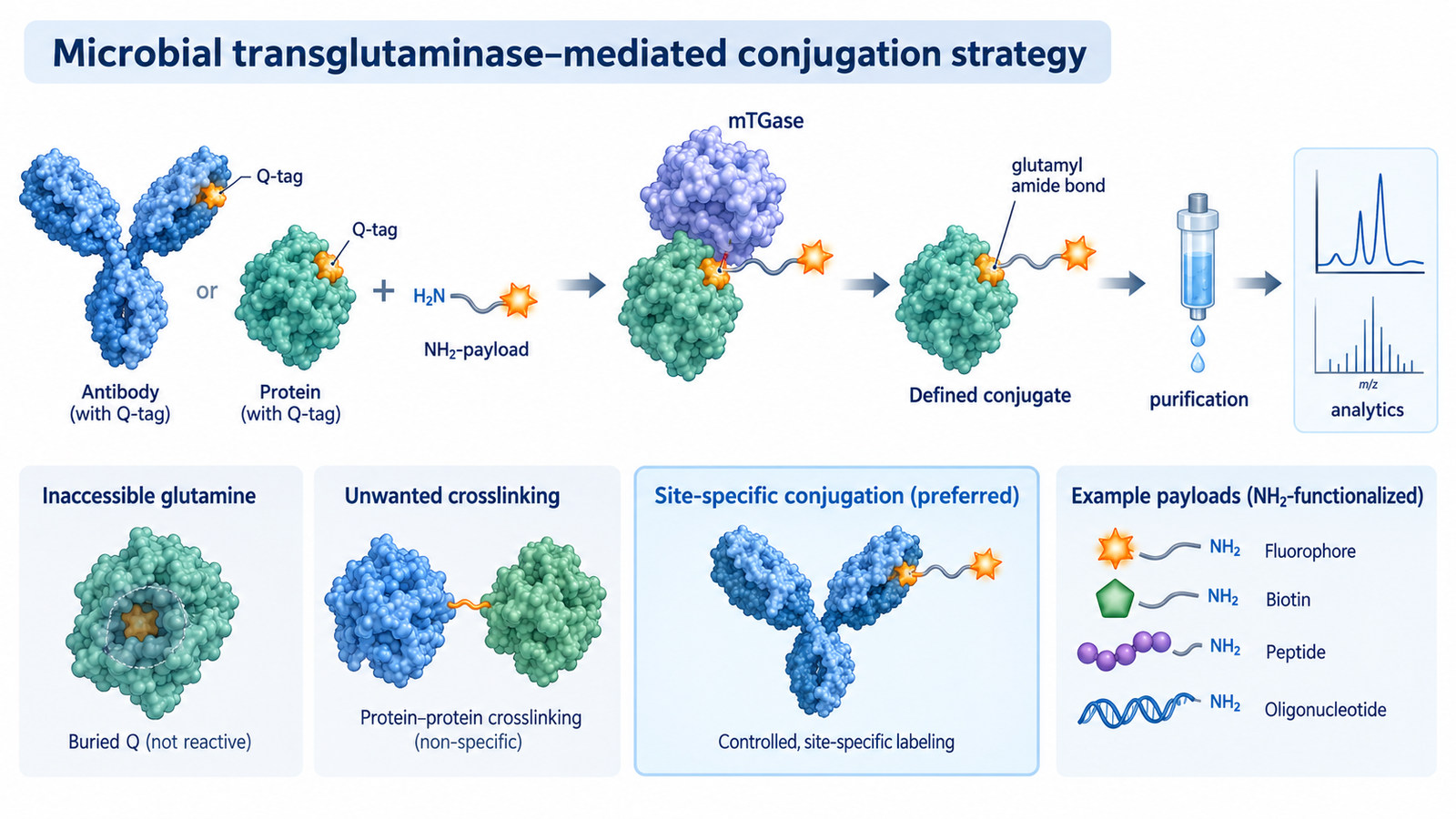 Transglutaminase-mediated conjugation integrates reactive-site selection, amine-compatible payload design, enzymatic coupling, purification, and analytical confirmation.
 Antibody Site Conjugation
We develop mTG-mediated strategies for antibodies and antibody fragments where controlled attachment position is important. Depending on antibody architecture, this may involve an engineered glutamine-containing tag, an accessible Fc glutamine strategy, glycan-related accessibility planning, or another substrate-engineering route.
The goal is a conjugate architecture that is easier to characterize and reproduce than broadly distributed lysine modification when the antibody format is compatible with enzyme-mediated site control.
 Protein Labeling Services
Recombinant proteins, enzymes, binding proteins, and other protein scaffolds can be evaluated for transglutaminase-mediated installation of fluorophores, affinity tags, polymers, chemical handles, or other functional groups.
This service is suitable for research teams that need controlled protein labeling without relying exclusively on stochastic surface-lysine modification.
 Peptide Conjugation Design
Peptides can serve as the glutamine-containing acyl donor, the lysine/amine-containing acceptor, or a functional component of a larger protein–peptide construct. We plan peptide sequences and spacers around the intended mTG reaction rather than treating the reactive residue independently of its local sequence environment.
Customers can use this approach to create defined peptide-functionalized research reagents or modular conjugation intermediates.
 Amine Payload Coupling
mTG can accept selected exogenous primary amines in place of a lysine side chain. We evaluate whether dyes, linker intermediates, PEG derivatives, small molecules, oligonucleotide adapters, or other payloads contain an enzyme-compatible amine or require an additional spacer.
This approach expands transglutaminase conjugation beyond direct protein–protein coupling and can simplify preparation of multifunctional constructs.
 Protein Crosslinking
When both biomolecular partners provide compatible glutamine and lysine or primary-amine functions, transglutaminase can be used for covalent protein–protein or protein–peptide assembly. Because uncontrolled crosslinking can also produce oligomers, reaction architecture is evaluated before scale-up.
Related projects can also be supported through our enzymatic crosslinking services.
 Custom Method Development
Difficult substrates often require empirical optimization because mTG reactivity depends on local sequence, three-dimensional accessibility, payload architecture, and reaction conditions. We can develop project-specific methods rather than forcing all molecules into a standard reaction recipe.
Deliverables can include purified conjugate, analytical data, reaction-condition summaries, and recommendations for subsequent development.
Transglutaminases catalyze acyl transfer involving the γ-carboxamide group of a glutamine residue. In the commonly used microbial transglutaminase reaction, the enzyme first recognizes a sufficiently accessible glutamine-containing substrate and forms an enzyme-linked acyl intermediate. A suitable nucleophilic primary amine then attacks that intermediate to generate a substituted glutamyl amide bond.
When the amine is the ε-amino group of a lysine residue, the result is a γ-glutamyl-ε-lysine isopeptide linkage. When the acceptor is an external primary amine on a dye, linker, polymer, small molecule, peptide, or modified oligonucleotide, the same catalytic logic can be used to introduce that functional component at the reactive glutamine site.
Site selectivity is determined largely by substrate recognition and physical accessibility rather than by the presence of glutamine alone. Many glutamines in a folded protein are poor mTG substrates, while selected exposed sequences or engineered Q-tags can be considerably more reactive. Conversely, if multiple suitable donor and acceptor sites are simultaneously available, undesired crosslinking can occur. Substrate mapping and reaction design are therefore central to a useful transglutaminase conjugation workflow.
Transglutaminase conjugation can accommodate diverse biomolecules, but compatibility depends on which component acts as the glutamine acyl donor and which provides the nucleophilic amine. The matrix below summarizes common project configurations.
| Molecule / Format | Reactive Handle | Role in mTG Reaction | Key Design Considerations | Typical Research Output |
| Antibodies & Fragments | Accessible Gln, engineered Q-tag, selected Lys/amine configuration | Usually glutamine donor; alternative architectures are possible | Fc glycan accessibility, tag position, binding-domain separation, conjugation stoichiometry | Site-controlled labeled or payload-bearing antibody conjugates |
| Recombinant Proteins | Native exposed Gln or engineered Gln-containing motif | Commonly acyl donor | Local folding, surface accessibility, functional-domain proximity, aggregation risk | Fluorescent, affinity-tagged, polymer-modified, or multifunctional proteins |
| Peptides | Gln motif, Lys, or terminal / side-chain primary amine | Donor or acceptor | Sequence context, steric accessibility, solubility, competing reactive residues | Protein–peptide, peptide–peptide, or peptide–payload conjugates |
| Small Molecules & Dyes | Accessible primary amine, often presented through a spacer | Acyl acceptor | Amine structure, spacer length, hydrophobicity, solvent compatibility | Site-directed fluorescent or functional protein labeling |
| PEG & Polymers | Primary amine-functionalized polymer | Acyl acceptor | Polymer size, steric demand, solubility, degree of modification | Protein–polymer conjugates and surface-property modification |
| Oligonucleotides | Amine-bearing linker or mTG-compatible adapter | Usually acyl acceptor | Spacer architecture, oligo charge, purification challenge, protein accessibility | Protein–DNA or protein–RNA research conjugates |
| Functional Handles | Amine-bearing azide, alkyne, cyclooctyne, tetrazine, or related reagent | Acyl acceptor | Preserving orthogonal handle reactivity after enzymatic installation | Chemoenzymatic intermediates for subsequent ligation steps |
Transglutaminase chemistry is particularly valuable when conventional random modification produces too many positional isomers or when a project needs a defined enzymatic entry point without exposing the biomolecule to strongly reactive chemical conditions.
When conjugation position matters: An engineered Q-tag or suitably accessible glutamine can confine labeling to a defined region and reduce modification across unrelated surface lysines.
When protein function must be protected: Positioning the reactive site away from a binding surface, catalytic site, or structural interface can reduce the risk of disrupting the function that motivated the conjugation project.
When a controlled modification level is preferred: A known number of reactive sites can make the product distribution easier to manage than stochastic amine labeling, although the actual conjugation degree still requires experimental verification.
When the payload can be equipped with a primary amine: Dyes, linkers, polymers, and chemical handles can often be adapted with an amine-bearing spacer for mTG-mediated installation.
When enzymatic and chemical methods need to be combined: mTG can first introduce an orthogonal chemical handle, followed by a second-stage click or other selective ligation reaction.
Transglutaminase is not automatically the best choice for every biomolecule. Projects with no suitably accessible glutamine, incompatible payload architecture, extensive competing crosslinking, or simpler requirements may be better served by other approaches. Our chemical vs enzymatic antibody conjugation resource provides additional context for method selection.
Chemistry selection should be based on available functional groups, desired site control, acceptable protein engineering, payload structure, and analytical requirements. The following comparison highlights practical differences rather than treating one conjugation method as universally superior.
| Method | Primary Reactive Handle | Typical Site Control | Key Strength | Main Consideration |
| Transglutaminase | Reactive Gln + primary amine / Lys | Potentially high with selected site or engineered tag | Enzyme-guided modification under biomolecule-compatible conditions | Requires an mTG-reactive donor site and compatible amine partner; accessibility is substrate-dependent |
| NHS Ester Coupling | Surface primary amines, mainly Lys and N-termini | Generally low on unengineered proteins | Simple and broadly applicable | Multiple accessible amines can create positional and loading heterogeneity |
| Maleimide–Thiol | Free cysteine thiol | Moderate to high when cysteine placement is controlled | Efficient reaction with accessible thiols | May require disulfide reduction or cysteine engineering; linkage behavior depends on reagent design |
| Click Chemistry | Azide/alkyne, tetrazine/alkene, or related orthogonal pair | High after handle installation | Excellent orthogonality and modular payload attachment | Bioorthogonal handles normally need to be introduced before the final ligation |
| Sortase-Mediated | Recognition motif such as LPXTG + oligoglycine partner | High at designed recognition site | Sequence-defined enzymatic ligation | Typically requires specific peptide motifs and is often used near protein termini |
Each project is developed around the actual substrate pair and intended downstream use. The workflow can be shortened for established constructs or expanded when site engineering and method screening are required.


We review the protein, antibody, peptide, or other biomolecule together with the desired label or payload, required attachment position, expected conjugation level, sample amount, and downstream application. This establishes whether mTG is appropriate before reaction development begins.

Potential glutamine donor sites and amine acceptors are evaluated for sequence context and structural accessibility. If the native molecule is unsuitable, a Q-tag, alternative peptide motif, payload spacer, or two-stage chemoenzymatic route can be proposed.

We define donor/acceptor orientation, substrate ratios, enzyme strategy, buffer requirements, and whether direct coupling or mTG-assisted handle installation provides the cleaner development path.

Candidate conditions are compared for desired product formation, residual starting material, higher-order crosslinking, aggregation, and conjugation distribution. Reaction time and component ratios can be adjusted around the behavior of the actual substrate.

Free payload, enzyme, unreacted biomolecule, and undesirable high- or low-molecular-weight species are removed using purification methods selected for the size, charge, hydrophobicity, and stability of the conjugate.

Relevant analytical methods are applied to confirm conjugation, assess product distribution and integrity, and support interpretation of the selected preparation. Deliverables can include purified material, analytical results, and a summary of the optimized conjugation conditions.
Successful enzymatic coupling does not by itself establish that a conjugate is suitable for downstream research. The final material may contain unreacted biomolecule, free payload, residual transglutaminase, partially modified species, or intermolecular crosslinking products. Purification and analysis are therefore planned together with the conjugation reaction.
Depending on molecular size and physicochemical properties, purification can include size-exclusion chromatography, ion-exchange chromatography, affinity-based separation, preparative chromatography, ultrafiltration/diafiltration, desalting, or buffer exchange. The selected method is intended to distinguish the desired conjugate from the major process-related species rather than applying a single purification format to every project.
Intact-mass analysis, LC-MS, SDS-PAGE or CE-based analysis, and chromatography can be used as appropriate to verify formation of the expected conjugate and identify residual starting material or higher-molecular-weight products.
Degree of labeling or conjugation, conjugate-to-protein ratio, intact mass shifts, peptide mapping, or site-occupancy measurements can be considered when the project requires greater confidence about modification number or attachment position.
SEC-based aggregation assessment, spectroscopic measurements, binding assays, enzyme-activity measurements, or other application-relevant tests can be incorporated where needed to determine whether conjugation altered important biomolecular properties. For antibody-focused projects, additional background is available in our resource on how to characterize antibody conjugates.
The mere presence of glutamine does not guarantee efficient modification. Local sequence, protein folding, solvent exposure, steric shielding, and nearby structural features all influence recognition by mTG. For this reason, native-site feasibility should be evaluated before assuming a protein is an appropriate substrate.
Payloads require a suitable nucleophilic amine to act as the acyl acceptor. Bulky or poorly accessible amines can react inefficiently, and a lysine-like or flexible spacer can be useful when the functional payload itself is sterically demanding.
For conventional mTG modification of certain native IgG Fc glutamine sites, nearby glycosylation can restrict enzyme access. Depending on the project, strategies may include glycan modification, an engineered glutamine tag, or a transglutaminase variant with different substrate-access characteristics. The appropriate route depends on the antibody and the desired final construct.
Proteins containing multiple accessible glutamine and lysine sites can form intermolecular products rather than a single desired conjugate. Substrate orientation, concentration, reaction time, tag design, and acceptor excess can all influence this outcome.
The enzyme, protein, and payload must remain soluble and functional in the same reaction environment. Buffer composition, pH, additives, cosolvent requirements, protein concentration, and storage history may therefore need joint optimization.
Even a chemically well-defined attachment can alter protein function if the modification is placed near a binding interface or affects local structure. Conjugation-site selection should therefore be guided by the intended biological or analytical function, followed by appropriate functional comparison when required.
Conjugation design begins with the actual protein sequence, structure, reactive-site accessibility, and payload chemistry. This helps identify when a native site is practical, when an engineered tag is preferable, and when another chemistry should be considered.

We consider Q-tag placement, native glutamine accessibility, amine-payload architecture, and functional-domain separation together to support more deliberate control over where conjugation occurs.
Reaction development is linked to a realistic separation and characterization plan so that free payload, enzyme, unreacted material, and crosslinked species can be addressed rather than discovered only after conjugation is complete.
Projects can range from feasibility assessment and condition screening to purified research conjugates, repeat preparation, and integration with related antibody, protein, peptide, or chemoenzymatic conjugation workflows.
Whether you are developing a site-controlled antibody conjugate, labeling a recombinant protein, connecting a peptide or polymer to a defined protein region, or evaluating mTG as an alternative to random amine chemistry, BOC Sciences can support the project from substrate assessment through conjugation, purification, and analytical characterization.
Share your biomolecule format, sequence or molecular information, desired payload, available reactive handles, expected modification level, and downstream research requirements. Contact our scientific team to discuss a project-specific transglutaminase-mediated conjugation strategy.
Microbial transglutaminase commonly transfers the acyl group of a suitable protein- or peptide-bound glutamine to a lysine ε-amino group or another compatible primary amine. This allows proteins and peptides to be coupled to other biomolecules, dyes, polymers, linkers, oligonucleotide adapters, and selected small molecules.
No. Reactivity depends strongly on local sequence, solvent exposure, protein folding, and steric accessibility. Many glutamines in folded proteins are poor substrates, which is why native-site assessment or introduction of an optimized Q-tag can be important.
Not always. Some substrates contain naturally accessible mTG-reactive glutamines, while certain antibody strategies make use of defined Fc sites. However, an engineered Q-tag can provide a more predictable reactive location when native residues are inaccessible or insufficiently selective.
Potentially, but the route depends on the antibody and enzyme system. With conventional mTG, Fc glycosylation near the conserved Q295 region can restrict access. Strategies reported for antibody research include glycan modification, engineered glutamine tags, and engineered transglutaminases capable of accessing different substrate environments.
A common configuration uses a protein- or peptide-bound glutamine as the donor and a primary amine on the payload as the acceptor. Payload geometry matters: bulky functional groups may benefit from an accessible, flexible amine-bearing spacer rather than placing the reactive amine immediately next to the payload.