Fast Bioorthogonal iEDDA ConjugationTetrazine–TCO & Strained Dienophile ChemistryCustom Biomolecule Assembly, Labeling & Method Development
BOC Sciences provides custom tetrazine ligation services for research projects requiring rapid, selective, and catalyst-free coupling of biomolecules, labels, linkers, and functional payloads. Tetrazine ligation is based on the inverse-electron-demand Diels–Alder (iEDDA) reaction between an electron-deficient 1,2,4,5-tetrazine and a compatible strained dienophile, most commonly trans-cyclooctene (TCO). The reaction can proceed efficiently under mild aqueous conditions and is particularly useful when conventional amine- or thiol-reactive chemistry does not provide sufficient orthogonality.
Our support can begin with reactive-handle selection and installation or with customer-supplied tetrazine- or TCO-functionalized materials. Projects may include proteins, antibodies, peptides, oligonucleotides, fluorescent reporters, biotin derivatives, small molecules, polymers, and other research reagents. We design each workflow around the actual conjugation problem, including handle accessibility, linker length, tetrazine stability, TCO isomerization risk, molecule concentration, purification requirements, and the analytical methods needed to verify the final construct.
Tetrazine ligation can also be integrated with broader custom bioconjugation services or used as an orthogonal step in multi-stage conjugation strategies. For additional chemistry background, see our resources on tetrazine ligation and bioorthogonal reactions.
A tetrazine ligation project is rarely limited to mixing two click-compatible reagents. The most common development problems arise earlier: deciding which molecule should carry the tetrazine, choosing between TCO and alternative dienophiles, placing the reactive handle without disrupting biomolecular function, controlling the number of installed handles, preserving reaction-competent TCO, and selecting a purification method that separates the desired conjugate from unreacted material.
Our tetrazine conjugation services address these decisions as an integrated workflow. Depending on the project, we can support initial functionalization, linker selection, iEDDA reaction development, purification, analytical verification, and repeat-batch or scale-up planning.
 Reactive Handle Installation
Scope: Introduction of tetrazine, TCO, BCN, norbornene, or other appropriate iEDDA-compatible handles before the final ligation step.
Deliverables and value: A defined handle-installation strategy and functionalized intermediate designed for efficient downstream iEDDA coupling without assuming that the click reaction itself creates site specificity.
 Protein & Antibody Ligation
Scope: Tetrazine-mediated conjugation of proteins, antibodies, antibody fragments, recombinant proteins, and other macromolecular reagents.
Deliverables and value: Purified protein or antibody conjugates with project-appropriate analytical data to assess conjugation, integrity, and aggregation behavior.
 Peptide & Oligo Ligation
Scope: Assembly of tetrazine-reactive peptides, oligonucleotides, peptide–oligo constructs, and related hybrid research molecules.
Deliverables and value: Structurally defined conjugates suitable for chemical biology, assay development, affinity studies, and biomolecular interaction research. Related peptide projects can also be coordinated through our peptide conjugation services.
 Label & Payload Coupling
Scope: Attachment of fluorescent dyes, affinity tags, biotin derivatives, small molecules, linkers, and other research payloads through tetrazine ligation.
Deliverables and value: Labeled research reagents with free label or payload removed using a purification strategy matched to the molecular-size difference and analytical objective. Fluorophore projects can be coordinated with our fluorescence labeling capabilities.
 Site-Selective Assembly
Scope: Tetrazine ligation following installation of a reactive handle at a defined or enriched position.
Deliverables and value: Greater control over conjugate architecture when the starting material supports defined handle placement, while avoiding the misleading assumption that tetrazine chemistry alone determines the modification site.
 Method Optimization & Scale-Up
Scope: Development or troubleshooting of an existing tetrazine ligation workflow.
Deliverables and value: A documented conjugation workflow with reaction, purification, and analytical parameters that can support repeat preparation and further process development.
Tetrazine ligation is an inverse-electron-demand Diels–Alder reaction in which an electron-poor tetrazine reacts with an electron-rich or ring-strained dienophile. TCO is the most widely used partner when very rapid ligation is required, although BCN, norbornene, cyclopropene derivatives, and other dienophiles can be useful when size, stability, orthogonality, or reagent architecture is more important than maximum reaction speed.
In a typical bioconjugation workflow, the two target components are first equipped with complementary reactive handles. For example, a protein may be functionalized with TCO while a fluorophore, peptide, oligonucleotide, or second protein carries tetrazine. Once combined under compatible conditions, the iEDDA cycloaddition is followed by nitrogen extrusion to generate a covalently linked dihydropyridazine/pyridazine-derived product. No copper catalyst is required for the ligation step.
The fast final reaction does not remove the need for careful upstream design. If too many TCO groups are introduced onto an antibody, if the tetrazine is unstable under the selected handling conditions, or if a reactive handle is sterically buried, the nominal speed of the chemistry may not translate into an efficient preparation. Our workflow therefore treats handle installation, reagent stability, ligation, purification, and characterization as connected development stages.
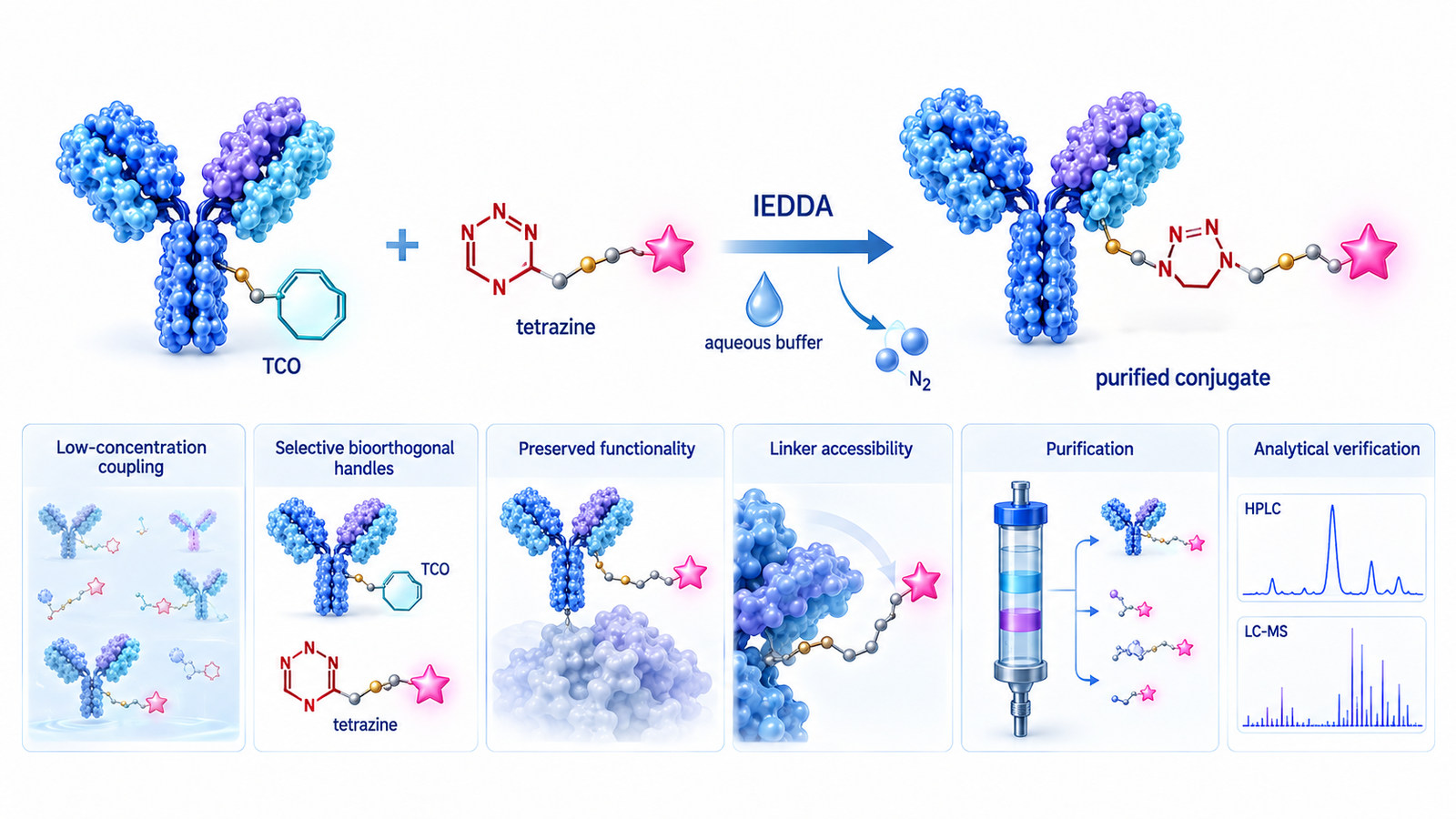 Tetrazine ligation connects pre-functionalized biomolecules through a rapid bioorthogonal iEDDA reaction while preserving unrelated native functional groups.
Tetrazine ligation can be applied to many molecular classes, but the tetrazine or dienophile usually has to be introduced through an upstream modification step. The appropriate installation chemistry depends on the starting molecule and the degree of positional control required.
| Molecule Type | Possible Handle Installation | iEDDA Partner Options | Technical Considerations | Typical Project Output |
| Antibodies | Accessible lysines, selected cysteines, engineered or enzymatically introduced sites | Tetrazine or TCO; BCN in selected designs | Handle density, binding-region accessibility, linker hydrophobicity, aggregation, and whether modification is random or site-directed | Antibody–label, antibody–oligo, antibody–protein, or antibody–small-molecule research conjugates |
| Proteins & Enzymes | Amines, thiols, termini, engineered residues, or pre-installed bioorthogonal handles | Tetrazine, TCO, BCN, or other validated strained partners | Structural accessibility, activity retention, buffer compatibility, oligomeric state, and concentration | Protein–protein, protein–label, protein–peptide, or protein–oligo conjugates |
| Peptides | N-terminus, side-chain amines or thiols, synthetic incorporation of modified amino acids | Tetrazine or strained dienophile | Sequence-dependent solubility, reactive-site placement, payload size, and HPLC behavior | Peptide–label, peptide–oligo, peptide–protein, or multifunctional peptide constructs |
| Oligonucleotides | 5′/3′ functionalization, amino- or thiol-containing linker, direct synthetic handle incorporation where suitable | Tetrazine, TCO, BCN, or compatible pre-functionalized linker | Hybridization domain accessibility, charge, linker length, purification, and modification position | Oligo–protein, oligo–antibody, oligo–peptide, reporter, or affinity constructs |
| Small Molecules & Dyes | Amine, carboxyl, thiol, hydroxyl, or synthetic intermediate converted to a click-ready derivative | Tetrazine- or TCO-functionalized reagent | Solubility, linker attachment position, fluorophore quenching, payload hydrophobicity, and excess reagent removal | Labeled proteins, peptides, antibodies, oligos, or other research probes |
| Polymers & Nanomaterials | Surface or polymer functional groups converted to tetrazine- or dienophile-bearing handles | Tetrazine/TCO and selected alternative iEDDA pairs | Surface density, accessibility, nonspecific adsorption, particle stability, and purification limitations | Biomolecule-decorated surfaces, particles, polymers, or research materials |
Important: Tetrazine ligation is highly selective for the installed bioorthogonal handles, but the overall site selectivity of a final conjugate is determined primarily by how those handles were introduced. Random NHS-based installation on multiple lysines, for example, can still produce a heterogeneous population even though the subsequent tetrazine–TCO reaction is bioorthogonal.
Tetrazine ligation is especially useful when the project needs an orthogonal final coupling step that can operate efficiently without a metal catalyst. It is often selected for low-concentration biomolecular assembly, rapid reporter attachment, sequential conjugation, and systems in which native amines or thiols must remain unreacted during the final coupling step.
Fast TCO–tetrazine kinetics can be useful when one or both components are available only at relatively low concentration and slower bimolecular reactions would require long incubation or large reagent excess.
The iEDDA step does not require copper catalysis, making it attractive for proteins, antibodies, oligonucleotides, and other systems where copper exposure or subsequent metal-removal steps are undesirable.
Pre-installed tetrazine and dienophile handles can provide a selective final connection after other functionalization steps, supporting modular assembly of multi-component research reagents.
Fluorophores, biotin derivatives, affinity reagents, and other click-ready reporters can be attached after the target biomolecule has been prepared and purified.
Once complementary click handles are installed, the final ligation can proceed without intentionally consuming the remaining native amines, carboxylates, or thiols that may be needed for function or additional chemistry.
SPAAC, CuAAC, NHS ester coupling, maleimide chemistry, or enzymatic conjugation may be preferable when reagent storage stability, very small handle size, lower reagent complexity, a specific attachment site, or an established manufacturing workflow is more important than maximum ligation speed.
Chemistry selection should be based on the substrate, required positional control, concentration, available functional groups, reaction environment, and downstream purification—not on reaction speed alone. The matrix below summarizes practical differences among commonly used conjugation approaches.
| Method | Reactive Pair | Catalyst Requirement | Relative Reaction Behavior | Key Advantages | Main Considerations |
| Tetrazine Ligation | Tetrazine + TCO or another compatible strained dienophile | None for the iEDDA step | Very fast with appropriately matched tetrazine/TCO systems; dependent on structure and conditions | Rapid, bioorthogonal, catalyst-free, useful at low concentration, suitable for modular assembly | Tetrazine stability, TCO isomerization, reagent size/hydrophobicity, and upstream handle placement |
| SPAAC | Azide + strained cyclooctyne such as DBCO or BCN | None | Typically slower than optimized TCO–tetrazine ligation | Stable azide handle, copper-free operation, widely used for biomolecules | Cyclooctyne hydrophobicity and steric bulk; BCN can also react with tetrazines, which matters in multiplex designs |
| CuAAC | Azide + terminal alkyne | Copper catalyst | Efficient when catalyst system and substrates are optimized | Small handles, robust triazole formation, useful in synthetic and selected biomolecular workflows | Copper compatibility, ligand/reductant requirements, and subsequent cleanup |
| NHS Ester Coupling | Activated ester + primary amine | None | Practical but dependent on pH, reagent hydrolysis, and accessible amines | Simple, widely accessible, useful for installing tetrazine or TCO handles | Often generates heterogeneous modification when multiple amines are available |
| Maleimide Coupling | Maleimide + thiol | None | Efficient under suitable thiol-selective conditions | Useful when a controlled cysteine or thiol is available; also useful for handle installation | Competing thiols, disulfide management, hydrolysis, and long-term linkage considerations |
For broader context on copper-free and catalyst-assisted click strategies, see our click chemistry and bioorthogonal click chemistry resources.
Tetrazine conjugation projects are developed around both components of the final reaction rather than treating one material as a generic substrate. This helps identify stability, accessibility, purification, and analytical issues before valuable starting material is committed to the final ligation.


We review both conjugation partners, available quantities, molecular weights, functional groups, buffers, required conjugate architecture, intended downstream use, and any known stability or activity constraints. This establishes whether tetrazine ligation is appropriate and which component should carry each reactive handle.

Tetrazine, TCO, BCN, or another compatible pair is selected based on reaction-speed requirements, stability, molecular size, linker geometry, solubility, and available attachment sites. Handle density and spacer length are planned before functionalization.

One or both starting materials are converted to click-ready intermediates when required. Excess linker or activated reagent is removed before the final ligation so that residual reactive material does not consume the complementary partner or complicate stoichiometry.

Complementary partners are combined under conditions selected for biomolecule stability, reactant concentration, solubility, and expected handle accessibility. Reaction progress can be assessed analytically when the molecular format and available methods permit.

Free click reagent, unconjugated payload, unreacted biomolecule, and process-related components are removed using a separation strategy matched to the product. Buffer exchange can be incorporated when the final research format requires different handling or storage conditions.

Relevant analytical methods are selected to evaluate identity, conjugation extent, purity, aggregation, molecular integrity, or functional performance. Final materials are supplied together with project-appropriate analytical and handling information.
Tetrazine ligation can generate a clean covalent connection, but purification requirements depend strongly on the size and properties of the two starting materials. A protein linked to a small fluorescent tetrazine requires a different cleanup strategy from a protein–protein or antibody–oligonucleotide conjugate. Analytical methods are therefore selected according to the product rather than applied as a fixed package.
| Development Need | Possible Approach | What It Helps Evaluate |
| Remove Free Small Reagent | Desalting, size-exclusion chromatography, dialysis, or ultrafiltration where appropriate | Removal of excess tetrazine/TCO reagent, dye, linker, salt, or low-molecular-weight reaction components |
| Resolve Conjugate Species | SEC, ion-exchange, hydrophobicity-based separation, or other project-specific chromatography | Separation of aggregates, unconjugated starting material, or conjugate populations when their properties allow resolution |
| Peptide/Oligo Purification | RP-HPLC, ion-pair chromatography, or other suitable chromatographic methods | Product isolation from excess click partner, side products, and incomplete starting material |
| Identity Assessment | LC-MS, intact-mass analysis, MALDI-MS, or other molecular-format-appropriate techniques | Confirmation of expected molecular change and differentiation from unmodified starting material where analytically feasible |
| Conjugation Extent | UV-Vis, chromatographic analysis, mass-based analysis, or reagent-specific measurements | Assessment of labeling or payload incorporation and comparison of candidate reaction conditions |
| Aggregation & Integrity | SEC, DLS, SDS-PAGE, electrophoretic methods, or other suitable assays | Detection of aggregation, fragmentation, or major changes associated with functionalization and ligation |
| Functional Assessment | Binding, activity, hybridization, fluorescence, or other application-relevant testing when included in the project | Whether the final conjugate retains a function that cannot be inferred from chemical identity alone |
Highly reactive tetrazines are not automatically the best choice for every project. Structural changes that increase iEDDA reactivity can also reduce chemical stability in aqueous or biologically complex environments. Reagent selection should therefore consider the expected reaction time, storage period, exposure conditions, and partner concentration together.
TCO is commonly preferred for fast ligation, but other dienophiles may provide a better compromise between size, stability, reaction rate, or synthetic accessibility. BCN can be useful when TCO stability is a concern, while smaller or slower dienophiles may be attractive for specialized architectures.
Reaction-competent trans-cyclooctene can isomerize to the much less reactive cis form. The risk depends on the TCO structure and environment and becomes important when a TCO-functionalized intermediate must remain active through extended processing, storage, or exposure to complex mixtures.
A chemically intact tetrazine or TCO is not useful if it is sterically inaccessible. Handle position and linker length should be selected with the three-dimensional environment of the biomolecule in mind, particularly for antibodies, folded proteins, structured oligonucleotides, and crowded surfaces.
The nominal number of installed handles may differ from the number that remains accessible and reaction competent. Reaction design should therefore consider functional handle availability rather than relying only on the input ratio used during the preceding modification step.
Standard tetrazine ligation is designed to form a covalent connection. Tetrazine-triggered click-to-release chemistry is a distinct design concept that requires specially engineered TCO linker architecture and release kinetics. Projects requiring payload release should therefore be planned differently from permanent conjugation projects.
We evaluate both the iEDDA pair and the chemistry used to install it. This helps avoid workflows in which a fast tetrazine reaction is undermined by uncontrolled handle loading, inaccessible sites, or an incompatible linker.

Reaction pH, concentration, solvent exposure, linker structure, and purification are planned around the stability of the actual protein, antibody, peptide, oligonucleotide, or other substrate rather than around idealized small-molecule reaction conditions.
We distinguish between bioorthogonality of the final tetrazine reaction and site control of the upstream modification step, allowing projects to select random, enriched, or more defined architectures according to the starting material and research objective.
Purification and characterization are selected according to conjugate size and physicochemical properties, with analytical emphasis placed on questions that affect project decisions: conversion, free reagent removal, integrity, aggregation, labeling extent, and function where applicable.
Whether you need to introduce a tetrazine or TCO handle, connect two pre-functionalized biomolecules, troubleshoot incomplete iEDDA conversion, or compare tetrazine ligation with another conjugation route, BOC Sciences can develop a project-specific strategy around your starting materials and intended research format.
Useful information for an initial technical review includes the identity and amount of each starting material, molecular weight, available functional groups or existing modifications, current buffer, desired conjugate architecture, preferred labeling ratio or site-control requirement, intended downstream use, and any analytical methods that are important to the project. Contact our scientific team to discuss your tetrazine ligation requirements.
Tetrazine ligation is a bioorthogonal inverse-electron-demand Diels-Alder reaction between a tetrazine and a compatible dienophile. TCO is the most common high-reactivity partner, although BCN, norbornene, cyclopropene derivatives, and other dienophiles can also be used depending on the project.
No. The tetrazine-dienophile iEDDA step does not require a copper catalyst. This distinguishes it from CuAAC and can simplify projects involving copper-sensitive biomolecules or workflows where metal-removal steps are undesirable.
Either arrangement can work. The better orientation depends on handle-installation chemistry, reagent stability, molecular size, accessibility, storage requirements, and which component is easier to prepare and purify. The decision should be made for the complete workflow rather than from reaction rate alone.
No. TCO is widely used because of its high reactivity, but it can lose activity through trans-to-cis isomerization. BCN may offer a useful stability/reactivity balance in some systems, while norbornene or smaller dienophiles can be appropriate when other design constraints dominate. The optimal pair is application-dependent.
The final reaction is highly selective for complementary bioorthogonal handles, but site specificity depends on how those handles were installed. Random modification of several lysines can still generate a heterogeneous product population. A defined handle must first be introduced at a controlled site if a more site-specific architecture is required.