Strategy-Driven Bioconjugation DevelopmentMethod Optimization, Purification & CharacterizationScale-Aware Support for Complex Conjugates
Bioconjugation development requires more than selecting a reactive reagent and confirming that coupling occurred. The biomolecule, conjugation partner, reactive-group accessibility, linker architecture, desired loading level, reaction environment, purification route, analytical method, and downstream use all influence whether a conjugate can be prepared reproducibly and retain the properties required for research.
We provide custom bioconjugation development services for proteins, antibodies, peptides, oligonucleotides, small molecules, labels, and other functional components. Projects can begin with an early conjugation concept, an existing method that needs troubleshooting, or a partially developed workflow requiring better control of conversion, loading, purification, stability, or scale. Our development approach connects chemistry selection with reaction optimization, purification planning, analytical verification, and scale-up considerations so that each stage supports the next.
Development plans are built around the properties of both conjugation partners rather than around a fixed reaction protocol. We evaluate functional groups, molecular size, solubility, structural sensitivity, desired site control, linker requirements, expected product heterogeneity, and downstream analytical needs before selecting conditions. Projects can also be coordinated with our broader custom bioconjugation services when preparation of final research conjugates is required after development.
 Conjugation Strategy & Feasibility Assessment
We review whether the proposed biomolecules and functional groups can support a practical conjugation route before extensive experimental work begins.
Typical deliverables: recommended development route, key technical risks, starting reaction conditions, purification considerations, and an analytical plan for comparing candidate conjugates.
 Method Development & Optimization
Initial reaction conditions are refined to improve useful conversion while protecting biomolecule integrity and controlling unwanted species.
Customer value: development decisions are based on both reaction performance and the quality of the recoverable conjugate rather than on conversion alone.
 Bioconjugate Purification
Purification is planned as part of method development because an efficient reaction may still be impractical if product, starting material, free label, aggregates, or closely related conjugate species cannot be separated appropriately.
Typical output: a purification workflow aligned with conjugate size, charge, hydrophobicity, stability, and the impurities generated by the selected chemistry.
 Bioconjugate Characterization
Analytical methods are selected according to the conjugate rather than applying a single test to every project.
Customer value: the analytical package is designed to answer development questions such as whether the desired conjugate formed, how heterogeneous it is, and which candidate is suitable to advance.
 Bioconjugate Stability Assessment
Candidate conjugates can be examined under project-relevant conditions to identify instability that may not be apparent immediately after purification.
Typical deliverables: stability observations, comparative analytical data, and practical recommendations for handling or further optimization.
 Scale-Up Support
Conditions that perform well in a small screening experiment may change when reaction volume, material concentration, mixing, addition sequence, or purification load increases.
Customer value: scale-up is treated as a development stage rather than simply multiplying the quantities used in a small reaction.
Different conjugate classes create different development problems. A strategy suitable for a short peptide may not translate directly to an antibody, and a reaction that produces acceptable conversion with a small fluorescent label may become difficult when the partner is an oligonucleotide, protein, polymer, or poorly soluble small molecule. Development therefore starts by examining both components and identifying the factors most likely to limit reaction control, purification, and analytical interpretation.
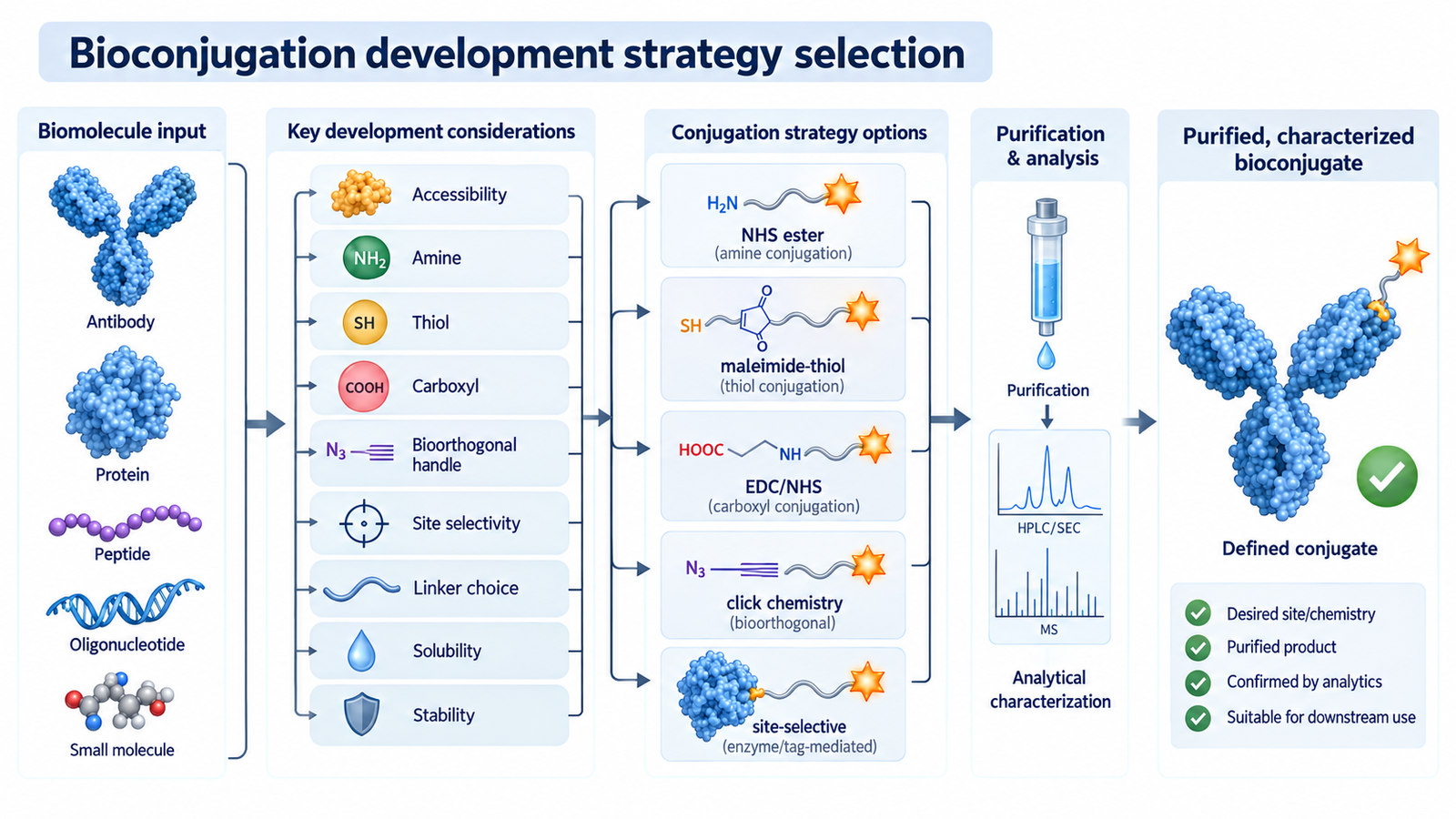 Bioconjugation development begins by matching biomolecule properties and reactive-group accessibility with site-control, purification, stability, and analytical requirements.
| Conjugate Type | Primary Development Focus | Typical Chemistry Questions | Common Development Risks | Purification & Analytical Priorities |
| Antibody Conjugates | Control modification while maintaining antibody integrity and the required binding properties. | Random amine labeling versus cysteine-based or more site-selective routes; desired loading range; linker placement. | Broad conjugate distributions, over-labeling, aggregation, modification near functionally important regions, and difficult removal of related species. | Conjugation-ratio distribution, free label or payload, aggregation, antibody integrity, and function-oriented testing where required. |
| Protein Conjugates | Balance reaction accessibility with structural stability and retention of the protein property required downstream. | Accessible lysines or cysteines, terminal modification, introduced handles, protein concentration, buffer tolerance, and reaction-site control. | Denaturation, precipitation, aggregation, low accessibility of reactive residues, and activity loss after modification. | SEC or electrophoretic assessment, mass or labeling analysis, aggregate monitoring, and suitable functional comparison. |
| Peptide Conjugates | Use sequence-defined handles while managing solubility, side-chain reactivity, and separation of closely related products. | N- or C-terminal modification, lysine or cysteine placement, orthogonal protecting-group logic, click handles, and linker length. | Competing reactive residues, poor aqueous solubility, oxidation, multiple positional products, and difficult chromatographic separation. | RP-HPLC, LC-MS, product identity, purity, and confirmation of the expected modification state. |
| Oligonucleotide Conjugates | Preserve oligonucleotide integrity while positioning a reactive handle or partner at a defined location. | 5′, 3′, or internal handle placement; amine, thiol, azide, alkyne, or other functionalization; spacer selection; partner compatibility. | Incomplete coupling, secondary structure effects, hydrophobic conjugate behavior, residual free partner, and difficult recovery of amphiphilic products. | HPLC or LC-MS as appropriate, oligonucleotide integrity, conjugation confirmation, free component removal, and hybridization-related testing when relevant. |
| Small Molecule & Hapten Conjugates | Introduce or select a coupling handle without disrupting the functional portion of the small molecule. | Which functional group can be derivatized, whether a spacer is required, and whether direct or two-step activation is preferable. | Poor water solubility, competing functionality, unstable activated intermediates, excessive organic solvent, and low conjugation accessibility. | Removal of free small molecule, measurement of loading where feasible, structural confirmation, and evaluation of the carrier component. |
| Biomolecule-to-Biomolecule Conjugates | Create a directional linkage between two complex partners while minimizing uncontrolled crosslinking. | Which partner should receive the first reactive handle, whether an orthogonal two-step strategy is needed, and how stoichiometry will be controlled. | Oligomerization, multiple product architectures, low recovery, steric interference, and limited resolution between desired and undesired species. | Size-based analysis, mass assessment where possible, confirmation of both components, aggregate control, and function-relevant evaluation. |
Chemistry selection begins with the molecular question the project needs to solve. Available functional groups matter, but so do site selectivity, biomolecule stability, linker design, purification feasibility, downstream conditions, and whether an additional handle-introduction step is acceptable. No single conjugation chemistry is optimal for every substrate.
| Development Situation | Potential Starting Strategy | Why It May Fit | Key Development Checks |
| Multiple accessible primary amines are available and random or distributed modification is acceptable | NHS ester–amine conjugation | Provides a direct route to stable amide formation without requiring prior installation of a new reactive handle. | Amine accessibility, buffer composition, pH window, reagent hydrolysis, degree of labeling, activity retention, and removal of hydrolyzed or excess reagent. |
| A free or selectively generated thiol is available and improved positional control is desirable | Maleimide–thiol conjugation or another thiol-selective route | Lower natural abundance of free thiols can provide better control than broad lysine modification in suitable proteins or peptides. | Thiol accessibility, disulfide reduction strategy, competing thiols, oxidation, protein integrity, linker stability, and control of reaction stoichiometry. |
| A carboxyl group must be coupled directly to an amine without retaining a long crosslinker spacer | EDC/NHS-assisted coupling | Carbodiimide activation can connect available carboxyl and amine groups through an amide linkage. | Which component is activated first, hydrolysis of activated intermediates, uncontrolled intermolecular crosslinking, pH compatibility, and whether reactive groups are present at multiple undesired positions. |
| The partners can be equipped with complementary bioorthogonal handles | , including CuAAC, SPAAC, or other compatible bioorthogonal reactions | Orthogonal handles can decouple final conjugation from the many native functional groups present on biomolecules. | Handle-installation chemistry, copper tolerance where relevant, steric effects, linker hydrophobicity, intermediate purification, and residual unreacted handles. |
| A narrow loading distribution or defined modification position is a central project requirement | Site-selective chemical, engineered-handle, or enzymatic strategy where compatible | Controlling the available reaction site can reduce the structural diversity produced by broad modification of native residues. | Starting-material design, accessibility of the selected site, additional preparation steps, analytical confirmation of site occupancy, reaction recovery, and scalability. |
| Both conjugation partners contain many competing native functional groups | Staged heterobifunctional or orthogonal two-step conjugation | Activating one partner first and purifying the intermediate can reduce uncontrolled crosslinking and provide clearer control over reaction order. | Intermediate stability, excess reagent removal, residual reactive groups, crosslinker orientation, purification burden, and total process recovery. |
Bioconjugation development problems are often interconnected. Low conversion can encourage excessive reagent use, which can increase heterogeneity or complicate purification. A highly hydrophobic label may improve one functional property while creating aggregation or recovery problems. Development therefore focuses on identifying the limiting variable rather than optimizing reaction yield in isolation.
Low conversion can result from inaccessible reactive groups, reagent hydrolysis or degradation, unfavorable pH, competing buffer components, low effective concentration, steric effects, or poor compatibility between the two partners. Development may involve changing reagent ratio, concentration, reaction sequence, linker architecture, or the conjugation chemistry itself rather than simply increasing reaction time.
Hydrophobic labels, small-molecule payloads, multivalent modification, changes in surface charge, organic cosolvents, or high protein concentrations can reduce conjugate solubility. We evaluate reaction concentration, linker polarity, reagent addition, buffer conditions, loading level, purification conditions, and final formulation together to identify a more usable operating window.
Biomolecules containing several accessible lysines, cysteines, or other reactive sites can generate mixtures with different conjugation numbers or positions. Depending on the application, development may focus on narrowing reagent exposure, controlling reduction, changing the reactive handle, using a staged workflow, or evaluating a more site-selective strategy.
Product isolation becomes challenging when the conjugate and starting biomolecule have similar size or charge, when multiple loading states are present, or when hydrophobic components interact strongly with chromatography media. Purification feasibility is therefore assessed early, and reaction conditions can be adjusted to create a mixture that is easier to resolve.
Large, heterogeneous, highly charged, hydrophobic, or multi-component conjugates may not be fully described by one analytical technique. We select complementary methods based on the specific questions that need to be answered, such as identity, purity, average loading, loading distribution, aggregation, free component content, or retained function.
A conjugate that appears acceptable immediately after preparation may change during storage, concentration, buffer exchange, freeze-thaw handling, or downstream incubation. Development can compare linker chemistry, conjugation site, loading level, buffer conditions, and handling parameters to determine which variable contributes most strongly to the observed instability.
Development is organized as a connected workflow so that chemistry selection, purification, characterization, and scale decisions are supported by data from the previous stage.


We define both conjugation partners, available material, intended conjugate architecture, desired loading or site control, downstream research use, analytical expectations, and target preparation scale. Understanding the end use first prevents optimization around parameters that are not meaningful to the project.

Reactive groups, structural sensitivity, solubility, concentration limits, buffer compatibility, and potential side reactions are reviewed. This step identifies whether a direct chemistry is reasonable or whether handle installation, a spacer, or a staged conjugation strategy is preferable.

Candidate chemistries and starting conditions are selected together with the purification and analytical methods required to distinguish successful conjugation from over-modification, aggregation, free reagent, or other reaction-related species.

Small-scale experiments examine the variables most likely to influence conjugate quality. Reaction ratio, concentration, pH, time, temperature, solvent, addition order, or pre-activation conditions may be adjusted according to the chemistry and molecular system.

Candidate conjugates are purified and compared using molecule-appropriate analytical methods. Where required, selected conditions are also evaluated for handling or storage stability so advancement decisions are based on purified material rather than crude reaction conversion alone.

The selected method is reviewed for the required preparation scale, with attention to mixing, addition sequence, purification load, concentration, and recovery. Final output can include conjugates, analytical results, key process parameters, handling observations, and recommendations for subsequent research preparation.
Chemistry selection is project-specific. We support common native-functional-group reactions as well as orthogonal and more selective approaches, and can compare alternative routes when the first strategy does not provide suitable conjugate quality.
Amine-reactive NHS ester chemistry is commonly considered for proteins, antibodies, peptides, and amino-functionalized molecules when accessible primary amines provide an acceptable labeling route.
Thiol-reactive strategies can support conjugation through native, reduced, engineered, or introduced sulfhydryl groups when cysteine availability and the required positional control make this route appropriate.
CuAAC, SPAAC, and related bioorthogonal reactions can be incorporated into multi-step workflows when complementary handles can be introduced and orthogonality is valuable for complex substrates.
Carbodiimide-assisted coupling can be evaluated for carboxyl-to-amine conjugation and other crosslinking workflows where direct amide formation is compatible with the available functional groups.
Heterobifunctional, homobifunctional, and staged crosslinking approaches can be developed for protein, peptide, and mixed-biomolecule projects that require controlled reaction order.
Projects requiring better positional control can be evaluated for cysteine-directed, terminal, engineered-handle, enzymatic, or other site-selective approaches according to starting-material compatibility.
Related development programs can also incorporate fluorescence labeling, biotinylation, or enzyme labeling when the required conjugate includes these functional components.
Support can connect strategy assessment, method development, optimization, purification, characterization, and stability evaluation within a coordinated project workflow, reducing fragmentation between individual development activities.

Development strategies can be adapted to different biomolecules, conjugation partners, reactive handles, and chemical or enzymatic approaches according to project-specific requirements.
Reaction conditions, stoichiometry, loading, linker considerations, purification, and analytical strategies can be developed around the properties and objectives of each conjugate rather than relying on a fixed conjugation protocol.
Purification and characterization can be incorporated during development to evaluate conversion, purity, loading, heterogeneity, aggregation, and other relevant attributes and to inform subsequent optimization.
Bioconjugation development supports research programs that require customized molecular constructs, controlled labeling, reliable conjugate preparation, or improved performance across downstream experimental workflows. Development strategies can be adapted to different biomolecules, conjugation partners, labeling requirements, and analytical needs.
Whether you are evaluating a new conjugation concept, troubleshooting low conversion or aggregation, trying to control conjugate loading, improving purification, building a more informative analytical package, or preparing to increase research-scale production, we can develop a project plan around your molecules and downstream requirements.
To begin a technical review, provide the identities and formats of the molecules to be conjugated, available functional groups or modifications, approximate material quantities, preferred conjugation ratio or site requirements, current method information if available, and the intended downstream research use. Contact our scientific team to discuss your bioconjugation development project and request a project-specific proposal.
Useful starting information includes the identities and formats of both conjugation partners, available functional groups or existing modifications, material quantities, desired conjugation ratio or site, downstream research use, and any current reaction or analytical data. These details help determine feasible chemistries and the appropriate development scope.
Selection depends on the reactive groups available on both molecules, required site control, biomolecule stability, buffer and solvent tolerance, linker requirements, purification feasibility, and downstream conditions. NHS esters commonly target primary amines, maleimides are used with suitable thiols, EDC/NHS supports carboxyl-to-amine coupling, and click chemistry is useful when complementary bioorthogonal handles can be introduced.
Yes. Development strategy is adjusted to the substrate class. Antibodies and proteins require particular attention to structural integrity and heterogeneous modification, peptides often allow more sequence-defined handle placement, and oligonucleotides commonly use terminal or internal functionalization to create controlled conjugation sites.
Options may include adjusting reagent stoichiometry and reaction time, controlling thiol generation or reduction, changing the reactive handle, using staged conjugation, or moving to a more site-selective strategy. The appropriate approach depends on whether heterogeneity comes from multiple accessible sites, uncontrolled activation, or secondary reactions.
Purification can combine chromatography, size-based separation, desalting, ultrafiltration/diafiltration, or other molecule-specific methods. Characterization is typically based on complementary techniques selected to assess identity, purity, molecular integrity, loading, aggregation, and residual free components rather than relying on one universal assay.