Carbonyl-Selective BioconjugationCustom Hydrazone Ligation DevelopmentPurified & Characterized Research Conjugates
BOC Sciences provides custom hydrazone ligation services for connecting aldehyde- or ketone-bearing molecules with hydrazine- or hydrazide-functionalized partners. This compact carbonyl ligation chemistry is useful for proteins, antibodies, peptides, oligonucleotides, carbohydrates, small molecules, polymers, and functional surfaces when a chemoselective reaction is needed without relying directly on native lysines or cysteines.
Our support covers reactive-handle planning, carbonyl installation, hydrazine or hydrazide partner design, reaction optimization, purification, analytical verification, and transfer to follow-up batches. Projects can be integrated with broader custom bioconjugation services when hydrazone chemistry needs to be evaluated alongside alternative conjugation routes.
Hydrazone ligation is conceptually straightforward, but successful biomolecule conjugation depends on more than mixing a carbonyl compound with a hydrazine derivative. Research teams frequently need to determine how to introduce an aldehyde without damaging the starting molecule, whether a hydrazine or hydrazide partner is more appropriate, how strongly pH affects conversion, whether the reactive groups remain accessible after modification, and whether the final C=N-containing linkage is sufficiently stable for the planned experiment.
Practical projects can also be limited by slow conversion at dilute biomolecule concentrations, excessive reagent requirements, competing carbonyl-containing components, loss of protein activity during handle installation, incomplete removal of free reagent, product heterogeneity, or difficulty distinguishing successful ligation from noncovalent association. Our development approach considers handle chemistry, substrate stability, reaction environment, purification, and analytical confirmation together so that the conjugation method is matched to the actual molecule and downstream workflow.
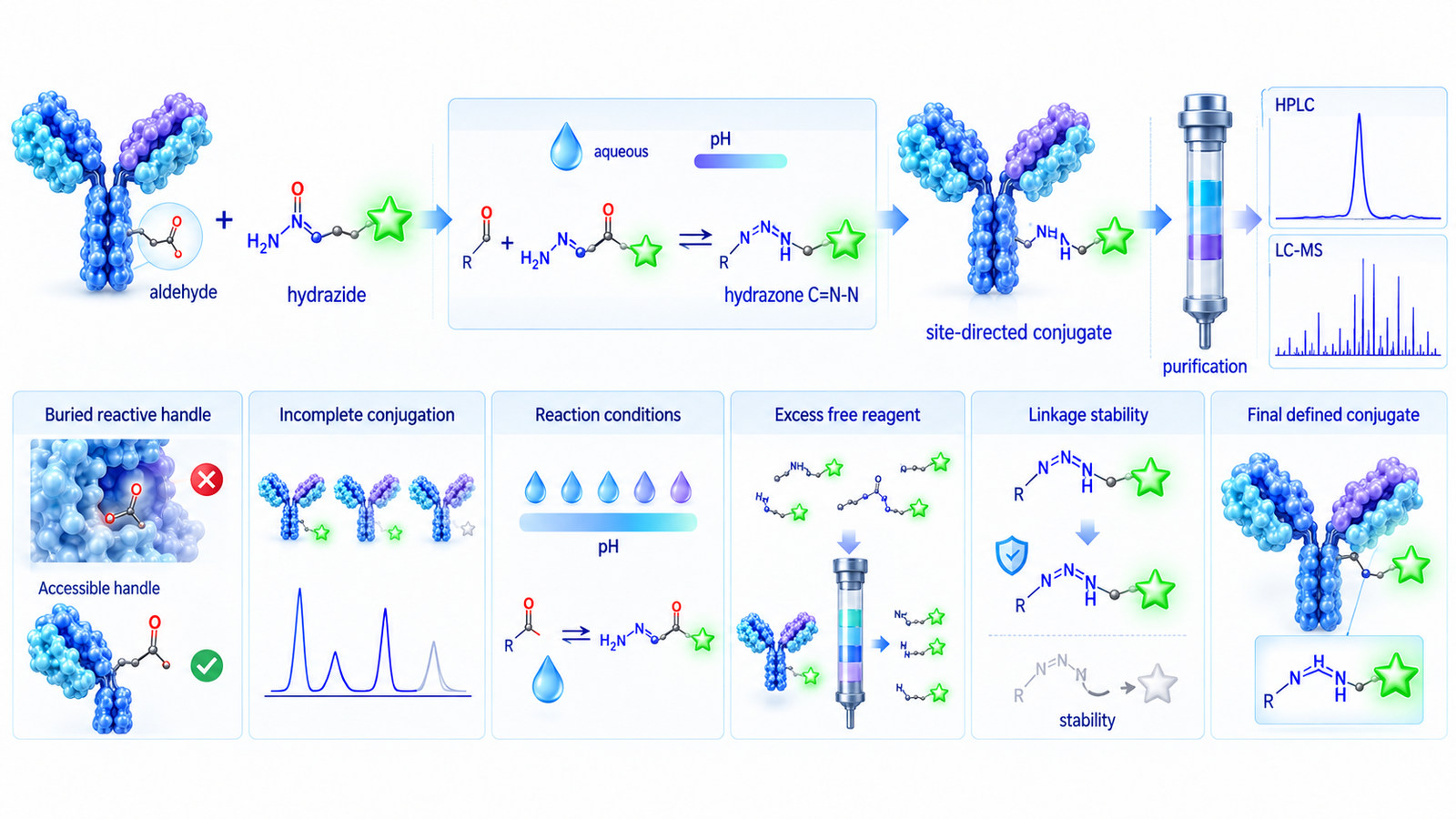 Hydrazone ligation development connects carbonyl-handle design with reaction optimization, purification, and verification of the final conjugate.
 Carbonyl Handle Design
Scope: Planning or introducing aldehyde and ketone handles that can participate in hydrazone formation.
Applicable molecules: Proteins, antibodies, peptides, glycoconjugates, oligonucleotides, polymers, and small molecules.
Technical considerations: We evaluate whether the carbonyl is already present or should be introduced through an N-terminal strategy, glycan oxidation, a prefunctionalized linker, synthetic modification, or another molecule-compatible route. Handle position and accessibility are considered alongside the risk of oxidation or structural perturbation.
Deliverables: Recommended handle architecture, reaction route, spacer considerations, and proposed ligation conditions.
Customer value: The carbonyl is positioned with the downstream conjugation in mind instead of being introduced as an isolated modification step.
 Hydrazine Partner Design
Scope: Selection or installation of hydrazine, hydrazide, or related carbonyl-reactive functionality on the second conjugation partner.
Applicable molecules: Fluorophores, biotin derivatives, peptides, oligonucleotides, polymers, small molecules, haptens, and other research payloads.
Technical considerations: Hydrazine and acyl hydrazide derivatives differ in nucleophilicity, reaction rate, and linkage properties. Spacer length, payload solubility, steric accessibility, and modification site are reviewed before coupling.
Deliverables: Functionalization strategy, linker recommendation, prepared reactive partner where included in project scope, and handling guidance.
Customer value: Partner design is coordinated with the carbonyl-bearing molecule to avoid discovering compatibility problems only after both components have been prepared.
 Protein & Antibody Ligation
Scope: Hydrazone-based labeling or coupling of proteins, enzymes, antibodies, antibody fragments, and other protein reagents.
Applicable molecules: Carbonyl-functionalized recombinant proteins, oxidized glycoproteins, aldehyde-tagged proteins, and suitably modified antibodies.
Technical considerations: Protein stability, carbonyl location, buffer composition, reaction concentration, pH tolerance, aggregation tendency, and preservation of binding or enzymatic function are considered during method design.
Deliverables: Purified conjugate, reaction and purification summary, and agreed analytical characterization.
Customer value: Hydrazone ligation can complement broader protein conjugation services and antibody conjugation services when carbonyl-directed attachment offers a more suitable route than direct lysine or cysteine modification.
 Peptide & Oligo Ligation
Scope: Coupling of synthetic peptides and oligonucleotides containing intentionally installed carbonyl, hydrazine, or hydrazide handles.
Applicable molecules: Peptides, DNA, RNA, modified oligonucleotides, aptamers, and hybrid biomolecular constructs.
Technical considerations: Terminal versus internal modification, secondary structure, solubility, charge, linker accessibility, reagent stoichiometry, and purification resolution can strongly affect the practical outcome.
Deliverables: Conjugated material, purification data, identity or mass confirmation where applicable, and project-specific documentation.
Customer value: Projects can be coordinated with peptide conjugation services or specialized protein–oligonucleotide workflows when multiple molecular classes must be integrated.
 Small-Molecule Coupling
Scope: Attachment of dyes, affinity tags, haptens, probes, linkers, and other small-molecule research components through hydrazone-forming chemistry.
Applicable molecules: Aldehydes, ketones, hydrazines, hydrazides, carbonyl-bearing linkers, and custom functional molecules.
Technical considerations: Solvent demand, payload hydrophobicity, carbonyl reactivity, linker placement, reagent excess, and compatibility with the macromolecular partner are incorporated into reaction planning.
Deliverables: Reaction strategy, purified target conjugate where feasible, and appropriate analytical confirmation.
Customer value: Small-molecule attachment is developed around the properties of both partners instead of forcing poorly soluble or sterically hindered molecules into a standard protocol.
 Method Development Support
Scope: Optimization of projects showing incomplete conversion, hydrolysis, poor recovery, excessive free reagent, aggregation, or inconsistent batch behavior.
Applicable molecules: New constructs, customer-supplied intermediates, difficult macromolecules, and previously developed hydrazone conjugates requiring refinement.
Technical considerations: Reaction pH, concentration, molar ratio, temperature, reaction time, catalyst use, solvent content, purification route, and storage environment can be screened according to substrate tolerance.
Deliverables: Optimized procedure, selected operating conditions, purification strategy, analytical summary, and recommendations for repeat or expanded-scale preparation.
Customer value: Development focuses on a usable process window rather than a single reaction condition that may not transfer reliably to subsequent batches.
Hydrazone ligation is a carbonyl condensation reaction. An aldehyde or ketone reacts with a hydrazine-derived nucleophile to form a carbon–nitrogen double bond. When the nucleophile is an acyl hydrazide, the product is more specifically described as an acylhydrazone. The initial nucleophilic addition produces a tetrahedral intermediate, followed by proton transfer and dehydration to generate the C=N–N linkage.
Reaction rate depends strongly on the structures of both partners. Aldehydes are generally more reactive than comparable ketones, while steric accessibility and electronic effects can produce substantial differences between individual substrates. Hydrazone formation is commonly developed under mildly acidic aqueous conditions because acid catalysis assists carbonyl condensation, but the optimum pH must also preserve the biomolecule being modified. For sensitive proteins, reaction conditions therefore need to balance chemical conversion against structural stability.
Nucleophilic catalysts can be considered when reaction speed at low biomolecule concentration is limiting. Catalyst selection and concentration should be evaluated alongside downstream purification and molecule tolerance rather than applied automatically. Certain activated aldehyde structures may also provide faster ligation behavior.
Carbonyl handles can be installed in multiple ways. Examples include chemical installation through linkers, oxidation of suitable glycan or vicinal-diol motifs, oxidation of selected N-terminal amino-alcohol motifs, or engineered approaches that generate a defined aldehyde on a protein. When a carbonyl is introduced at a predetermined position, hydrazone ligation can support site-selective conjugation strategies. For projects requiring precise protein modification, related design options are discussed in our site-specific protein labeling resource.
Hydrazone ligation can connect diverse molecular formats, but compatibility depends on having a sufficiently accessible carbonyl on one partner and a suitable hydrazine-derived nucleophile on the other. The matrix below summarizes common starting points for custom project planning.
| Molecule Type | Possible Carbonyl Handle | Hydrazone Partner | Key Technical Considerations | Typical Project Goal |
| Proteins & Peptides | Installed aldehyde/ketone, suitable N-terminal aldehyde, or engineered carbonyl handle | Hydrazine- or hydrazide-functionalized label, peptide, linker, or payload | Protein stability, handle accessibility, oxidation sensitivity, reaction concentration, functional-site location | Site-selective labeling, probe attachment, protein–molecule conjugation |
| Antibodies & Glycoproteins | Carbonyl generated from suitable glycan motifs or another installed aldehyde handle | Hydrazide or hydrazine functional label/linker | Extent of oxidation, glycan heterogeneity, aggregation, preservation of binding activity | Region-directed labeling and preparation of functional antibody conjugates |
| Oligonucleotides | 5′, 3′, or internally installed aldehyde/ketone | Hydrazine-functionalized peptide, protein, polymer, or small molecule | Modification position, oligo integrity, secondary structure, purification resolution | DNA/RNA conjugates, probes, and hybrid biomolecular constructs |
| Carbohydrates | Reducing-end carbonyl or aldehydes generated from selected diol structures | Hydrazide- or hydrazine-bearing biomolecule | Multiple reactive sites, oxidation control, regioselectivity, carbohydrate integrity | Glycoconjugate preparation and carbohydrate labeling |
| Small Molecules | Native or synthetically installed aldehyde/ketone | Hydrazine/hydrazide-bearing biomolecule, or the reverse configuration | Solubility, steric environment, carbonyl reactivity, payload stability | Reporter, ligand, hapten, linker, or probe attachment |
| Polymers & Surfaces | Aldehyde- or ketone-functional surface/linker | Hydrazine/hydrazide-functional biomolecule | Surface density, accessibility, nonspecific adsorption, orientation, washing conditions | Immobilization, capture-reagent preparation, biomaterial functionalization |
Hydrazone ligation is especially useful when the available starting materials or desired product architecture make carbonyl-directed coupling attractive. Selection should nevertheless account for the expected lifetime and environment of the final conjugate.
When a Unique Carbonyl Handle Is Available: Aldehydes and ketones are uncommon in native protein side chains, so an intentionally installed carbonyl can provide a chemically differentiated attachment point.
When Site Control Is Important: A carbonyl generated at a defined terminus, engineered site, or selected glycan region can direct conjugation away from multiple native lysines and reduce the randomness associated with conventional amine labeling.
When a Compact Linkage Is Preferred: Hydrazone formation introduces a relatively small connection compared with conjugation systems that require large reactive pairs or multicomponent linkers.
When Mild Aqueous Processing Is Needed: Many hydrazone reactions can be developed in aqueous buffers without the metal catalyst required for CuAAC, although individual substrates may still require a cosolvent or reaction catalyst.
When Controlled Reversibility Is Useful: The susceptibility of hydrazones to hydrolysis can be useful in studies that intentionally employ dynamic or acid-responsive linkages. The same property can be a disadvantage when maximum long-term hydrolytic stability is the main requirement.
If the finished conjugate must tolerate prolonged exposure to conditions where hydrazone hydrolysis could become limiting, oxime formation, click chemistry, thiol coupling, or another more persistent linkage should be evaluated during method selection rather than assuming hydrazone ligation is automatically the best route.
The most appropriate conjugation chemistry depends on which functional groups can be introduced without compromising the molecule, how much site control is required, the desired linkage stability, and what reaction conditions the substrates can tolerate. The matrix below highlights practical differences rather than treating one chemistry as universally preferable.
| Method | Reactive Pair | Selectivity Profile | Linkage Considerations | When It May Fit |
| Hydrazone Ligation | Aldehyde/ketone + hydrazine or hydrazide | High chemical differentiation when a carbonyl handle is deliberately installed | C=N-containing linkage; hydrolytic stability depends strongly on structure and environment | Carbonyl-bearing substrates, compact linkages, site-selective labeling, dynamic conjugates |
| Oxime Ligation | Aldehyde/ketone + aminooxy group | Similar carbonyl-directed selectivity | Oximes are generally more resistant to hydrolysis than simple hydrazones | Carbonyl conjugation where increased hydrolytic persistence is important |
| Reductive Amination | Carbonyl + primary amine + reducing step | Can be less intrinsically selective on molecules containing multiple accessible amines | Reduction converts the initially reversible imine chemistry into a more persistent C–N linkage | Carbonyl-to-amine coupling where the reducing conditions and available amines are acceptable |
| NHS Ester Coupling | Activated ester + primary amine | Broad reaction with accessible lysines and N-termini | Stable amide linkage, but modification can be heterogeneous on proteins | Simple, robust labeling where site heterogeneity is acceptable |
| Maleimide–Thiol | Maleimide + thiol | Targets accessible thiols; site control depends on cysteine availability or engineering | Linkage behavior depends on maleimide design and reaction environment | Cysteine-accessible proteins, peptides, and thiol-functionalized molecules |
| SPAAC Click Chemistry | Azide + strained cyclooctyne | Highly orthogonal after installation of both reactive handles | Produces a persistent triazole-based linkage; reactive handles are larger than hydrazone partners | Projects prioritizing orthogonality and stable covalent attachment |
Projects involving azide, alkyne, tetrazine, or related handles can also be evaluated through our resources on bioorthogonal reactions and click chemistry.
Each project is developed around the starting molecules rather than a fixed reaction recipe. The workflow below is designed to identify compatibility constraints early and connect reaction development with purification and analytical verification.


We review the molecular structures, available quantities, reactive groups, desired attachment site, downstream use, buffer requirements, and any known stability limitations. This determines whether hydrazone ligation is technically appropriate before material is committed to modification.

We determine which partner should carry the carbonyl and which should carry the hydrazine or hydrazide group. Handle location, spacer length, modification route, and accessibility are assessed to reduce steric or functional interference.

Reaction pH, concentration, stoichiometry, temperature, time, cosolvent level, and catalyst use are adjusted according to substrate reactivity and stability. When needed, small-scale conditions can be compared before selecting the preparative route.

The selected carbonyl and hydrazine-derived partners are reacted under the defined conditions while monitoring conversion, solubility, and any signs of aggregation, degradation, or unexpected side products.

Unreacted small molecules, free labels, excess reactive partner, catalyst, and other low-molecular-weight components are removed using a purification approach selected for the conjugate's size and physicochemical properties.

The purified material is evaluated with methods appropriate to the molecular format. The resulting conjugate, analytical information, and relevant preparation or handling notes are then organized for downstream research or repeat preparation.
Hydrazone conjugation is not complete from a practical standpoint until unreacted material has been separated and the intended product has been distinguished from free reagent, aggregates, and other species. Purification and analytical methods are therefore selected together with the reaction strategy.
| Development Need | Possible Approach | What It Helps Evaluate | Selection Considerations |
| Free Reagent Removal | Desalting, size-exclusion separation, dialysis, ultrafiltration, or chromatography | Removal of excess hydrazide, hydrazine reagent, dye, linker, catalyst, or small-molecule reactant | Molecular-size difference, conjugate recovery, buffer requirements |
| Product Separation | HPLC or other format-appropriate chromatographic separation | Separation of desired conjugate from starting material or related species | Conjugate size, charge, hydrophobicity, stability, and required resolution |
| Identity Confirmation | Mass spectrometry or another molecule-appropriate identity method | Evidence for expected mass change or formation of the intended modified species | Size and ionization behavior of the conjugate |
| Purity Assessment | Analytical HPLC, SEC, electrophoretic analysis, or complementary methods | Residual starting material, aggregates, fragments, or product heterogeneity | Conjugate class and the impurities most relevant to the project |
| Labeling Assessment | Spectroscopic, chromatographic, or mass-based analysis | Extent of labeling or incorporation where the molecular format permits quantification | Optical properties, product heterogeneity, molecular weight |
| Stability Evaluation | Time-point comparison under defined buffer, pH, or storage conditions | Hydrolysis, aggregation, degradation, or loss of conjugate integrity | Intended handling conditions and known sensitivity of the hydrazone linkage |
Not every method is required for every project. Analytical scope is selected according to molecular size, structural complexity, available material, and the specific question the characterization needs to answer.
Introducing the carbonyl is often the most important upstream design decision. Oxidation-based methods can be efficient but must be controlled to avoid unwanted modification of sensitive groups. Synthetic or engineered carbonyl handles can provide greater positional definition but require compatible starting-material preparation.
Mildly acidic conditions commonly accelerate hydrazone formation, while some activated systems can operate effectively closer to neutral pH. The selected condition must accommodate both reaction kinetics and substrate stability. Nucleophilic catalysis can be evaluated when dilute reactants or slow conversion become limiting.
Hydrazone linkages are reversible to varying degrees and can undergo hydrolysis. Stability depends on the structures of the carbonyl and hydrazine-derived partners as well as pH, temperature, and surrounding environment. Stability requirements should therefore be defined before chemistry selection.
A chemically reactive group may still conjugate poorly if buried near a protein surface, constrained within a folded oligonucleotide, or shielded by a bulky payload. Spacer design and reactive-site placement can be used to improve productive encounters between the two partners.
Excess reagent can drive conversion but may complicate purification, consume valuable material, or increase nonspecific association. Stoichiometry should be optimized together with reactant concentration, accessibility, and the chosen purification route.
Buffers, additives, cosolvents, and sample components should be reviewed for their effect on carbonyl chemistry and biomolecule stability. Carbonyl-containing additives or other reagents that compete with the intended reactive partners can interfere with ligation and should be considered during formulation planning.
Hydrazone ligation is evaluated in the context of your actual molecule, available functional groups, stability constraints, and downstream purpose. Where another coupling route is more appropriate, the project can be considered within a broader bioconjugation strategy rather than forcing carbonyl chemistry onto an unsuitable substrate.

We consider carbonyl generation and hydrazine/hydrazide functionalization as part of the overall conjugation design. This helps align modification site, spacer architecture, reaction accessibility, and final product requirements from the beginning.
Reaction design takes downstream separation into account. Reagent excess, molecular-size difference, hydrophobicity, and product heterogeneity are considered before conjugation so that free reagent removal and product recovery are not treated as afterthoughts.
Characterization is selected to answer practical project questions such as whether coupling occurred, whether starting material remains, whether aggregation increased, and whether the product remains suitable for the next experimental stage. Development can also be adapted for repeat preparation or larger research batches.
If your project involves an aldehyde- or ketone-bearing biomolecule, a hydrazide-functionalized label, an oxidized glycoprotein, a difficult carbonyl conjugation, or an existing hydrazone method that requires optimization, BOC Sciences can help evaluate the chemistry from reactive-handle design through purification and analytical verification.
Share the structures or molecular formats of both conjugation partners, available quantities, desired attachment site, downstream buffer or assay conditions, and any known stability constraints. Contact our scientific team to discuss a project-specific hydrazone ligation strategy.
Hydrazone ligation is the condensation of an aldehyde or ketone with a hydrazine-derived nucleophile. Hydrazines form hydrazones, while acyl hydrazides form acylhydrazones. It is widely used as a carbonyl-directed bioconjugation strategy.
One conjugation partner requires an accessible aldehyde or ketone, while the other carries a hydrazine or hydrazide group. These handles can be native to a molecule or introduced through chemical, synthetic, oxidative, or engineered modification.
Mildly acidic conditions are commonly screened because acid catalysis promotes carbonyl condensation. The optimum pH is substrate-dependent, and sufficiently reactive or catalyzed systems can also operate closer to neutral pH.
Stability depends strongly on hydrazone structure and environment. Hydrazones can undergo hydrolysis, particularly under acid-catalyzed conditions, so the required storage and experimental environment should be considered during chemistry selection.
Both use aldehyde or ketone handles. Hydrazone ligation uses a hydrazine-derived nucleophile, whereas oxime ligation uses an aminooxy/hydroxylamine group. Oximes are generally more hydrolytically stable than simple hydrazones, although reaction behavior also depends on reactant structure.