Chemistry Selection by Reactive HandleCustom Conjugation Strategy DevelopmentPurification & Analytical Planning
BOC Sciences provides custom bioconjugation chemistry services for connecting proteins, antibodies, peptides, oligonucleotides, small molecules, polymers, nanoparticles, labels, and other research components. We help select and develop conjugation strategies based on the functional groups available on each molecule, required site control, linker architecture, reaction compatibility, purification needs, and analytical objectives. Projects can begin with an established chemistry or with a molecule-level review when the most suitable conjugation route has not yet been determined.
Different bioconjugation chemistries solve different problems. Native amines or thiols may support direct modification, while projects requiring greater positional control may benefit from orthogonal handles, carbonyl-directed reactions, or enzyme-recognized motifs. Our chemistry development work considers both the coupling reaction and the behavior of the complete conjugate after modification.
 NHS Ester Conjugation
 EDC/NHS Coupling
 Thiol-Maleimide Conjugation
 Click Chemistry Conjugation
 Tetrazine Ligation
 Carbonyl-Selective Conjugation
 Enzymatic Bioconjugation
Choosing a conjugation chemistry is usually a multi-variable decision rather than a choice between reaction names. A method may be chemically feasible but still create an unsuitable product distribution, interfere with a binding or catalytic region, require modification of the starting material, increase aggregation, complicate removal of free label, or make the final conjugate difficult to characterize. We therefore evaluate the reactive handles together with the required site control, biomolecule sensitivity, desired loading level, linker properties, purification route, and downstream analytical plan.
This is particularly important when customers are deciding between native-group chemistries such as NHS ester or EDC/NHS coupling and more controlled approaches based on thiols, bioorthogonal handles, carbonyl groups, or enzyme-recognition motifs.
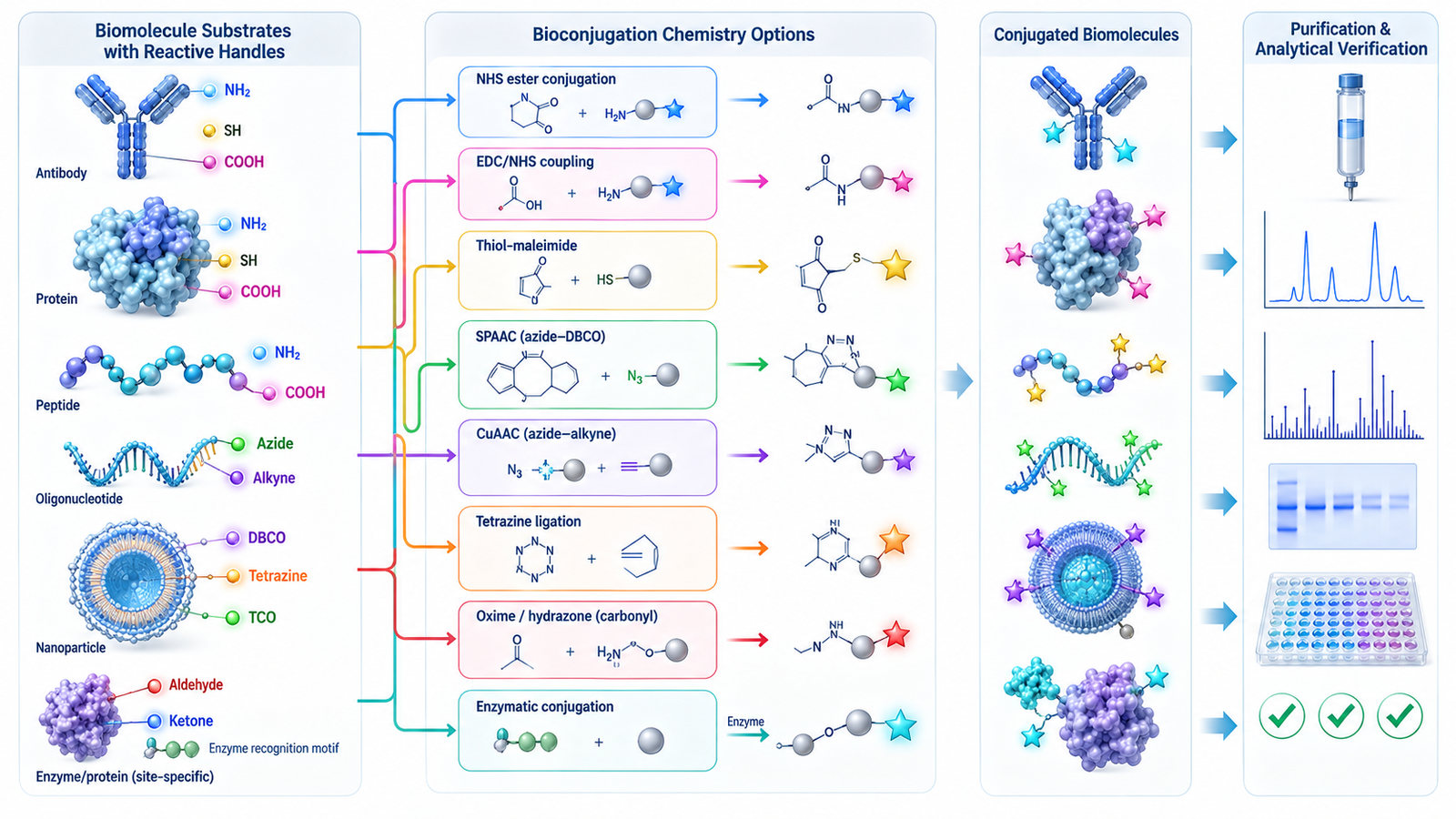 A chemistry-selection framework connects available functional groups with site-control requirements, reaction compatibility, purification strategy, and analytical verification before conjugation development begins.
| Chemistry | Typical Handle A | Handle B | Site Control | Key Consideration | Typical Biomolecules |
| NHS Ester | NHS ester | Primary amine | Low–Medium | Distribution of accessible lysines or other primary amines; hydrolysis during labeling | Protein, peptide, antibody |
| Maleimide | Maleimide | Thiol | Medium–High | Number, location, and oxidation state of available thiols | Protein, antibody, peptide, modified oligonucleotide |
| EDC/NHS | Carboxyl | Primary amine | Low–Medium | Activation conditions, orientation, and competing carboxyl/amine sites | Protein, peptide, polymer, nanoparticle |
| SPAAC | Azide | DBCO/BCN | High* | Defined handle installation, cyclooctyne accessibility, and linker properties | Protein, peptide, antibody, oligonucleotide |
| CuAAC | Azide | Terminal alkyne | High* | Copper compatibility, catalyst system, and downstream metal removal where required | Peptide, oligonucleotide, small molecule, modified protein |
| Tetrazine | Tetrazine | TCO / strained alkene | High* | Handle installation, accessibility, stability, and hydrophobicity | Protein, antibody, peptide, oligonucleotide |
| Oxime / Hydrazone | Aminooxy / hydrazide | Aldehyde / ketone | High* | Controlled carbonyl introduction and reaction-condition compatibility | Protein, peptide, glycan, carbohydrate |
| Enzymatic | Enzyme-recognized motif or residue | Compatible substrate | High* | Recognition-site accessibility, substrate scope, conversion, and enzyme removal | Protein, antibody, peptide |
*Higher site control depends on installing or presenting the reactive handle, recognition motif, or substrate at a defined location. A selective reaction mechanism alone does not automatically make a conjugation site-specific.
The most suitable bioconjugation chemistry depends not only on the reactive groups involved, but also on the molecular structure, modification tolerance, required site control, solubility, purification behavior, and analytical characteristics of each conjugation partner. Antibodies, proteins, peptides, oligonucleotides, small molecules, carbohydrates, lipids, polymers, and nanoparticles therefore require different chemistry-selection logic even when similar reactive handles are available.
Antibody conjugation may use lysine-directed NHS ester chemistry, cysteine-directed thiol-maleimide coupling, glycan or carbonyl-selective modification, click chemistry, tetrazine ligation, or enzyme-mediated approaches. Chemistry selection depends on accessible lysines or cysteines, disulfide architecture, desired loading distribution, preservation of antigen binding, aggregation risk, and whether native or engineered attachment sites are preferred. Projects requiring broader molecule-specific development can be integrated with our Antibody Conjugation Services.
Protein conjugation strategies can involve NHS ester labeling of primary amines, EDC/NHS coupling through carboxyl groups, cysteine-maleimide chemistry, carbonyl-selective reactions, click chemistry, tetrazine ligation, or enzymatic modification. Selection should account for accessible residues, protein folding, catalytic or binding regions, native cysteines, buffer composition, solubility, activity retention, and the level of site control required. Learn more about our Protein Conjugation Services.
Peptides often provide greater freedom to position reactive handles at the N-terminus, C-terminus, or selected side chains. Depending on sequence design, conjugation may use terminal amines, lysine residues, cysteine-maleimide coupling, azide-alkyne click chemistry, tetrazine ligation, oxime ligation, hydrazone formation, or other orthogonal handles. Key considerations include residue accessibility, side-chain reactivity, oxidation, peptide solubility, linker placement, and separation of the desired conjugate from unreacted peptide or coupling reagent. Explore our Peptide Conjugation Services.
Oligonucleotides can be synthesized or modified with defined 5′, 3′, or internal amine, thiol, azide, alkyne, DBCO, BCN, tetrazine, TCO, biotin, or other functional handles. This enables NHS ester coupling, thiol-maleimide chemistry, CuAAC, SPAAC, tetrazine ligation, and related post-synthetic conjugation strategies. Chemistry selection should consider handle location, oligonucleotide integrity, hybridization behavior, hydrophobicity introduced by the conjugate, removal of excess small-molecule reagent, and final product purification. Explore our Oligonucleotide Bioconjugation services.
Small molecules such as fluorophores, affinity ligands, haptens, chelators, probes, linker components, and other functional compounds may contain or be modified with amines, carboxyl groups, thiols, maleimides, NHS esters, azides, alkynes, strained cyclooctynes, tetrazines, TCO groups, or carbonyl-reactive handles. Chemistry selection is driven by the number and position of available functional groups, linker requirements, steric effects, hydrophobicity, reagent stability, and the ability to remove excess small molecule after conjugation. Projects without a predefined route can be reviewed through our Custom Bioconjugation Services, while specific formats may include Oligonucleotides Conjugated with Small Molecules.
Carbohydrate and glycan conjugation frequently relies on native or introduced carbonyl chemistry. Aldehydes generated or presented on carbohydrate structures can support aminooxy-oxime ligation, hydrazide or hydrazone formation, reductive amination, and related carbonyl-selective reactions. Click-enabled carbohydrate derivatives can provide additional orthogonal attachment options. Important considerations include controlled carbonyl generation, preservation of carbohydrate structure, reducing-end versus internal modification, conjugate heterogeneity, and purification of highly polar products. Related capabilities include Carbohydrate-Protein Conjugation and Carbohydrate-Oligonucleotide Conjugation.
Lipid conjugation may involve amino-functional lipids, activated esters, thiol- or maleimide-containing lipids, azide- or alkyne-functional lipids, cholesterol derivatives, PEG-lipids, and other lipid anchors. NHS ester coupling, thiol-maleimide chemistry, click chemistry, and orthogonal linker strategies can be selected according to the biomolecule and lipid structure. Development must consider limited aqueous solubility, amphiphilic behavior, linker length, membrane association, aggregation, reaction solvent compatibility, and purification of free lipid from the final conjugate. Explore our Lipid Conjugation services.
Polymer conjugation can use terminal or pendant NHS esters, maleimides, carboxyl groups, amines, azides, alkynes, or other functional handles to attach proteins, antibodies, peptides, oligonucleotides, small molecules, or additional functional components. Chemistry selection should consider polymer molecular weight and dispersity, functional-group density, end-group accessibility, steric shielding, hydrophilicity, conjugate solubility, polymer-to-biomolecule ratio, and separation of unconjugated polymer. Explore our Polymer Conjugation services.
Nanoparticle conjugation is selected according to particle composition and surface functionality rather than the particle core alone. Carboxyl-functional surfaces can support EDC/NHS coupling, maleimide surfaces can react with thiolated biomolecules, gold surfaces can support sulfur-based attachment, and azide, alkyne, DBCO, or other engineered surface groups can enable click-based conjugation. Surface density, biomolecule orientation, colloidal stability, passivation, nonspecific adsorption, aggregation, and removal of unbound biomolecule are central development considerations. Explore our Nanoparticles & Beads Conjugation services.
Our development workflow is designed to move from the actual molecular inputs to a workable reaction and analytical plan without turning chemistry selection into a long theoretical exercise.


We review each conjugation partner, molecular format, current buffer, structural constraints, desired product, and downstream use to identify compatibility risks before reaction design.

Native amines, thiols, carboxyl groups, or carbonyls are evaluated alongside the option to introduce azide, alkyne, TCO, tetrazine, engineered residues, or enzyme-recognition motifs.

Candidate reactions are compared according to selectivity, required site control, aqueous compatibility, linker design, substrate sensitivity, and practical downstream processing.

Reactant ratio, concentration, buffer, pH, reaction sequence, time, and other controllable variables are adjusted to establish a useful conjugation window.

Cleanup is matched to the size, charge, hydrophobicity, and physical behavior of the conjugate so that free label, linker, starting material, and side products can be separated where practical.

Suitable analytical methods are selected to examine conjugation success, product distribution, purity, loading or labeling level, molecular integrity, and function-related characteristics when required.
Reaction and purification parameters can be refined around the analytical results, desired loading window, stability, repeatability, and scale requirements of the research program.
Chemistry selection should begin with the properties of the actual substrates and the required conjugate rather than with a preferred reagent. The considerations below are reviewed together because improving one parameter can create tradeoffs elsewhere in the workflow.
| Selection Factor | What We Assess | Why It Changes the Strategy |
| Biomolecule Compatibility | Structure, stability, solubility, sequence or surface features, and sensitivity to modification | Determines which reaction conditions and modification sites the substrate can reasonably tolerate |
| Available Reactive Groups | Primary amines, thiols, carboxyl groups, carbonyls, glycans, termini, or introduced orthogonal handles | Defines whether direct conjugation is practical or an activation/handle-installation step is required |
| Site Selectivity | Random, site-biased, residue-selective, handle-selective, or motif-directed attachment | Affects product heterogeneity, loading distribution, functional-site exposure, and analytical complexity |
| Reaction Conditions | pH, temperature, catalyst, reducing conditions, solvent exposure, concentration, and reaction time | Must remain compatible with both coupling partners and the desired final structure |
| Aqueous Compatibility | Solubility of the biomolecule, linker, label, and activated intermediate | Poor solubility can reduce conversion, increase aggregation, or require cosolvent and formulation adjustments |
| Linker Requirements | Length, flexibility, hydrophilicity, spacer architecture, and reactive-handle orientation | The linker can influence steric accessibility, solubility, payload presentation, and conjugate behavior |
| Conjugate Stability | Linkage stability, oxidation sensitivity, hydrolysis, exchange reactions, and storage conditions | The bond must remain suitable for the handling and downstream workflow planned for the conjugate |
| Purification Strategy | Difference in size, charge, hydrophobicity, affinity, and physical state between product and impurities | A chemically successful reaction is not sufficient if excess reagent and side products cannot be removed effectively |
| Characterization Requirements | Identity, purity, loading, conjugate distribution, aggregation, integrity, and functional readout | The chemistry should produce a conjugate that can be meaningfully measured and compared |
| Scale Requirements | Material availability, concentration, reagent demand, reaction handling, and purification format | Methods suitable for a feasibility experiment may need adjustment before repeat preparation or larger research batches |
For broader project planning, our Strategy and Design of Bioconjugation resource provides additional context on integrating molecular design with conjugation development.
Our chemistry development services are organized around the conjugate researchers need to build rather than around broad industry labels. Each construct can require a different balance between coupling efficiency, loading control, molecular function, purification, and analytical verification.
Bioconjugation development often requires decisions across chemistry, biomolecule handling, purification, and analysis at the same time. Our service model is designed around these connected decisions rather than treating the coupling reaction as an isolated step.
Chemistry is selected from the functional groups, molecular format, desired attachment pattern, and downstream requirements of the actual project instead of applying one standard reaction to every substrate.

Native reactive groups, introduced handles, linker length, hydrophilicity, and molecular accessibility are evaluated together so attachment chemistry supports the intended conjugate architecture.
Cleanup strategy is considered during reaction design, helping avoid routes that produce a workable reaction mixture but an impractical separation problem.
Characterization is planned around the questions that matter for the construct, including conjugation confirmation, loading or labeling level, purity, product distribution, aggregation, and molecular integrity where applicable.
If you are comparing NHS ester, EDC/NHS, thiol-maleimide, click, tetrazine, carbonyl-selective, enzymatic, or hybrid conjugation strategies, we can review your biomolecules and help develop a chemistry plan around the available handles, required site control, desired conjugate format, purification route, and analytical needs.
To support an initial technical review, provide the identity and format of each conjugation partner, available or installed functional groups, current buffer where relevant, desired loading or attachment site, project scale, and downstream research use. Contact our scientific team to discuss a project-specific bioconjugation chemistry strategy.
Start with the functional groups available on both conjugation partners, then consider the level of site control required, biomolecule stability, linker design, desired loading, reaction conditions, purification feasibility, and analytical requirements. Native-group methods such as NHS ester or EDC/NHS can be convenient, while click, carbonyl-directed, thiol-selective, or enzymatic approaches may offer greater control when suitable handles are available.
Site selectivity generally improves when a unique thiol, site-installed azide or alkyne, tetrazine/TCO pair, defined carbonyl, engineered residue, or enzyme-recognition motif is used. NHS ester labeling of multiple accessible lysines is usually less site-selective. The reaction itself does not guarantee site specificity unless its reactive handle is located at a defined site.
NHS ester chemistry is useful when accessible primary amines are available and a broader labeling distribution is acceptable. Maleimide chemistry is preferred when a suitable free thiol can be generated or introduced and more controlled sulfhydryl-directed attachment is desired. Thiol state, disulfide integrity, and reaction conditions should be reviewed before selecting the maleimide route.
Both connect azide and alkyne-derived handles. CuAAC uses a copper catalyst and a terminal alkyne, whereas SPAAC uses a strained cyclooctyne such as DBCO or BCN and does not require copper. SPAAC is often considered for copper-sensitive biomolecules, while CuAAC can be useful when catalyst compatibility and subsequent cleanup are acceptable.
Yes. Existing amine, thiol, azide, alkyne, DBCO/BCN, TCO, tetrazine, carbonyl, biotin, linker, or other modifications can be reviewed together with their location and accessibility. The conjugation route can then be planned around those installed handles rather than introducing unnecessary additional chemistry.