Site-Selective Enzymatic CouplingDefined Biomolecule ModificationCustom Conjugation, Purification & Characterization
Enzymatic bioconjugation uses the molecular recognition of enzymes to install labels, linkers, reactive handles, peptides, oligonucleotides, small molecules, or other functional components at defined positions on biomolecules. Compared with conventional modification of abundant lysine or cysteine residues, enzyme-mediated conjugation can provide greater control over conjugation site, orientation, and product distribution while operating under conditions compatible with sensitive proteins and antibodies.
BOC Sciences provides custom enzymatic bioconjugation services covering route selection, substrate and recognition-site assessment, enzyme-mediated coupling, chemoenzymatic handle installation, reaction optimization, purification, and analytical characterization. Projects may be integrated with our protein conjugation services, antibody conjugation services, or broader custom bioconjugation services according to the molecule, payload, and downstream research requirements.
Enzymatic conjugation is not a single chemistry. The appropriate platform depends on whether the target molecule contains an accessible native substrate site, can accommodate a short recognition tag, contains a modifiable glycan, or requires installation of an orthogonal reactive handle before the final coupling step. We develop project-specific workflows rather than applying one enzyme system to every substrate.
 Sortase A Ligation
Scope: Site-selective transpeptidation of proteins, antibody fragments, recombinant antibodies, peptides, and other engineered biomolecules carrying a suitable sortase recognition motif.
Deliverables: Purified conjugate, reaction summary, and selected analytical data. Customer value: Defined attachment near a designed terminus can reduce the product heterogeneity associated with random side-chain modification.
 Transglutaminase Conjugation
Scope: Microbial transglutaminase-mediated coupling of accessible glutamine residues or engineered Q-tags to primary-amine-containing payloads and linker modules.
Deliverables: Conjugated material with site and loading assessment selected for the project. Customer value: Transglutaminase provides a practical route to stable amide-linked conjugates when substrate accessibility and recognition are appropriately controlled.
 Glycan-Directed Conjugation
Scope: Chemoenzymatic modification of glycoproteins and antibodies through enzymatic trimming, remodeling, or installation of functionalized sugars at suitable glycan sites.
Deliverables: Glycan-remodeled intermediate or purified final conjugate with appropriate analytical assessment. Customer value: Glycan-directed approaches can position functionalization away from many protein binding surfaces without broadly modifying exposed lysines.
 FGE Handle Installation
Scope: Formylglycine-generating enzyme-mediated conversion of a cysteine within an appropriate recognition sequence into an aldehyde-bearing formylglycine residue.
Deliverables: Handle-installed protein or final conjugate with reaction and characterization summary. Customer value: The introduced aldehyde provides a chemically distinct reaction site that can support selective downstream functionalization.
 Ligase-Assisted Labeling
Scope: Tag-assisted enzymatic labeling strategies using ligase or transferase systems when the protein can accommodate the required peptide-recognition sequence.
Deliverables: Site-defined labeled protein or reactive intermediate. Customer value: Tag-recognizing enzymes can convert a genetically specified position into a controlled labeling site for modular downstream assembly.
 Method Development Support
Scope: Custom development for substrates that do not fit a standard enzymatic conjugation protocol or that require comparison of several enzyme-mediated and chemical routes.
Deliverables: Project-specific method, purified conjugate, analytical summary, and recommended operating conditions. Related projects may also be coordinated with enzymatic crosslinking services.
Enzymatic bioconjugation exploits molecular recognition between an enzyme and a defined amino acid, peptide sequence, glycan, or engineered tag. The enzyme either forms the final covalent bond directly or installs a reactive handle that is subsequently coupled through a selective chemical reaction. Because recognition is determined by more than simple functional-group abundance, the modification can often be directed to a much narrower set of sites than conventional lysine- or cysteine-based labeling.
For customers, the main challenge is not simply whether an enzyme can catalyze a reaction. The recognition site must be accessible in the folded biomolecule, the payload must match the enzyme's substrate requirements, and the reaction must be compatible with the stability window of the protein or antibody. The selected route must also produce species that can be separated from unreacted substrate, enzyme, excess payload, and aggregates.
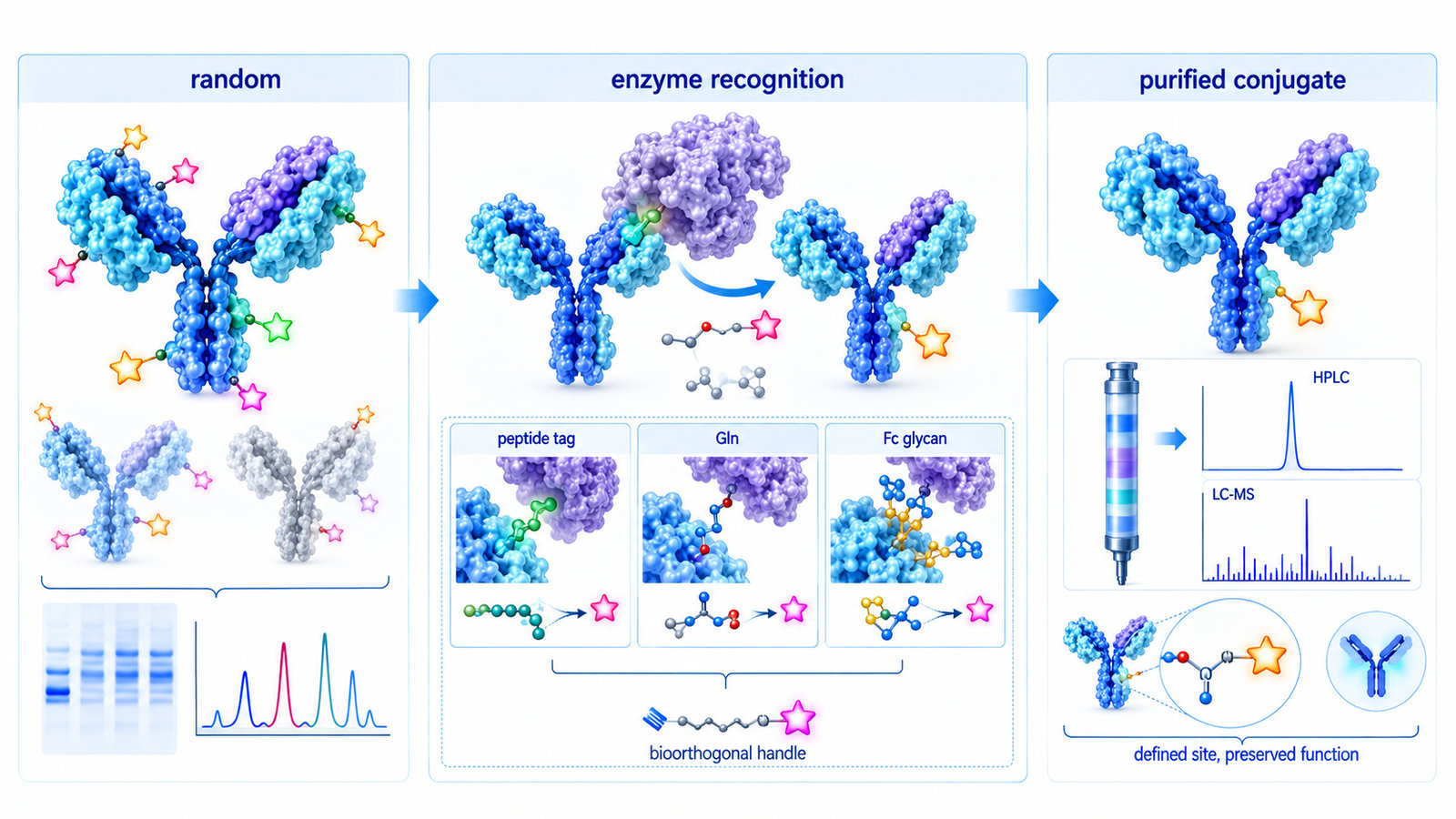 Enzymatic recognition directs a functional payload or orthogonal chemical handle to a defined biomolecular site, helping reduce uncontrolled modification and simplify product interpretation.
Modification of multiple surface lysines or cysteines can generate a distribution of positional isomers, some of which may place the label near a binding interface or functional domain. A recognition-based enzyme system can concentrate modification at a deliberately selected region when a compatible site or tag is available.
When a molecule contains many similarly reactive residues, increasing reagent equivalents does not necessarily provide a single defined product. Enzymatic strategies can narrow the number of accessible reaction sites and make conjugate loading easier to interpret analytically.
Some proteins are susceptible to organic solvent, reducing agents, strong oxidation, extreme pH, or prolonged exposure to reactive electrophiles. Many enzyme-mediated reactions operate in aqueous buffers under comparatively mild conditions, although enzyme-specific buffer and cofactor requirements must still be considered.
Enzymatic specificity does not eliminate purification requirements. Residual catalyst, excess payload, unmodified protein, hydrolyzed intermediates, and aggregates may still be present. The conjugation strategy is therefore designed together with a practical purification and analytical plan.
Compatibility depends on both the biomolecule and the enzyme recognition mechanism. The matrix below summarizes common starting materials, recognition elements, and payload-side handles used in enzymatic or chemoenzymatic bioconjugation.
| Enzymatic Route | Typical Biomolecules | Protein-Side Recognition Element | Payload / Partner Requirement | Key Compatibility Considerations |
| Sortase A | Recombinant proteins, antibody fragments, engineered antibodies, peptides | Accessible LPXTG-type motif, commonly positioned near a terminus | Oligoglycine-functionalized peptide, protein, oligonucleotide, probe, or linker | Tag accessibility, reverse reaction, enzyme variant, substrate concentration, and purification strategy |
| Microbial Transglutaminase | Proteins, antibodies, fragments, engineered protein scaffolds | Accessible glutamine residue or engineered Q-tag | Primary-amine-containing payload or linker | Local protein structure strongly influences glutamine accessibility and site selectivity |
| Glycan Remodeling | Glycoproteins and antibodies with suitable N-linked glycans | Defined glycan structure or enzymatically generated glycan acceptor | Modified sugar donor followed by click-, carbonyl-, or other handle-selective payload | Starting glycoform heterogeneity, glycan accessibility, remodeling sequence, and secondary coupling chemistry |
| FGE-Mediated Labeling | Recombinant proteins, antibodies, antibody fragments | Short FGE-compatible recognition sequence containing the convertible cysteine | Aldehyde-reactive aminooxy, hydrazine-derived, or other compatible partner | Recognition-tag placement, efficiency of formylglycine generation, and stability of the secondary linkage |
| Ligase / Transferase Tags | Recombinant proteins, peptides, fusion proteins | Enzyme-specific peptide tag | Native or modified cofactor/substrate analogue accepted by the selected enzyme | Tag size, substrate scope, cofactor requirements, and accessibility of the engineered site |
| Chemoenzymatic Handle Installation | Proteins, antibodies, glycoproteins, engineered biomolecules | Enzyme-recognized residue, tag, or glycan | Azide, alkyne, tetrazine, carbonyl, or complementary bioorthogonal payload handle | Two-step compatibility, handle stability, payload solubility, and removal of excess secondary reagent |
Payloads may include fluorophores, affinity tags, peptides, proteins, polymers, chelators, oligonucleotides, and appropriately derivatized small molecules. Projects involving nucleic-acid payloads can also be coordinated with our oligonucleotide bioconjugation capabilities.
Enzymatic bioconjugation is particularly useful when positional control is more important than simply maximizing reaction conversion. It can also be valuable when the conjugated molecule must be interpreted as a defined molecular construct rather than as a statistical mixture of labeling states.
Choose an enzymatic route when the payload should be located at a selected terminus, engineered tag, accessible glutamine, or glycan rather than distributed across many surface residues.
A defined coupling site can be useful when uncontrolled modification near a binding interface, catalytic pocket, recognition sequence, or interaction surface would complicate functional studies.
Enzyme recognition can narrow the distribution of attachment sites and labeling states, supporting clearer mass-spectrometric interpretation and more consistent comparisons between experimental batches.
A reusable recognition tag or enzyme-installed orthogonal handle can allow the same protein scaffold to be paired with several probes or payloads without redesigning the entire biomolecule for each construct.
An enzymatic route is not automatically the most efficient choice for every project. A simple NHS ester or thiol-based reaction may be more practical when random labeling is acceptable, while click chemistry can provide excellent chemoselectivity if a suitable handle has already been introduced site-specifically. For additional route-selection guidance, see our resource on site-specific protein labeling.
Conjugation methods should be compared according to the required level of site control, starting-material design, payload chemistry, protein stability, purification burden, and analytical goals. The matrix below summarizes practical differences between common approaches.
| Method | Site Control | Starting-Material Requirement | Typical Conditions | Main Strength | Main Limitation |
| Enzymatic Bioconjugation | High when a unique recognition site, glycan, or engineered tag is used | Compatible recognition residue, motif, tag, or glycan | Usually aqueous and comparatively mild; enzyme-specific requirements apply | Combines molecular recognition with controlled placement | May require protein engineering, glycan preprocessing, specialized substrates, or enzyme removal |
| NHS Ester Coupling | Usually low on proteins containing multiple accessible amines | Accessible lysine residues or N-terminal amine | Mildly basic aqueous buffer | Straightforward and broadly applicable | Multiple reactive amines can produce heterogeneous positional isomers and labeling ratios |
| Maleimide–Thiol Coupling | Moderate to high when the number and location of free thiols are controlled | Native, reduced, or engineered cysteine plus maleimide payload | Near-neutral aqueous conditions are commonly used | Strong preference for thiols under appropriate conditions | Reduction strategy, cysteine accessibility, disulfide integrity, and linkage stability require attention |
| Bioorthogonal Click Chemistry | Determined by how the complementary handles are installed | Azide/alkyne, tetrazine/TCO, or another complementary handle pair | Generally mild; catalyst requirements depend on the click reaction | High chemoselectivity and broad payload flexibility | Click chemistry itself does not define the attachment site unless the handle was introduced site-selectively |
| Genetic Fusion | Defined at the sequence level | Recombinant construct encoding both partners | Protein expression and purification rather than post-expression coupling | Directly encoded connectivity | Less suitable for many synthetic payloads and may influence expression, folding, or partner orientation |
For antibody-focused method selection, our overview of chemical vs enzymatic antibody conjugation provides additional context on route-specific tradeoffs.
The workflow is designed around the recognition mechanism of the selected enzyme and the properties of both coupling partners. Reaction development and purification are planned together so that high conversion does not come at the expense of difficult downstream isolation.


We review biomolecule type, sequence or structural information, available material, desired attachment position, payload chemistry, target conjugation ratio, downstream use, and analytical expectations. This establishes whether an enzymatic route offers a practical advantage for the project.

Candidate recognition sites, peptide tags, accessible glutamines, glycans, or enzyme-specific motifs are assessed. We then match the substrate to sortase, transglutaminase, glycan remodeling, FGE, or another suitable enzymatic platform.

Required tags or reactive partners are prepared or confirmed. Payloads may be equipped with oligoglycine, primary amine, click, carbonyl-reactive, or other enzyme-compatible functionality according to the selected route.

Enzyme concentration, biomolecule concentration, substrate equivalents, pH, ionic strength, cofactors, temperature, and reaction time are adjusted as needed. Conversion is considered together with aggregation, hydrolysis, competing reactions, and preservation of biomolecule integrity.

A purification sequence is selected to remove residual enzyme, unreacted payload, unconjugated biomolecule, small-molecule reagents, and undesirable high-molecular-weight species. The final material can be exchanged into a project-appropriate buffer.

Analytical methods are selected according to conjugate type and project questions. Results may support identity, molecular integrity, loading, site assignment, aggregation assessment, and functional comparison before delivery or progression to repeat preparation.
A successful enzyme-mediated reaction can still contain several molecular populations. Purification and characterization are therefore tailored to the size, charge, hydrophobicity, payload, and intended use of the conjugate rather than relying on a single generic cleanup method.
| Development Question | Typical Approach | What It Helps Resolve | Typical Output |
| Remove Free Payload | Desalting, dialysis, ultrafiltration, SEC, or chromatography selected by molecular size and payload properties | Residual dye, linker, peptide, oligonucleotide, or small-molecule coupling partner | Purified conjugate fraction and selected recovery information |
| Remove Enzyme | Affinity separation, SEC, ion exchange, or orthogonal chromatography where appropriate | Residual sortase, transglutaminase, glycosidase, transferase, or other catalyst | Cleaner final conjugate preparation |
| Assess Molecular Integrity | Intact-mass analysis, LC-MS, SDS-PAGE, CE-SDS, or related methods depending on molecule type | Expected mass shift, fragmentation, incomplete processing, or major impurities | Identity and integrity assessment |
| Evaluate Aggregation | SEC-HPLC/UPLC or other suitable size-based analysis | Monomeric species versus high-molecular-weight material | Size-distribution or aggregation profile |
| Determine Conjugation Level | Intact MS, HIC, UV-Vis, fluorescence, or other payload-specific methods | Number or distribution of attached labels or payloads | Conjugation-ratio or labeling-state assessment |
| Verify Attachment Site | Peptide mapping or other site-focused MS strategies when required | Whether modification occurred at the intended enzyme-recognition region | Site-assignment evidence appropriate to the project |
| Check Functional Retention | Binding, catalytic, fluorescence, affinity, or other application-relevant assay | Whether conjugation changed the functional property important to the study | Comparative functional data where included in project scope |
Enzyme specificity is only one part of a successful conjugation strategy. Site accessibility, payload structure, reaction equilibrium, purification behavior, and the stability of the final bond should be assessed before selecting the method. Broader route-planning principles are discussed in our strategy and design of bioconjugation resource.
An enzyme-recognition motif can be present in the sequence but poorly accessible in the folded structure. Terminal position, local secondary structure, glycan shielding, neighboring domains, and oligomeric state can all affect conversion. Site placement should therefore be reviewed in structural as well as sequence context.
Sortase, transglutaminase, FGE, glycosyltransferases, and ligases recognize fundamentally different substrates. The payload may also need a glycine nucleophile, primary amine, modified sugar, cofactor analogue, or secondary reactive handle. Both sides of the reaction must be designed as a compatible pair.
Large, hydrophobic, charged, or sterically demanding payloads can behave differently from simple model substrates. A spacer or two-step handle-installation strategy may improve accessibility, solubility, and modularity when direct enzymatic attachment is inefficient.
Buffer composition must satisfy both enzyme activity and biomolecule stability. pH, ionic strength, metal ions or cofactors, additives, substrate concentration, and temperature can influence reaction rate as well as aggregation or hydrolysis.
A highly specific reaction can still be incomplete. Enzyme loading, reaction equilibrium, payload equivalents, recognition-site accessibility, and substrate quality influence the distribution between starting material and conjugated product. Optimization should focus on an isolatable product rather than conversion alone.
Enzyme and payload properties should be considered before the reaction begins. A conjugation route that generates species with clearly different size, charge, affinity, or hydrophobicity may simplify purification and make repeat preparation more practical.
Enzyme-mediated conjugation is useful for research programs that require controlled orientation, defined attachment sites, modular probe construction, or reproducible comparison between molecular variants.
Enzymatic systems are selected according to the actual recognition site, biomolecule architecture, payload chemistry, and downstream use rather than forcing every project into one platform.

Recognition motifs, accessible residues, glycans, and engineered tags are reviewed with the goal of placing modification where it is analytically clear and less likely to interfere with the function being studied.
Reaction development considers protein concentration, buffer tolerance, cofactors, temperature, payload solubility, and aggregation risk together with catalytic performance.
When direct enzyme-mediated attachment is restrictive, an enzyme can first create a unique reactive handle that is subsequently diversified using click or carbonyl-selective chemistry.
Residual enzyme, excess payload, starting material, and aggregates are considered during route design so that the target conjugate can be separated using a realistic downstream workflow.
Characterization packages are selected to answer project-specific questions about identity, site, labeling level, aggregation, and functional retention rather than generating unrelated analytical data.
Whether you need a site-selectively labeled protein, an enzymatically modified antibody, a protein-peptide or protein-oligonucleotide conjugate, or a chemoenzymatic route for installing a bioorthogonal handle, the starting point is understanding the molecular architecture of both coupling partners and the level of site control required.
Share your biomolecule type, available sequence or structural information, desired payload, preferred attachment region, material scale, and downstream analytical needs. Our team can evaluate suitable enzyme systems, identify potential substrate constraints, and develop a conjugation, purification, and characterization strategy aligned with your research goals. Contact our scientific team to discuss your enzymatic bioconjugation project.
Enzymatic bioconjugation uses an enzyme to recognize a particular amino acid, peptide motif, glycan, or engineered tag and catalyze either direct coupling or installation of a reactive handle. This recognition can provide greater positional control than reactions directed only by abundant lysines or cysteines.
Frequently used platforms include Sortase A, microbial transglutaminase, formylglycine-generating enzyme, glycosidases/glycosyltransferases, biotin ligase, lipoic acid ligase, phosphopantetheinyl transferases, and related enzyme-tag systems. The appropriate enzyme depends on the substrate and desired attachment site.
Not always. Sortase, FGE, and many ligase systems commonly use an engineered recognition tag, while some transglutaminase or glycan-remodeling strategies can exploit suitable features of native proteins or antibodies. Accessibility and molecular format still need to be evaluated for each project.
Sortase A recognizes an LPXTG-type sequence, cleaves at the threonine-glycine region, and transfers the protein acyl intermediate to an oligoglycine-containing nucleophile. This enables defined terminal or near-terminal attachment of appropriately functionalized payloads.
Microbial transglutaminase typically couples a suitable glutamine side chain to a primary-amine-containing partner, whereas Sortase A relies on a peptide recognition sequence and an oligoglycine nucleophile. Transglutaminase can use accessible native or engineered glutamine sites, while Sortase generally requires a compatible recognition motif.