Selective Cysteine-Targeted CouplingCustom Maleimide Linker DesignIntegrated Purification & Characterization
BOC Sciences provides custom thiol-maleimide conjugation services for proteins, antibodies, peptides, oligonucleotides, small molecules, labels, polymers, and other research materials requiring selective sulfhydryl coupling. Thiol-maleimide chemistry uses the reaction between a free thiol and a maleimide-functionalized partner to form a covalent thiosuccinimide linkage under mild, near-neutral conditions. When the number and location of accessible thiols are controlled, this chemistry can provide a more defined modification pattern than reactions directed toward abundant surface amines.
Our support covers functional-group assessment, cysteine or thiol preparation, maleimide reagent and linker selection, conjugation optimization, purification, and analytical verification. Projects can be coordinated with our custom bioconjugation services, protein conjugation services, antibody conjugation services, and other molecule-specific workflows according to the composition and intended research use of the final conjugate.
Thiol-maleimide conjugation is straightforward in principle but highly dependent on thiol accessibility, reduction state, reagent stability, molecular solubility, linker design, and the required degree of modification. We develop the conjugation route around the actual molecules involved rather than applying one reaction condition to every substrate.
 Protein Thiol Conjugation
We conjugate maleimide-functionalized labels, ligands, linkers, polymers, peptides, and other research molecules to proteins containing naturally accessible, selectively generated, or engineered cysteine thiols.
Deliverables may include purified protein conjugate, reaction and purification summary, and selected analytical results supporting conjugation assessment. This service can also be coordinated with broader protein conjugation requirements.
 Antibody Cysteine Conjugation
We support cysteine-directed antibody conjugation when researchers need more control over the number and location of reactive sites than is usually obtained through broad lysine modification.
The approach is useful for research conjugates involving fluorescent labels, biotin derivatives, peptides, oligonucleotides, polymers, and other functional components. Related projects can also be developed through our antibody conjugation services.
 Peptide Thiol Conjugation
Peptides containing an N-terminal, C-terminal, or side-chain cysteine can be coupled to maleimide-functionalized proteins, labels, small molecules, polymers, and other partners.
Customers receive a conjugation route designed around both peptide chemistry and the properties of the second component. Additional peptide-focused options are available through our peptide conjugation services.
 Oligonucleotide Thiol Conjugation
Thiol-modified DNA, RNA, aptamers, and other oligonucleotides can be coupled to maleimide-functionalized biomolecules or materials through terminal or selected internal reactive handles.
The workflow can support protein-oligonucleotide, peptide-oligonucleotide, label-oligonucleotide, and related research constructs and can be integrated with our oligonucleotide bioconjugation platform.
 Label Payload Attachment
Maleimide-functionalized labels and functional molecules can be attached to thiol-containing biomolecules for research reagent development and molecular tracking studies.
This service is useful when an off-the-shelf maleimide reagent must be adapted to a specific biomolecule or when a custom maleimide-functionalized component is required.
 Linker Method Development
For difficult substrates or multi-component constructs, we develop the activation and coupling sequence together with the linker architecture rather than treating maleimide conjugation as an isolated reaction.
The resulting workflow provides a defined starting point for repeat preparation and helps reduce avoidable variability caused by changing activation and coupling conditions between batches.
Researchers often choose thiol-maleimide chemistry when broad amine labeling produces too many modification sites, when the attachment must be positioned at a selected cysteine, or when a mild aqueous reaction is needed for a sensitive biomolecule. The practical challenge is that a successful result depends on more than simply mixing a thiol-containing molecule with a maleimide reagent. Free thiols can oxidize to disulfides, reduction can alter biomolecule structure, excess reductant can interfere with coupling, hydrophobic maleimide reagents may cause solubility problems, and aged or hydrolyzed maleimide may lose useful reactivity.
In the core reaction, the thiolate form of a sulfhydryl group attacks the electron-deficient carbon-carbon double bond of the maleimide ring through a Michael-type addition. The initial product is a thiosuccinimide-linked conjugate. Reactions are commonly designed near neutral pH, where cysteine thiols can react efficiently while competing modification of primary amines remains comparatively limited.
Site control therefore comes from controlling the thiol—not from the maleimide group alone. A protein containing one uniquely accessible cysteine can give a comparatively defined product, whereas a partially reduced antibody or a protein with several accessible thiols may generate multiple conjugated species. Before reaction design, we evaluate where the thiol originates, how many reactive sites are expected, whether the thiol must be generated by reduction, and how modification may affect the molecule's structure or function.
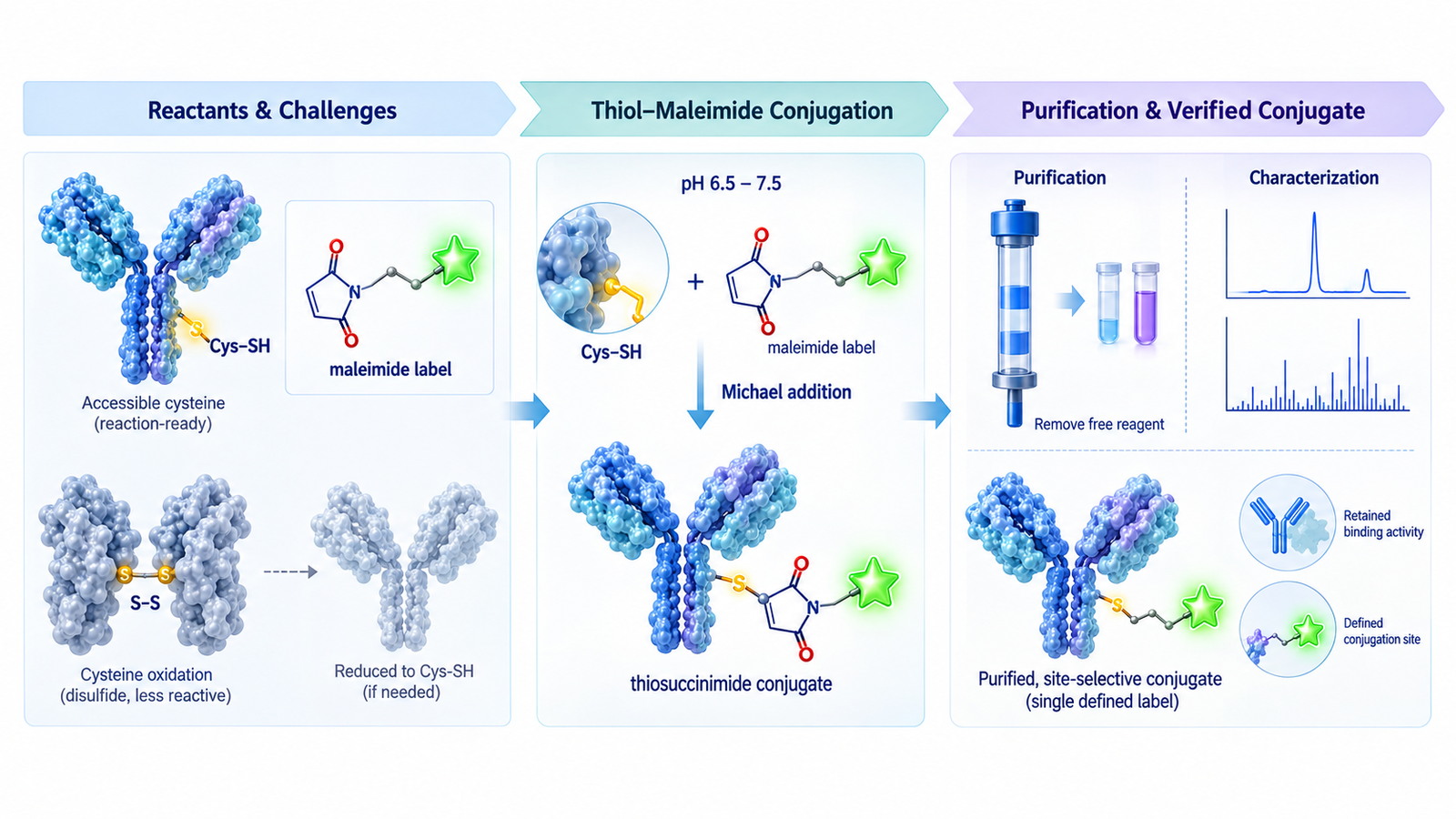 Thiol-maleimide conjugation converts a controlled free-thiol site into a covalent conjugate while reaction conditions, linker design, purification, and analytical verification are managed together.
For projects in which thiol availability, conjugate stability, or maleimide handling is uncertain, feasibility work can compare alternative conditions or another chemistry before material is committed to a larger preparation. More background on the underlying reaction is available in our maleimide conjugation guide.
Thiol-maleimide conjugation can connect many different molecular classes, provided one partner carries an accessible free thiol and the other carries a sufficiently reactive maleimide. The matrix below summarizes common starting formats and the design questions that should be resolved before conjugation.
| Molecule Type | Typical Thiol or Maleimide Handle | Common Conjugation Partner | Key Technical Consideration | Typical Project Value |
| Antibodies & Fragments | Reduced interchain cysteine, engineered cysteine, accessible native thiol | Maleimide label, peptide, oligonucleotide, polymer, linker, or small molecule | Reduction level and cysteine accessibility determine conjugation distribution and structural impact | More controlled attachment than broad modification of many surface lysines when thiol sites are appropriately defined |
| Proteins & Enzymes | Native free cysteine, engineered cysteine, selectively exposed thiol | Maleimide dye, biotin derivative, polymer, ligand, peptide, or surface | Reactive cysteine must be distinguished from disulfides essential for structural integrity | Supports selective protein labeling and construction of functional protein conjugates |
| Peptides | N-terminal cysteine, C-terminal cysteine, internal cysteine, thiol-containing spacer | Maleimide protein, carrier, dye, polymer, small molecule, or material | Cysteine position and spacer architecture can influence binding, accessibility, and purification | Provides a predefined coupling position when peptide design allows intentional cysteine placement |
| Oligonucleotides | 5'-thiol, 3'-thiol, suitable internal thiol modification | Maleimide protein, antibody, peptide, fluorophore, polymer, or particle | Protected thiols may require activation, and purification must resolve free oligo from the conjugate | Useful for constructing defined nucleic-acid-containing research reagents |
| Small Molecules & Labels | Maleimide-functionalized fluorophore, biotin, ligand, chelator, or linker; alternatively a small-molecule thiol | Thiol-containing biomolecule or maleimide-activated biomolecule | Hydrophobicity, reagent stability, and cosolvent tolerance can control effective conversion | Enables attachment of functional labels or chemical modules without modifying multiple unrelated sites |
| Polymers & Materials | Maleimide-functionalized PEG/polymer/surface or thiolated material | Thiol-containing protein, peptide, oligonucleotide, or ligand | Effective handle density, steric accessibility, and purification or washing format must be considered | Supports biomolecule immobilization, polymer conjugation, and surface functionalization studies |
| Nanoparticles & Beads | Maleimide-activated coating or introduced thiol handle | Thiolated biomolecule or maleimide-functionalized biomolecule | Surface density, particle stability, nonspecific adsorption, and separation method affect final performance | Enables controlled display of biomolecules on particulate research platforms |
Thiol-maleimide chemistry is particularly useful when the project can define or generate a suitable sulfhydryl handle and when the selectivity offered by cysteine-directed coupling is valuable to the final construct. The best choice still depends on the molecule, required site control, working environment, and intended stability profile.
Proteins and antibodies may contain many primary amines but substantially fewer controllable thiols. A unique or deliberately generated cysteine can therefore provide a narrower modification pattern than random lysine labeling.
The reaction can usually be performed near neutral pH and at moderate temperature, making it useful for biomolecules that should not be exposed to strongly acidic or basic coupling conditions.
Peptides, recombinant proteins, and selected antibody constructs can be designed with an accessible cysteine away from a functional region, providing a practical route toward site-directed modification.
Many dyes, biotin derivatives, PEG reagents, linkers, and other chemical modules are available in maleimide-functionalized formats, which can simplify project design when the complementary molecule contains a suitable thiol.
Controlling the number of free thiols can help control substitution level. This is especially useful when excessive labeling changes solubility, activity, charge, or aggregation behavior.
If no suitable thiol is available, if reduction would damage essential disulfides, or if the final conjugate will face conditions where thiol exchange is a major concern, NHS ester, click, or another site-selective chemistry may provide a better design starting point.
Selecting a conjugation method requires balancing functional-group availability, site control, reaction compatibility, linker size, purification needs, and final-product stability. Thiol-maleimide chemistry is highly practical, but it is not automatically the best route for every biomolecule.
| Conjugation Method | Reactive Handles | Site-Control Potential | Key Advantages | Main Considerations | Typical Selection Logic |
| Thiol-Maleimide | Free thiol + maleimide | Moderate to high when the thiol number and position are defined | Rapid coupling near neutral pH, strong cysteine preference, broad reagent availability | Requires a free thiol; maleimide hydrolysis and thiosuccinimide exchange behavior may require attention | Useful when a native, reduced, or engineered cysteine provides a practical attachment site |
| NHS Ester-Amine | Primary amine + NHS ester | Generally lower for proteins with multiple accessible lysines | Simple workflow and broad compatibility with amine-containing biomolecules | Multiple surface amines can create heterogeneous labeling distributions; NHS ester hydrolysis competes with coupling | Useful when broad labeling is acceptable and accessible thiols are unavailable |
| EDC/NHS Coupling | Carboxyl group + primary amine | Low to moderate unless the reactive groups are uniquely positioned | Forms a compact amide linkage without leaving a large crosslinker structure | Competing carboxyl and amine sites can make orientation difficult to control in biomacromolecules | Useful for carboxyl-to-amine coupling when a zero-length connection is desirable |
| SPAAC Click Chemistry | Azide + strained cyclooctyne | High when handles are installed at defined positions | Strong bioorthogonality and no copper catalyst requirement | Both partners usually require pre-installed handles; cyclooctyne reagents add linker size and hydrophobicity | Useful for highly orthogonal multi-component systems or when cysteine modification is undesirable |
| Haloacetyl-Thiol | Free thiol + iodoacetyl/bromoacetyl group | Moderate to high when thiol sites are controlled | Forms a non-maleimide thioether and provides another cysteine-directed option | Reaction rate and selectivity depend strongly on conditions and reagent structure | Useful when a thiol-directed method is needed but maleimide-specific stability considerations are undesirable |
For projects comparing cysteine chemistry with orthogonal handle-based approaches, our click chemistry resources can help frame the trade-offs between handle installation, reaction selectivity, and linker architecture.
Our workflow is designed to identify conjugation risks before reaction scale is increased. The individual steps can be adapted to customer-supplied molecules, pre-functionalized reagents, or projects requiring linker development.


We review the molecular structures or sequences, desired conjugation partners, target modification level, available material, downstream use, and handling limitations. This establishes whether thiol-maleimide chemistry is appropriate before experimental work begins.

Free thiols, disulfide bonds, engineered cysteines, protected thiols, and existing maleimide groups are evaluated. The expected number and accessibility of reactive sites guide the planned stoichiometry and level of site control.

We select the maleimide reagent, linker or spacer, buffer system, reduction approach where required, molar ratio, reaction concentration, and addition sequence. Solubility and biomolecule stability are considered at the same stage.

Conditions are adjusted to obtain useful conversion while limiting oxidation, nonspecific reaction, excessive modification, aggregation, or loss of material. Difficult projects may use small-scale condition screening before the selected method is advanced.

Free reagent, linker, reducing components, unconjugated partner, and other reaction-derived species are separated using a method suited to the size and physicochemical difference between the conjugate and impurities.

Selected analytical methods are used to evaluate conjugation, purity profile, substitution level, molecular integrity, or aggregation according to the project. Conjugates are then supplied with the agreed project information and handling recommendations.
Purification and analytical planning should be defined alongside the conjugation reaction. A high conversion estimate is not sufficient if residual maleimide reagent, free label, unconjugated peptide, aggregates, or multiple substitution states interfere with downstream experiments. The methods below can be selected according to molecular size, charge, hydrophobicity, expected heterogeneity, and the information required from the project.
| Stage | Method or Approach | What It Addresses | Typical Use |
| Small-Molecule Removal | Desalting, size-exclusion chromatography, dialysis, or ultrafiltration | Excess maleimide reagent, salts, reductant, and other low-molecular-weight components | Protein, antibody, enzyme, and other macromolecular conjugates |
| Conjugate Separation | Preparative or analytical HPLC, chromatography, SEC, or project-specific separation | Unreacted partner, side products, different conjugate populations, or aggregates | Peptide, oligonucleotide, small-molecule, protein, and mixed-molecular-weight conjugates |
| Identity Assessment | Mass spectrometry or other molecule-appropriate analytical techniques | Confirmation of expected mass change or conjugate formation when analytically accessible | Peptides, proteins, oligonucleotides, and defined small-molecule conjugates |
| Purity Profile | HPLC/UPLC, SEC, electrophoretic methods, or related chromatography | Product distribution, remaining free material, fragments, or higher-molecular-weight species | Selection depends on conjugate size and physicochemical behavior |
| Thiol Assessment | Free-thiol quantification using an appropriate sulfhydryl assay | Available thiol before conjugation or residual free thiol after reaction | Useful for optimizing reduction state and interpreting coupling efficiency |
| Substitution Analysis | UV-Vis, fluorescence, mass-based analysis, or other quantitative approaches | Approximate label-to-protein, payload-to-biomolecule, or other substitution ratio | Applicable when the conjugated component provides a measurable analytical signature |
| Aggregation Assessment | SEC, DLS, or molecule-appropriate analytical method | Detection of conjugation-associated aggregation or changes in apparent size | Particularly useful for proteins, antibodies, polymers, and particulate systems |
| Functional Evaluation | Customer-defined or project-specific binding, activity, fluorescence, or assay readout | Determines whether chemical modification is compatible with the intended research function | Recommended when activity retention is a key project decision point |
Maleimide requires an accessible reduced sulfhydryl. Native cysteines may be buried, involved in disulfide bonds, or important for structure. A useful conjugation plan therefore distinguishes intentionally reactive thiols from cysteines that should remain untouched. For engineered molecules, cysteine placement can often be planned to reduce interference with the functional region.
Thiol-maleimide coupling is commonly performed around pH 6.5–7.5. Moving to higher pH can increase competing reactions and maleimide hydrolysis, while lower pH decreases the fraction of thiol present as the more nucleophilic thiolate. Buffer composition should also be checked for components that interfere with either the thiol or maleimide partner.
Reduction may be needed to expose cysteine thiols, but excessive reduction can disrupt structurally important disulfides or generate more reactive sites than intended. Thiol-containing reducing agents such as DTT can directly compete with the biomolecule for maleimide, while phosphine-reductant handling should be matched to the specific reagent and conditions. Reduction, cleanup, and conjugation are therefore planned as a connected sequence.
Maleimide groups are susceptible to hydrolysis in aqueous solution, particularly as pH increases. Reagent age, storage, moisture exposure, solution preparation, and the time between dissolution and reaction can therefore affect effective coupling capacity. Fresh preparation and deliberate reaction timing are often important for reproducibility.
Maleimide chemistry is thiol-selective, but thiol selectivity does not automatically mean one-site conjugation. A molecule containing several accessible thiols can still produce a distribution of modified species. Thiol number, molar excess, reaction concentration, and accessible-site distribution should be considered together when a controlled conjugation ratio is required.
Conventional thiol-maleimide conjugates can show thiosuccinimide ring hydrolysis or retro-Michael/thiol-exchange behavior depending on structure and environment. When extended stability in thiol-rich conditions is important, linker design, post-conjugation behavior, or an alternative cysteine-selective chemistry may need to be considered. N-terminal cysteine conjugates can also require additional evaluation because sequence- and condition-dependent rearrangements may complicate product profiles.
A practical thiol-maleimide project requires coordination between molecule preparation, reactive-handle chemistry, conjugation conditions, purification, and analytical interpretation. Our service model is designed to address these variables as one development workflow.
We evaluate whether the available cysteine, thiol, or maleimide handle is suitable for the intended construct and whether another coupling route should be considered before material is committed to reaction development.

Thiol availability, disulfide architecture, maleimide stability, competing nucleophiles, linker chemistry, buffer composition, and solubility are reviewed together to reduce avoidable conjugation problems.
Reaction development is paired with a purification and characterization plan so that conversion, residual free reagent, aggregation, substitution level, and other relevant properties can be evaluated rather than relying only on reaction completion.
We support customer-supplied biomolecules, commercially available maleimide reagents, custom linkers, difficult substrates, small-scale method development, repeat preparations, and project-specific characterization requirements.
Whether you need to couple a maleimide label to a protein, attach a cysteine-containing peptide to another biomolecule, prepare an antibody conjugate, functionalize a thiol-modified oligonucleotide, or troubleshoot an existing maleimide reaction, BOC Sciences can develop a project-specific conjugation and analytical plan.
Share the identity or structure of both conjugation partners, available reactive handles, desired conjugation ratio, approximate scale, buffer constraints, and downstream research use. Contact our scientific team to discuss feasibility and request a customized thiol-maleimide conjugation proposal.
Thiol-maleimide conjugation is a cysteine- or sulfhydryl-directed reaction in which a free thiol adds to the electron-deficient double bond of a maleimide to form a covalent thiosuccinimide-linked conjugate. It is widely used for attaching labels, linkers, peptides, oligonucleotides, polymers, and small molecules to biomolecules.
A reaction window around pH 6.5-7.5 is commonly used because thiols remain sufficiently reactive while maleimide selectivity over many amines is favorable. Higher pH can increase maleimide hydrolysis and competing reactions.
It can provide site-selective or site-specific attachment when the molecule contains one defined accessible thiol, such as an engineered cysteine or intentionally positioned peptide cysteine. If several thiols are accessible, the reaction may still produce multiple conjugation states.
Only when the required reactive cysteine is present as a disulfide rather than a free thiol. Reduction should be controlled because excessive reduction may expose unwanted cysteines or disturb structurally important disulfide bonds.
Thiol-containing reductants such as DTT can compete directly with the target biomolecule for maleimide and normally need to be accounted for or removed. Handling of non-thiol reducing agents such as TCEP depends on the particular reagent and reaction conditions, so reduction and coupling should be designed together.