Metal-Free Azide–Phosphine LigationTraceless & Non-Traceless StrategiesCustom Conjugation for Biomolecules & Research Probes
Staudinger ligation is a chemoselective, metal-free bioconjugation reaction that couples an organic azide with a specially designed phosphine reagent. Because the azide is compact and generally orthogonal to common native biomolecular functional groups, the reaction provides a useful route for connecting proteins, peptides, oligonucleotides, glycans, lipids, small molecules, polymers, and reporter groups when conventional amine- or thiol-directed conjugation does not provide sufficient site control.
BOC Sciences provides custom Staudinger ligation conjugation services covering reactive-handle planning, non-traceless and traceless ligation strategies, substrate preparation, reaction optimization, purification, and analytical characterization. Projects can be coordinated with broader custom bioconjugation services, while researchers evaluating reaction selection can also review our resources on Staudinger ligation and bioorthogonal reactions.
Staudinger ligation projects are designed around the location of the azide, the structure and stability of the phosphine reagent, the desired final linkage, and the properties of both conjugation partners. Rather than applying one reaction format to every substrate, we select the ligation architecture according to molecular size, solubility, accessible functional groups, site requirements, purification constraints, and downstream research use.
 Azide Handle Design
We plan azide placement for proteins, peptides, oligonucleotides, carbohydrates, lipids, and small molecules when an azide-bearing starting material is not already available.
Deliverables may include a recommended handle orientation, linker configuration, conjugation route, and analytical plan for the proposed construct.
 Phosphine Probe Coupling
We support coupling of azide-functionalized biomolecules with appropriately designed phosphine-containing reporters, affinity groups, small molecules, linkers, or other research payloads.
This route is useful when an azide has already been incorporated into the target molecule and a copper-free reporter or payload attachment step is required.
 Traceless Ligation Design
Traceless Staudinger ligation is available for projects where the final connection should form an amide linkage without retaining the phosphine-derived group in the conjugated product.
Traceless strategies are particularly relevant to peptide assembly and other constructs where minimizing residual linker structure is important.
 Protein Peptide Ligation
Staudinger chemistry can be applied to site-defined protein and peptide modification when an accessible azide or complementary phosphine-containing partner can be incorporated into the conjugation design.
Related projects can be coordinated through our protein conjugation services and peptide conjugation services.
 Oligonucleotide Conjugation
We develop Staudinger ligation routes for DNA, RNA, and other oligonucleotide constructs carrying terminal or internal bioorthogonal handles.
Projects requiring broader nucleic-acid modification can also be integrated with our oligonucleotide bioconjugation capabilities.
 Custom Method Development
Existing azide-bearing compounds, unconventional phosphine reagents, difficult substrates, or partially developed customer methods can be evaluated through project-specific optimization.
The resulting development package can support repeat preparation, downstream research, or transition to an alternative bioorthogonal chemistry if Staudinger ligation is not the most suitable route.
Staudinger ligation adapts the reaction between an organic azide and a phosphine so that the initial aza-ylide intermediate is captured before simple hydrolysis converts the azide to an amine. In a non-traceless ligation, a suitably positioned electrophilic group on the phosphine reagent enables intramolecular acyl transfer, producing a stable amide-containing conjugate while retaining phosphine-derived structure in the final linkage. In a traceless design, the acyl-transfer architecture is arranged so that hydrolysis releases the phosphine oxide component and leaves a phosphorus-free amide linkage.
For conjugation projects, the practical value comes from combining a very small azide reporter with metal-free, chemoselective coupling. This can address several problems encountered with conventional amine- or thiol-directed methods: heterogeneous modification of multiple native residues, interference from abundant lysines or cysteines, the need to avoid copper, or the need to preserve a defined attachment position. The trade-off is that Staudinger ligation is generally slower than several newer bioorthogonal reactions, while phosphine oxidation and poor reagent solubility can reduce productive conversion if reaction conditions are not planned carefully.
Amine- and thiol-reactive methods can modify multiple accessible residues. Introducing an azide at a predetermined location provides an orthogonal reaction point that can improve control over where the second molecule is attached.
Staudinger ligation does not require a copper catalyst. This can be useful when copper exposure is undesirable for a sensitive protein, nucleic acid, reporter system, or other research construct.
An azide adds relatively little steric bulk compared with many strained-ring bioorthogonal handles. This can be advantageous when the modification site is close to a binding, folding, recognition, or hybridization region.
Projects can be designed around a conventional Staudinger linkage or a traceless format. Selecting between them early helps prevent an unwanted phosphine-derived spacer from becoming part of the final molecular architecture.
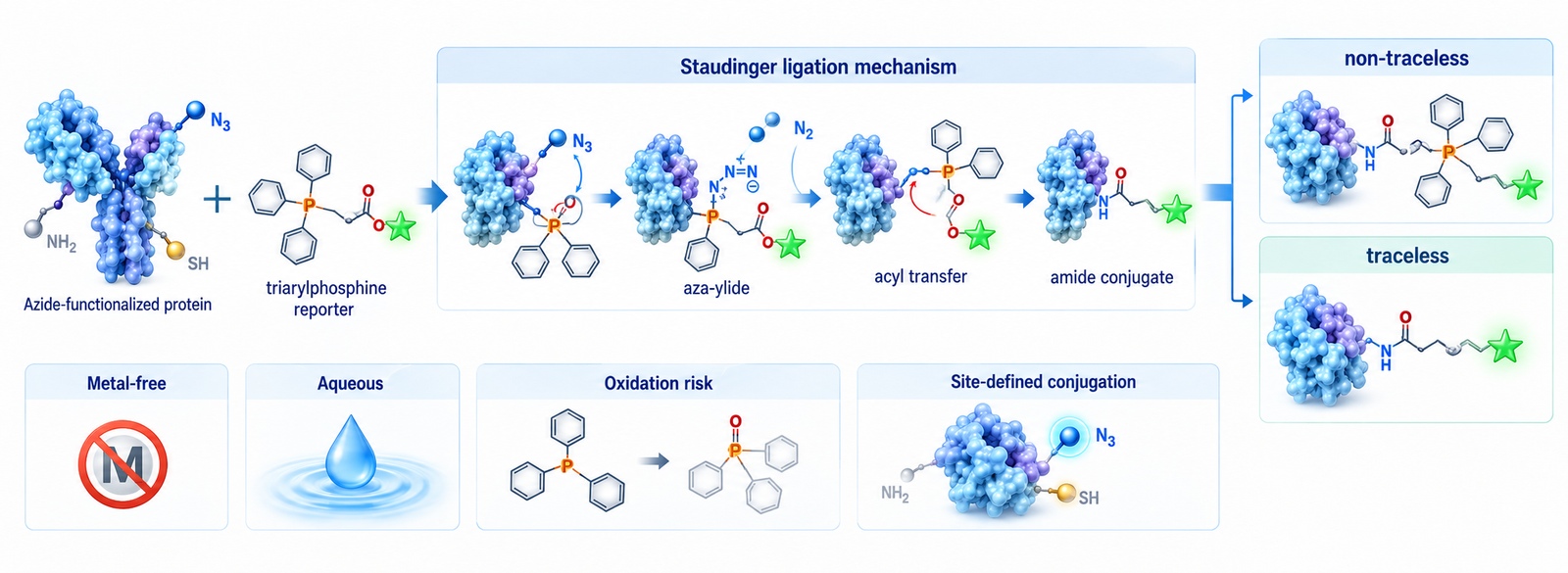 Schematic of azide–phosphine conjugation showing how Staudinger ligation provides a metal-free, site-directed route while highlighting phosphine oxidation and traceless versus non-traceless product design.
The azide is usually the preferred handle on the biomolecule because of its compact size and chemical stability, while the more oxidation-sensitive phosphine is often incorporated into the reporter, linker, or second conjugation partner. The actual orientation can be reversed when molecular architecture or synthesis constraints make that approach more practical.
| Molecule Type | Typical Azide Presentation | Complementary Partner | Key Technical Considerations | Typical Project Output |
| Proteins & Antibodies | Site-defined azido amino acid, linker-installed azide, or appropriately modified glycan/side chain | Phosphine-functionalized reporter, peptide, affinity group, PEG, or small molecule | Handle accessibility, protein stability, reagent solubility, aggregation, and separation of excess phosphine reagent | Site-directed labeled or functionalized protein conjugate |
| Peptides | N-terminal, C-terminal, or side-chain azide; azido amino acid building block | Phosphine probe or traceless acyl-transfer reagent | Sequence solubility, steric environment, protecting-group history, and compatibility with downstream HPLC | Labeled peptide, peptide-small molecule conjugate, or ligated peptide construct |
| DNA, RNA & Oligonucleotides | 5′, 3′, or internal linker-borne azide | Phosphine-modified label, peptide, small molecule, or affinity module | Sequence integrity, secondary structure, handle spacing, organic cosolvent tolerance, and purification resolution | Site-defined oligonucleotide conjugate or labeled research probe |
| Glycans & Lipids | Chemically or metabolically introduced azide-bearing building block | Phosphine-functionalized reporter or capture reagent | Amphiphilicity, solubility, matrix composition, and accessibility of the azide in assembled systems | Tagged glycan, lipid, or glycoconjugate for chemical biology research |
| Small Molecules | Alkyl or linker-borne azide positioned away from essential structural features | Phosphine-containing biomolecule, linker, tag, or complementary small molecule | Functional-group compatibility, hydrophobicity, regioisomer considerations, and chromatographic behavior | Defined small molecule–biomolecule or bifunctional conjugate |
| PEG & Polymers | Terminal or pendant azide | Phosphine-functionalized biomolecule or functional payload | Polymer dispersity, handle accessibility, excess-reagent removal, and conjugate heterogeneity | PEGylated or polymer-linked research construct |
Staudinger ligation is most useful when its combination of handle size, chemoselectivity, and metal-free operation addresses a project constraint that is not well served by conventional residue-directed conjugation. Reaction speed should also be considered: very dilute systems or applications demanding near-instantaneous coupling may be better served by faster bioorthogonal chemistries.
Existing azide-functionalized proteins, peptides, oligonucleotides, glycans, lipids, or small molecules can often be routed directly into a Staudinger ligation strategy without introducing a second bioorthogonal handle family.
The reaction can be selected when avoiding Cu(I) is important because of biomolecule sensitivity, downstream analytical requirements, or incompatibility with other components in the reaction mixture.
The small azide group can be attractive near structurally sensitive sites where incorporation of a larger strained alkyne or alkene could alter folding, molecular recognition, or local hydrophobicity.
A traceless Staudinger route may be considered when the final product should contain an amide connection without a persistent phosphine-derived residue.
Deliberate placement of an azide can provide a defined conjugation address rather than relying on the natural distribution of lysines, cysteines, carboxylates, or other common functional groups.
Staudinger ligation is better suited to workflows where sufficient reaction time and reagent concentration can be provided. For very rapid labeling at low concentrations, SPAAC or tetrazine-based chemistry may warrant evaluation instead.
Selection of a bioorthogonal conjugation method should consider more than whether a reaction is catalyst-free. Handle size, reaction rate, reagent stability, product structure, water solubility, substrate sensitivity, and purification requirements can all determine which chemistry is practical for a specific construct.
| Method | Reactive Pair | Catalyst Requirement | Relative Reaction Speed | Product / Linkage | Key Selection Considerations |
| Staudinger Ligation | Azide + engineered phosphine | No metal catalyst | Generally slow | Stable amide-containing linkage with phosphine-derived structure retained | Small azide handle and high chemoselectivity; phosphine oxidation and reaction rate require careful management |
| Traceless Staudinger | Azide + acyl-transfer phosphine reagent | No metal catalyst | Generally slow | Phosphorus-free amide linkage | Useful when residual phosphine-derived linker structure is undesirable; reagent architecture and competing hydrolysis are important |
| CuAAC | Azide + terminal alkyne | Cu(I) catalyst | Fast under optimized conditions | Triazole | Small reactive handles and efficient coupling; copper compatibility and catalyst removal must be considered for sensitive substrates |
| SPAAC | Azide + strained cyclooctyne | No metal catalyst | Typically faster than Staudinger ligation | Triazole | Convenient copper-free azide chemistry; strained alkyne size, hydrophobicity, stability, and possible side reactions should be considered |
| IEDDA Ligation | Tetrazine + suitable strained dienophile | No metal catalyst | Very fast | Dihydropyridazine/pyridazine-type adduct depending on reagent design | Attractive for rapid low-concentration labeling; reactive-handle size and stability can be more demanding than an azide-based design |
Staudinger ligation is therefore not automatically the preferred reaction for every azide-bearing molecule. Its strongest fit is usually found where copper-free chemistry, a compact azide reporter, controlled attachment, or traceless amide formation outweigh the need for maximum reaction speed.
Each project is planned around both the ligation step and the operations required before and after it. This is particularly important for Staudinger chemistry because handle accessibility, phosphine condition, purification strategy, and analytical sensitivity can determine whether a chemically plausible reaction becomes a practical conjugation workflow.


We review the molecular structures, available material, desired attachment position, downstream application, required final format, and any existing azide or phosphine functionality. This establishes whether Staudinger chemistry is appropriate before experimental development begins.

The azide-bearing partner, phosphine reagent, spacer geometry, and non-traceless or traceless pathway are selected. Potential effects on molecular function, accessibility, purification, and final linkage structure are considered at this stage.

Required reactive handles are introduced or customer-supplied materials are conditioned for conjugation. Phosphine-containing reagents are handled with attention to oxidation, while biomolecule buffers and additives are reviewed for reaction compatibility.

Reaction concentration, stoichiometry, solvent composition, temperature, and time are adjusted within substrate-compatible conditions. For challenging projects, multiple conditions can be compared to distinguish poor reactivity from solubility, accessibility, or reagent-stability limitations.

Unreacted starting materials, oxidized phosphine species, low-molecular-weight reagents, and other reaction components are separated using methods appropriate for the size and physicochemical properties of the target conjugate.

The purified conjugate is evaluated using analytical methods selected for the construct. Deliverables can include the conjugated material, analytical results, preparation details, and recommended handling or repeat-preparation conditions.
Successful Staudinger ligation requires more than detecting disappearance of a starting material. The analytical strategy should distinguish productive conjugation from phosphine oxidation, incomplete coupling, residual free label, hydrolysis products, aggregation, and other species relevant to the particular substrate. Purification and characterization methods are therefore selected according to molecular size, charge, hydrophobicity, and the required level of structural information.
| Development Need | Typical Method Options | What It Helps Establish | Relevant Molecule Types |
| Removal of Free Reagents | Desalting, dialysis, centrifugal filtration, size-based separation | Removal of excess phosphine reagent, small-molecule byproducts, salts, and cosolvents | Proteins, antibodies, large nucleic acids, polymers |
| Conjugate Purification | RP-HPLC, ion-exchange separation, SEC, or other construct-appropriate chromatography | Separation of conjugated material from unreacted substrate and structurally related species | Peptides, oligonucleotides, proteins, small-molecule conjugates |
| Identity Confirmation | LC-MS, intact-mass analysis, MALDI-TOF MS, or other suitable mass-based analysis | Confirmation that the expected mass change is consistent with the intended conjugation | Small molecules, peptides, oligonucleotides, proteins where method-compatible |
| Purity Assessment | HPLC/UPLC, SEC-based analysis, electrophoretic methods as appropriate | Evaluation of major product species, residual starting material, degradation, and aggregation-related components | Broadly applicable according to molecular format |
| Labeling Assessment | UV-Vis, fluorescence measurements, mass spectrometry, or chromatographic quantification | Evaluation of reporter incorporation or conjugation level where the selected label permits quantitative analysis | Fluorescent, chromophoric, affinity-tagged, and selected protein conjugates |
| Aggregation / Size Review | SEC and size-based analytical methods; DLS where suitable | Assessment of conjugation-associated aggregation or changes in apparent molecular size | Proteins, antibodies, nanoparticles, selected polymeric constructs |
Reactive phosphines can be converted to phosphine oxides during storage or handling, decreasing the amount of reagent available for ligation. Reagent age, atmosphere, solvent history, preparation sequence, and reaction exposure should therefore be considered during method development.
A chemically intact azide may still react poorly if it is buried in a folded protein, shielded by a polymer chain, or positioned within a sterically constrained molecular region. Spacer length and handle orientation can be as important as the nominal chemistry itself.
Aromatic phosphine reagents can introduce hydrophobicity, while many biomolecules require predominantly aqueous conditions. Cosolvent selection must improve reagent availability without destabilizing proteins, disrupting nucleic-acid structure, or precipitating the conjugation partners.
Non-traceless and traceless Staudinger ligations produce different final molecular architectures. The desired product structure should therefore be defined before selecting the phosphine reagent rather than attempting to change the linkage after conjugation.
Because Staudinger ligation is comparatively slow, very dilute reactions can be challenging. Practical development may require adjustment of concentration, stoichiometric excess, reaction time, or molecular presentation while staying within substrate-stability limits.
Buffer composition, pH, temperature, organic cosolvent, incubation duration, and downstream purification all need to remain compatible with the biomolecule. Conditions that improve chemical conversion are not useful if they compromise the intended function or physical state of the conjugate.
We evaluate whether non-traceless Staudinger ligation, traceless ligation, or an alternative bioorthogonal chemistry better matches the substrate and final linkage requirements instead of forcing every project into one reaction format.

Molecular size, solubility, reactive-handle accessibility, folding requirements, and sensitivity to reaction conditions are incorporated into route planning for proteins, peptides, oligonucleotides, small molecules, and other conjugation partners.
Purification and characterization are considered during reaction design so that the expected conjugate can be separated from unreacted starting materials, oxidized phosphine species, and other process-related components.
Projects can begin with customer-supplied azide/phosphine reagents, partially developed methods, or a new conjugate concept, with support extending from feasibility assessment through optimized preparation and analytical review.
Whether you already have an azide-functionalized biomolecule, need to design the reactive handles for a new conjugate, or are deciding between Staudinger ligation and another bioorthogonal reaction, BOC Sciences can help evaluate the complete chemistry from handle placement through purification and analytical verification.
Share the structures or molecular types of both conjugation partners, available functional handles, desired attachment site, approximate material scale, downstream research use, and any known stability or buffer constraints. Contact our scientific team to discuss a project-specific Staudinger ligation conjugation strategy.
Staudinger ligation is a bioorthogonal conjugation reaction between an organic azide and a specially designed phosphine reagent. Unlike a simple Staudinger reduction, the ligation reagent contains an electrophilic trapping group that captures the aza-ylide intermediate and forms a covalent amide-containing conjugate.
In Staudinger reduction, reaction of an azide with a phosphine ultimately converts the azide into an amine. In Staudinger ligation, the phosphine reagent is engineered with an electrophilic group that traps the intermediate and links the two reaction partners instead of simply producing the reduced amine.
Non-traceless Staudinger ligation retains phosphine-derived structure in the final conjugate. Traceless Staudinger ligation uses an acyl-transfer reagent architecture that releases the phosphine oxide component during the reaction, leaving a phosphorus-free amide linkage.
The chemistry can be adapted to azide- or phosphine-functionalized proteins, antibodies, peptides, DNA, RNA, other oligonucleotides, glycans, lipids, small molecules, PEG, polymers, and selected surface-functionalized materials. Suitability depends on handle accessibility, solubility, molecular stability, and purification requirements.
Staudinger ligation can be useful when a compact azide handle, metal-free conditions, or a traceless amide-forming route is important. SPAAC is generally faster and is often more convenient for low-concentration copper-free labeling, but it requires a comparatively bulky strained cyclooctyne partner.