Bioconjugates can lose performance after conjugation even when initial coupling and purification appear successful. Aggregation, linker cleavage, label or payload loss, loading drift, chemical degradation, and sensitivity to pH, temperature, freeze-thaw, agitation, light, or complex matrices can emerge during development and complicate downstream use. BOC Sciences provides Bioconjugate Stability Assessment Services to identify these liabilities, compare candidate designs, and define practical stability conditions for continued development. We support antibody, protein, peptide, oligonucleotide, and other research bioconjugates, including newly prepared constructs, reformulated samples, transferred methods, and existing conjugates showing unexplained instability or batch-to-batch changes.
Stability assessment should reflect the architecture of the complete conjugate rather than evaluate only the unconjugated biomolecule. Our study plans therefore consider the biomolecule, conjugation partner, linker, attachment site, loading level, buffer environment, intended handling conditions, and analytical question together. Individual projects can focus on troubleshooting a known instability or comparing several conjugate designs before further development.
 Stability Study Design
We develop project-specific assessment plans based on the conjugate structure, current development stage, suspected failure mode, available material, and downstream requirements.
Deliverables may include a stability study plan, recommended stress conditions, analytical endpoints, time-point strategy, and comparison criteria. This helps customers avoid testing conditions that generate data without answering the actual development question.
 Physical Stability Profiling
Physical stability assessment focuses on whether conjugation changes solubility, colloidal behavior, molecular size distribution, or susceptibility to aggregation and precipitation.
Results can support buffer selection, conjugate redesign, loading adjustment, or further purification when instability is associated with hydrophobicity, heterogeneous populations, or intermolecular interactions.
 Linkage Integrity Testing
We evaluate whether the bond connecting the biomolecule, linker, label, payload, polymer, lipid, or other conjugation partner remains intact under conditions relevant to the project.
The resulting data help determine whether observed instability originates from the biomolecule itself, the linkage, or the attached component, allowing redesign to target the actual liability.
 Chemical Integrity Assessment
Conjugation can introduce new chemical liabilities or change the exposure of existing reactive sites. We assess changes that may affect the intact conjugate during storage or stress.
Customers receive a clearer view of which conditions accelerate chemical change and which development variables may be adjusted to improve conjugate robustness.
 Handling Stress Studies
Some bioconjugates remain stable during static storage but change after repeated handling. We can design studies around practical stresses expected during research use and downstream processing.
These studies can identify handling-sensitive constructs and help establish practical sample preparation, storage, aliquoting, and transfer conditions.
 Comparative Stability Screening
When several conjugate designs are available, stability can be used as a development criterion rather than evaluated only after a final construct has been selected.
Comparative studies provide development teams with evidence for selecting the construct or condition that offers the most appropriate balance of conjugation performance and stability.
Bioconjugate instability is rarely caused by one variable alone. The parent molecule, conjugation site, linker, attached component, loading distribution, purification history, and storage environment can interact to produce degradation patterns that are difficult to interpret from a single analytical measurement. Our stability assessment strategy is designed around the specific failure mode that is limiting further development.
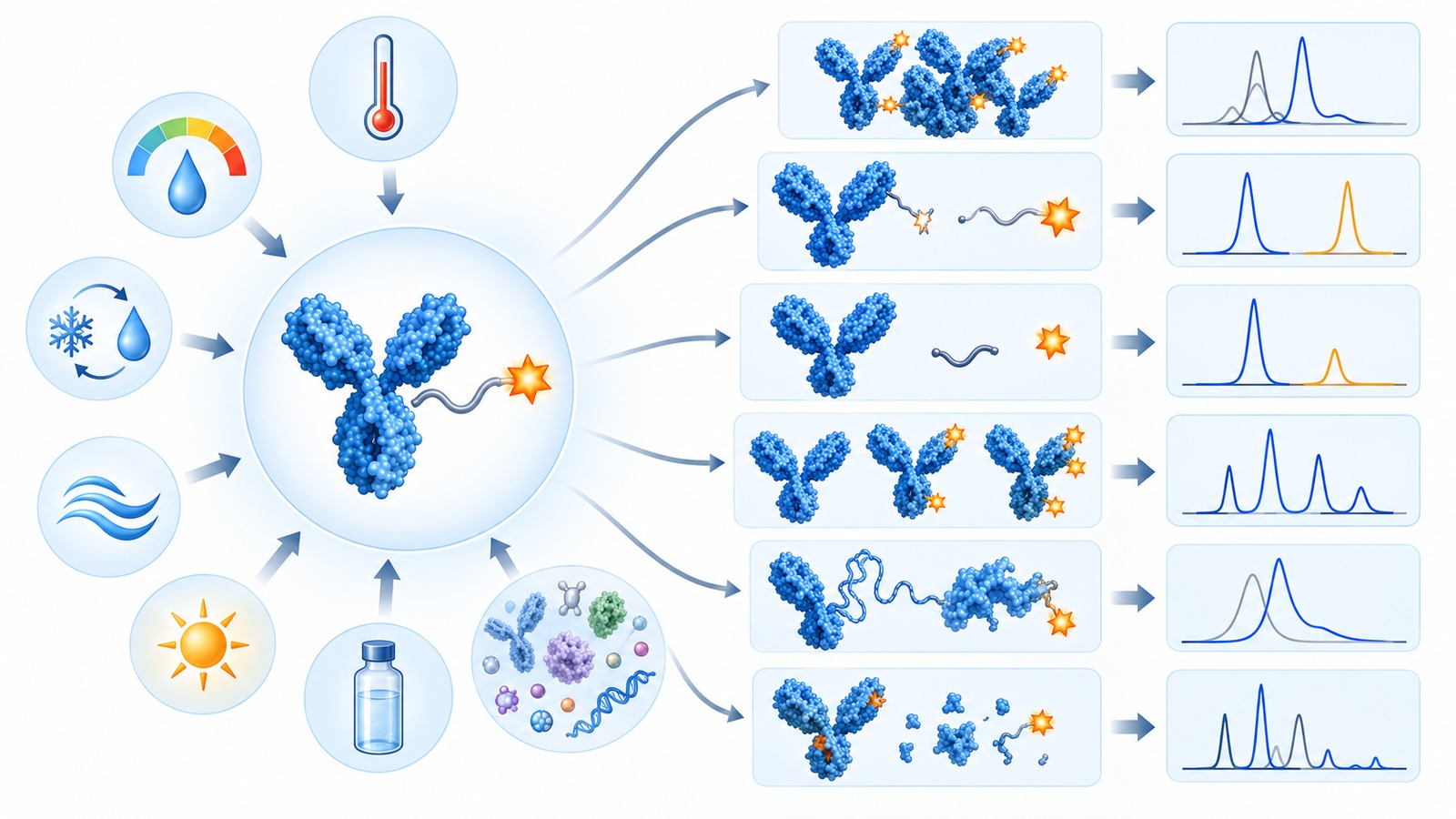 Bioconjugate stability assessment can distinguish physical aggregation, linkage instability, loading changes, and chemical degradation under relevant storage and stress conditions.
Addition of hydrophobic labels, drugs, lipids, polymers, or other partners can alter the surface properties of proteins and other biomolecules. We evaluate whether aggregation is associated with conjugation level, buffer conditions, concentration, stress exposure, or a particular conjugate population.
A construct may remain physically intact while gradually losing the attached component. We assess linkage integrity under appropriate storage, buffer, handling, or matrix conditions and compare alternative chemistries when premature deconjugation is suspected.
Drug-to-antibody ratio, degree of labeling, polymer loading, oligonucleotide loading, or other conjugate ratios may shift if selected populations degrade or the linkage is unstable. Time-dependent loading analysis can reveal changes that total concentration measurements miss.
New fragments, aggregates, deconjugated species, modified biomolecules, or free conjugation partner can increase sample complexity over time. We use orthogonal analytical endpoints to determine how the conjugate population changes rather than relying on one bulk measurement.
A conjugate may retain the expected average mass while losing a functionally important property because of unfolding, chemical modification, steric effects, or degradation of the attached component. Stability plans can therefore include function-relevant evaluation where the project requires it.
Instability during purification, concentration, shipment simulation, freezing, thawing, or routine sample handling can create apparent batch differences. We help separate process-related variation from intrinsic conjugate instability and identify conditions that require tighter control.
A meaningful bioconjugate stability study connects each analytical endpoint to a specific development risk. The parameters below are commonly considered when defining the study rather than automatically applying the same panel to every conjugate.
| Stability Parameter | Why It Matters | What We Evaluate | Potential Development Approach |
| Physical Integrity | Conjugation can change hydrophobicity, charge, intermolecular interactions, and solubility. | Aggregate formation, monomer loss, precipitation, particle-size change, or visible instability as applicable. | Adjust buffer, concentration, loading, linker design, purification, or handling conditions. |
| Linkage Stability | Premature cleavage or exchange can convert an intact conjugate into free biomolecule and released partner. | Intact conjugate level, deconjugated species, free component, and time-dependent linkage changes. | Compare attachment chemistry, spacer, conjugation site, linker structure, or environmental conditions. |
| Loading Stability | Average loading can shift even when total biomolecule concentration remains similar. | DAR, degree of labeling, conjugation ratio, loading distribution, or site occupancy where relevant. | Optimize starting loading, reduce unstable high-loading populations, or modify conjugation conditions. |
| Chemical Integrity | The biomolecule, linker, or conjugation partner may undergo hydrolysis, oxidation, or other chemical changes. | Intact mass or chromatographic profile, fragments, modified species, and degradation-related components. | Refine pH, buffer composition, exposure conditions, linker chemistry, or storage environment. |
| pH and Buffer Effects | Buffer identity, ionic strength, and pH can affect both the biomolecule and the connecting chemistry. | Aggregation, solubility, conjugate recovery, chemical integrity, and loading retention across selected conditions. | Define a more suitable working or storage buffer window. |
| Temperature Sensitivity | Elevated or inappropriate temperatures can accelerate physical and chemical degradation pathways. | Time-dependent changes in integrity, aggregation, loading, and conjugate-related impurities. | Compare storage conditions or use thermal stress to identify likely stability liabilities. |
| Handling Sensitivity | Freeze-thaw, agitation, dilution, concentration, and repeated manipulation may destabilize some constructs. | Changes before and after defined handling cycles. | Develop aliquoting, mixing, thawing, concentration, and transfer recommendations. |
| Matrix Compatibility | Complex research matrices may alter linkage stability, aggregation behavior, or recovery. | Conjugate integrity and property retention after selected matrix exposure. | Modify linker, assay exposure conditions, formulation, or analytical recovery strategy. |
Stability risks depend strongly on the molecular architecture of the conjugate. Study conditions and analytical endpoints are therefore adapted to the parent biomolecule, the attached component, and the type of linkage being evaluated.
| Conjugate Type | Common Stability Concerns | Relevant Assessment Focus |
| Antibody Conjugates | Aggregation, fragmentation, loading drift, deconjugation, hydrophobicity-related instability, and structural changes. | Size distribution, conjugation ratio, linker integrity, heterogeneity, and function-relevant properties. |
| Protein Conjugates | Protein unfolding, aggregation, precipitation, chemical modification, and conjugate-partner loss. | Protein integrity, solubility, aggregation, conjugation level, and retention of project-relevant function. |
| Peptide Conjugates | Linker cleavage, peptide degradation, oxidation, hydrolysis, solubility changes, and free-component growth. | Intact conjugate, chromatographic purity, mass profile, linker stability, and degradation products. |
| Oligonucleotide Conjugates | Cleavage, linker instability, strand degradation, aggregation, adsorption, or changes caused by hydrophobic partners. | Intact conjugate ratio, oligonucleotide integrity, free partner, linkage stability, and solution behavior. |
| Small-Molecule or Label Conjugates | Label loss, hydrolysis, photochemical change, loading variability, or altered biomolecule stability. | Degree of labeling, free label, intact mass, optical properties where relevant, and biomolecule integrity. |
| Polymer, Lipid or Nanomaterial Conjugates | Colloidal instability, desorption, linker cleavage, heterogeneous loading, and matrix-dependent behavior. | Conjugate association, size behavior, loading retention, free component, and condition-dependent stability. |
Method selection is driven by the degradation pathway that must be detected. A single assay rarely describes every relevant change in a complex bioconjugate, so stability programs may combine separation-based, mass-based, spectroscopic, biophysical, and function-relevant measurements where appropriate.
The starting conjugate is characterized before stress or storage so initial aggregates, free components, loading distribution, or heterogeneity are not mistaken for newly formed degradation products.
Selected analytical attributes are followed across defined time points to determine whether changes are gradual, threshold-dependent, or associated with a particular storage condition.
Controlled thermal, pH, oxidation, light, freeze-thaw, agitation, or other project-relevant stresses can be used to reveal likely degradation pathways and compare the relative robustness of candidate designs.
Intact conjugate, free component, loading ratio, or other linkage-sensitive attributes are monitored under selected conditions to identify premature cleavage, exchange, or deconjugation.
Depending on the molecule and question, evaluation may combine size-based analysis, chromatography, mass analysis, electrophoretic methods, spectroscopy, light-scattering measurements, or thermal stability methods so that one analytical limitation does not dominate the interpretation.
Where the development decision depends on binding, hybridization, enzymatic behavior, fluorescence response, or another defined property, stability-related analytical changes can be compared with the corresponding functional readout.
Stability testing is most useful when the experimental design reflects the actual molecular and project risks. We therefore select conditions and analytical endpoints after reviewing the complete conjugate architecture and the decision the data must support.
| Project Variable | Potential Stability Risk | Assessment Emphasis | Development Decision Supported |
| Parent Molecule | Unfolding, oxidation, hydrolysis, aggregation, strand degradation, or sequence-dependent instability. | Biomolecule integrity and comparison with unconjugated control where useful. | Determine whether conjugation introduced or accelerated the liability. |
| Conjugation Partner | Increased hydrophobicity, altered solubility, steric effects, photochemical sensitivity, or chemical degradation. | Physical stability, free-component formation, and property retention. | Select partner, spacer, or loading conditions. |
| Conjugation Chemistry | Hydrolysis, exchange, bond cleavage, or chemistry-specific side products. | Linkage stability and intact-conjugate monitoring. | Compare attachment chemistries or optimize reaction design. |
| Conjugation Site | Local structural disturbance, variable accessibility, or site-dependent linkage behavior. | Structural integrity, loading distribution, and comparative stability. | Assess whether a different site or site-specific approach is preferable. |
| Loading Level | Increased hydrophobicity, aggregation, solubility loss, or preferential instability of highly loaded species. | Loading distribution, aggregation, conjugate recovery, and time-dependent ratio changes. | Define a practical loading range rather than maximizing conjugation alone. |
| Storage Environment | Temperature-, pH-, salt-, concentration-, light-, or buffer-dependent degradation. | Time-course comparison across selected conditions. | Establish storage and handling recommendations. |
| Intended Matrix | Linker cleavage, nonspecific interaction, aggregation, adsorption, or reduced analytical recovery. | Matrix exposure combined with linkage and integrity measurements. | Decide whether conjugate design or downstream conditions require modification. |
| Analytical Requirement | One method may miss an important degradation pathway or fail to distinguish related species. | Selection of complementary analytical endpoints. | Build a stability-indicating data set matched to the development question. |
Stability cannot be separated from the chemistry used to build the conjugate. Our assessment plans can be aligned with the attachment route so the most relevant degradation pathways are monitored without repeating a full chemistry-development study.
For constructs produced by NHS ester conjugation or related EDC/NHS and amine-reactive chemistry, stability studies can focus on conjugate heterogeneity, loading retention, hydrolytic behavior, aggregation, and changes associated with reaction-site distribution.
For maleimide conjugation, assessment can emphasize linkage integrity, deconjugation behavior, loading drift, free partner formation, and the influence of buffer or matrix conditions on the final thioether-containing construct.
SPAAC-derived conjugates can be evaluated for overall conjugate integrity, stability of the installed linker architecture, aggregation or solubility changes caused by hydrophobic handles, and retention of the desired loading.
For constructs generated through CuAAC, stability evaluation can be integrated with analytical review of the final purified conjugate, including intact-conjugate behavior, heterogeneity, and project-specific chemical or physical liabilities.
Conjugates prepared through tetrazine ligation can be assessed with attention to the complete linker architecture, attached-component stability, loading distribution, and changes observed during storage or handling.
Products generated by enzymatic crosslinking or other site-controlled approaches can be evaluated to determine whether improved positional control translates into more consistent loading, physical stability, or batch behavior.
The workflow is adjusted to the conjugate and the development decision being made. Projects may begin with a fully characterized conjugate or with an existing sample for which the cause of instability is still uncertain.


We review the biomolecule, conjugation partner, chemistry, linker, site, loading, current formulation, available analytical data, current instability problem, and the conditions the conjugate is expected to encounter.

Likely physical, chemical, linkage, and handling-related liabilities are prioritized. This determines which controls, stress conditions, time points, and analytical measurements can most directly answer the development question.

Storage and stress conditions are selected based on the suspected failure mode. Candidate buffers, temperatures, pH ranges, handling cycles, matrix exposure, or comparative conjugate designs can be included where appropriate.

Samples are evaluated at the defined conditions and time points. Experimental design emphasizes consistent sample handling so observed changes can be linked to the variable under investigation rather than uncontrolled preparation differences.

Relevant measurements are combined to examine conjugate integrity, aggregation, linkage stability, loading, heterogeneity, and other project-specific attributes. Additional purification or analytical investigation can be incorporated when degradation products require separation or clarification.

Results are reviewed across conditions and analytical endpoints to identify the dominant instability pathway and practical next steps, such as linker redesign, loading adjustment, buffer modification, handling changes, additional purification, or targeted method development.
Stability performance is evaluated using attributes that reflect both the intact conjugate and the changes that matter to the project. The exact acceptance logic is defined from the customer's development objective rather than applying a universal threshold to unrelated conjugate types.
We determine whether the principal conjugate population remains intact or develops fragments, degraded species, deconjugated material, or other structural changes.
Monomer retention, aggregate formation, precipitation tendency, or particle-size changes are evaluated when physical instability is relevant to the molecule.
Changes in intact conjugate, free partner, cleavage products, or exchanged species are used to determine whether the attachment chemistry remains suitable under the selected conditions.
DAR, degree of labeling, conjugation ratio, or other relevant loading attributes can be monitored to identify selective loss of highly or weakly conjugated species.
When stability must be linked to performance, selected binding, hybridization, optical, enzymatic, or other function-relevant properties can be compared with physicochemical changes.
Replicate or comparative measurements can help determine whether the observed instability is consistent and whether revised preparation or handling conditions improve experimental repeatability.
Stability assessment is particularly useful when a project has moved beyond confirming that conjugation occurred and needs to determine whether the resulting construct remains suitable during subsequent handling, comparison, or development.
Use stability assessment when a new linker, partner, loading level, or conjugation site has been introduced and its effect on the complete construct is not yet understood.
Stability profiling can help determine whether aggregation originates from loading, hydrophobicity, buffer conditions, concentration, purification, or handling.
Compare intact conjugate and free component over time when premature cleavage, exchange, or conjugation-partner loss is suspected.
Parallel stability screening can differentiate linker, chemistry, site, spacer, loading, or buffer options that initially show similar conjugation efficiency.
Use condition studies to investigate temperature, pH, freeze-thaw, agitation, concentration, or buffer sensitivity before establishing routine research handling procedures.
Comparative assessment can determine whether the difference reflects loading distribution, purification history, starting material, storage exposure, or intrinsic conjugate instability.
We select stress conditions and analytical endpoints around the suspected instability mechanism instead of applying an identical stability panel to every molecule. This makes the resulting data more useful for development decisions.

Antibodies, proteins, peptides, oligonucleotides, labels, polymers, and other conjugation partners do not fail in the same way. Study design is adjusted to the molecular architecture and attachment chemistry.
Where appropriate, multiple analytical attributes are evaluated together so aggregation, deconjugation, loading drift, and chemical degradation can be distinguished rather than interpreted from one signal alone.
Stability observations can be connected to practical next steps in linker selection, conjugation chemistry, loading control, purification, buffer conditions, or handling strategy, allowing the assessment to support the next experiment rather than end with descriptive data.
To discuss a stability assessment project, share the molecule or conjugate type, conjugation partner, current chemistry or linker if known, development status, observed problem, current storage or handling conditions, desired outcome, available analytical information, and approximate sample scale. Projects may begin with a fully defined stability plan or simply with a conjugate that aggregates, loses loading, deconjugates, or behaves inconsistently.
You do not need to have the final conjugation chemistry, purification route, stability protocol, or analytical strategy established before contacting us. BOC Sciences can review the available information, identify the most relevant stability questions, and propose a study strategy aligned with your development objective. Contact our scientific team to discuss your Bioconjugate Stability Assessment Services requirements.
Useful starting information includes the parent molecule, conjugation partner, linker or chemistry if known, conjugation site, approximate loading, current buffer, storage conditions, observed instability, available analytical data, desired outcome, and available sample amount. Projects can still be evaluated when some of these details have not yet been finalized.
Yes. Stability assessment can be incorporated during conjugation development to compare chemistries, linkers, sites, loading levels, or buffers. Early comparison is often useful when several constructs show acceptable initial conjugation but differ in aggregation, deconjugation, or handling behavior.
Yes. An existing method can be reviewed when it does not detect the expected degradation pathway, produces inconsistent results, uses unsuitable stress conditions, or relies on a single analytical measurement that does not explain the observed conjugate behavior.
The assessment is selected according to the conjugate and project question. Relevant attributes may include intact conjugate level, aggregation, fragmentation, linkage stability, free component formation, loading or labeling ratio, heterogeneity, chemical degradation, and changes in a function-relevant property.
Purification or sample-cleanup work can be incorporated when free label, unconjugated partner, aggregates, degradation products, or distinct conjugate populations interfere with interpretation or when a purified fraction is needed for further comparison.