Carboxyl-to-Amine ConjugationZero-Length Amide Bond FormationCustom Coupling, Purification & Characterization
EDC/NHS coupling is a widely used carbodiimide-mediated conjugation strategy for forming stable amide bonds between carboxyl groups and primary amines. By activating a carboxyl-containing molecule with EDC and stabilizing the reactive intermediate with NHS or Sulfo-NHS, the chemistry provides a practical route for connecting proteins, antibodies, peptides, oligonucleotides, small molecules, polymers, beads, nanoparticles, and functionalized surfaces without introducing a permanent crosslinker-derived spacer into the final bond.
BOC Sciences supports custom EDC/NHS coupling projects from reactive-handle assessment and coupling-route design through activation optimization, conjugation, purification, and analytical characterization. Projects can be integrated with broader custom bioconjugation services when EDC/NHS must be compared with alternative amine-, thiol-, or bioorthogonal conjugation strategies. Our development approach focuses on the practical variables that determine whether an EDC/NHS reaction is useful in a real research workflow: functional-group accessibility, substrate concentration, pH, activation timing, competing hydrolysis, unwanted crosslinking, product heterogeneity, purification feasibility, and retention of downstream molecular function.
EDC/NHS conjugation can be applied to many molecular classes, but the reaction should not be treated as a universal one-condition protocol. The preferred activation sequence, reagent format, substrate ratio, purification route, and analytical package depend on which partner carries the carboxyl group, which partner provides the primary amine, and how much positional heterogeneity the downstream application can tolerate. We configure each project around those variables.
 Protein & Antibody Coupling
We support carboxyl-to-amine coupling involving recombinant proteins, carrier proteins, enzymes, antibodies, antibody fragments, and other amine-bearing biomolecules. Projects may involve activation of a carboxyl-containing small molecule, peptide, polymer, linker, or surface followed by reaction with accessible lysine or N-terminal amines on the protein.
Typical deliverables: purified protein or antibody conjugate, reaction summary, selected analytical results, and project-specific handling recommendations.
 Peptide & Hapten Coupling
Peptides and haptens frequently contain carboxyl groups, primary amines, or both, making EDC/NHS coupling useful but potentially prone to uncontrolled intermolecular reaction. We design coupling routes around terminal functionality, side-chain composition, desired orientation, and the intended carrier or biomolecule partner.
Typical deliverables: purified peptide conjugate or carrier-protein conjugate with characterization selected according to molecular size and downstream research use.
 Oligonucleotide Coupling
EDC/NHS chemistry can be used with DNA, RNA, and modified oligonucleotides when a suitable carboxyl or primary amine handle has been intentionally introduced. This approach is particularly useful for constructing oligonucleotide conjugates with proteins, peptides, polymers, particles, or small molecules that carry the complementary reactive group.
Typical deliverables: purified oligonucleotide conjugate and analytical data selected to assess identity, purity, conjugation status, and relevant loading characteristics.
 Nanoparticle & Bead Coupling
Carboxyl-functionalized particles and beads are common EDC/NHS substrates because surface carboxyl groups can be converted into amine-reactive esters before coupling to proteins, antibodies, peptides, amino-modified oligonucleotides, or other ligands.
Typical deliverables: functionalized particles or beads with project-appropriate loading, particle, and stability characterization.
 Small Molecule Coupling
Carboxyl-containing small molecules, labels, haptens, linker intermediates, and research payloads can be activated by EDC/NHS and coupled to amine-bearing biomolecules when substrate solubility and functional-group compatibility permit.
Typical deliverables: purified small-molecule conjugate plus project-relevant confirmation of conjugation and product composition.
 Method Development Support
Difficult EDC/NHS projects often require more than transferring a published protocol. We support method development for substrates with poor solubility, low accessible amine density, extensive native carboxyl groups, aggregation sensitivity, unstable activated intermediates, or challenging purification profiles.
Customer value: a coupling process designed around the actual molecular system rather than a generic EDC/NHS recipe.
EDC, or 1-ethyl-3-(3-dimethylaminopropyl)carbodiimide, activates a carboxyl group to generate a reactive O-acylisourea intermediate. That intermediate can react directly with a primary amine, but it is short-lived in water and can hydrolyze back to the starting carboxyl group or undergo other side reactions. NHS or the more water-soluble Sulfo-NHS is therefore commonly included to convert the O-acylisourea into a more persistent amine-reactive ester. A primary amine then attacks the activated ester to form the final amide bond.
Because EDC is not retained as a spacer in the final conjugate, the process is often described as zero-length crosslinking. In many biomolecular projects, carboxyl activation and amine coupling are treated as separate stages so that the activation conditions can be optimized independently from the conditions required for efficient aminolysis.
Activated carboxyl intermediates are consumed by water as well as by the intended amine partner. Delayed reagent addition, overly dilute substrates, inappropriate pH, or extended handling of an activated intermediate can therefore reduce productive conjugation. We plan activation and coupling as a coordinated sequence rather than treating activation as a stable endpoint.
Proteins, antibodies, and peptides may contain many accessible carboxyl and amine groups. EDC/NHS coupling can therefore generate a distribution of attachment sites when native functional groups are used. For molecules whose active or binding region contains important lysines, Asp/Glu residues, or terminal groups, the reaction strategy must consider whether random coupling is acceptable.
Primary amine-containing buffers can consume activated esters instead of allowing them to react with the intended substrate. Activation and coupling also favor different pH conditions. Buffer exchange, pH staging, and the timing of amine-containing quench reagents are therefore important parts of an optimized EDC/NHS workflow.
When a biomolecule presents both carboxyl groups and primary amines, uncontrolled activation may lead to intermolecular coupling, oligomerization, or aggregation. Separating activation from the final coupling step, controlling reactive-group density, and selecting an appropriate purification strategy can reduce these problems.
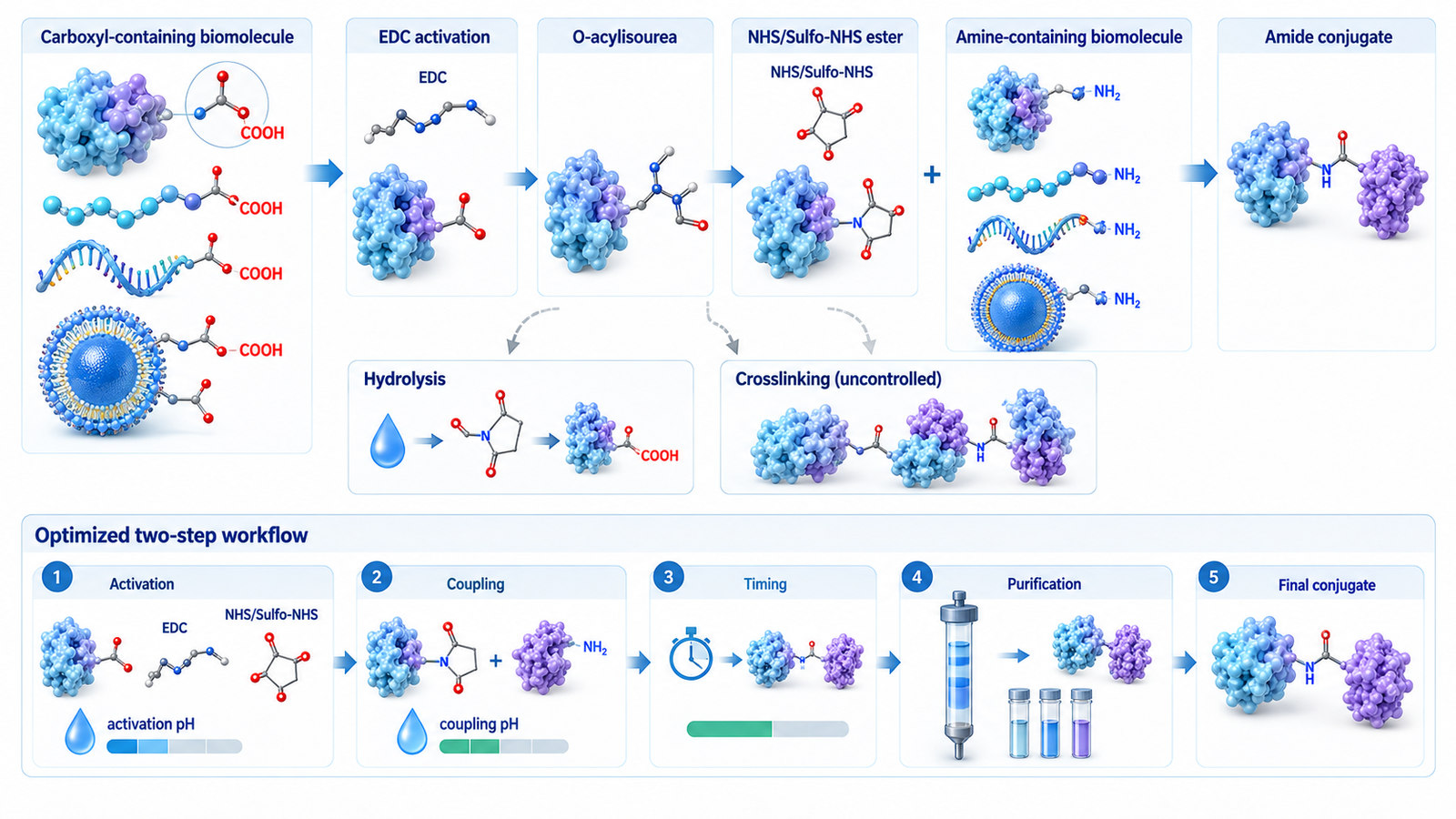 Schematic overview of EDC/NHS coupling, highlighting controlled carboxyl activation, NHS ester formation, amine coupling, and the competing hydrolysis pathways that must be managed during method development.
EDC/NHS coupling is most useful when one partner provides an accessible carboxyl group and the second partner provides an accessible primary amine. These handles may be native to the molecule or deliberately introduced to improve orientation, reaction control, or purification.
| Molecule Class | Carboxyl Handle | Amine Handle | Typical EDC/NHS Project | Important Considerations |
| Proteins & Antibodies | Asp/Glu side chains, C-terminus, introduced COOH linker | Lysine side chains, N-terminus, engineered amine handle | Coupling to carboxyl-bearing peptides, small molecules, polymers, particles, or surfaces | Multiple native handles can produce heterogeneous products; binding or catalytic regions should be considered before random modification |
| Peptides & Haptens | C-terminus, Asp/Glu, introduced carboxyl spacer | N-terminus, Lys, amino linker | Peptide-carrier conjugation, hapten attachment, peptide-protein coupling | Molecules containing both carboxyls and amines may self-couple unless orientation or protection strategy is considered |
| DNA & RNA Oligos | 5′, 3′, or internal carboxyl modification | 5′, 3′, or internal amino modification | Oligo-protein, oligo-peptide, oligo-polymer, or oligo-particle conjugation | Purpose-built reactive handles are typically preferred; spacer length and oligonucleotide charge influence coupling and purification |
| Small Molecules & Linkers | Native or introduced carboxylic acid | Primary aliphatic amine | Attachment of labels, haptens, ligands, spacers, or functional small molecules | Solubility, competing nucleophiles, multiple acids, and organic co-solvent requirements should be evaluated |
| Polymers & Polysaccharides | Carboxylated polymer backbone or terminal COOH | Aminated polymer or amine-bearing biomolecule | Protein-polymer, peptide-polymer, or biomaterial functionalization | Functional-group density, viscosity, steric accessibility, and gelation or network formation may influence reaction behavior |
| Nanoparticles & Beads | Carboxylated particle, bead, coating, or surface | Protein, antibody, peptide, amino-oligo, or amine linker | Covalent surface immobilization and probe preparation | Surface density, aggregation, particle washing, nonspecific adsorption, and ligand orientation require control |
| Surfaces & Matrices | Carboxyl-functional surface or matrix | Amine-bearing biomolecule or ligand | Immobilization for affinity capture, biosensor research, or assay development | Surface accessibility and immobilization density can affect target binding and mass-transfer behavior |
EDC/NHS is especially useful when the molecular partners already provide, or can readily be given, complementary carboxyl and primary amine groups. It is often selected when a stable amide linkage is required and the additional length of a permanent crosslinker spacer is undesirable. The decision should still account for site distribution, molecular stability, purification, and the level of conjugate heterogeneity acceptable for the intended research application.
Use EDC/NHS when the objective is to form a direct covalent amide connection between an available carboxyl group and a primary amine without retaining the carbodiimide reagent in the final linkage.
The chemistry is well suited to carboxylated beads, nanoparticles, polymers, and other materials that need to be coupled to amine-bearing proteins, antibodies, peptides, or modified oligonucleotides.
Carboxyl-containing peptides, haptens, small molecules, and linkers can be activated before exposure to an amine-bearing biomolecule, providing a convenient route when pre-synthesized active esters are unavailable.
EDC and Sulfo-NHS can support largely aqueous coupling workflows, which can be useful for proteins and other biomolecules that are poorly suited to prolonged exposure to organic reaction media.
Native lysine- and carboxyl-directed coupling is most appropriate when an ensemble of attachment sites is compatible with the study. If a defined attachment site or orientation is essential, maleimide, click, enzymatic, or engineered-handle strategies may be more suitable.
EDC/NHS can also be used in a planned two-stage design where an amino or carboxyl handle is first installed at a chosen position, reducing dependence on poorly controlled native functional-group distributions.
Chemistry selection should be based on the available reactive handles, the acceptable level of heterogeneity, the required linkage architecture, and the stability limits of the substrates. EDC/NHS is highly useful for carboxyl-to-amine coupling, but it is not the preferred method when a project requires a uniquely defined conjugation site and the molecules provide better orthogonal handles.
| Conjugation Method | Reactive Pair | Final Linkage | Selectivity Profile | Best Fit | Main Considerations |
| EDC/NHS Coupling | Carboxyl + primary amine | Amide | Low to moderate with native biomolecular handles; can be improved through engineered handles | Carboxylated particles, carboxyl-containing payloads, peptide-carrier coupling, general amide formation | Hydrolysis, pH staging, multiple native reactive sites, unwanted crosslinking, and activation timing |
| Preformed NHS Ester | NHS ester + primary amine | Amide | Usually lysine/N-terminus directed when used with proteins | Labels or linkers already available in activated ester form | Avoids in situ carboxyl activation, but the active ester still competes with hydrolysis and may modify multiple amines |
| Maleimide-Thiol | Maleimide + free thiol | Thioether-containing succinimide adduct | Higher when a unique or deliberately introduced thiol is available | Cysteine-directed protein or peptide conjugation and projects needing improved orientation | Requires accessible thiol control; reducing agents and maleimide hydrolysis must be managed |
| Click Chemistry | Azide + alkyne or other orthogonal click pair | Chemistry-dependent, commonly triazole for azide-alkyne routes | High when handles are installed at defined positions | Site-controlled or modular conjugates, multifunctional constructs, difficult native-group backgrounds | Requires installation of orthogonal handles and may add synthesis or modification steps |
| Enzymatic Ligation | Enzyme-specific substrate motifs | Enzyme-dependent | Potentially high with compatible substrates | Site-aware protein or peptide modification | Requires suitable sequence motifs, enzyme compatibility, and project-specific substrate engineering |
For broader chemistry-selection context, see our conjugation method resource and chemical crosslinking services.
A reliable EDC/NHS workflow begins with molecular review rather than reagent addition. We evaluate which partner should be activated, how quickly the activated species must be transferred into the coupling step, what side reactions are plausible, and how the resulting conjugate can be separated from starting materials.


We review molecular structures, sequence information, available carboxyl and amine groups, molecular concentration, solubility, stability, and the desired final conjugate. Mapping the reactive handles helps determine which molecule should undergo activation and whether native-group coupling is appropriate.

We select NHS or Sulfo-NHS, define activation and coupling buffers, establish compatible pH windows, and assess whether staged activation is preferable to a one-pot reaction. This step also addresses amine-containing buffers, competing reactive groups, and possible aggregation risks.

The selected carboxyl-bearing partner is activated under conditions designed to generate a useful population of amine-reactive ester while limiting unnecessary exposure to EDC and minimizing loss through hydrolysis or rearrangement.

The activated partner is reacted with the amine-bearing molecule under coupling conditions selected for adequate nucleophilicity and molecular stability. Residual reactive species are then quenched or removed so they do not continue modifying the product during downstream handling.

Free EDC-derived byproducts, NHS or Sulfo-NHS, excess coupling partner, and unconjugated starting material are separated using a purification route chosen according to molecular size, charge, hydrophobicity, and physical format.

Appropriate analytical methods are used to assess conjugate formation, purity, product distribution, aggregation or particle behavior, and other project-defined attributes. Final materials are delivered with the analytical and process information relevant to continued research use.
Purification is a central part of EDC/NHS coupling because successful activation does not by itself produce a usable conjugate. The reaction mixture may contain unreacted substrate, hydrolyzed material, free coupling partner, NHS or Sulfo-NHS, EDC-derived urea products, oligomeric species, and conjugates with different degrees of modification. The purification strategy should therefore be selected at the same time as the coupling chemistry.
Desalting, dialysis, ultrafiltration, or size-exclusion chromatography may be used when there is a useful size difference between the conjugate and low-molecular-weight reagents or free payload. The specific format depends on the size and stability of the conjugate.
Reversed-phase, ion-exchange, size-exclusion, or other HPLC-based approaches can be considered for peptides, oligonucleotides, small molecules, and compatible biomolecular conjugates when size alone does not provide sufficient separation.
Nanoparticle and bead conjugates may require centrifugal washing, magnetic separation, ultrafiltration, or repeated buffer exchange to remove unbound biomolecule while preserving particle dispersion and surface functionality.
Depending on the molecular class, analytical options can include HPLC or UPLC, LC-MS or related mass analysis, SEC-HPLC, SDS-PAGE, UV-Vis spectroscopy, free-handle or loading assays, DLS, zeta potential, and project-specific functional testing. Methods are selected according to what can meaningfully distinguish conjugate formation from residual starting material or undesirable side products.
Where loading or degree of modification matters, we also consider whether the analytical method measures an average substitution level, resolves individual conjugate species, or only confirms that coupling occurred. This distinction is important for projects in which product heterogeneity may influence downstream assay performance or batch comparison.
Carboxyl activation and reaction of an NHS-activated intermediate with a primary amine favor different conditions. A common two-stage strategy uses mildly acidic activation conditions, often around pH 5–6, followed by coupling under near-neutral to mildly basic conditions. Primary amine-containing buffers such as Tris or glycine should not be present during active-ester coupling because they can compete with the intended amine substrate.
NHS and Sulfo-NHS support the same general carboxyl-activation logic and lead to the same amide linkage after reaction with a primary amine. Sulfo-NHS adds a sulfonate group that improves aqueous solubility, which can make it particularly useful for water-based biomolecule, bead, and nanoparticle coupling workflows.
O-acylisourea and NHS-ester intermediates are not indefinitely stable in water. Productive coupling competes with hydrolysis, and the balance changes with pH, temperature, concentration, and molecular environment. Activated material should therefore move into the amine-coupling stage according to a defined workflow rather than being held without justification.
Excess coupling reagent or excessive reactive-group density can increase side reactions, while highly dilute substrates may lose a larger fraction of activated ester through hydrolysis before productive collision with the amine partner. Reactant ratios should be optimized around the desired degree of modification and the practical purification window.
Proteins and peptides may contain many carboxyl and amino groups, so native-handle EDC/NHS coupling can create heterogeneous or crosslinked products. When orientation or site definition matters, it may be preferable to activate a separate carboxyl-bearing payload or introduce a defined amine/carboxyl handle rather than activating the biomolecule indiscriminately.
Coupling changes charge, hydrophobicity, molecular size, and sometimes conformational behavior. Reaction design should consider whether the conjugate is likely to remain soluble and whether modification near a binding, catalytic, hybridization, or recognition region could reduce function. Lower loading or an alternative chemistry may be preferable when activity retention is more important than maximum conjugation density.
We evaluate which molecular partner should be activated, whether native handles are suitable, and whether EDC/NHS provides enough positional control for the intended project. This helps avoid forcing carbodiimide chemistry onto substrates that would be better served by another conjugation route.

Projects can involve proteins, antibodies, peptides, modified oligonucleotides, small molecules, polymers, beads, nanoparticles, and functional surfaces, allowing the coupling strategy to be developed around the actual molecular pair rather than a single predefined substrate format.
Reaction conditions and purification are considered together. We assess how free starting material, hydrolyzed substrate, oligomeric products, and low-molecular-weight reaction components can be separated before finalizing the coupling workflow.
Difficult substrates can be addressed through staged activation, buffer optimization, reagent-ratio screening, alternative handle design, comparative chemistry assessment, and project-specific analytical planning, with conditions adjusted as research requirements evolve.
Whether you need to couple a carboxyl-containing peptide to a protein, immobilize an antibody on a carboxylated particle, connect a modified oligonucleotide to a biomolecule, or troubleshoot an EDC/NHS reaction affected by hydrolysis, aggregation, or poor recovery, we can review the molecular pair and help define an appropriate conjugation strategy.
Share the structures or molecular types involved, available reactive groups, starting-material amounts, preferred final format, downstream research use, and any existing conjugation data. Contact our scientific team to discuss your EDC/NHS coupling requirements and request a project-specific proposal.
EDC/NHS coupling is a carbodiimide-mediated reaction used to connect a carboxyl group to a primary amine through a stable amide bond. EDC first activates the carboxyl group, while NHS or Sulfo-NHS converts the short-lived intermediate into a more persistent amine-reactive ester. EDC itself is not retained in the final linkage, which is why the method is described as zero-length coupling.
The O-acylisourea intermediate produced directly by EDC is unstable in water and competes strongly with hydrolysis. NHS or Sulfo-NHS converts this intermediate into a more stable active ester, extending the useful reaction window for coupling to a primary amine.
The standard EDC/NHS amide-coupling format requires an accessible carboxyl group on one partner and an accessible primary amine on the other. These groups may be native or deliberately introduced through a linker or terminal modification.
In a two-stage workflow, carboxyl activation is commonly performed under mildly acidic conditions, often around pH 5-6, while reaction of the NHS-activated material with a primary amine is generally more efficient near pH 7-8. Exact conditions should be adjusted for substrate stability and solubility.
Tris contains a primary amine and can compete with the intended amine-bearing substrate for an NHS-activated carboxyl group. It is therefore normally avoided during the coupling stage, although amine-containing compounds may be useful later as quenching reagents once productive coupling is complete.