Glycan-Directed Bioconjugation Services
Carbohydrate-Directed AttachmentControlled Glycan FunctionalizationResearch-Ready Glycoconjugates with Analytical Support
BOC Sciences provides glycan-directed bioconjugation services for antibodies and other glycoproteins where carbohydrate structures can serve as accessible or regionally restricted conjugation sites. Projects can incorporate glycan oxidation, enzymatic trimming or remodeling, functional glycan installation, and subsequent selective coupling to labels, linkers, oligonucleotides, or other payloads.
The development strategy considers glycan architecture, glycoform heterogeneity, accessibility, protein format, remodeling chemistry, handle installation, payload compatibility, purification, and analytical confirmation. Related work can connect with enzymatic bioconjugation services, antibody conjugation services, and glycan research resources.
What Problems Can Glycan-Directed Bioconjugation Solve?
Protein-side-chain modification can generate broad positional distributions, while cysteine approaches may require reduction or protein engineering. Glycan-directed conjugation provides an alternative by addressing carbohydrate structures, including conserved Fc-associated glycans in compatible IgG formats, through chemical or chemoenzymatic modification.
Glycan-directed routes can place functionalization in carbohydrate regions rather than directly modifying many protein side chains, but glycan heterogeneity, oxidation or remodeling efficiency, and structural integrity must be characterized. Route development therefore combines glycan processing with selective coupling and orthogonal analytical verification.
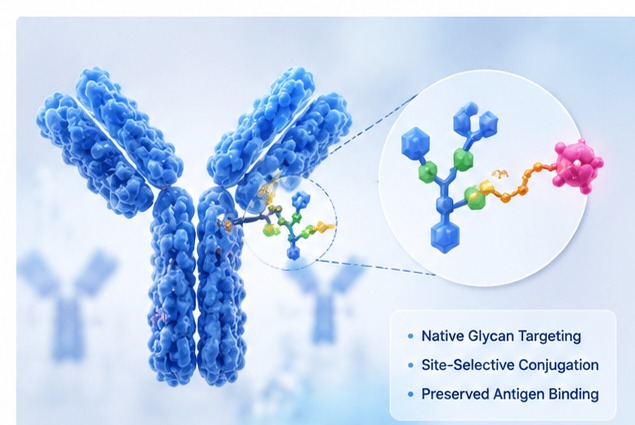
Technical illustration of glycan-directed bioconjugation services, highlighting the relationship between site selection, conjugation chemistry, and functional payload attachment.
Key Challenges in Glycan-Directed Bioconjugation Projects
Managing Glycan Heterogeneity
Antibodies and glycoproteins can contain multiple glycoforms and glycan sites. The starting glycan profile and the effect of processing must be considered when defining the conjugation strategy.
Installing a Suitable Reactive Handle
Oxidation, enzymatic remodeling, and glycan installation can generate different handles and product distributions. The selected route must match substrate compatibility and the final coupling chemistry.
Maintaining Protein Integrity
Glycan processing should preserve the underlying protein structure and function. pH, temperature, enzyme exposure, oxidation conditions, and buffer composition require appropriate control.
Confirming Glycan Modification
Evidence may require intact-mass, glycan or glycopeptide analysis, chromatography, and functional assessment. A change in conjugate mass alone may not fully establish the intended glycan modification.
Our Glycan-Directed Bioconjugation Services
We provide custom development from route selection and reaction planning through conjugation, purification, and analytical characterization. Project scope can be configured around customer-supplied biomolecules, functionalized payloads, engineered constructs, or an existing method requiring optimization.
 Glycan Oxidation and Carbonyl Coupling
Capabilities include:
- Oxidize compatible carbohydrate structures to generate aldehyde-containing groups for subsequent coupling.
- Select hydrazide, aminooxy, or related chemistry when compatible with the substrate and payload.
- Control oxidation and coupling conditions to balance conversion and biomolecule integrity.
Typical applications:
Carbohydrate-directed labeling and selected glycoprotein conjugates.
 Enzymatic Glycan Remodeling
Capabilities include:
- Use glycosidases or glycosyltransferase-based approaches to alter accessible glycan structures.
- Develop a remodeling sequence around substrate glycoform and enzyme compatibility.
- Characterize the resulting glycan state before or after payload attachment.
Typical applications:
Fc glycan remodeling and antibody conjugate development.
 Clickable Glycan Installation
Capabilities include:
- Install functional sugar structures or handles that can participate in subsequent bioorthogonal coupling.
- Select the glycan-processing route around protein format and intended payload.
- Use modular coupling when direct glycan chemistry is not optimal for the final payload.
Typical applications:
Bioorthogonal antibody labeling and multifunctional glycoconjugates.
 Glycan-Directed Antibody Conjugation
Capabilities include:
- Combine glycan processing with selective linker-payload attachment in compatible antibody formats.
- Consider Fc glycan accessibility, glycoform distribution, and desired loading.
- Characterize modification and product heterogeneity using orthogonal methods.
Typical applications:
Antibody probes, antibody–oligonucleotide constructs, and selected ADC research.
Key Design Parameters for Glycan-Directed Bioconjugation
Site-specific conjugation performance depends on the relationship between the biomolecule, accessible attachment site, reaction chemistry, linker and payload, loading target, and downstream analytical requirements. The table below summarizes the variables that most often influence development decisions.
| Design Parameter | Common Options | Development Considerations | Impact on Conjugate Performance | Why It Matters to Customers |
| Glycan Architecture | Fc-associated glycans, N-glycans, O-glycans, remodeled glycans | Site distribution, glycoform composition, and accessibility influence route selection. | Determines available carbohydrate structures and potential product distribution. | Helps define whether glycan direction is technically suitable. |
| Glycan Processing | Oxidation, enzymatic trimming, remodeling, glycan installation | Processing conditions can alter glycan composition and reactive-handle availability. | Controls the number and type of conjugation handles. | Links glycan engineering with downstream coupling. |
| Coupling Handle | Aldehyde, aminooxy-compatible handle, azide, alkyne, or other compatible group | Handle chemistry must be compatible with both glycan processing and payload. | Influences selectivity and linkage formation. | Allows modular route design. |
| Payload and Linker | Fluorophore, oligonucleotide, small molecule, linker-payload, affinity reagent | Payload size, charge, and chemistry affect coupling and purification. | Can affect accessibility, stability, and product distribution. | Connects glycan chemistry to final conjugate behavior. |
| Protein Integrity | Buffer, pH, temperature, enzyme exposure, oxidation strength | Conditions should limit unwanted protein modification or structural damage. | Affects conjugate integrity and function. | Important when carbohydrate processing is performed on intact proteins. |
| Glycan and Product Analytics | LC-MS, glycan/glycopeptide analysis, HPLC, SEC, functional assays | Orthogonal methods may be needed to distinguish glycan modification from nonspecific protein changes. | Establishes glycan state, conjugation, purity, and product behavior. | Provides evidence for route selection and reproducibility. |
Glycan-Directed Bioconjugation Strategies & Process Development Considerations
Method selection should be driven by biomolecule architecture, site accessibility, reactive-group compatibility, payload properties, desired loading, and the analytical evidence needed to verify the final construct. Different routes can be compared when a single chemistry does not adequately balance selectivity, stability, and product quality.
| Conjugation Strategy | Technical Approach | Common Applications | Development Advantages |
| Glycan Oxidation and Carbonyl Coupling | Compatible carbohydrate groups are oxidized to aldehydes and coupled with suitable carbonyl-reactive partners. | Glycoprotein labeling and selected antibody conjugates | Directly connects carbohydrate processing with selective coupling. |
| Enzymatic Glycan Remodeling | Enzymes trim or remodel glycans before installation or exposure of a desired reactive structure. | Antibody and glycoprotein site-selective conjugation | Provides chemoenzymatic control over the carbohydrate region. |
| Glycan-Handle Installation | A functional sugar or bioorthogonal handle is introduced for subsequent coupling. | Modular antibody labeling and glycoconjugate development | Separates glycan engineering from final payload attachment. |
| Bioorthogonal Payload Coupling | An installed azide, alkyne, or other compatible handle is coupled to the payload. | Multifunctional glycoprotein and antibody conjugates | Enables modular payload selection after glycan functionalization. |
| Glycan-Directed Antibody Conjugation | Glycan processing and payload coupling are integrated into a defined antibody conjugation workflow. | Antibody probes and selected ADC research | Can place modification in carbohydrate regions while allowing analytical assessment of glycan heterogeneity. |
Analytical Characterization & Quality Control Framework
Analytical characterization is used to establish whether the intended modification occurred and whether the resulting conjugate has the purity, loading, structural integrity, and functional properties needed for the research objective. Orthogonal methods are selected according to construct and development stage.
| Analytical Category | Methodology | Purpose in Development | Data Delivered |
| Glycan Profile | LC-MS, glycan profiling, glycopeptide analysis, chromatography | Characterize the starting and processed glycan state. | Glycan composition or comparative profile. |
| Handle Installation | LC-MS, labeling assays, chromatography, suitable chemical analysis | Confirm generation of the intended reactive handle. | Handle-installation or conversion data. |
| Conjugation / Loading | LC-MS, HPLC, UV-Vis, or suitable quantitative methods | Assess payload attachment and loading. | Conjugation and loading summary. |
| Purity and Aggregation | SEC-HPLC, HPLC, electrophoresis | Assess product distribution and aggregation after processing and coupling. | Purity and aggregation observations. |
| Protein Integrity and Function | Intact mass, spectroscopy, binding or application-specific assays | Determine whether processing and conjugation preserve the required protein properties. | Structural and functional comparison. |
Workflow for Custom Glycan-Directed Bioconjugation Services
 Project workflow: strategy selection, site-specific conjugation, purification, analytical characterization, and delivery of the resulting research conjugate and data package.
Glycan and Protein Feasibility Review
Define protein format, glycan type, starting glycoform information, payload, and intended application.
Glycan Processing Strategy
Select oxidation, enzymatic remodeling, glycan installation, or another compatible route to create the desired conjugation handle.
Selective Coupling and Purification
Perform the payload coupling and remove unreacted components and unsuitable product species.
Glycan, Structural, and Functional Characterization
Assess glycan modification, conjugation, loading, purity, integrity, and relevant function.
Conjugate Delivery and Documentation
Provide the research conjugate with analytical results and relevant process information.
Why Choose Our Glycan-Directed Bioconjugation Platform
Glycan-Aware Route Design
Glycan architecture and heterogeneity are considered before selecting oxidation, enzymatic remodeling, or handle installation.

Chemoenzymatic Integration
Glycan processing and final coupling are developed as connected steps rather than isolated reactions.
Orthogonal Analytical Support
Glycan state, conjugation, purity, and protein integrity are assessed with methods matched to the construct.
Flexible Payload Integration
Fluorophores, oligonucleotides, linkers, small molecules, and other compatible payloads can be incorporated according to project chemistry.
Common Research Applications of Glycan-Directed Bioconjugation
Glycan-Directed Antibody Conjugates
- Use accessible antibody glycan structures as conjugation regions in compatible formats.
- Combine glycan processing with selective payload coupling.
- Characterize glycan modification, loading, and product distribution.
Fluorescent Glycoprotein Labeling
- Attach fluorescent labels through carbohydrate-directed chemistry.
- Consider glycan accessibility and protein integrity during route development.
- Prepare characterized glycoprotein probes for research assays.
Antibody–Oligonucleotide Conjugates
- Install glycan-compatible handles for subsequent oligonucleotide coupling.
- Select linkers around oligonucleotide size and charge.
- Characterize conjugation and product integrity.
Glycoprotein Probe Development
- Develop carbohydrate-directed attachment strategies for affinity or functional probes.
- Compare glycan processing and coupling conditions.
- Support analytical and application-relevant evaluation of candidate conjugates.
Discuss Your Glycan-Directed Bioconjugation Project
Whether your project involves glycan-directed antibody conjugation, fluorescent glycoprotein labeling, or another carbohydrate-focused construct, we support route development from glycan processing through coupling and characterization.
Share your glycoprotein format, glycan information, payload or linker, desired modification level, and application with our scientific team. Contact our scientific team to discuss your glycan-directed bioconjugation requirements.
Frequently Asked Questions (FAQ)
What is glycan-directed bioconjugation?
It is a conjugation strategy that modifies carbohydrate structures on glycoproteins or antibodies to provide a defined or regionally restricted attachment site.
Why are antibody glycans used for conjugation?
Fc glycans are positioned away from the Fab antigen-binding regions in IgG antibodies, making them attractive sites when modification away from the binding interface is desired.
What methods are used for glycan-directed conjugation?
Approaches include mild oxidation to create aldehydes, enzymatic trimming and remodeling, functionalized sugar installation, and downstream click or carbonyl-selective coupling.
Does glycan-directed conjugation require antibody engineering?
Not necessarily. Native Fc glycans can be modified chemically or enzymatically, although the exact route depends on the antibody glycoform and project objectives.
How is glycan modification characterized?
Depending on the project, characterization can include intact mass, glycan or glycopeptide analysis, chromatography, SEC, and functional or binding assessment.