Cholesterol Biotinylation Services
Cholesteryl-PEG-Biotin and Direct Biotin-CholesterolBiotin-Presenting Bilayers for Capture and Targeting
Biotinylated cholesterol provides a way to place biotin on lipid assemblies, liposomes, and artificial bilayers through a natural sterol anchor. Depending on the design, the biotin sits directly on the sterol scaffold or is held away from the membrane by a PEG spacer, so it remains accessible to streptavidin rather than buried in the bilayer. We synthesize both formats with defined structure and characterize the resulting material before it is used for capture, targeting, or membrane-modeling studies.
Projects can start from a derivative design, a specific PEG length, or an existing liposome and bilayer system that needs biotin presented on its surface. Where the work involves lipid-based particles, we coordinate with biotinylated lipids and liposome conjugation programs so the biotin cholesterol fits a broader formulation and targeting plan.
What Problems Can Biotinylated Cholesterol Services Solve?
Cholesterol is a powerful membrane anchor but a difficult molecule to functionalize well. If the biotin is attached too close to the sterol, it can be hidden by the bilayer; if the PEG spacer is not controlled, batch behavior drifts. Biotinylated cholesterol solves these problems by giving research teams a defined sterol conjugate whose insertion depth and biotin presentation are designed rather than left to chance.
A practical approach treats derivative structure, PEG length, molar ratio in the membrane, and insertion route as one system. That matters when the same biotin-presenting bilayer must support streptavidin bridging, ligand display, or capture across repeated preparations without losing membrane integrity or becoming inconsistent between batches.
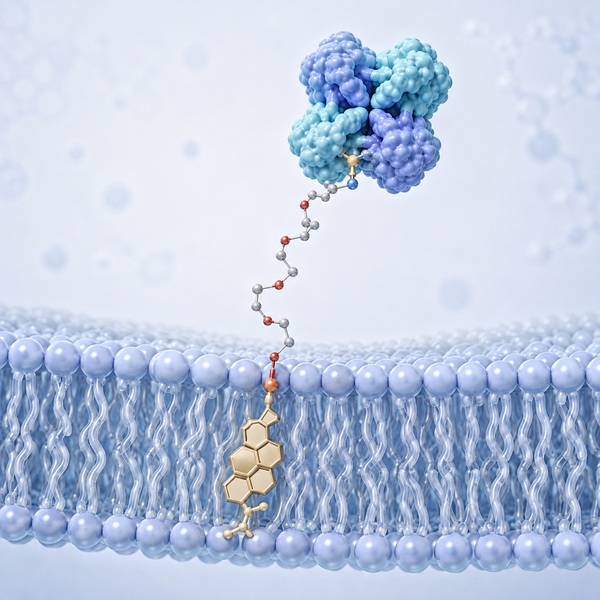 Schematic of cholesteryl-PEG-biotin inserted in a lipid bilayer, with biotin held above the membrane surface for streptavidin access.
Key Challenges Research Teams Face in Biotinylated Cholesterol Services
Sterol Hydrophobicity and Solubility
Cholesterol and its conjugates are poorly soluble in aqueous buffers, which complicates formulation and handling. We prepare and supply biotinylated cholesterol in forms and conditions that are practical to dispense and incorporate without precipitation.
Controlling Membrane Insertion Depth
The sterol anchor embeds in the bilayer while the biotin must remain exposed. Insertion depth and spacer length together decide whether streptavidin can actually reach the biotin, so we design and verify the presentation geometry.
Preserving Bilayer Integrity
Adding any sterol derivative can change membrane packing, rigidity, and stability. We test incorporation behavior and provide formulation guidance so biotin presentation does not come at the cost of vesicle integrity.
Batch-to-Batch PEG Length Variation
PEG spacers can vary in length and polydispersity, which shifts biotin presentation between batches. We specify PEG length and verify it analytically so the conjugate behaves consistently across preparations.
Our Biotinylated Cholesterol Services
We provide custom biotinylated cholesterol built around the membrane system you use, with derivative structure, PEG length, and insertion support defined for the study goal.
 Cholesteryl-PEG-Biotin Synthesis and Supply
Capabilities include:
- Synthesis of cholesteryl-PEG(n)-biotin with defined PEG length
- PEG spacer options that hold biotin away from the bilayer surface
- HPLC purity assessment and structural confirmation by NMR and mass spectrometry
- Biotin content verification by HABA-based quantitation
- Supply in forms suitable for co-formulation or post-insertion use
Typical applications:
Membrane anchoring with outward biotin presentation for liposome targeting, bilayer capture, and streptavidin-bridged assembly.
 Direct Biotin-Cholesterol Preparation
Capabilities include:
- Biotin coupled to the sterol scaffold without a PEG spacer
- Compact probes for studies where a short linkage is preferred
- Structural variants matched to membrane and raft research
- Purity, identity, and biotin content documentation
Typical applications:
Compact membrane probes, lipid raft studies, and biotin-presenting artificial bilayers where a close sterol-biotin geometry is acceptable.
 Biotinylated Lipid and Sterol Conjugate Design
Capabilities include:
- Design of mixed biotin-lipid and biotin-sterol systems for specialized membranes
- Evaluation of PEG length, linkage chemistry, and biotin position
- Coordination with lipid conjugation and PEG lipid synthesis workflows
- Structural and functional characterization of the final conjugate
Typical applications:
Nanodiscs, mixed bilayers, and model membranes that need defined biotin presentation with controlled spacer geometry.
 Membrane and Liposome Insertion Support
Capabilities include:
- Guidance on co-formulation versus post-insertion into preformed vesicles
- Optimization of molar ratio for target biotin surface density
- Assessment of membrane integrity after insertion
- Coordination with cholesterol conjugation programs
- Analytical support including size, zeta, and biotin accessibility checks
Typical applications:
Biotin-presenting liposomes, membrane protein and lipid raft studies, and model bilayer systems for biophysics.
Biotinylated Cholesterol Product Options and Selection
The right derivative depends on how far the biotin needs to sit from the membrane and how the conjugate will be introduced. The table below summarizes the main product forms we build and the considerations that guide each choice.
| Product Form | Structure | Typical Use | Development Considerations |
| Cholesteryl-PEG-biotin | Cholesterol anchor plus PEG spacer plus biotin | Outward biotin presentation on liposomes and bilayers | PEG length sets how far biotin sits from the membrane surface |
| Direct biotin-cholesterol | Biotin coupled directly to the sterol scaffold | Compact membrane and raft probes | Short linkage keeps the probe small but may reduce biotin access |
| Biotin-cholesterol with extended or cleavable linkage | Sterol with a defined extended linker | Controlled capture and release studies | Linker stability must match the experimental window |
| Custom sterol-biotin variants | Modified sterol backbone with biotin | Specialized bilayer and targeting designs | Choice depends on insertion behavior and downstream assay needs |
Membrane Co-Formulation Planning for Biotinylated Cholesterol
When biotinylated cholesterol is co-formulated into liposomes or bilayers, the lipid recipe decides membrane behavior and how much biotin is displayed. The planning ranges below are typical starting points and are adjusted to the specific study.
| Lipid Component | Role in the Bilayer | Typical Molar Range |
| Phospholipid (DOPC, DSPC, POPC) | Main bilayer scaffold | 50-70% |
| Cholesterol | Membrane rigidity and packing | 20-40% |
| Biotinylated cholesterol or biotin-lipid | Biotin presentation | 0.5-5% |
| PEG lipid (optional) | Shielding and stabilization | 0-5% |
| Fluorescent lipid (optional) | Tracking and imaging | 0.1-1% |
Analytical Verification and Quality Control for Biotinylated Cholesterol
For biotinylated cholesterol, analytical quality means confirming the intended structure, the PEG spacer, the biotin content, and the ability to insert into membranes. The verification set below is typical of our release data.
| Verification Item | Method | What It Confirms |
| Structural identity | NMR and mass spectrometry | The correct cholesterol-PEG-biotin structure |
| Chemical purity | HPLC | No significant side products or residual starting material |
| Biotin content | HABA assay | Biotin loading consistent with the design |
| PEG length and distribution | Mass spectrometry or size analysis | Spacer length matches the specification |
| Membrane incorporation | DLS, zeta, or bilayer assay | The conjugate inserts into target membranes |
| Batch consistency | Comparative analytical data | Reproducible behavior across lots |
Workflow for Custom Biotinylated Cholesterol Services


Requirement and Feasibility Review
We clarify the membrane system, whether the biotin should be PEG-spaced or direct, the target biotin density, and the downstream use. This decides derivative design and insertion route before synthesis begins.

Derivative Design
PEG length, linkage chemistry, biotin position, and sterol variant are defined against the application. The design is documented so the conjugate can be repeated and compared.

Synthesis and Purification
The biotinylated cholesterol is synthesized and purified with structural identity and chemical purity confirmed by the appropriate analytical methods.

Membrane Insertion or Co-Formulation
Depending on the project, the derivative is co-formulated into lipids or inserted into preformed liposomes and bilayers. Conditions are optimized for biotin accessibility and membrane integrity.

Analytical Characterization
Purity, identity, biotin content, and membrane incorporation are measured. Where relevant, biotin accessibility to streptavidin is assessed.

Delivery of Material and Data
Final output includes the biotinylated cholesterol, formulation or insertion guidance, and an analytical summary supporting use in the intended study.
Why Choose Our Biotinylated Cholesterol Services Platform
PEG Length Control for Real Biotin Access
We specify and verify PEG length so biotin is held above the membrane rather than buried in it. This distinguishes a presentation-designed conjugate from a sterol that merely carries a biotin label.

Synthesis and Membrane Handling in One Workflow
Sterol chemistry and liposome or bilayer handling are coordinated in a single program, so the derivative and its insertion are optimized together instead of being developed as separate steps.
Verified Structure and Biotin Content
Purity, identity, and biotin loading are confirmed analytically, which supports reproducibility and makes it easier to interpret downstream capture and targeting results.
Formulation Guidance Beyond the Material
We provide molar ratio planning, insertion route advice, and membrane integrity checks so the conjugate performs in the actual lipid system rather than only as a free compound.
Common Research Applications of Biotinylated Cholesterol Services
Membrane Protein and Lipid Raft Studies
- Biotin-presenting bilayers for raft and membrane-domain research
- Sterol-anchored probes for lateral organization studies
- Defined biotin density to control capture and labeling behavior
Targeted Liposomes via Streptavidin Bridging
- Biotinylated cholesterol as a modular anchor for ligand display
- Streptavidin-mediated bridging to biotinylated antibodies or ligands
- Integration with biotin-streptavidin conjugation designs
Biotin-Presenting Artificial Bilayers
- Model membranes with controlled biotin surface density
- Solid-supported or free bilayer formats for binding studies
- PEG-spaced biotin for reliable streptavidin access
Cell Surface and Delivery Tracking
- Sterol-anchored biotin for cell-surface labeling studies
- Combined biotin and fluorescent tags for imaging
- Support for drug delivery and membrane-tracking research
Discuss Your Biotinylated Cholesterol Services Project
Whether you need a defined cholesteryl-PEG-biotin for liposome targeting, a compact biotin-cholesterol for raft studies, or help designing a biotin-presenting bilayer system, we provide support from derivative design through synthesis, insertion, and characterization.
Our team works with customer-defined lipid systems and application goals to deliver biotinylated cholesterol and data packages that are easier to evaluate and integrate into downstream research. Contact our scientific team to discuss your biotinylated cholesterol requirements and request a project-specific proposal.
Frequently Asked Questions (FAQ)
What is biotinylated cholesterol?
It is cholesterol with a biotin group attached, either directly at the sterol hydroxyl or through a PEG spacer as cholesteryl-PEG-biotin. The sterol anchor embeds in membranes while biotin provides a streptavidin-compatible handle for capture, targeting, or imaging.
How does cholesteryl-PEG-biotin work?
The cholesterol end inserts into the lipid bilayer, the PEG spacer lifts the biotin above the membrane surface, and streptavidin or avidin binds that biotin. The PEG length controls how far the biotin sits from the membrane and how accessible it is.
How do you insert it into liposomes?
We typically post-insert preformed biotinylated cholesterol micelles into existing liposomes, or co-formulate it with the lipid film. Post-insertion is useful when you want to keep cargo encapsulated during formulation.
Does biotinylated cholesterol disrupt the membrane?
At controlled molar ratios it is generally well tolerated, but too much sterol can change packing, curvature, or leakage. We optimize the cholesterol-to-phospholipid ratio and verify stability after insertion.
How is biotin content measured?
We use a HABA displacement or streptavidin-binding assay to estimate biotin per liposome or per molecule, supported by purity and identity analysis of the derivative.
Where is it used in targeted delivery?
Biotin on the liposome outer leaflet can be bridged through streptavidin to a biotinylated antibody or ligand, giving a modular targeting layer that can be swapped without reformulating the liposome.