RNA Biotinylation Services
Enzymatic and Chemical RNA BiotinylationUniform Incorporation with Structural PreservationCapture-Ready Probes for Pull-Down and Detection
Biotin labeled RNA converts a plain transcript into an affinity-enabled reagent that can be captured, enriched, immobilized, or detected through the biotin-streptavidin interaction. We build these probes by enzymatic incorporation of biotin-UTP during in vitro transcription or by chemical labeling at defined terminal positions, then purify and qualify them so the final material performs in the assay it was made for rather than only in the synthesis tube.
Projects can start from a customer-supplied RNA or template, a literature sequence that needs reformatting, or an existing transcript that requires better capture behavior. Where the study needs a coordinated panel, we align the work with biotin labeled nucleic acids and nucleic acid labeling programs, and can extend into oligonucleotide bioconjugation when primers, aptamers, or mixed constructs are part of the design.
What Problems Can Biotin Labeled RNA Services Solve?
Many RNA experiments fail not because the sequence is wrong but because the biotin is introduced in a way that changes folding, buries the label, or leaves incorporation uneven along the transcript. Biotin labeled RNA solves this by converting RNA into a selectively capturable probe, but only when label position, density, RNA integrity, and purity are controlled as one system rather than as separate steps.
A practical labeling strategy therefore considers transcript length and structure, the number and spacing of biotins, the purification route, and the downstream matrix together. That is especially important when the same probe must retain hybridization behavior, support streptavidin capture, tolerate wash steps, and remain consistent across screening, optimization, and repeat builds.
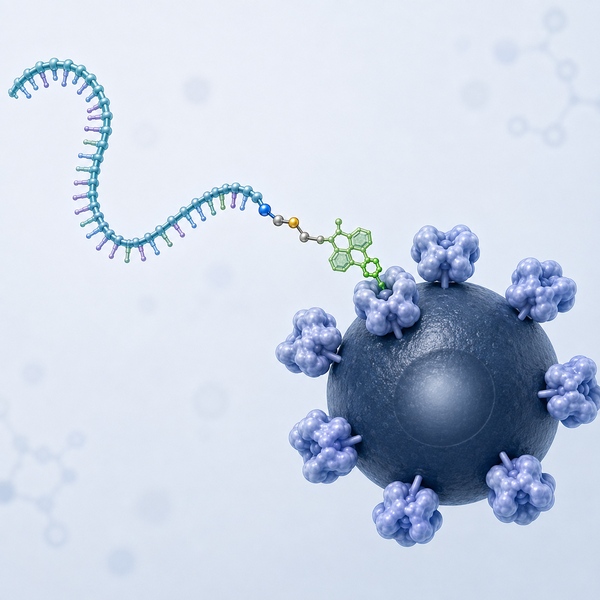 Schematic of biotin-tagged RNA transcripts immobilized on a streptavidin surface, illustrating capture-ready probe design for enrichment and hybridization studies.
Key Challenges Research Teams Face in Biotin Labeled RNA Services
RNase Exposure During Labeling and Purification
RNA is intrinsically sensitive to ribonucleases, and every handling step adds risk. We run labeling and cleanup under RNase-controlled conditions and verify integrity after the process so the delivered probe is not already degraded before it reaches the pull-down or hybridization step.
Uneven Biotin Incorporation Across Batches
The number of biotins per transcript changes capture efficiency and can shift assay behavior if it drifts between builds. We define an incorporation window for each project and confirm biotin density rather than assuming the transcription mix produced the intended ratio.
Labeling That Disturbs RNA Structure or Hybridization
Internal or terminal biotin can interfere with folding and duplex formation when placed without regard to sequence context. We review the sequence and choose positions and spacers that preserve the regions the downstream assay depends on.
Weak Capture in Complex Matrices
A probe that binds streptavidin in buffer can still underperform in cell lysate, serum, or hybridization buffer. We include capture-relevant checks and, where needed, adjust biotin density or spacing to improve performance in the actual working matrix.
Our Biotin Labeled RNA Services
We provide custom biotin-labeled RNA built around the format you actually use, from long in vitro transcripts to short chemically synthesized RNA. Each route is chosen for the RNA type, the intended assay, and the biotin geometry the study requires.
 In Vitro Transcription RNA Biotinylation
Capabilities include:
- T7, T3, or SP6 transcription systems matched to template design
- Incorporation of biotin-11-UTP or biotin-16-UTP at a defined ratio
- Tuning of biotin density for uniform labeling across the transcript
- Template review and optimization for yield and labeling consistency
- RNase-free synthesis and purification throughout the workflow
- Optional co-labeling with modified nucleotides where the study needs them
Typical applications:
Pull-down baits, uniformly labeled hybridization probes, and long transcript capture reagents for RNA-protein interaction studies.
 Chemical Terminal RNA Biotin Labeling
Capabilities include:
- 3 prime periodate oxidation followed by biotin hydrazide coupling
- 5 prime amino group labeling with NHS-ester biotin reagents
- Spacer and linker options to keep biotin accessible on the surface
- Gentle conditions suited to short or structurally folded RNA
- Dual-end designs when both termini must carry a functional group
Typical applications:
End-labeled probes for FISH and blotting, structured RNA labeling, and constructs where internal modification is not desirable.
 Biotinylated Oligonucleotide and Primer Production
Capabilities include:
- DNA and RNA oligos with 5 prime, 3 prime, or internal biotin
- Biotinylated primer design for capture during amplification workflows
- PAGE or HPLC purification with documented purity
- Scale from single probes to panel-sized oligo sets
- Coordination with biotin labeled primer and biotinylated dUTP workflows
Typical applications:
PCR capture, sequencing enrichment, hybridization probes, and affinity reagents for nucleic acid analysis.
 Biotin Labeled miRNA and Small RNA Services
Capabilities include:
- Biotinylation of miRNA mimics, inhibitors, and small RNA constructs
- Low-input labeling strategies for scarce small RNA material
- Enrichment workflows designed around short, structured sequences
- Coordination with biotinylated miRNA services
- QC adapted to the limited material available in small RNA studies
Typical applications:
miRNA pull-down, small RNA enrichment, expression profiling support, and functional studies of regulatory RNA.
Biotin Labeling Route Selection for Biotin Labeled RNA
There is no single route that fits every RNA. The table below compares the main labeling approaches by RNA format, typical biotin position, and the development considerations that decide which route is practical for a given project.
| Labeling Route | RNA Format | Typical Biotin Position | Best Fits | Development Considerations |
| Enzymatic transcription incorporation | mRNA, lncRNA, long in vitro transcripts | Internal, distributed via UTP substitution | Pull-down baits and uniformly labeled probes | Incorporation ratio must balance yield with downstream capture performance |
| 3 prime periodate-hydrazide coupling | Short or structured RNA | 3 prime terminus | End-labeled probes, limited material | Requires controlled oxidation of the 3 prime ribose |
| 5 prime amino NHS-ester labeling | Oligo-sized or chemically synthesized RNA | 5 prime terminus | Hybridization probes and dual-end designs | Needs a 5 prime amino handle and mild coupling buffer |
| Primer-embedded biotin (PCR or IVT) | Amplicons, primers, small RNA constructs | Defined by primer design | Capture during amplification workflows | Biotin must survive PCR cycling and downstream purification |
Typical Deliverable Specifications for Biotin Labeled RNA
Deliverables are defined per project so the material can be evaluated, repeated, and transferred to a downstream assay without re-negotiating what was made. Typical specification categories are summarized below.
| Specification | Typical Range / Option | Notes |
| RNA format | Single-stranded, duplex, capped, or modified transcript | Depends on construct purpose and downstream use |
| Biotin density | Low, moderate, or high per transcript or oligo | Tuned to capture efficiency and structural tolerance |
| Label position | 5 prime, 3 prime, or internal | Matched to the geometry required by the assay |
| Purity | Gel or capillary electrophoresis verified | RNase-free handling maintained through purification |
| Biotin incorporation | HABA or streptavidin-binding check | Confirmed on the final material, not assumed from the mix |
| Amount | Microgram to milligram scale | Based on project scope and downstream consumption |
| QC package | Integrity, incorporation, concentration, capture test | Supports method transfer and repeat builds |
Quality Checks and Functional Verification for Biotin Labeled RNA
Analytical quality for biotin-labeled RNA is not limited to showing that biotin is present. It must also show that the RNA is intact, the label is accessible, and the probe can actually be captured. Our standard QC set is summarized below.
| QC Check | Method | What It Confirms |
| RNA integrity | Denaturing gel or capillary electrophoresis | No significant degradation during labeling and cleanup |
| Biotin incorporation | HABA assay or streptavidin bead binding | Biotin is present and accessible on the final material |
| Concentration | A260 measurement with appropriate correction | Reliable input amount for downstream experiments |
| Functional capture | Streptavidin pull-down of the labeled probe | The probe behaves as a capture reagent in practice |
| RNase-free status | Incubation and integrity recheck | Material survives realistic handling conditions |
| Documentation | Synthesis and QC summary report | Supports reproducibility and method transfer |
Workflow for Custom Biotin Labeled RNA Services


Application Definition and Feasibility Review
We clarify the RNA type, target or partner of interest, assay format, working matrix, and whether you already have a sequence, template, or transcript. This prevents route selection and biotin geometry from being optimized in the wrong direction.

Labeling Route Selection
Based on the RNA format and downstream use, we select enzymatic incorporation, chemical terminal labeling, or primer-based biotinylation. Position, spacer, and density are defined against the assay requirement.

Synthesis and Optimization
Transcription or chemical synthesis is run under RNase-controlled conditions with the biotin reagent and density matched to the project. Small optimization rounds are used when yield, integrity, or incorporation needs adjustment.

RNase-Free Purification
The labeled RNA is purified away from unincorporated biotin and reaction components using methods that preserve integrity. The chosen cleanup depends on RNA length, format, and the impurity profile of the build.

Analytical and Functional Characterization
Integrity, concentration, biotin incorporation, and capture behavior are measured on the final material. Functional pull-down is included where it supports the project decision.

Delivery of Probe and Data Package
Final output includes the biotin-labeled RNA, storage recommendations, and an analytical summary so the probe can be evaluated, repeated, or integrated into the downstream assay.
Why Choose Our Biotin Labeled RNA Services Platform
Two Complementary Labeling Routes
Enzymatic incorporation gives uniform internal labeling for long transcripts, while chemical terminal labeling suits short or structured RNA. Having both means the route is chosen for the molecule and assay, not limited by a single capability.

Integrity and RNase-Free Handling Built In
Labeling, purification, and QC are designed around RNA stability from the start. Integrity is verified at the end, so the probe arrives intact rather than degraded by the process that was supposed to prepare it.
Incorporation Measured, Not Assumed
Biotin density is confirmed on the final material with HABA or streptavidin-binding checks. This matters when capture efficiency, reproducibility, and method transfer depend on how much biotin the probe actually carries.
Capture-Relevant Qualification
Our QC connects analytical data to the functional question of whether the probe can be captured and used in the intended workflow. That helps teams decide which build to advance instead of only confirming that labeling occurred.
Common Research Applications of Biotin Labeled RNA Services
RNA Pull-Down of RNA-Binding Proteins
- Biotinylated RNA baits immobilized on streptavidin supports
- Enrichment of RNA-binding proteins and associated complexes
- Support for immunoprecipitation and co-immunoprecipitation workflows
FISH and Hybridization Probes
- Biotin-labeled probes for in situ hybridization detection
- Structured RNA labeling that preserves target recognition
- Probes compatible with enzymatic or fluorescence-based readout
Microarray and Blot Detection
- Biotinylated RNA for array capture and northern blot analysis
- Uniformly labeled transcripts for consistent signal generation
- Dual biotin and reporter designs where needed
Affinity Purification of RNA-Protein Complexes
- Streptavidin-based capture from lysate or complex matrices
- Controlled biotin density for efficient complex recovery
- Integration with streptavidin conjugation strategies
Discuss Your Biotin Labeled RNA Services Project
Whether you are preparing a biotin-labeled RNA bait for pull-down, building FISH or hybridization probes, labeling a scarce miRNA, or troubleshooting weak capture in an existing construct, we provide technically focused support across route selection, synthesis, purification, and functional qualification.
Our team works with customer-supplied sequences, templates, and transcripts to deliver biotin-labeled RNA and data packages that are easier to evaluate, reproduce, and integrate into downstream research. Contact our scientific team to discuss your biotin labeled RNA requirements and request a project-specific proposal.
Frequently Asked Questions (FAQ)
What is biotin labeled RNA?
Biotin labeled RNA is an RNA molecule with one or more biotin groups attached, made by incorporating biotin-UTP during transcription or by chemically tagging a terminal position. The biotin lets the RNA bind streptavidin or avidin surfaces, which is useful for capture, pull-down, and detection while the RNA still carries its sequence and structure.
How do you incorporate biotin into RNA?
The most common route is enzymatic: biotin-11-UTP or biotin-16-UTP replaces UTP during in vitro transcription with T7, T3, or SP6 polymerase. When transcription is not suitable, we label the 3 prime end after periodate oxidation with biotin hydrazide, or label a 5 prime amino group with an NHS-ester biotin reagent.
Does biotinylation change RNA structure or activity?
It can if the tag is placed without spacing, especially on short or structured RNA. We prefer terminal positions and add a PEG or nucleoside spacer when needed, so labeling improves handleability without stripping the RNA of its folding or target behavior.
How is biotin incorporation measured?
We use a streptavidin-binding assay such as HABA displacement or capture on streptavidin beads to estimate how much biotin is present per RNA molecule, supported by mass confirmation of the expected biotin adduct.
Can you label miRNA and other small RNAs?
Yes. miRNA and small RNAs are labeled by terminal or enzymatic routes selected for their length and stability, with low-input handling and mass plus binding QC appropriate to scarce material.
How should biotinylated RNA be stored and handled?
It is stored under RNase-free conditions, typically frozen in a suitable buffer, and handled with certified reagents and surfaces. We provide concentration and storage guidance so the probe keeps integrity after delivery.