What Makes Antibody Conjugation Site-Specific?
Site-specific antibody conjugation means the payload is attached to a defined site or a deliberately restricted set of sites on the antibody. This is different from conventional random lysine labeling, where many accessible amines may react, or partial cysteine reduction, where multiple interchain disulfide-derived thiols may contribute to a product distribution.
In practical bioconjugation, "site-specific" can describe several levels of control. Some methods deliver precise residue-level attachment, such as an engineered cysteine or an enzymatic tag. Others are more accurately described as site-selective, such as Fc glycan modification or N-terminal labeling, because they focus conjugation within a defined antibody region. Both approaches can be valuable when they improve product consistency, analytical clarity, and application performance.
The most important point is that site-specific conjugation should be selected for a reason. It is most valuable when the conjugation site affects drug-to-antibody ratio, degree of labeling, binding retention, aggregation, stability, orientation, or downstream assay reproducibility.
Site-specific conjugation is a design strategyThe chemistry is only one part of the decision. The antibody format, payload, linker, target site, purification method, and analytical package must be planned together.
Site-specific does not mean automatically betterA more controlled conjugation site can reduce heterogeneity, but the final product still depends on payload properties, linker stability, antibody tolerance, and purification quality.
Why Use Site-Specific Antibody Conjugation?
Site-specific conjugation is usually considered when random labeling creates too much variability or when the payload has a strong effect on antibody behavior. This is common in antibody-drug conjugates, antibody-oligonucleotide conjugates, antibody-polymer conjugates, imaging agents, and quantitative diagnostic reagents.
For ADCs, conjugation site can influence DAR distribution, hydrophobicity, aggregation, stability, and analytical comparability. For diagnostic antibodies, the site and labeling ratio can affect signal intensity, background, immobilization orientation, and antigen recognition. For antibody-oligonucleotide conjugates, the size and charge of the oligonucleotide make ratio control and free-oligo removal especially important.
| Project Need | Why Site-Specific Conjugation Helps | Common Application |
|---|
| Controlled DAR or DOL | Defined attachment sites help limit the number and distribution of payloads per antibody. | ADCs, fluorescent antibodies, antibody-oligonucleotide conjugates |
| Reduced product heterogeneity | Fewer possible attachment positions simplify purification and characterization. | Research-stage ADCs, imaging probes, quantitative assay reagents |
| Binding retention | Payloads can be positioned away from antigen-binding regions or known sensitive domains. | Diagnostic antibodies, bispecific formats, antibody fragments |
| Improved analytical interpretation | Defined sites make mass analysis, peptide mapping, and batch comparison more meaningful. | Custom antibody conjugates, developability studies, method optimization |
| Payload-specific risk control | Hydrophobic, bulky, charged, or biologically active payloads can be placed more deliberately. | Drug-linkers, oligonucleotides, PEG, enzymes, nanoparticles |
Engineered Cysteine Antibody Conjugation
Engineered cysteine conjugation introduces one or more designed cysteine residues into the antibody sequence. These cysteines provide defined thiol handles that can react with maleimide, haloacetamide, disulfide-rebridging, or newer thiol-selective linker systems. The approach is widely associated with controlled ADC design because the number and placement of cysteine handles can be engineered into the antibody.
The main advantage is clear: if the engineered cysteine is accessible, stable, and positioned away from sensitive structural or binding regions, it can support a defined conjugation ratio and reduce the product complexity seen in random lysine conjugation. However, engineered cysteine conjugation is not simply "add cysteine and react." The site must be evaluated for solvent accessibility, thiol reactivity, local structure, disulfide integrity, and the effect of payload installation on antibody behavior.
This route is especially useful when the antibody sequence can be modified and expressed as a designed construct. It is less convenient when the customer only has a commercial antibody with no opportunity for engineering.
Best fitADC design, controlled antibody-probe conjugates, defined DAR studies, and antibody engineering projects where sequence modification is acceptable.
Main risksLow thiol accessibility, oxidation, disulfide scrambling, aggregation after payload attachment, or loss of binding if the engineered site is poorly chosen.
Glycan-Based Site-Specific Antibody Conjugation
Most IgG antibodies contain conserved N-glycans in the Fc region. Glycan-based antibody conjugation uses this Fc glycan as a modification region, often through oxidation, enzymatic remodeling, or chemoenzymatic installation of reactive handles. Because the Fc glycan is spatially separated from the antigen-binding Fab regions, glycan-based conjugation is attractive when payload installation should avoid direct interference with antigen recognition.
Glycan-based strategies may use aldehyde generation followed by oxime or hydrazone chemistry, enzymatic transfer of azide- or alkyne-bearing sugars, or endoglycosidase-mediated remodeling followed by bioorthogonal ligation. The key limitation is that glycan heterogeneity and remodeling efficiency must be understood. The starting antibody glycoform profile, enzyme compatibility, reaction completeness, and final product distribution should all be evaluated analytically.
| Glycan Strategy | Technical Basis | Advantages | Considerations |
|---|
| Oxidation-based glycan conjugation | Generates aldehyde groups on glycans for hydrazone or oxime-type ligation. | Uses native glycan region and avoids Fab modification. | Oxidation conditions must be controlled to avoid antibody damage. |
| Chemoenzymatic glycan remodeling | Installs defined sugar derivatives or reactive handles onto Fc glycans. | Can provide more controlled glycan-handle placement. | Requires enzyme compatibility and confirmation of remodeling efficiency. |
| Glycan-click conjugation | Uses installed azide, alkyne, or other bioorthogonal handles for payload ligation. | Combines Fc-region targeting with modular payload attachment. | Click reagent selection, solubility, and cleanup must be optimized. |
Enzyme-Mediated Site-Specific Antibody Conjugation
Enzyme-mediated conjugation uses biological catalysts to recognize specific amino acid motifs, residues, tags, or glycan structures. These methods are attractive because many enzyme reactions can proceed under mild, aqueous, antibody-compatible conditions. They can also offer strong regioselectivity when the correct substrate motif is available.
Common enzymatic approaches include microbial transglutaminase-mediated conjugation, sortase-mediated ligation, glycosyltransferase-based remodeling, and endoglycosidase-based glycan engineering. Enzymatic methods are powerful, but they are not universal. The antibody must present a compatible site, tag, or glycan substrate. Steric accessibility, enzyme removal, reaction completeness, and residual enzyme control may also matter depending on the project stage.
| Enzymatic Method | Recognition Principle | Best Fit | Key Limitation |
|---|
| Transglutaminase-mediated conjugation | Targets suitable glutamine residues or engineered recognition contexts. | Antibody conjugates requiring mild conditions and controlled Fc-region concepts. | Accessibility and substrate context can strongly affect efficiency. |
| Sortase-mediated conjugation | Uses peptide recognition motifs such as LPXTG-type tags and nucleophilic partners. | Terminal labeling of engineered antibodies, fragments, or recombinant formats. | Usually requires sequence engineering and tag design. |
| Glycosyltransferase-based remodeling | Transfers modified sugars or handles to Fc glycan structures. | Glycan-directed antibody conjugation and glycan-click workflows. | Depends on glycan state and enzyme-substrate compatibility. |
| Endoglycosidase-based remodeling | Trims or rebuilds Fc glycans for controlled handle installation. | Fc-glycan-specific ADCs and antibody-probe conjugates. | Requires careful glycan analysis and process control. |
Click Chemistry in Site-Specific Antibody Conjugation
Click chemistry is often used after an antibody has been equipped with a defined reactive handle. In this strategy, the site specificity comes from where the handle is installed, while the click reaction provides modular payload attachment. This is useful for antibody-drug conjugates, antibody-oligonucleotide conjugates, imaging probes, pretargeting systems, and dual-component research constructs.
Common click-enabled routes include SPAAC between azides and strained alkynes, CuAAC between azides and terminal alkynes, and tetrazine ligation with trans-cyclooctene or other strained alkene partners. SPAAC is especially useful when copper-free conditions are preferred for sensitive biomolecule workflows.
The most important design rule is to plan the handle and the click partner together. A good click reaction can still underperform if the handle is buried, the linker is too short, the payload is poorly soluble, or the purification method cannot remove unreacted reagent.
| Click Method | Reactive Partners | Advantages | Common Use Cases |
|---|
| SPAAC | Azide + strained alkyne, such as DBCO or BCN | Copper-free and biomolecule-friendly | Antibody-oligo conjugates, antibody-probe conjugates, glycan-click workflows |
| CuAAC | Azide + terminal alkyne with copper catalyst | Highly established and efficient in compatible systems | Synthetic intermediates, non-sensitive conjugates, handle validation |
| Tetrazine ligation | Tetrazine + strained alkene or strained alkyne | Often fast and useful for low-concentration systems | Advanced bioorthogonal labeling, pretargeting concepts, rapid ligation workflows |
Terminal and Tag-Based Antibody Conjugation
Terminal and tag-based conjugation methods target the antibody N-terminus, C-terminus, or an engineered peptide sequence. These strategies are particularly useful for recombinant antibody formats, antibody fragments, nanobodies, single-chain formats, and engineered full-length antibodies where sequence design is part of the project.
N-terminal modification may exploit the distinct reactivity of terminal amines under controlled conditions or use engineered motifs. C-terminal strategies often rely on engineered tags that are recognized by enzymes or chemical ligation systems. Tag-based designs can also introduce bioorthogonal handles for later click chemistry.
The main advantage is predictable placement. The main limitation is construct dependency. If the antibody cannot be engineered or re-expressed, terminal and tag-based methods may not be feasible.
Best fitRecombinant antibody fragments, nanobodies, Fc-fusion-like formats, assay reagents, and projects where terminal orientation matters.
Main planning questionCan the antibody be engineered, expressed, purified, and characterized with the required terminal tag or reactive motif intact?
Site-Specific Antibody Conjugation Method Comparison
No single method is best for every antibody conjugate. The right choice depends on whether the antibody can be engineered, where the payload should be positioned, what ratio is needed, how sensitive the antibody is, and how the product will be purified and analyzed.
| Method | Engineering Required? | Site Control | Payload Compatibility | Best Fit | Main Limitation |
|---|
| Engineered cysteine | Usually yes | High when the site is well designed | Strong for maleimide and thiol-selective linkers | ADCs and controlled antibody-probe conjugates | Requires construct design and thiol control |
| Fc glycan conjugation | Often no antibody sequence engineering | Regional Fc control | Good for click handles, drugs, probes, and polymers | Antibody conjugates where Fab regions should be avoided | Glycan remodeling and heterogeneity must be managed |
| Enzymatic ligation | Sometimes, depending on enzyme and tag | High if recognition motif is accessible | Good for small molecules, peptides, polymers, and click handles | Defined antibody fragments and engineered antibody formats | Substrate accessibility and enzyme compatibility are critical |
| Click-enabled conjugation | Depends on handle installation route | Defined by handle placement | Excellent modularity across many payload types | Antibody-oligo, ADC, imaging, and dual-component constructs | Requires paired design of handle, linker, click partner, and purification |
| Terminal or tag-based | Usually yes | High for engineered formats | Good for labels, peptides, oligos, and polymers | Fragments, nanobodies, recombinant antibodies, oriented immobilization | Less suitable for fixed commercial antibodies |
How to Choose a Site-Specific Antibody Conjugation Method
Method selection should begin with the antibody and the application, not with the chemistry name. A method that works well for one antibody-payload pair may fail with another if the site is inaccessible, the payload is too hydrophobic, or the analytical method cannot resolve the product.
Choose engineered cysteine when:- The antibody can be engineered and expressed.
- A defined thiol handle is desirable.
- The project needs controlled DAR or defined payload placement.
- Thiol-selective linker chemistry is compatible with the payload.
Choose glycan conjugation when:- The antigen-binding region should be avoided.
- Fc-region modification is acceptable for the application.
- Glycan remodeling or oxidation can be analytically controlled.
- The project benefits from a conserved antibody modification region.
Choose enzymatic conjugation when:- A compatible motif, residue, tag, or glycan substrate is available.
- Mild aqueous conditions are important.
- The enzyme can access the intended site.
- Residual enzyme and reaction byproducts can be removed or controlled.
Choose click-enabled conjugation when:- Modular payload installation is needed.
- An azide, alkyne, tetrazine, TCO, or related handle can be installed at a useful site.
- The payload is an oligonucleotide, dye, drug-linker, polymer, or multifunctional probe.
- The click partner can be purified away cleanly after reaction.
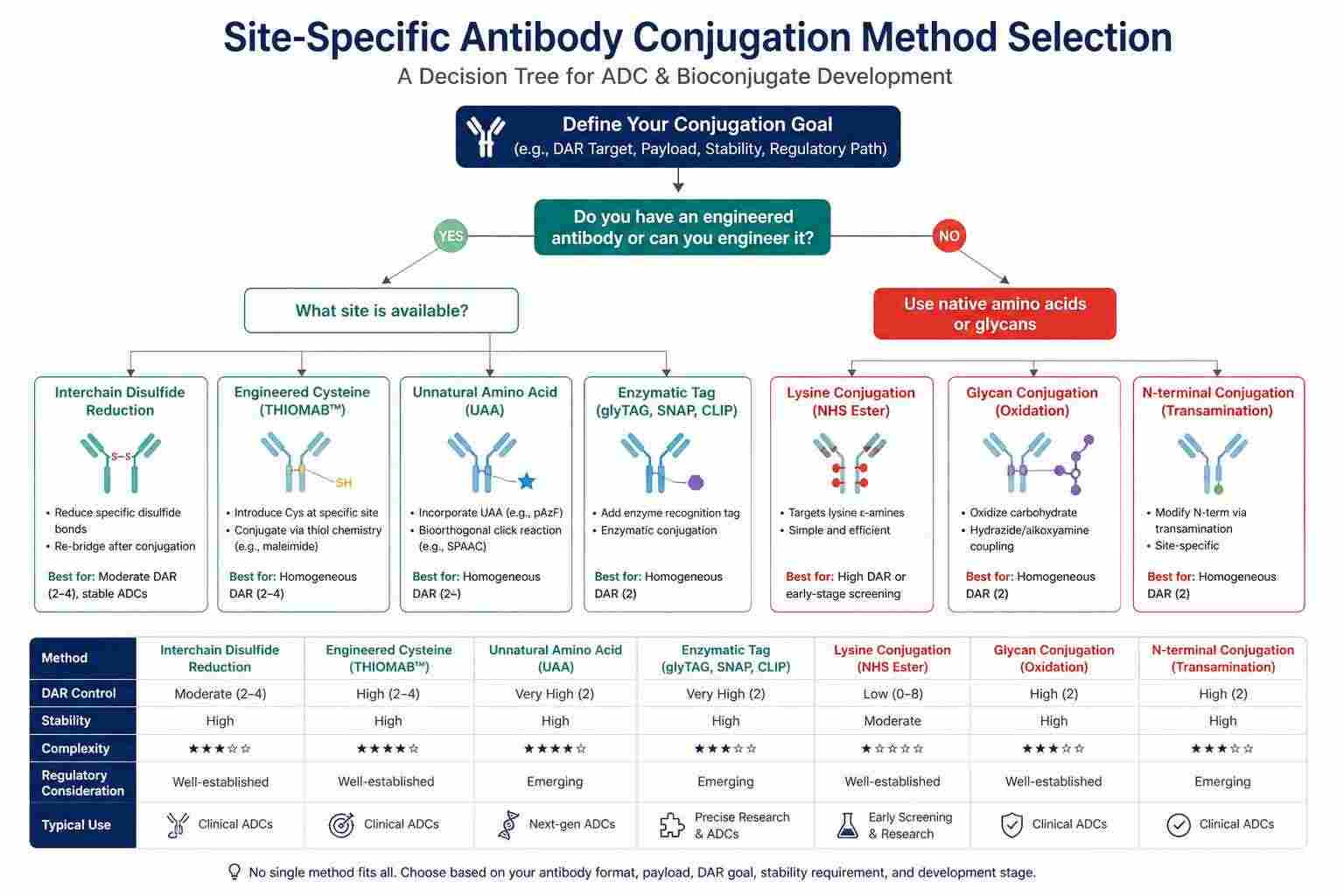 Site-specific antibody conjugation method selection should match antibody engineering feasibility, payload properties, target site, purification strategy, and analytical requirements.
Characterization and QC for Site-Specific Antibody Conjugates
Site-specific conjugation does not remove the need for characterization. In fact, because the value of the method comes from control, analytical confirmation is essential. The QC package should show whether the expected site was modified, whether the intended ratio was achieved, whether unconjugated antibody or free payload remains, and whether the antibody still performs its intended function.
| QC Need | Common Methods | Why It Matters |
|---|
| DAR or DOL measurement | LC-MS, HIC, UV-visible analysis, fluorescence-based methods | Confirms payload ratio and supports batch comparison. |
| Site confirmation | Peptide mapping, reduced mass analysis, intact mass analysis | Shows whether the payload is attached at the intended location. |
| Purity and free payload removal | SEC, HPLC, electrophoresis, affinity cleanup, desalting or buffer exchange | Ensures the final product is not dominated by unreacted antibody or excess reagent. |
| Aggregation assessment | SEC, light scattering, formulation-relevant assays | Important for hydrophobic drug-linkers, high payload ratios, and polymer conjugates. |
| Functional testing | ELISA, antigen binding, flow cytometry, cell-based assay, enzyme activity assay | Confirms that conjugation did not compromise the intended biological or assay function. |
BOC Sciences Support for Site-Specific Antibody Conjugation
BOC Sciences supports custom antibody conjugation projects that require careful matching of antibody format, payload chemistry, conjugation site, linker design, purification method, and analytical characterization. Site-specific methods can be developed or evaluated for ADCs, antibody-oligonucleotide conjugates, fluorescent antibodies, biotinylated antibodies, PEG-conjugated antibodies, antibody-polymer conjugates, and other research-stage antibody conjugates.
Route selectionEvaluation of engineered cysteine, glycan-based, enzymatic, click-enabled, terminal, and tag-based approaches according to antibody and payload requirements.
Payload and linker compatibilitySupport for payload classes including drug-linkers, fluorescent dyes, biotin, oligonucleotides, PEG, polymers, enzymes, and nanoparticle-related constructs.
Conjugation and purification workflowProject-specific reaction design, buffer evaluation, stoichiometry optimization, purification strategy, and cleanup planning for antibody conjugates.
Analytical characterizationFit-for-purpose assessment of conjugation ratio, purity, aggregation, identity, site confirmation, and functional retention based on project needs.
Need Help Selecting a Site-Specific Antibody Conjugation Method?
Share your antibody format, payload structure, desired DAR or degree of labeling, preferred conjugation site if known, available material amount, buffer constraints, and analytical requirements. BOC Sciences can help evaluate whether engineered cysteine, glycan-based, enzymatic, click-enabled, or terminal/tag-based conjugation is the most practical starting point.
- Site-specific antibody conjugation route evaluation
- ADC, antibody-oligonucleotide, fluorescent antibody, and PEG-antibody conjugation
- Click chemistry, maleimide, glycan, and enzyme-mediated workflow support
- Purification and analytical characterization for custom antibody conjugates
Frequently Asked Questions
What are the main site-specific antibody conjugation methods?
Major methods include engineered cysteine conjugation, Fc glycan-based conjugation, enzyme-mediated ligation, click chemistry-enabled conjugation, terminal modification, and tag-based conjugation. Each method has different requirements for antibody engineering, handle installation, payload compatibility, purification, and characterization.
Is engineered cysteine conjugation suitable for ADCs?
Yes, engineered cysteine conjugation is widely used in ADC design because it can provide defined thiol handles and controlled payload placement. However, the engineered site must be evaluated for accessibility, stability, aggregation risk, and compatibility with the selected linker-payload.
What is glycan-based antibody conjugation?
Glycan-based antibody conjugation uses the Fc glycan region as a modification site. It may involve oxidation, enzymatic remodeling, or installation of clickable handles. This strategy is attractive when payload attachment should avoid direct modification of antigen-binding regions.
How is click chemistry used in site-specific antibody conjugation?
Click chemistry is used after a defined handle, such as an azide, alkyne, tetrazine, or TCO group, has been installed on the antibody. The click step then attaches the payload modularly. The overall site specificity depends on where and how the handle is introduced.
Which site-specific antibody conjugation method is best?
There is no universal best method. Engineered cysteine methods are strong when antibody engineering is possible. Glycan-based methods are useful for Fc-region modification. Enzymatic methods are attractive for compatible motifs or glycan substrates. Click-enabled methods are useful when modular payload installation is needed. The best choice depends on antibody format, payload, desired ratio, application, and QC requirements.
What QC methods are needed for site-specific antibody conjugates?
Typical QC methods may include DAR or DOL measurement, LC-MS, peptide mapping, SEC, HPLC, electrophoresis, UV-visible or fluorescence analysis, and functional assays. The final QC package should be matched to the antibody, payload, and intended application.