Why Site-Specific Antibody Conjugation Matters in ADC Development
An antibody-drug conjugate combines a targeting antibody, a linker, and a highly active payload. The position where the linker-payload is attached can influence drug loading, hydrophobicity, aggregation, plasma stability, antigen binding, internalization behavior, purification, and analytical interpretation. Site-specific antibody conjugation is used when this attachment position needs to be controlled rather than left to statistical modification.
In traditional ADC preparation, lysine residues or reduced interchain cysteines are often used as attachment points. These methods can be practical and useful, especially in early research. However, they may generate mixtures with different drug-to-antibody ratios and different attachment locations. Site-specific conjugation narrows this distribution by using defined antibody sites or defined reactive handles.
For ADC development, the value of site-specific conjugation is not simply "higher precision." Its practical value is that it helps researchers compare ADC designs more clearly. When payload number and attachment site are better controlled, differences in biological activity, stability, aggregation, and linker behavior can be interpreted with fewer confounding variables.
What site-specific conjugation helps controlPayload number, attachment position, conjugate distribution, analytical comparability, and structure-property interpretation during ADC optimization.
What it does not guaranteeSite-specific conjugation does not automatically guarantee better potency, stability, pharmacokinetics, or safety. The antibody, linker, payload, site, formulation, and target biology must still be evaluated experimentally.
Random vs Site-Specific ADC Conjugation
Random and site-specific ADC conjugation are not simply "old" and "new" methods. They serve different development needs. Random methods can be useful for speed and early screening, while site-specific methods are often selected when defined DAR, controlled payload placement, or cleaner analytical interpretation is required.
| Feature | Random ADC Conjugation | Site-Specific ADC Conjugation | Development Impact |
|---|
| Attachment sites | Multiple native lysines or reduced cysteines may react. | Payload is directed to engineered, enzymatic, glycan, terminal, or bioorthogonal sites. | Site-specific methods reduce positional complexity. |
| DAR distribution | Often produces a distribution around an average DAR. | Can be designed for a narrower DAR or defined payload number. | Narrower distributions improve comparison across candidates. |
| Speed | Often faster for early feasibility studies. | May require antibody engineering, handle installation, or enzymatic processing. | Random methods can be useful before committing to a defined-site program. |
| Analytical complexity | Broad mixtures can complicate mass analysis and product interpretation. | Defined sites can simplify site confirmation and batch comparison. | Site-specific methods can support more rational optimization. |
| Risk profile | Modification near sensitive regions or high hydrophobic loading may create liabilities. | Payload placement can be selected to avoid known sensitive regions. | Site choice can reduce risk, but must still be tested. |
ADC Design Factors Controlled by Site-Specific Conjugation
Site-specific conjugation should be evaluated as part of the whole ADC design system. The conjugation site interacts with the linker, payload, antibody structure, desired DAR, and purification method. A site that performs well with one linker-payload may not be optimal for another.
| Design Factor | Why It Matters | Site-Specific Conjugation Consideration |
|---|
| DAR target | DAR affects payload exposure, hydrophobicity, potency interpretation, and product consistency. | Defined sites can support target DAR values such as low-load or moderate-load ADC designs. |
| Payload hydrophobicity | Hydrophobic payloads can promote aggregation, nonspecific binding, or difficult purification. | Site placement and linker design should reduce exposed hydrophobic burden where possible. |
| Antigen binding | Payloads near complementarity-determining regions may reduce binding or internalization. | Sites should be selected away from regions required for target recognition. |
| Fc-related behavior | Fc interactions, FcRn binding, and antibody stability can influence ADC behavior. | Fc-region methods should be evaluated for their effect on the intended ADC use case. |
| Linker stability | Local solvent exposure and steric environment may affect linker accessibility and stability. | The same linker may behave differently at different antibody sites. |
| Purification route | Conjugation changes size, charge, hydrophobicity, and chromatographic behavior. | Site-specific ADC design should include a realistic purification and cleanup plan. |
Site and linker-payload must be pairedA conjugation site should be screened or selected in the context of the actual linker-payload rather than judged only by accessibility or theoretical reactivity.
Average DAR is not the whole storyTwo ADCs with the same average DAR can differ in DAR distribution, positional isomers, aggregation, stability, and biological performance.
Major Site-Specific Antibody Conjugation Methods for ADCs
Several site-specific and site-selective strategies are used in ADC development. The right method depends on whether the antibody can be engineered, whether Fc modification is acceptable, which linker-payload is used, what DAR is desired, and how the final ADC will be characterized.
| Method | Technical Basis | ADC Development Value | Main Limitation |
|---|
| Engineered cysteine conjugation | Introduces defined cysteine residues for thiol-selective linker-payload attachment. | Supports controlled DAR and site-comparison studies. | Requires antibody engineering and thiol accessibility evaluation. |
| Fc glycan-based conjugation | Uses antibody Fc glycans for oxidation, enzymatic remodeling, or handle installation. | Targets a conserved region away from antigen-binding domains. | Glycan heterogeneity and remodeling efficiency must be controlled. |
| Enzyme-mediated conjugation | Uses enzymes such as transglutaminase, sortase, or glycan-processing enzymes. | Can provide mild and selective conjugation when a suitable motif is available. | Requires compatible substrate site, tag, or glycan structure. |
| Noncanonical amino acid conjugation | Installs an unnatural reactive handle into the antibody sequence. | Allows highly defined bioorthogonal payload attachment. | Requires specialized expression and handle-incorporation systems. |
| Click chemistry-enabled conjugation | Uses installed azide, alkyne, tetrazine, TCO, or related handles for modular ligation. | Useful for modular linker-payload installation and advanced ADC constructs. | Handle placement, click partner choice, and purification must be optimized together. |
| Terminal or tag-based conjugation | Targets engineered N-terminal, C-terminal, or peptide-tag sites. | Useful for recombinant antibody formats and defined payload placement. | Less practical for fixed commercial antibodies that cannot be re-engineered. |
Engineered Cysteine Conjugation for ADC Development
Engineered cysteine conjugation is one of the most widely recognized site-specific ADC strategies. In this approach, one or more cysteine residues are introduced at selected antibody positions. These engineered thiols can then react with maleimide-functionalized or other thiol-selective linker-payloads.
The approach is attractive because the number and location of cysteine handles can be designed into the antibody. This makes it possible to compare sites, control payload number, and build ADCs with more defined drug loading. However, the cysteine site must be carefully selected. A poorly exposed site may give low conjugation efficiency, while a destabilizing or hydrophobic local environment may increase aggregation after payload attachment.
When it works wellEngineered cysteine conjugation is useful when antibody engineering is feasible, thiol accessibility can be confirmed, and the linker-payload is compatible with thiol-selective chemistry.
What to evaluateSite exposure, free thiol status, disulfide integrity, conjugation efficiency, DAR distribution, aggregation, linker stability, and retained antigen binding.
Glycan-Based Site-Specific ADC Conjugation
Glycan-based ADC conjugation uses the conserved Fc glycan region as a site-selective modification platform. Because Fc glycans are positioned away from the antigen-binding Fab regions, glycan conjugation can be attractive when payload attachment should avoid direct interference with target recognition.
Common glycan-directed workflows include mild oxidation to create aldehyde handles, enzymatic remodeling to introduce azide- or alkyne-bearing sugars, and chemoenzymatic approaches followed by click chemistry. These methods can provide a regionally defined ADC conjugation site without necessarily changing the antibody amino acid sequence.
The main development challenge is analytical control. Fc glycan structure can vary by antibody source and production system, and remodeling efficiency must be confirmed. Glycan-based ADCs should therefore be evaluated using ratio analysis, glycan or glycopeptide analysis where relevant, SEC, mass-based methods, and functional testing.
| Glycan Strategy | How It Supports ADC Development | Key QC Need |
|---|
| Oxidation-based glycan conjugation | Creates aldehyde handles on glycan structures for further ligation. | Check oxidation control, antibody integrity, and product distribution. |
| Chemoenzymatic glycan remodeling | Installs defined glycan handles for downstream payload attachment. | Confirm remodeling efficiency and handle incorporation. |
| Glycan-click ADC assembly | Combines Fc-region targeting with modular click-based linker-payload installation. | Confirm click conversion, free payload removal, DAR, and aggregation profile. |
Enzyme-Mediated Site-Specific ADC Conjugation
Enzyme-mediated ADC conjugation uses enzymes to recognize specific antibody motifs, residues, tags, or glycan substrates. These reactions are attractive because they can occur under mild aqueous conditions and may provide high regioselectivity when the antibody presents a compatible site.
Transglutaminase-based methods, sortase-mediated ligation, glycosyltransferase-assisted remodeling, and endoglycosidase-mediated glycan engineering are common examples. Depending on the design, the enzyme may directly attach the linker-payload or install a reactive handle for a second ligation step.
| Enzymatic Route | Recognition Principle | ADC Use Case | Development Challenge |
|---|
| Transglutaminase-mediated conjugation | Targets suitable glutamine-containing contexts or engineered motifs. | Mild conjugation of selected antibody sites or Fc-region concepts. | Substrate accessibility and enzyme specificity must be validated. |
| Sortase-mediated ligation | Recognizes peptide tags and ligates suitable nucleophilic partners. | Terminal or tag-based ADC designs using engineered antibody formats. | Usually requires antibody engineering and tag optimization. |
| Glycosyltransferase-assisted conjugation | Transfers modified sugars or handles to glycan structures. | Glycan-directed ADC development and glycan-click workflows. | Depends on glycan substrate state and enzyme compatibility. |
| Endoglycosidase-based remodeling | Trims or rebuilds Fc glycans to create more uniform glycan structures. | Fc-glycan-specific ADCs and antibody-probe conjugates. | Requires careful glycan analysis and product profiling. |
Click Chemistry-Enabled Site-Specific ADCs
Click chemistry is often used as the final ligation step after a defined handle has been installed on the antibody. The site specificity comes from handle placement, while the click reaction provides modular linker-payload attachment.
SPAAC, CuAAC, and tetrazine ligation are common bioorthogonal reaction families used in antibody conjugation research. SPAAC is useful when copper-free conditions are preferred. Tetrazine ligation can be attractive when rapid bioorthogonal ligation is needed. CuAAC is well established but may be less suitable for sensitive antibody workflows if copper compatibility is a concern.
Click-enabled ADC development requires paired planning. The antibody handle, linker length, payload solubility, click partner, reaction medium, and purification method should be designed together. A highly efficient click reaction can still underperform if the handle is buried or if the payload creates aggregation.
| Click Route | Reactive Partners | ADC Development Value | Key Consideration |
|---|
| SPAAC | Azide + strained alkyne such as DBCO or BCN. | Copper-free payload attachment for sensitive antibody workflows. | Cyclooctyne hydrophobicity and linker architecture may affect ADC behavior. |
| CuAAC | Azide + terminal alkyne with copper catalyst. | Established chemistry for compatible intermediates and selected conjugation settings. | Copper exposure, cleanup, and antibody compatibility must be evaluated. |
| Tetrazine ligation | Tetrazine + TCO or related strained alkene partners. | Fast bioorthogonal ligation for advanced ADC and pretargeting concepts. | Handle stability, isomer purity, and reagent compatibility need attention. |
Typical Site-Specific ADC Development Workflow
Site-specific ADC conjugation should be planned as a workflow rather than a single reaction. The sequence below shows how antibody design, linker-payload selection, conjugation, purification, and characterization fit together.
1. Define ADC objectiveClarify target antigen, antibody format, desired DAR, payload class, screening assay, and development stage.
2. Select conjugation siteChoose engineered cysteine, Fc glycan, enzymatic motif, noncanonical amino acid, terminal tag, or click handle.
3. Match linker-payloadEvaluate hydrophobicity, solubility, release mechanism, reactive group, spacer length, and stability needs.
4. Run conjugation and purificationControl reaction conditions, remove free payload, separate aggregates, and preserve antibody integrity.
5. Characterize and compareMeasure DAR, purity, aggregation, identity, site occupancy, linker stability, binding, and activity.
How to Choose a Site-Specific ADC Conjugation Method
Method selection should start from project constraints. The same ADC goal can often be approached through more than one site-specific strategy, but each route has different requirements for antibody engineering, linker design, purification, and analytics.
Choose engineered cysteine when:- The antibody can be engineered and expressed.
- Defined thiol handles are acceptable.
- The project needs controlled DAR and site comparison.
- The linker-payload is compatible with thiol-selective chemistry.
Choose glycan-based conjugation when:- Modification should be directed away from antigen-binding regions.
- Fc-region conjugation is compatible with the ADC design.
- Glycan remodeling or oxidation can be analytically controlled.
- Antibody sequence engineering is not preferred.
Choose enzymatic conjugation when:- A suitable recognition motif, tag, residue, or glycan substrate is available.
- Mild aqueous processing is important.
- The enzyme can access the intended site.
- Residual enzyme and byproducts can be removed or controlled.
Choose click-enabled conjugation when:- A defined bioorthogonal handle can be installed.
- Modular linker-payload installation is needed.
- Multiple linker-payloads will be compared on the same antibody platform.
- The click partner and purification workflow are compatible with the ADC.
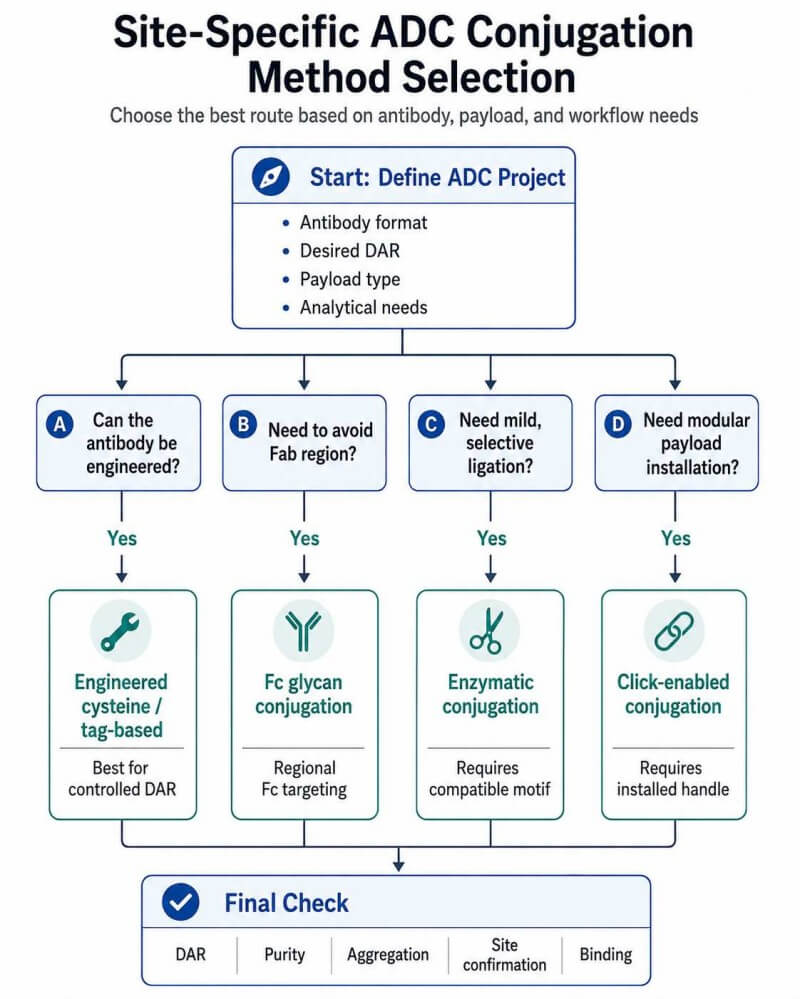 Site-specific ADC conjugation method selection should connect antibody engineering feasibility, target DAR, linker-payload risk, purification strategy, and analytical confirmation.
Characterization and QC for Site-Specific ADCs
A site-specific ADC is only useful if the product can be verified. Characterization should confirm the intended drug loading, attachment site, purity, aggregation profile, linker stability, free payload removal, and retained antibody function.
| QC Question | Common Methods | Why It Matters |
|---|
| What is the DAR? | HIC, LC-MS, UV-visible analysis, intact or reduced mass analysis. | Confirms whether the ADC reached the intended payload loading. |
| Where is the payload attached? | Peptide mapping, subunit LC-MS, reduced mass analysis, glycopeptide analysis. | Confirms site-specificity and checks off-target modification. |
| Is the ADC pure? | SEC, HPLC, electrophoresis, LC-MS, small-molecule impurity analysis. | Detects unconjugated antibody, free payload, fragments, aggregates, and byproducts. |
| Is aggregation controlled? | SEC, SEC-MALS, DLS, formulation or stress studies. | Assesses developability risk caused by payload, linker, or conjugation site. |
| Is linker-payload stable? | Serum stability assay, LC-MS, released payload analysis. | Evaluates premature deconjugation or payload release risk. |
| Does antibody binding remain? | ELISA, SPR, BLI, flow cytometry, cell-binding assay. | Confirms that conjugation did not compromise target recognition. |
Troubleshooting Site-Specific ADC Conjugation
When a site-specific ADC does not meet expectations, the issue may come from the antibody site, linker-payload, reaction conditions, purification method, or analytical workflow. Troubleshooting should evaluate these factors together rather than treating conjugation chemistry as the only variable.
| Observed Issue | Possible Cause | Best Next Step |
|---|
| Low conjugation efficiency | Handle is poorly accessible, oxidized, buried, or incompatible with linker-payload. | Check handle installation, site exposure, buffer, pH, spacer length, and reaction stoichiometry. |
| High aggregation | Payload hydrophobicity, high DAR, destabilizing site, harsh reaction conditions, or poor purification. | Assess by SEC and consider lower DAR, alternate site, hydrophilic linker, or improved formulation. |
| Binding loss | Payload placement affects antigen binding region, antibody conformation, or internalization behavior. | Run binding assays and consider site relocation or reduced payload loading. |
| Unexpected DAR distribution | Incomplete handle conversion, off-target modification, over-reduction, or mixed antibody species. | Use LC-MS, HIC, reduced mass analysis, and site mapping to identify product distribution. |
| Free payload remains | Purification method does not separate linker-payload from ADC effectively. | Optimize SEC, HIC, dialysis, ultrafiltration, affinity cleanup, or payload-specific removal method. |
| Site confirmation is unclear | Complex glycoforms, poor digestion, payload instability, or overlapping mass species. | Use subunit analysis, peptide mapping, deglycosylation strategy, or orthogonal MS workflow. |
BOC Sciences Support for Site-Specific ADC Conjugation
BOC Sciences supports research-stage ADC projects that require site-specific antibody conjugation strategy, linker-payload compatibility evaluation, conjugation workflow development, purification, and analytical characterization. Support can be tailored to early feasibility studies, linker-payload comparison, controlled DAR development, or method troubleshooting.
Site-specific route evaluationAssessment of engineered cysteine, glycan-based, enzymatic, click-enabled, terminal, and tag-based conjugation approaches based on antibody and payload requirements.
Linker-payload conjugationSupport for linker-payload attachment strategies, reactive handle selection, hydrophobicity considerations, spacer design, and payload compatibility.
ADC purification workflowDevelopment-stage cleanup to remove free payload, unconjugated antibody, fragments, aggregates, and process-related byproducts where applicable.
ADC characterizationFit-for-purpose analytical support for DAR, purity, aggregation, identity, site occupancy, linker stability, and retained antibody binding.
Need Site-Specific Antibody Conjugation Support for an ADC Project?
Share your antibody format, target antigen, linker-payload structure, desired DAR, preferred conjugation site if known, available material amount, buffer constraints, and analytical requirements. BOC Sciences can help evaluate whether engineered cysteine, glycan-based, enzymatic, click-enabled, or another site-specific ADC conjugation strategy is the most practical starting point.
- Site-specific ADC conjugation route selection
- Engineered cysteine, glycan, enzymatic, and click-enabled ADC workflows
- Linker-payload compatibility and conjugation feasibility assessment
- DAR, purity, aggregation, site occupancy, and functional characterization support
Frequently Asked Questions
What is site-specific antibody conjugation for ADC development?
Site-specific antibody conjugation for ADC development is a controlled approach that attaches linker-payloads to defined antibody sites or defined reactive handles. The goal is to reduce product heterogeneity, control DAR, improve analytical interpretation, and support rational ADC optimization.
Is site-specific ADC conjugation always better than random conjugation?
No. Site-specific ADC conjugation can improve control, but it does not automatically guarantee better biological performance. Random or partially controlled conjugation may be useful for early screening, while site-specific strategies are often preferred when defined DAR, site control, and comparability are important.
Which site-specific conjugation method is best for ADCs?
There is no universal best method. Engineered cysteine conjugation is useful when antibody engineering is possible. Glycan-based conjugation is useful for Fc-region targeting. Enzymatic methods are useful when a compatible motif or glycan substrate is available. Click-enabled methods are useful when modular linker-payload installation is needed.
How does site-specific conjugation help control DAR?
Site-specific conjugation controls DAR by limiting the number of available reactive sites or handles on the antibody. For example, a designed number of engineered cysteines, glycan handles, or bioorthogonal handles can restrict payload loading more effectively than broad random lysine labeling.
What analytical methods are needed for site-specific ADCs?
Useful methods may include HIC, LC-MS, intact and reduced mass analysis, peptide mapping, SEC, HPLC, serum stability analysis, free payload analysis, and binding or cell-based functional assays. The final analytical package should match the ADC structure and development stage.
When should an ADC project move to site-specific conjugation?
A project should consider site-specific conjugation when random conjugation produces excessive heterogeneity, difficult purification, high aggregation, unstable linker behavior, unclear structure-activity relationships, or insufficient control over DAR and payload placement.