Immunoliposome PEGylation Services
Antibody-Targeted PEG LiposomesDistal-PEG Conjugation and Orientation ControlLong-Circulating Vesicles for Targeted Delivery
PEGylated immunoliposomes combine the long circulation of PEG-shielded liposomes with the cell selectivity of an antibody or antibody fragment, producing a vesicle that stays in the blood longer and binds a chosen receptor on target cells. The antibody is attached to the distal end of the PEG chains so it extends beyond the shielding corona and remains accessible to the antigen, while the PEG layer continues to reduce recognition by the reticuloendothelial system. We develop these constructs from antibody selection and reactive-lipid design through conjugation, purification, and characterization, with payload encapsulation where the study requires it.
Projects can start from a validated antibody or fragment, a reactive liposome platform, or a target receptor with a known antibody. Where the work involves vesicle engineering, we coordinate with antibody liposome conjugation, liposome conjugation, and PEG lipid synthesis and conjugation programs.
What Problems Can PEGylated Immunoliposome Services Solve?
An immunoliposome that targets well but clears fast, or circulates well but cannot reach its antigen, helps no one. Early immunoliposome designs were cleared rapidly by the liver and spleen; simple PEG coatings improved circulation but hid the antibody behind the polymer layer. The solution is a construction where the antibody sits on the PEG terminus rather than under it, and where conjugation does not cost the antibody its binding activity or the vesicle its stability.
A practical immunoliposome strategy treats antibody format, PEG length, reactive-lipid chemistry, ligand density, and orientation as connected variables. That matters because the same vesicle must evade serum proteins, reach the target tissue, bind the receptor, and in many projects be internalized with its payload intact. We design these features together and verify them after conjugation rather than assuming the antibody survived the coupling chemistry.
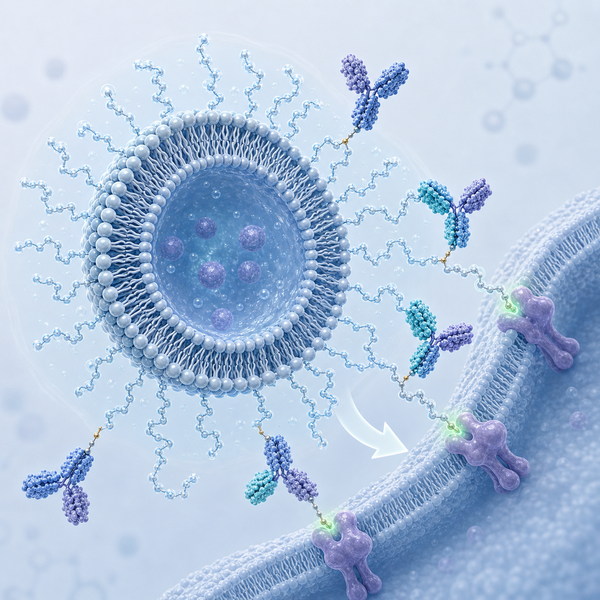 Schematic of a long-circulating PEG liposome with antibodies conjugated at the PEG distal termini, illustrating receptor-mediated targeting.
Key Challenges Research Teams Face in PEGylated Immunoliposome Services
Antibody Buried Under the PEG Corona
Antibodies anchored directly on the bilayer can be sterically hidden by the PEG layer. We attach the antibody or fragment at the distal end of PEG chains, so it extends beyond the corona and remains accessible to the antigen.
Conjugation That Costs Binding Activity
Random coupling can modify the antigen-binding site or denature the antibody. We select site-oriented chemistries such as maleimide-thiol coupling of reduced hinge fragments and control the reaction so antigen recognition is preserved.
Orientation and Density Control
How many antibodies sit on the vesicle and which way they face decide avidity and uptake. We tune ligand density and use orientation-aware conjugation, then verify binding and, where relevant, internalization.
Stability and Reproducibility After Coupling
Surface conjugation can shift size, zeta potential, and storage behavior, and batch-to-batch variation breaks comparative studies. We characterize size, charge, and antibody content per batch and document them for reproducible builds.
Our PEGylated Immunoliposome Services
We provide custom PEGylated immunoliposomes built around the antibody format and targeting goal, with reactive-lipid design, conjugation chemistry, and characterization defined for the project.
 Antibody and Fragment Selection Review
Capabilities include:
- Assessment of full IgG, F(ab')2, Fab', scFv, and engineered fragments for the target
- Evaluation of receptor biology: expression level, internalization, and accessibility
- Antibody-to-liposome chemistry planning from the available reactive groups
- Coordination with antibody liposome conjugation workflows
Typical applications:
Targeting constructs for receptors such as HER2, EGFR, CD19, TfR, and related cell-surface markers.
 Reactive PEG Lipid and Vesicle Design
Capabilities include:
- DSPE-PEG-maleimide, DSPE-PEG-COOH, and related reactive lipid options
- PEG length selection (e.g., PEG2000 to PEG5000) for shielding and antigen access
- Lipid composition planning with cholesterol and helper lipids
- Coordination with PEG lipid synthesis for custom reactive anchors
Typical applications:
Vesicles engineered with the reactive handle at the PEG terminus for antibody attachment.
 Conjugation, Purification and Stabilization
Capabilities include:
- Maleimide-thiol coupling of reduced antibody fragments or thiolated IgG
- Site-oriented conjugation preserving the antigen-binding region
- Removal of unconjugated antibody and reactive-lipid byproducts
- Post-conjugation stabilization and buffer exchange
- Payload encapsulation support where the study requires a cargo
Typical applications:
Functional immunoliposomes with controlled antibody loading and retained binding activity.
 Characterization and Targeting Verification
Capabilities include:
- Size and polydispersity by dynamic light scattering before and after coupling
- Zeta potential and antibody content per vesicle
- Binding and uptake verification in target-expressing cells where requested
- Stability assessment under storage and relevant conditions
- Coordination with liposome conjugation characterization services
Typical applications:
Release-ready immunoliposomes with a defined analytical and functional profile.
Antibody Conjugation Routes for PEGylated Immunoliposome
The conjugation route decides where the antibody sits, whether it remains active, and how reproducible the construct is. The comparison below ties the route to the antibody format and the targeting goal.
| Conjugation route | Antibody format | Attachment point | Typical use |
| Maleimide-thiol coupling | Reduced F(ab')2 or thiolated IgG | Hinge or engineered thiol | Site-oriented, activity-preserving targeting |
| Amide coupling to DSPE-PEG-COOH | IgG, F(ab')2, scFv | Lysine or available amine | Flexible format, moderate orientation control |
| Click chemistry (azide-DBCO) | Engineered or modified antibody | Defined handle | Orthogonal, low-background conjugation |
| Post-insertion of antibody-PEG-lipid | Pre-formed antibody-lipid conjugate | Distal PEG | Preserving encapsulated cargo and vesicle integrity |
Formulation and PEG Design Choices for PEGylated Immunoliposome
The lipid recipe and PEG architecture set circulation, antibody access, and vesicle behavior. The ranges below are typical starting points adjusted to the specific project.
| Component | Role | Typical choice / range |
| Core lipid (DSPC, HSPC, DOPC) | Bilayer scaffold | 50-70 mol% |
| Cholesterol | Stability and packing | 30-45 mol% |
| PEG lipid (DSPE-PEG) | Stealth and antibody anchoring | 3-8 mol% (PEG2000 common) |
| Reactive PEG lipid (maleimide, COOH, azide) | Antibody attachment point | 0.5-3 mol% |
| Antibody loading | Targeting ligand | 10-40 molecules per vesicle typical |
| Payload (optional) | Encapsulated cargo | Drug, siRNA, mRNA, or label per project |
Characterization and Release Checks for PEGylated Immunoliposome
For immunoliposomes, release data must cover the vesicle, the antibody, and the targeting function together. The checks below are typical of the qualification package.
| Check | Method | What It Confirms |
| Vesicle size and PDI | Dynamic light scattering | Stable size distribution after coupling |
| Surface charge | Zeta potential | Expected surface state maintained |
| Antibody content | Protein assay or labeled-antibody quantification | Ligand loading per vesicle |
| Binding function | Target-binding or cell-binding assay | Antibody remains active on the vesicle |
| Uptake (optional) | Flow or microscopy with labeled vesicles | Receptor-mediated internalization |
| Stability | Storage study | Size, binding, and payload retained over time |
Workflow for Custom PEGylated Immunoliposome Services


Target and Antibody Review
We clarify the receptor, its expression and internalization behavior, and the antibody or fragment you plan to use. This decides format, chemistry, and density before formulation.

Reactive Liposome Design
Lipid composition, PEG length, and reactive-lipid handle are selected so the antibody attaches at the PEG distal end and the vesicle circulates well.

Conjugation and Purification
The antibody is coupled by the chosen route, then purified away from unconjugated antibody and reaction byproducts while vesicle integrity is preserved.

Post-Conjugation Stabilization
Buffer, blocking, and storage conditions are set so the immunoliposome remains dispersible and stable for the intended use.

Characterization and Targeting Verification
Size, zeta, antibody content, and binding are measured; uptake is verified where the project needs it.

Delivery of Vesicles and Data
Final output includes the PEGylated immunoliposomes, handling guidance, and an analytical summary supporting targeted delivery research.
Why Choose Our PEGylated Immunoliposome Services Platform
Antibody on the PEG Terminus, Not Under It
We attach the antibody at the distal end of the PEG chains so it extends beyond the shielding corona. This is the design difference between an immunoliposome that binds its antigen and one that circulates well but cannot reach it.

Activity-Preserving Conjugation
Site-oriented chemistries such as maleimide-thiol coupling are used to keep the antigen-binding region intact, and binding is verified on the finished vesicle rather than assumed.
Orientation and Density Tuned
Ligand density and facing are controlled for avidity and uptake, so the vesicle binds and, where required, is internalized with its payload.
Characterized as a Complete System
Size, charge, antibody content, binding, and stability are reported together, giving a picture of the immunoliposome that supports comparative and downstream studies.
Common Research Applications of PEGylated Immunoliposome Services
Receptor-Targeted Cancer Research
- Immunoliposomes against HER2, EGFR, and related tumor antigens
- Targeted delivery of small molecules or nucleic acids
- Uptake and efficacy studies in receptor-positive models
CNS and Blood-Brain Barrier Delivery
- Antibodies against transferrin or insulin receptors for transcytosis
- Targeted delivery of neuroprotective agents and gene therapies
- Brain-targeting proof-of-concept in research models
Nucleic Acid and Vaccine Delivery
- Antibody-targeted liposomes for siRNA, mRNA, or plasmid cargo
- Cell-specific delivery to immune or tumor populations
- Combined targeting and stealth for systemic use
Imaging and Diagnostics Research
- Immunoliposomes carrying fluorophores or contrast agents
- Targeted visualization of receptor-positive cells
- Preclinical imaging method development
Discuss Your PEGylated Immunoliposome Services Project
Whether you need a receptor-targeted immunoliposome for cancer research, a brain-targeting vesicle for CNS delivery, or a stealth liposome with a defined antibody for imaging, we provide support from antibody and vesicle design through conjugation, purification, and targeting verification.
Our team works with customer-defined antibodies, lipid systems, and payloads to deliver PEGylated immunoliposomes and data packages that are easier to evaluate and integrate into downstream research. Contact our scientific team to discuss your PEGylated immunoliposome requirements and request a project-specific proposal.
Frequently Asked Questions (FAQ)
What is a PEGylated immunoliposome?
It is a liposome with a PEG coating that prolongs circulation and an antibody or antibody fragment attached, usually at the distal end of the PEG chains, that binds a target receptor. The combination gives a long-circulating vesicle with cell-selective targeting.
Why attach the antibody to the end of the PEG chain?
If the antibody sits directly on the bilayer, the PEG corona can hide it from the antigen. Attaching it at the PEG distal terminus lets it extend beyond the shielding layer, so the immunoliposome keeps its stealth properties and still binds the target.
Which antibody formats can be used?
Full IgG, F(ab')2, Fab', and scFv fragments can all be conjugated. Smaller formats are often preferred when reduced steric burden, better surface access, or a more compact vesicle is needed.
How do you preserve antibody activity during conjugation?
We use site-oriented chemistries such as maleimide-thiol coupling of reduced fragments, and we control density and reaction conditions to protect the antigen-binding region. Binding is verified on the finished vesicle.
How many antibodies are typically on each vesicle?
Ligand density is tuned to the project, with tens of antibody molecules per vesicle as a common working range. The value is measured and reported so avidity and uptake behavior can be interpreted.
Are PEGylated immunoliposomes for clinical use?
Delivered material is for research use only. Immunoliposome technology has clinical precedents in targeted liposomal drug development, but our services supply research-grade constructs and are not for clinical or therapeutic application.