Why Conjugation Site Matters in ADC Development
An antibody-drug conjugate is a multi-component molecule composed of an antibody, linker, cytotoxic or functional payload, and conjugation chemistry. The conjugation site determines where the linker-payload is installed on the antibody surface. That location can affect how the payload is exposed to solvent, how much hydrophobic surface is created, whether the antibody retains antigen binding, how the linker behaves in plasma, and how easily the final ADC can be purified and characterized.
Traditional ADC conjugation often uses native lysines or reduced interchain cysteines. These approaches can be practical, but they may generate mixtures with different payload numbers and attachment positions. Site-specific ADC conjugation attempts to reduce this complexity by directing payload attachment to engineered residues, Fc glycans, enzymatic tags, noncanonical amino acids, click handles, or other defined sites.
The important point is not that every ADC must be site-specific. Some development programs may use established random or partially controlled methods successfully. The real issue is whether the conjugation site supports the intended balance of potency, stability, manufacturability, analytical clarity, and safety margin. Recent ADC conjugation reviews emphasize that optimal conjugation technologies and locations depend on the specific antibody and linker-payload combination rather than a universal rule.
Conjugation site affects molecular behaviorA payload attached to a solvent-exposed, flexible, or structurally tolerant region may behave differently from the same payload attached near a sensitive domain, hydrophobic patch, Fc interface, or antigen-binding region.
Site-specific does not automatically mean betterBetter site control can improve homogeneity, but the best ADC design still depends on linker stability, payload hydrophobicity, target biology, internalization, clearance, and analytical confirmation.
ADC Design Is a Connected System
ADC development requires simultaneous control of antibody selection, linker chemistry, payload potency, payload hydrophobicity, conjugation ratio, conjugation site, purification, formulation, and bioanalytical strategy. Changing one variable can alter the behavior of the others.
For example, a highly hydrophobic payload may be acceptable at one conjugation site but problematic at another. A linker that is stable in one structural context may be more exposed or more labile in another. A DAR value that appears attractive for potency may increase aggregation, rapid clearance, or nonspecific uptake if the payload is poorly distributed on the antibody surface.
| ADC Design Variable | How Conjugation Site Can Influence It | Development Question |
|---|
| DAR distribution | Random sites may create broad product mixtures, while defined sites can restrict payload number. | Is the intended average DAR enough, or does the distribution also need control? |
| Hydrophobicity | Payload clustering or exposed hydrophobic linker-payload regions can alter retention, aggregation, and clearance behavior. | Does the selected site minimize hydrophobic liability for this linker-payload? |
| Binding retention | Modification near antigen-binding regions or structurally sensitive domains can reduce target recognition. | Is the payload far enough from regions required for antigen binding? |
| Linker stability | Local solvent exposure, steric environment, and nearby residues can affect linker accessibility and degradation behavior. | Does the site support the intended stability and release profile? |
| Analytical clarity | Fewer attachment sites can simplify mass analysis, peptide mapping, and batch comparison. | Can the final ADC be characterized with sufficient confidence? |
How Random Conjugation Can Affect ADC Heterogeneity
Random conjugation methods are widely used because they are practical and established. Lysine conjugation targets accessible amines across the antibody, while interchain cysteine conjugation typically follows partial disulfide reduction. Both approaches can produce useful ADCs, but they often generate a distribution of species rather than one precisely defined molecule.
The consequences of heterogeneity depend on the application and development stage. In early screening, a heterogeneous ADC may be acceptable if it answers a biological question quickly. In later-stage development, broad distribution can complicate potency interpretation, stability assessment, pharmacokinetic evaluation, release testing, and comparability.
| Random Conjugation Issue | Potential ADC Impact | How to Evaluate |
|---|
| Multiple attachment sites | Creates a complex mixture of positional isomers with different local environments. | LC-MS, peptide mapping, HIC, and method-specific site analysis. |
| Broad DAR distribution | May combine underloaded, target DAR, and overloaded species in one product pool. | DAR measurement by HIC, LC-MS, UV-visible analysis, or orthogonal methods. |
| Payload near sensitive regions | May reduce antigen binding, Fc-related behavior, or structural stability. | Binding assays, FcRn or Fc receptor assessment where relevant, thermal or stress testing. |
| High hydrophobic species | May contribute to aggregation, nonspecific binding, or faster clearance. | SEC, HIC, hydrophobicity profiling, formulation screens, and stress studies. |
What Site-Specific ADC Conjugation Changes
Site-specific ADC conjugation limits payload attachment to planned sites. These sites may be engineered cysteines, noncanonical amino acids, Fc glycans, enzymatic motifs, terminal tags, or bioorthogonal handles. By narrowing where conjugation occurs, site-specific strategies can reduce positional heterogeneity and support more interpretable structure-property relationships.
This can be valuable in ADC optimization because researchers can compare linker-payloads, DAR values, and antibody constructs with fewer confounding variables. However, site-specific conjugation can also introduce new challenges, including antibody engineering, expression changes, added enzymatic steps, extra purification requirements, and more demanding site-confirmation analytics. Reviews of ADC conjugation technologies specifically note that site-specific and site-selective approaches may improve homogeneity but can create additional CMC and analytical challenges.
What improvesSite-specific conjugation can improve control over attachment position, payload number, product distribution, and mechanistic interpretation during ADC optimization.
What still needs testingThe final ADC still requires evaluation of binding, aggregation, stability, potency, nonspecific uptake, plasma behavior, and manufacturability.
Key ADC Quality Attributes Affected by Conjugation Site
Conjugation site can influence multiple critical quality attributes. The same linker-payload may behave differently when attached to different antibody regions, and the same site may not work equally well for payloads with different hydrophobicity, charge, steric bulk, or release mechanisms.
| Quality Attribute | Why It Matters | Conjugation Site Effect | Useful Readouts |
|---|
| DAR and distribution | DAR affects potency, exposure, hydrophobicity, and product consistency. | Defined sites can narrow distribution; random sites may broaden it. | HIC, LC-MS, UV-visible analysis, reduced mass analysis. |
| Aggregation | Aggregates can affect stability, purification, formulation, and biological behavior. | Hydrophobic or clustered payload placement can increase aggregation risk. | SEC, light scattering, stress studies, formulation screens. |
| Hydrophobicity | Hydrophobic ADC species may show altered clearance or nonspecific interactions. | Site and linker architecture can change how exposed the payload is. | HIC, RP-HPLC, developability assays, nonspecific binding assays. |
| Plasma stability | Premature payload release may reduce therapeutic window and complicate PK interpretation. | Local site environment can affect linker exposure and stability. | Serum stability assays, LC-MS, released payload analysis. |
| Antigen binding | ADC activity depends on target recognition and internalization behavior. | Payloads placed near CDRs or sensitive surfaces may reduce binding. | ELISA, SPR/BLI, flow cytometry, cell-binding assays. |
| PK behavior | Exposure and clearance affect ADC performance and tolerability. | Site-dependent hydrophobicity, stability, and Fc interactions may alter behavior. | PK studies, FcRn binding assessment, serum stability, bioanalysis. |
Linker-Payload and Conjugation Site Work Together
A conjugation site cannot be evaluated in isolation. The linker-payload determines hydrophobicity, charge, steric size, release mechanism, stability, and target-cell killing mechanism. The antibody site determines the local environment where that linker-payload is displayed.
Recent site-specific ADC studies have directly examined combinations of multiple conjugation sites and linker structures. One study generated homogeneous THIOMAB-based ADCs across six conjugation sites and five linker structures and found that both conjugation site and linker design affected ADC-specific characteristics such as linker stability and target-dependent or target-independent cytotoxicity.
This means a site that works well with one linker-payload may not be optimal for another. Hydrophilic linkers may reduce liabilities for hydrophobic payloads, but they do not remove the need for site evaluation. Similarly, a highly stable linker may still create a problematic ADC if the payload is placed in a region that promotes aggregation or impairs binding.
Site-linker synergyThe best ADC design often emerges from evaluating site and linker-payload together rather than screening sites or linkers independently.
Payload-specific riskHydrophobic, bulky, charged, or very potent payloads often require more careful conjugation site selection and stronger analytical control.
Common ADC Conjugation Site Strategies
ADC conjugation strategies range from established random methods to highly engineered site-specific systems. The best route depends on project stage, antibody availability, desired DAR, payload class, timeline, analytical needs, and whether antibody engineering is feasible.
| Strategy | Site Control | Best Fit | Key Development Consideration |
|---|
| Random lysine conjugation | Low positional control | Early screening, legacy methods, rapid feasibility studies | Broad positional heterogeneity and possible binding-site interference. |
| Interchain cysteine conjugation | Partially controlled by disulfide-derived thiols | ADC prototypes and established cysteine-based workflows | Reduction control, DAR distribution, linker stability, and aggregation assessment. |
| Engineered cysteine conjugation | High if site is well designed | Site-specific ADC optimization and defined DAR studies | Requires antibody engineering, expression, thiol accessibility, and site screening. |
| Fc glycan conjugation | Regional Fc control | ADC designs aiming to avoid Fab-region modification | Glycan heterogeneity, remodeling efficiency, and glycan-site confirmation. |
| Enzymatic conjugation | High when the substrate motif is accessible | Defined antibody formats, engineered tags, and mild aqueous workflows | Motif availability, enzyme compatibility, residual enzyme removal, and conversion. |
| Click-enabled conjugation | Defined by handle placement | Modular ADC assembly, glycan-click ADCs, dual-payload or advanced constructs | Handle installation, click partner choice, solubility, and purification. |
Decision Framework for ADC Conjugation Site Selection
Site selection should begin with the ADC design goal. The development team should define the intended DAR, payload risk profile, antibody engineering flexibility, linker release mechanism, analytical method, and acceptable heterogeneity before choosing a conjugation strategy.
Start with random or partially controlled conjugation when:- The project is in early feasibility or target validation.
- Speed and material conservation are more important than precise site control.
- The payload is already known to be compatible with the antibody format.
- A broad ADC mixture is acceptable for the current decision point.
Move toward site-specific conjugation when:- The project needs defined DAR or narrower product distribution.
- The payload is hydrophobic, bulky, unstable, or highly potent.
- Binding retention, PK behavior, or stability becomes a bottleneck.
- Comparability and mechanism-driven optimization are important.
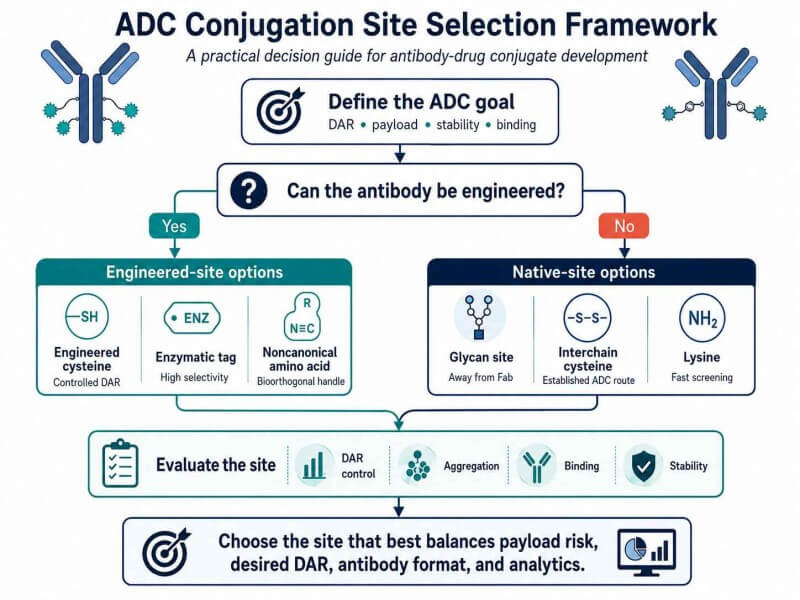 ADC conjugation site selection should connect antibody engineering feasibility, linker-payload risk, desired DAR, purification strategy, and analytical confirmation.
Characterization and QC for ADC Conjugation Site Evaluation
A site-specific ADC strategy is only useful if the conjugate can be verified. The analytical package should confirm payload ratio, site occupancy, purity, aggregation, linker stability, free payload removal, and retained antibody function. Orthogonal methods are often needed because no single assay answers every ADC quality question.
| QC Question | Useful Methods | What the Result Helps Decide |
|---|
| What is the DAR? | HIC, LC-MS, UV-visible analysis, reduced mass analysis | Whether the conjugation reaction reached the intended payload loading. |
| Where is the payload attached? | Peptide mapping, site-specific LC-MS workflows, reduced mass analysis | Whether the intended conjugation site was modified and whether off-target modification occurred. |
| Is the ADC aggregated? | SEC, SEC-MALS, stress studies, formulation screening | Whether the site-payload combination creates developability risk. |
| Is the linker stable? | Serum stability assay, LC-MS, released payload measurement | Whether premature deconjugation or payload release may be a concern. |
| Does the ADC still bind target? | ELISA, SPR, BLI, flow cytometry, cell-binding assays | Whether conjugation site or payload placement interferes with antigen recognition. |
| Is free payload removed? | HPLC, LC-MS, ultrafiltration checks, small-molecule impurity analysis | Whether purification is adequate for downstream biological evaluation. |
BOC Sciences Support for ADC Conjugation Site Strategy
BOC Sciences supports research-stage ADC conjugation projects that require practical evaluation of antibody format, linker-payload structure, conjugation chemistry, site selection, purification, and analytical characterization. Support can begin with exploratory conjugation or move directly into site-specific ADC design when a project requires stronger control over DAR, stability, or product distribution.
ADC conjugation route evaluationComparison of random lysine, cysteine-based, engineered-site, glycan-based, enzymatic, and click-enabled conjugation routes according to project needs.
Linker-payload compatibilityEvaluation of payload hydrophobicity, linker design, reactive handles, solubility, and conjugation feasibility for antibody-drug conjugates.
Purification and cleanup workflowDevelopment-stage purification planning to remove excess payload, unconjugated antibody, aggregates, and reaction byproducts where applicable.
ADC characterizationFit-for-purpose assessment of DAR, purity, aggregation, identity, linker stability, site occupancy, and antibody binding retention.
Need Help Evaluating an ADC Conjugation Site?
Share your antibody format, target antigen, linker-payload structure, desired DAR, available material amount, conjugation preference, and analytical requirements. BOC Sciences can help evaluate whether a random, cysteine-based, glycan-based, enzymatic, click-enabled, or engineered site-specific ADC conjugation route is the most practical starting point.
- ADC conjugation site and chemistry evaluation
- Linker-payload conjugation and compatibility assessment
- Random, cysteine, glycan, enzymatic, and click-enabled ADC workflows
- DAR, purity, aggregation, stability, and binding characterization support
Frequently Asked Questions
Why does conjugation site matter in ADC development?
The conjugation site controls where the linker-payload is displayed on the antibody. This can affect DAR distribution, hydrophobicity, aggregation, plasma stability, antigen binding, PK behavior, and analytical comparability.
Does site-specific conjugation always improve ADC performance?
No. Site-specific conjugation can improve control and reduce heterogeneity, but performance depends on the antibody, linker, payload, conjugation site, target biology, and formulation. Some site-specific ADCs may perform better or worse than random conjugates depending on the linker-payload and site combination.
How does DAR affect ADC quality?
DAR influences potency, hydrophobicity, stability, aggregation risk, exposure, and batch consistency. Average DAR alone is not always enough; the distribution of DAR species and their attachment sites can also affect ADC behavior.
Which ADC conjugation methods are commonly used?
Common methods include random lysine conjugation, reduced interchain cysteine conjugation, engineered cysteine conjugation, Fc glycan conjugation, enzymatic ligation, noncanonical amino acid strategies, and click chemistry-enabled conjugation.
What analytical methods are needed for ADC conjugation site evaluation?
Useful methods may include HIC, LC-MS, intact and reduced mass analysis, peptide mapping, SEC, SEC-MALS, HPLC, serum stability assays, released payload analysis, and binding or cell-based functional assays. The final QC package should match the ADC structure and development stage.
When should an ADC project move from random to site-specific conjugation?
A project should consider site-specific conjugation when random conjugation creates excessive heterogeneity, aggregation, unstable linker behavior, binding loss, difficult purification, poor comparability, or unclear structure-activity relationships.