Why Antibody Conjugation Strategy Matters
Antibodies are large, folded, function-sensitive biomolecules. A conjugation reaction that works well for a small molecule may not be suitable for an antibody if it modifies binding regions, causes aggregation, changes charge distribution, or creates a mixture that is difficult to analyze. This is why the choice between random and site-specific antibody conjugation should be made early in project design.
Random antibody conjugation attaches payloads to naturally available reactive groups, most often lysines or reduced cysteines. It is often faster and simpler, and it can be entirely appropriate for fluorescent labeling, biotinylation, enzyme labeling, early assay development, or proof-of-concept screening. Site-specific antibody conjugation attaches the payload at a defined or intentionally restricted location, such as an engineered cysteine, Fc glycan, enzymatic tag, terminal handle, or bioorthogonal chemistry site.
The central question is not whether site-specific conjugation is always better. It is not. The better question is: How much control does the final application require? A low-risk screening reagent may not justify the complexity of site-specific engineering. A therapeutic ADC, antibody-oligonucleotide conjugate, or quantitative diagnostic reagent may require a more controlled approach.
Random conjugation solves speed and practicalityIt is useful when the goal is to generate a functional antibody conjugate quickly, especially when moderate product heterogeneity is acceptable and the final assay can tolerate statistical labeling.
Site-specific conjugation solves control and reproducibilityIt is useful when conjugation site, payload number, batch consistency, functional retention, and analytical clarity are central to project success.
What Is Random Antibody Conjugation?
Random antibody conjugation modifies naturally occurring functional groups on the antibody without predefining a single attachment site. In practice, "random" does not mean careless. Reaction stoichiometry, pH, buffer composition, reaction time, antibody concentration, and purification method can still be controlled. However, the final product is usually a distribution of species with different modification numbers and attachment locations.
Random Lysine Conjugation
Lysine conjugation usually targets accessible amine groups on the antibody through activated esters such as NHS esters. It is widely used for fluorophore labeling, biotinylation, hapten attachment, enzyme labeling, and some drug-linker conjugation workflows. Because antibodies contain many lysine residues, the method can generate a broad mixture of conjugation sites.
Random Cysteine Conjugation
Cysteine-based random conjugation usually begins with partial reduction of interchain disulfides, followed by reaction with a thiol-selective payload such as a maleimide-functionalized linker. Compared with lysine conjugation, cysteine conjugation often provides a narrower range of possible payload numbers, but it can still produce mixtures depending on reduction conditions and disulfide accessibility.
| Method | Reactive Group | Common Uses | Advantages | Limitations |
|---|
| Random lysine conjugation | Accessible amines, commonly through NHS ester chemistry | Fluorescent antibodies, biotinylated antibodies, enzyme conjugates, screening conjugates | Simple, flexible, and broadly applicable | Broad site distribution and possible activity loss if critical lysines are modified |
| Random cysteine conjugation | Reduced interchain disulfide-derived thiols | ADC prototypes, antibody-drug conjugates, antibody-probe conjugates | Often more controlled than lysine conjugation in payload number | Requires reduction control and careful assessment of stability and aggregation |
What Is Site-Specific Antibody Conjugation?
Site-specific antibody conjugation is designed to attach the payload at a defined site or a controlled set of sites. The goal is to reduce product heterogeneity and improve predictability. This can be especially important when the antibody conjugate will be used as an ADC, quantitative diagnostic reagent, imaging probe, antibody-oligonucleotide conjugate, or platform molecule requiring batch-to-batch consistency.
Site-specific conjugation can be achieved through engineered cysteine residues, Fc glycan modification, enzyme-mediated ligation, N-terminal or C-terminal modification, or click chemistry after installing a bioorthogonal handle. The best route depends on antibody format, payload properties, desired conjugation ratio, purification requirements, and analytical expectations.
| Approach | Technical Basis | Best Fit | Main Consideration |
|---|
| Engineered cysteine conjugation | Introduces defined thiol sites for selective payload attachment | ADC design, antibody-probe conjugates, controlled DAR concepts | Requires antibody engineering and site accessibility evaluation |
| Glycan-based conjugation | Uses Fc glycan remodeling, oxidation, or enzymatic handle installation | Fc-region antibody conjugates where antigen-binding regions should be avoided | Depends on glycan structure, remodeling efficiency, and analytical confirmation |
| Enzyme-mediated conjugation | Uses enzymes such as transglutaminase, sortase, or other tag-directed systems | Defined antibody or fragment conjugates with mild reaction conditions | Requires compatible sequence motif, accessible substrate site, or engineered tag |
| Click chemistry-enabled conjugation | Installs azide, alkyne, tetrazine, TCO, or related handles for bioorthogonal ligation | Modular ADCs, antibody-oligonucleotide conjugates, imaging probes, dual-component constructs | Handle installation and click partner selection must be planned together |
Site-Specific vs Random Antibody Conjugation: Side-by-Side Comparison
The right choice depends on what the conjugate must do. A fluorescent antibody for exploratory flow cytometry may only require acceptable brightness, low background, and retained binding. An ADC candidate may require controlled DAR, reduced aggregation, defined linker-payload placement, and a robust analytical package.
| Feature | Random Antibody Conjugation | Site-Specific Antibody Conjugation | Practical Impact |
|---|
| Product heterogeneity | Usually produces a distribution of conjugation sites and labeling ratios | Designed to restrict attachment to defined sites or controlled regions | Site-specific methods usually simplify interpretation and comparability |
| Speed and simplicity | Often faster and easier to implement | May require engineering, handle installation, enzymatic processing, or method development | Random methods are attractive for early feasibility and routine labeling |
| DAR or DOL control | Controlled statistically through reagent ratio and reaction conditions | Controlled through site number, handle number, and reaction design | Site-specific methods are stronger when defined ratio is required |
| Binding retention | Risk depends on whether modification occurs near antigen-binding regions | Can place payload away from known functional regions | Site choice is important for sensitive antibodies and functional assays |
| Aggregation risk | Can increase with high labeling density or hydrophobic payloads | Can reduce uncontrolled hydrophobic distribution but still depends on payload and site | Both methods require SEC or comparable aggregation assessment |
| Analytical burden | May require more work to interpret broad mixtures | Can simplify mass, mapping, and batch comparison if design is successful | Analytical planning should be part of method selection |
How to Choose by Application
A useful way to choose between random and site-specific conjugation is to begin with the final application rather than the chemistry. The table below shows practical selection logic for common antibody conjugate projects.
| Application | Often Suitable Method | Why | Key QC Readout |
|---|
| Fluorescent antibody labeling | Random lysine labeling or site-specific labeling, depending on assay sensitivity | Random labeling is often sufficient when binding and background remain acceptable | DOL, fluorescence profile, binding assay, SEC |
| Biotinylated antibody | Random biotinylation for routine use; site-specific biotinylation for orientation-sensitive applications | Defined biotin placement can improve consistency in immobilization or quantitative assay formats | DOL, streptavidin binding, antigen binding |
| ADC development | Site-specific or controlled cysteine conjugation is often preferred for design-stage optimization | DAR, payload placement, hydrophobicity, and stability are central quality concerns | DAR, SEC, HIC or HPLC, LC-MS, binding and functional assays |
| Antibody-oligonucleotide conjugation | Often benefits from controlled or site-specific conjugation | Oligonucleotide size, charge, and ratio can strongly affect purification and assay behavior | Ab-oligo ratio, free oligo removal, binding retention, gel or LC-based analysis |
Decision Framework: When Should You Choose Each Method?
The following framework is designed for practical project planning. It does not replace feasibility testing, but it helps identify whether the project should begin with a simple random method or a more controlled site-specific route.
Choose random conjugation when:- The project is exploratory or proof-of-concept.
- The payload is a routine label such as a fluorophore or biotin.
- Moderate product heterogeneity is acceptable.
- The antibody tolerates statistical labeling without activity loss.
- Speed and cost are more important than exact site control.
Choose site-specific conjugation when:- The conjugate requires a defined DAR or DOL.
- The payload is hydrophobic, bulky, highly charged, or functionally sensitive.
- Batch-to-batch consistency is important.
- Binding retention or orientation is a major concern.
- The conjugate will be used for ADC research, quantitative diagnostics, or advanced assay development.
Practical Selection Questions
- What is the payload? A small dye, PEG, oligonucleotide, drug-linker, enzyme, nanoparticle, or polymer will create different conjugation and purification challenges.
- What ratio is needed? If a broad labeling distribution is acceptable, random conjugation may be sufficient. If a defined ratio is required, site-specific design becomes more valuable.
- Where can the antibody tolerate modification? Avoiding antigen-binding regions, Fc functional regions, or structurally sensitive areas may require a site-specific route.
- How will the product be purified? The conjugate may behave differently from the starting antibody in SEC, HIC, ion exchange, affinity purification, or membrane-based cleanup.
- Which QC data will define success? A method is only useful if the final conjugate can be characterized with sufficient confidence.
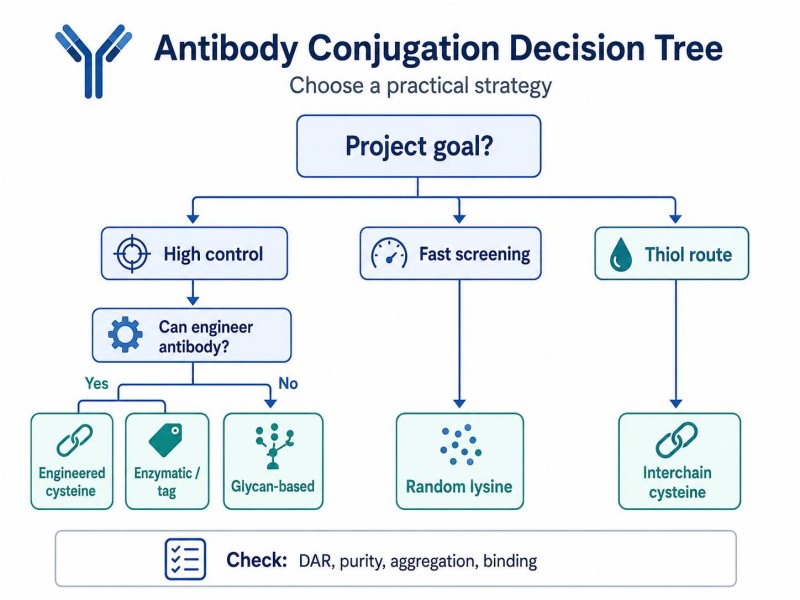 A practical antibody conjugation decision tree should begin with application, payload, required ratio, binding sensitivity, and analytical requirements.
Characterization and QC: The Step That Confirms the Choice
A conjugation strategy is only successful if the resulting antibody conjugate can be verified. Random and site-specific conjugates require overlapping but not identical analytical priorities.
| Analytical Need | Common Methods | Why It Matters |
|---|
| DAR or DOL | UV-visible analysis, LC-MS, HIC, RP-HPLC, fluorescence-based methods | Confirms average payload number and supports batch comparison |
| Identity and mass shift | Intact mass, reduced mass, peptide mapping, LC-MS | Confirms expected conjugation and can support site analysis |
| Purity | SEC, HPLC, electrophoresis, capillary methods | Detects unconjugated antibody, excess payload, fragments, or product mixtures |
| Aggregation | SEC, light scattering, formulation-relevant assays | Important for ADCs, hydrophobic payloads, polymers, and high-labeling conjugates |
| Functional retention | ELISA, antigen binding assay, flow cytometry, enzymatic assay, cell-based assay | Confirms that the conjugation did not compromise the intended biological function |
Common Problems and How Method Choice Affects Them
Many antibody conjugation problems are not simply reaction failures. They often reflect a mismatch between antibody structure, payload chemistry, conjugation site, reaction condition, and purification method.
| Observed Problem | Possible Cause | Method-Selection Lesson | Next Step |
|---|
| Loss of antigen binding | Modification near binding region or excessive labeling | Site-specific placement may help avoid sensitive regions | Reduce labeling ratio, test binding, or redesign the attachment site |
| High aggregation | Hydrophobic payload, high DAR, harsh reaction condition, or poor linker design | Site control helps, but payload and linker hydrophobicity still matter | Analyze by SEC and consider lower ratio, spacer redesign, or alternate site |
| Broad product distribution | Random lysine labeling or uncontrolled reduction | Site-specific conjugation may simplify product profile | Optimize stoichiometry or move to defined-site chemistry |
| Low conjugation efficiency | Poor site accessibility, incompatible buffer, weak handle installation, or payload solubility issue | Both random and site-specific methods need feasibility testing | Review buffer, pH, concentration, spacer length, and purification losses |
How BOC Sciences Supports Antibody Conjugation Strategy
BOC Sciences supports custom antibody conjugation projects where method selection, payload compatibility, conjugation ratio, purification, and analytical confirmation need to be evaluated together. The goal is not to force every project into site-specific chemistry, but to choose a practical route that fits the antibody, payload, application, and required quality profile.
Random antibody labelingSupport for fluorescent antibody labeling, biotinylation, enzyme conjugation, FITC conjugation, and other practical antibody-probe workflows where statistical labeling is acceptable.
Site-specific antibody conjugationSupport for controlled antibody modification using engineered residues, glycan-based approaches, enzymatic strategies, click chemistry handles, and application-specific conjugation workflows.
ADC and linker-payload conjugationSupport for antibody-drug conjugation projects involving payload attachment, linker chemistry, DAR considerations, purification development, and analytical characterization.
Conjugate characterizationFit-for-purpose analytical support may include mass-based confirmation, SEC, HPLC, labeling ratio assessment, electrophoretic methods, and function-oriented testing based on the project.
Need Help Choosing an Antibody Conjugation Method?
Share your antibody format, payload or label, desired DAR or degree of labeling, application, available material amount, and preferred analytical requirements. BOC Sciences can help evaluate whether random conjugation, site-specific conjugation, or a staged feasibility study is the most appropriate starting point.
- Random lysine and cysteine antibody labeling
- Site-specific antibody conjugation strategy development
- ADC, antibody-oligonucleotide, fluorescent antibody, and biotinylated antibody conjugation
- Purification and characterization support for custom antibody conjugates
Frequently Asked Questions
Is site-specific antibody conjugation always better than random conjugation?
No. Site-specific conjugation offers better control, but it may require more development effort, engineering, or specialized chemistry. Random conjugation can be suitable for routine fluorescent labeling, biotinylation, and early screening when moderate heterogeneity is acceptable and antibody function is retained.
When is random antibody conjugation acceptable?
Random conjugation is often acceptable when the application can tolerate a distribution of labeling sites and ratios. Common examples include many fluorescent antibody, biotinylated antibody, and enzyme-conjugated antibody reagents, provided that binding, background, purity, and stability meet the application requirements.
When should I choose site-specific antibody conjugation?
Site-specific conjugation is recommended when product consistency, defined DAR or DOL, low aggregation, binding retention, orientation, or analytical clarity is important. It is especially relevant for ADC research, antibody-oligonucleotide conjugates, quantitative diagnostics, imaging probes, and advanced assay systems.
How does conjugation method affect DAR or DOL?
Random conjugation controls DAR or DOL statistically through reagent ratio and reaction conditions. Site-specific conjugation controls ratio through the number and accessibility of defined conjugation sites or installed handles. In both cases, analytical confirmation is needed rather than assuming the intended ratio was achieved.
Can site-specific conjugation prevent antibody activity loss?
It can reduce risk by placing the payload away from sensitive regions, but it does not automatically guarantee retained activity. Payload size, hydrophobicity, linker design, conjugation ratio, and antibody structure still need to be evaluated experimentally.
What information is useful for a custom antibody conjugation inquiry?
Useful information includes antibody format and amount, buffer composition, payload or label structure, desired DAR or DOL, intended application, preferred conjugation strategy if known, required purity, and analytical methods needed for release or feasibility evaluation.